
 +9 photos
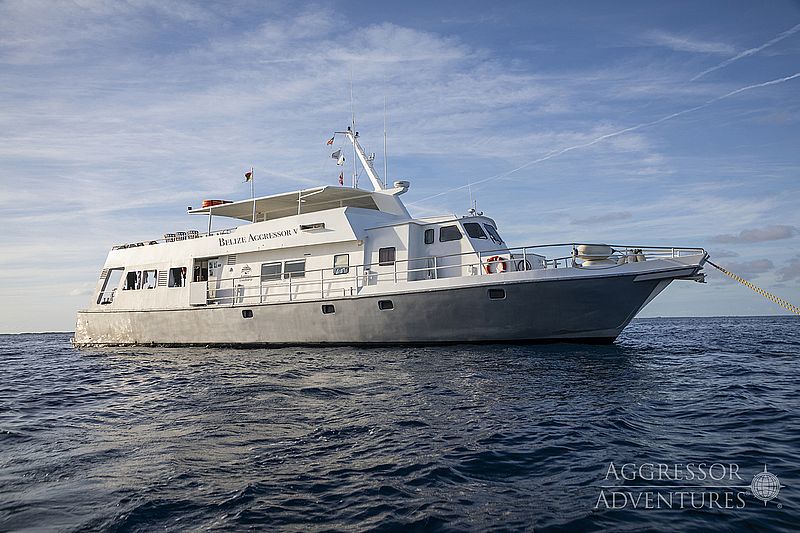
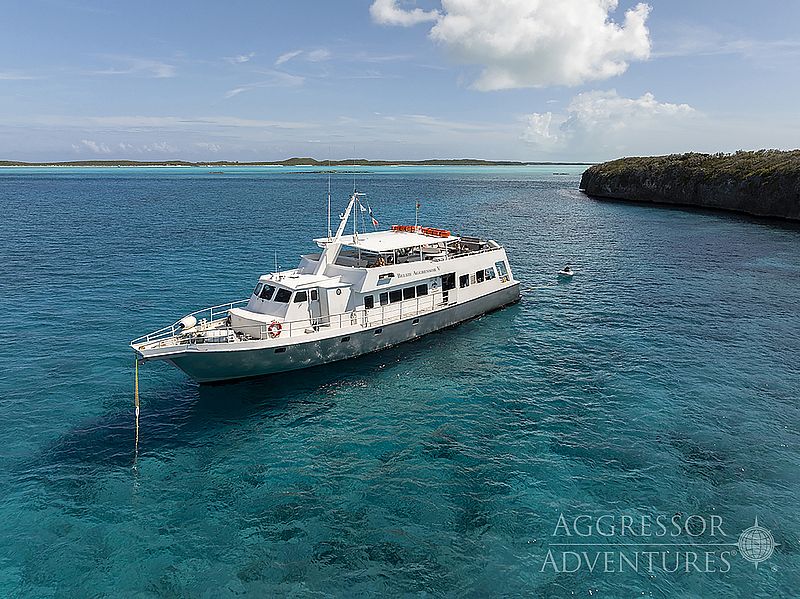
Belize Aggressor V
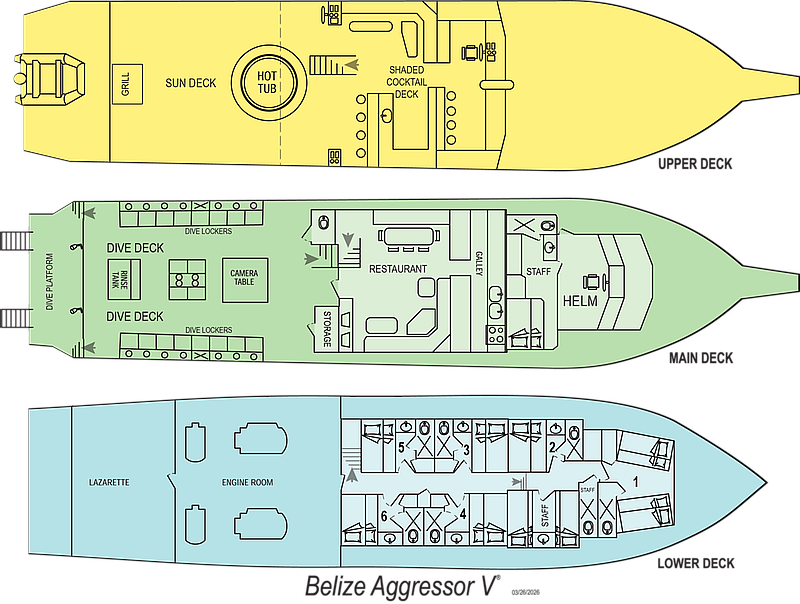
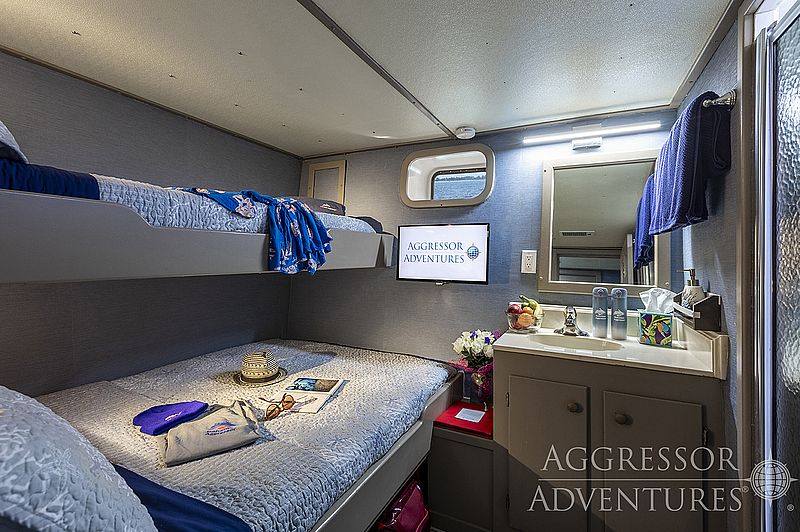
The Belize Aggressor V sleeps 14 guests in privacy and comfort. She features a roomy, air conditioned salon and dining area, sun deck complete with a hot tub, lounge and deck chairs, outdoor stereo system, shaded cocktail deck, grill, and a photo editing computer for guests. Diving amenities include individual dive lockers, camera table with low-pressure air hoses, and two hot, fresh water showers.
There is a variety of nightly entertainment, including diving, fish identification presentations, movies, games and more. If you have a favorite movie or digital presentation to share, we encourage you to bring it along.

-
Belize South7 nightsBelize: Belize South
Monday through Wednesday is spent at Glover's Reef Atoll. Glover’s Reef is a stunning oval-shaped coral atoll—approximately 18 miles long and 6 miles wide—located 27 miles (43 km) off the mainland and forming part of the outermost edge of the Belize Barrier Reef alongside Turneffe and Lighthouse Reef. As one of only four true coral atolls in the Caribbean, this UNESCO World Heritage Site is exceptionally well-preserved thanks to its remote, protected status. Its brilliant turquoise lagoon is filled with more than 800 thriving patch reefs and pinnacles, many rising to the surface and creating a maze of vibrant, largely untouched habitats. Guests explore this remarkable marine reserve, diving dramatic walls, shallow reef systems, and pristine coral formations with visibility often exceeding 100 feet (30 meters). Marine life is abundant, with frequent encounters including Caribbean reef and nurse sharks, eagle rays, nudibranchs, sea turtles, green moray eels, batfish, seahorse, and the endemic white-spotted toadfish—found only in Belize.
Dive Sites: BAKING SWASH REEF - Sunday morning guests will start their trip with a check-out dive at Baking Swash, a narrow cut through the western edge of the atoll. Two weathered tree limbs frame the channel’s beauty on each side. The shallow coral reefs break the surface, thriving in the protected waters.
SPLIT REEFS - This 40-foot (12 m) deep reef reaches to the surface with a deeper reef dropping down along a 100-foot (30 m) wall. This dive site offers rare specimens of healthy corals such as endangered elkhorn coral, boulders of brain coral, large cactus corals, and delicate staghorn corals together form intricate thickets. An array of soft corals and gorgonians like colorful sea whips, sea rods, corky sea fingers, and Venus sea fans also sway across the reef. A kaleidoscope of shimmering, small fish school together – blue chromis, sergeant majors, and blue-headed wrasse glide over and through the corals.
SHARK POINT - Shark Point is one of the more remote dive sites around the atoll; visits are weather permitting, only. It is an exposed area with a rare spawning aggregation site for groupers. Several species of sharks are associated with this dive site including nurse, blacktip, hammerhead, and tiger sharks. Sharks can be seen cruising along the sloping white sand channels and over the coral colonies.
GROUPER FLATS - This dive site is located on the northeastern reef tract and is home to several species of grouper. Both the shallow and deeper reefs here are home to rare, mature elkhorn coral and huge colonies of lettuce coral. The gentle topography of this amazing reef is home to Nassau, tiger, black, spotted and marble grouper often seen resting amid the sea whips and gorgonians.
LONG CAYE WALL - Long Caye Wall is a beautiful dive site with dense coral growth including endangered elkhorn coral. Forty feet (12 m) down, divers see garden eels, rays, gleaming schools of fish in the water column and smaller fish hovering over on soft sandy bottom. The vertical drop here has many overhangs adorned with giant, colorful sponges, black coral, and wire corals. Sea turtles, eagle rays, manta rays, and curious barracudas are regular visitors all along the wall.
SOUTH WEST CAYE WALL - The Southwest Caye Wall is a dramatic drop-off from its crest at 50 feet (15 m) down to an underwater cliff at 130 feet (40 m) deep. This dive site is characterized by boulder coral, wire coral, and spectacular sponges.
EMERALD FOREST REEF - Emerald Forest Reef is named for the huge elkhorn coral colony that dominates the shallow reef crest creating a large canopy of golden coral. Nearby, divers often see snappers, groupers, trunkfish, angelfish, lobsters, traveling schools of wrasse and clouds of blue chromis amidst the large basket, tube, and rope sponges.
Included in the price
- ✓ Accommodation in the selected cabin for the number of guests and nights indicated
- ✓ Full board on board: breakfast, lunch, snack and dinner
- ✓ Water, tea and instant coffee
- ✓ Soft drinks, local beer and wine
- ✓ Guided dives as per the programme
- ✓ Tanks, weight belt and weights
- ✓ On-site assistance from the cruise operator
Not included
- • Flights
- • Visas and any entry documents required by the destination country
- • Airport transfers (round trip)
- • Dinner on final evening before disembarkation
- • Spirit beverages
- • Diving equipment rental (full or partial)
- • Any currency or fuel surcharge
- • Tips and personal extras
- • Medical-Baggage and Trip Cancellation insurance (recommended, you can add it during check-out)
- • Mandatory diving insurance (DAN or similar, you can add it during check-out)
- • Anything not expressly listed under “Included in the price”
- Any mandatory costs payable on board or on site are detailed during checkout.
Departures
| Date | Itinerary | Duration | Availability | Price | |
|---|---|---|---|---|---|
| 21 Nov 2026→ 28 Nov 2026 | 7 nights | Available 14 places available | 3.092 € | Contact us | |
|
Belize South · 7 nights · 21 Nov 2026 → 28 Nov 2026
⚓ Embarkation: Placencia · 16:00-18:00 ⚓ Disembarkation: Placencia · 08:00
Dive areas & sites: Belize: Belize South
Monday through Wednesday is spent at Glover's Reef Atoll. Glover’s Reef is a stunning oval-shaped coral atoll—approximately 18 miles long and 6 miles wide—located 27 miles (43 km) off the mainland and forming part of the outermost edge of the Belize Barrier Reef alongside Turneffe and Lighthouse Reef. As one of only four true coral atolls in the Caribbean, this UNESCO World Heritage Site is exceptionally well-preserved thanks to its remote, protected status. Its brilliant turquoise lagoon is filled with more than 800 thriving patch reefs and pinnacles, many rising to the surface and creating a maze of vibrant, largely untouched habitats. Guests explore this remarkable marine reserve, diving dramatic walls, shallow reef systems, and pristine coral formations with visibility often exceeding 100 feet (30 meters). Marine life is abundant, with frequent encounters including Caribbean reef and nurse sharks, eagle rays, nudibranchs, sea turtles, green moray eels, batfish, seahorse, and the endemic white-spotted toadfish—found only in Belize. Dive Sites: BAKING SWASH REEF - Sunday morning guests will start their trip with a check-out dive at Baking Swash, a narrow cut through the western edge of the atoll. Two weathered tree limbs frame the channel’s beauty on each side. The shallow coral reefs break the surface, thriving in the protected waters. SPLIT REEFS - This 40-foot (12 m) deep reef reaches to the surface with a deeper reef dropping down along a 100-foot (30 m) wall. This dive site offers rare specimens of healthy corals such as endangered elkhorn coral, boulders of brain coral, large cactus corals, and delicate staghorn corals together form intricate thickets. An array of soft corals and gorgonians like colorful sea whips, sea rods, corky sea fingers, and Venus sea fans also sway across the reef. A kaleidoscope of shimmering, small fish school together – blue chromis, sergeant majors, and blue-headed wrasse glide over and through the corals. SHARK POINT - Shark Point is one of the more remote dive sites around the atoll; visits are weather permitting, only. It is an exposed area with a rare spawning aggregation site for groupers. Several species of sharks are associated with this dive site including nurse, blacktip, hammerhead, and tiger sharks. Sharks can be seen cruising along the sloping white sand channels and over the coral colonies. GROUPER FLATS - This dive site is located on the northeastern reef tract and is home to several species of grouper. Both the shallow and deeper reefs here are home to rare, mature elkhorn coral and huge colonies of lettuce coral. The gentle topography of this amazing reef is home to Nassau, tiger, black, spotted and marble grouper often seen resting amid the sea whips and gorgonians. LONG CAYE WALL - Long Caye Wall is a beautiful dive site with dense coral growth including endangered elkhorn coral. Forty feet (12 m) down, divers see garden eels, rays, gleaming schools of fish in the water column and smaller fish hovering over on soft sandy bottom. The vertical drop here has many overhangs adorned with giant, colorful sponges, black coral, and wire corals. Sea turtles, eagle rays, manta rays, and curious barracudas are regular visitors all along the wall. SOUTH WEST CAYE WALL - The Southwest Caye Wall is a dramatic drop-off from its crest at 50 feet (15 m) down to an underwater cliff at 130 feet (40 m) deep. This dive site is characterized by boulder coral, wire coral, and spectacular sponges. EMERALD FOREST REEF - Emerald Forest Reef is named for the huge elkhorn coral colony that dominates the shallow reef crest creating a large canopy of golden coral. Nearby, divers often see snappers, groupers, trunkfish, angelfish, lobsters, traveling schools of wrasse and clouds of blue chromis amidst the large basket, tube, and rope sponges. ℹ︎ Flexible programme subject to weather and sea conditions. |
|||||
| 28 Nov 2026→ 5 Dec 2026 | 7 nights | Available 10 places available | 3.274 € | ||
|
Belize South · 7 nights · 28 Nov 2026 → 5 Dec 2026
⚓ Embarkation: Placencia · 16:00-18:00 ⚓ Disembarkation: Placencia · 08:00
Dive areas & sites: Belize: Belize South
Monday through Wednesday is spent at Glover's Reef Atoll. Glover’s Reef is a stunning oval-shaped coral atoll—approximately 18 miles long and 6 miles wide—located 27 miles (43 km) off the mainland and forming part of the outermost edge of the Belize Barrier Reef alongside Turneffe and Lighthouse Reef. As one of only four true coral atolls in the Caribbean, this UNESCO World Heritage Site is exceptionally well-preserved thanks to its remote, protected status. Its brilliant turquoise lagoon is filled with more than 800 thriving patch reefs and pinnacles, many rising to the surface and creating a maze of vibrant, largely untouched habitats. Guests explore this remarkable marine reserve, diving dramatic walls, shallow reef systems, and pristine coral formations with visibility often exceeding 100 feet (30 meters). Marine life is abundant, with frequent encounters including Caribbean reef and nurse sharks, eagle rays, nudibranchs, sea turtles, green moray eels, batfish, seahorse, and the endemic white-spotted toadfish—found only in Belize. Dive Sites: BAKING SWASH REEF - Sunday morning guests will start their trip with a check-out dive at Baking Swash, a narrow cut through the western edge of the atoll. Two weathered tree limbs frame the channel’s beauty on each side. The shallow coral reefs break the surface, thriving in the protected waters. SPLIT REEFS - This 40-foot (12 m) deep reef reaches to the surface with a deeper reef dropping down along a 100-foot (30 m) wall. This dive site offers rare specimens of healthy corals such as endangered elkhorn coral, boulders of brain coral, large cactus corals, and delicate staghorn corals together form intricate thickets. An array of soft corals and gorgonians like colorful sea whips, sea rods, corky sea fingers, and Venus sea fans also sway across the reef. A kaleidoscope of shimmering, small fish school together – blue chromis, sergeant majors, and blue-headed wrasse glide over and through the corals. SHARK POINT - Shark Point is one of the more remote dive sites around the atoll; visits are weather permitting, only. It is an exposed area with a rare spawning aggregation site for groupers. Several species of sharks are associated with this dive site including nurse, blacktip, hammerhead, and tiger sharks. Sharks can be seen cruising along the sloping white sand channels and over the coral colonies. GROUPER FLATS - This dive site is located on the northeastern reef tract and is home to several species of grouper. Both the shallow and deeper reefs here are home to rare, mature elkhorn coral and huge colonies of lettuce coral. The gentle topography of this amazing reef is home to Nassau, tiger, black, spotted and marble grouper often seen resting amid the sea whips and gorgonians. LONG CAYE WALL - Long Caye Wall is a beautiful dive site with dense coral growth including endangered elkhorn coral. Forty feet (12 m) down, divers see garden eels, rays, gleaming schools of fish in the water column and smaller fish hovering over on soft sandy bottom. The vertical drop here has many overhangs adorned with giant, colorful sponges, black coral, and wire corals. Sea turtles, eagle rays, manta rays, and curious barracudas are regular visitors all along the wall. SOUTH WEST CAYE WALL - The Southwest Caye Wall is a dramatic drop-off from its crest at 50 feet (15 m) down to an underwater cliff at 130 feet (40 m) deep. This dive site is characterized by boulder coral, wire coral, and spectacular sponges. EMERALD FOREST REEF - Emerald Forest Reef is named for the huge elkhorn coral colony that dominates the shallow reef crest creating a large canopy of golden coral. Nearby, divers often see snappers, groupers, trunkfish, angelfish, lobsters, traveling schools of wrasse and clouds of blue chromis amidst the large basket, tube, and rope sponges. ℹ︎ Flexible programme subject to weather and sea conditions. |
|||||
| 5 Dec 2026→ 12 Dec 2026 | 7 nights | Available 14 places available | 3.092 € | ||
|
Belize South · 7 nights · 5 Dec 2026 → 12 Dec 2026
⚓ Embarkation: Placencia · 16:00-18:00 ⚓ Disembarkation: Placencia · 08:00
Dive areas & sites: Belize: Belize South
Monday through Wednesday is spent at Glover's Reef Atoll. Glover’s Reef is a stunning oval-shaped coral atoll—approximately 18 miles long and 6 miles wide—located 27 miles (43 km) off the mainland and forming part of the outermost edge of the Belize Barrier Reef alongside Turneffe and Lighthouse Reef. As one of only four true coral atolls in the Caribbean, this UNESCO World Heritage Site is exceptionally well-preserved thanks to its remote, protected status. Its brilliant turquoise lagoon is filled with more than 800 thriving patch reefs and pinnacles, many rising to the surface and creating a maze of vibrant, largely untouched habitats. Guests explore this remarkable marine reserve, diving dramatic walls, shallow reef systems, and pristine coral formations with visibility often exceeding 100 feet (30 meters). Marine life is abundant, with frequent encounters including Caribbean reef and nurse sharks, eagle rays, nudibranchs, sea turtles, green moray eels, batfish, seahorse, and the endemic white-spotted toadfish—found only in Belize. Dive Sites: BAKING SWASH REEF - Sunday morning guests will start their trip with a check-out dive at Baking Swash, a narrow cut through the western edge of the atoll. Two weathered tree limbs frame the channel’s beauty on each side. The shallow coral reefs break the surface, thriving in the protected waters. SPLIT REEFS - This 40-foot (12 m) deep reef reaches to the surface with a deeper reef dropping down along a 100-foot (30 m) wall. This dive site offers rare specimens of healthy corals such as endangered elkhorn coral, boulders of brain coral, large cactus corals, and delicate staghorn corals together form intricate thickets. An array of soft corals and gorgonians like colorful sea whips, sea rods, corky sea fingers, and Venus sea fans also sway across the reef. A kaleidoscope of shimmering, small fish school together – blue chromis, sergeant majors, and blue-headed wrasse glide over and through the corals. SHARK POINT - Shark Point is one of the more remote dive sites around the atoll; visits are weather permitting, only. It is an exposed area with a rare spawning aggregation site for groupers. Several species of sharks are associated with this dive site including nurse, blacktip, hammerhead, and tiger sharks. Sharks can be seen cruising along the sloping white sand channels and over the coral colonies. GROUPER FLATS - This dive site is located on the northeastern reef tract and is home to several species of grouper. Both the shallow and deeper reefs here are home to rare, mature elkhorn coral and huge colonies of lettuce coral. The gentle topography of this amazing reef is home to Nassau, tiger, black, spotted and marble grouper often seen resting amid the sea whips and gorgonians. LONG CAYE WALL - Long Caye Wall is a beautiful dive site with dense coral growth including endangered elkhorn coral. Forty feet (12 m) down, divers see garden eels, rays, gleaming schools of fish in the water column and smaller fish hovering over on soft sandy bottom. The vertical drop here has many overhangs adorned with giant, colorful sponges, black coral, and wire corals. Sea turtles, eagle rays, manta rays, and curious barracudas are regular visitors all along the wall. SOUTH WEST CAYE WALL - The Southwest Caye Wall is a dramatic drop-off from its crest at 50 feet (15 m) down to an underwater cliff at 130 feet (40 m) deep. This dive site is characterized by boulder coral, wire coral, and spectacular sponges. EMERALD FOREST REEF - Emerald Forest Reef is named for the huge elkhorn coral colony that dominates the shallow reef crest creating a large canopy of golden coral. Nearby, divers often see snappers, groupers, trunkfish, angelfish, lobsters, traveling schools of wrasse and clouds of blue chromis amidst the large basket, tube, and rope sponges. ℹ︎ Flexible programme subject to weather and sea conditions. |
|||||
| 12 Dec 2026→ 19 Dec 2026 | 7 nights | Available 14 places available | 3.092 € | ||
|
Belize South · 7 nights · 12 Dec 2026 → 19 Dec 2026
⚓ Embarkation: Placencia · 16:00-18:00 ⚓ Disembarkation: Placencia · 08:00
Dive areas & sites: Belize: Belize South
Monday through Wednesday is spent at Glover's Reef Atoll. Glover’s Reef is a stunning oval-shaped coral atoll—approximately 18 miles long and 6 miles wide—located 27 miles (43 km) off the mainland and forming part of the outermost edge of the Belize Barrier Reef alongside Turneffe and Lighthouse Reef. As one of only four true coral atolls in the Caribbean, this UNESCO World Heritage Site is exceptionally well-preserved thanks to its remote, protected status. Its brilliant turquoise lagoon is filled with more than 800 thriving patch reefs and pinnacles, many rising to the surface and creating a maze of vibrant, largely untouched habitats. Guests explore this remarkable marine reserve, diving dramatic walls, shallow reef systems, and pristine coral formations with visibility often exceeding 100 feet (30 meters). Marine life is abundant, with frequent encounters including Caribbean reef and nurse sharks, eagle rays, nudibranchs, sea turtles, green moray eels, batfish, seahorse, and the endemic white-spotted toadfish—found only in Belize. Dive Sites: BAKING SWASH REEF - Sunday morning guests will start their trip with a check-out dive at Baking Swash, a narrow cut through the western edge of the atoll. Two weathered tree limbs frame the channel’s beauty on each side. The shallow coral reefs break the surface, thriving in the protected waters. SPLIT REEFS - This 40-foot (12 m) deep reef reaches to the surface with a deeper reef dropping down along a 100-foot (30 m) wall. This dive site offers rare specimens of healthy corals such as endangered elkhorn coral, boulders of brain coral, large cactus corals, and delicate staghorn corals together form intricate thickets. An array of soft corals and gorgonians like colorful sea whips, sea rods, corky sea fingers, and Venus sea fans also sway across the reef. A kaleidoscope of shimmering, small fish school together – blue chromis, sergeant majors, and blue-headed wrasse glide over and through the corals. SHARK POINT - Shark Point is one of the more remote dive sites around the atoll; visits are weather permitting, only. It is an exposed area with a rare spawning aggregation site for groupers. Several species of sharks are associated with this dive site including nurse, blacktip, hammerhead, and tiger sharks. Sharks can be seen cruising along the sloping white sand channels and over the coral colonies. GROUPER FLATS - This dive site is located on the northeastern reef tract and is home to several species of grouper. Both the shallow and deeper reefs here are home to rare, mature elkhorn coral and huge colonies of lettuce coral. The gentle topography of this amazing reef is home to Nassau, tiger, black, spotted and marble grouper often seen resting amid the sea whips and gorgonians. LONG CAYE WALL - Long Caye Wall is a beautiful dive site with dense coral growth including endangered elkhorn coral. Forty feet (12 m) down, divers see garden eels, rays, gleaming schools of fish in the water column and smaller fish hovering over on soft sandy bottom. The vertical drop here has many overhangs adorned with giant, colorful sponges, black coral, and wire corals. Sea turtles, eagle rays, manta rays, and curious barracudas are regular visitors all along the wall. SOUTH WEST CAYE WALL - The Southwest Caye Wall is a dramatic drop-off from its crest at 50 feet (15 m) down to an underwater cliff at 130 feet (40 m) deep. This dive site is characterized by boulder coral, wire coral, and spectacular sponges. EMERALD FOREST REEF - Emerald Forest Reef is named for the huge elkhorn coral colony that dominates the shallow reef crest creating a large canopy of golden coral. Nearby, divers often see snappers, groupers, trunkfish, angelfish, lobsters, traveling schools of wrasse and clouds of blue chromis amidst the large basket, tube, and rope sponges. ℹ︎ Flexible programme subject to weather and sea conditions. |
|||||
| 19 Dec 2026→ 26 Dec 2026 | 7 nights | Available 14 places available | 3.092 € | ||
|
Belize South · 7 nights · 19 Dec 2026 → 26 Dec 2026
⚓ Embarkation: Placencia · 16:00-18:00 ⚓ Disembarkation: Placencia · 08:00
Dive areas & sites: Belize: Belize South
Monday through Wednesday is spent at Glover's Reef Atoll. Glover’s Reef is a stunning oval-shaped coral atoll—approximately 18 miles long and 6 miles wide—located 27 miles (43 km) off the mainland and forming part of the outermost edge of the Belize Barrier Reef alongside Turneffe and Lighthouse Reef. As one of only four true coral atolls in the Caribbean, this UNESCO World Heritage Site is exceptionally well-preserved thanks to its remote, protected status. Its brilliant turquoise lagoon is filled with more than 800 thriving patch reefs and pinnacles, many rising to the surface and creating a maze of vibrant, largely untouched habitats. Guests explore this remarkable marine reserve, diving dramatic walls, shallow reef systems, and pristine coral formations with visibility often exceeding 100 feet (30 meters). Marine life is abundant, with frequent encounters including Caribbean reef and nurse sharks, eagle rays, nudibranchs, sea turtles, green moray eels, batfish, seahorse, and the endemic white-spotted toadfish—found only in Belize. Dive Sites: BAKING SWASH REEF - Sunday morning guests will start their trip with a check-out dive at Baking Swash, a narrow cut through the western edge of the atoll. Two weathered tree limbs frame the channel’s beauty on each side. The shallow coral reefs break the surface, thriving in the protected waters. SPLIT REEFS - This 40-foot (12 m) deep reef reaches to the surface with a deeper reef dropping down along a 100-foot (30 m) wall. This dive site offers rare specimens of healthy corals such as endangered elkhorn coral, boulders of brain coral, large cactus corals, and delicate staghorn corals together form intricate thickets. An array of soft corals and gorgonians like colorful sea whips, sea rods, corky sea fingers, and Venus sea fans also sway across the reef. A kaleidoscope of shimmering, small fish school together – blue chromis, sergeant majors, and blue-headed wrasse glide over and through the corals. SHARK POINT - Shark Point is one of the more remote dive sites around the atoll; visits are weather permitting, only. It is an exposed area with a rare spawning aggregation site for groupers. Several species of sharks are associated with this dive site including nurse, blacktip, hammerhead, and tiger sharks. Sharks can be seen cruising along the sloping white sand channels and over the coral colonies. GROUPER FLATS - This dive site is located on the northeastern reef tract and is home to several species of grouper. Both the shallow and deeper reefs here are home to rare, mature elkhorn coral and huge colonies of lettuce coral. The gentle topography of this amazing reef is home to Nassau, tiger, black, spotted and marble grouper often seen resting amid the sea whips and gorgonians. LONG CAYE WALL - Long Caye Wall is a beautiful dive site with dense coral growth including endangered elkhorn coral. Forty feet (12 m) down, divers see garden eels, rays, gleaming schools of fish in the water column and smaller fish hovering over on soft sandy bottom. The vertical drop here has many overhangs adorned with giant, colorful sponges, black coral, and wire corals. Sea turtles, eagle rays, manta rays, and curious barracudas are regular visitors all along the wall. SOUTH WEST CAYE WALL - The Southwest Caye Wall is a dramatic drop-off from its crest at 50 feet (15 m) down to an underwater cliff at 130 feet (40 m) deep. This dive site is characterized by boulder coral, wire coral, and spectacular sponges. EMERALD FOREST REEF - Emerald Forest Reef is named for the huge elkhorn coral colony that dominates the shallow reef crest creating a large canopy of golden coral. Nearby, divers often see snappers, groupers, trunkfish, angelfish, lobsters, traveling schools of wrasse and clouds of blue chromis amidst the large basket, tube, and rope sponges. ℹ︎ Flexible programme subject to weather and sea conditions. |
|||||
| 26 Dec 2026→ 2 Jan 2027 | 7 nights | Available 10 places available | 3.274 € | ||
|
Belize South · 7 nights · 26 Dec 2026 → 2 Jan 2027
⚓ Embarkation: Placencia · 16:00-18:00 ⚓ Disembarkation: Placencia · 08:00
Dive areas & sites: Belize: Belize South
Monday through Wednesday is spent at Glover's Reef Atoll. Glover’s Reef is a stunning oval-shaped coral atoll—approximately 18 miles long and 6 miles wide—located 27 miles (43 km) off the mainland and forming part of the outermost edge of the Belize Barrier Reef alongside Turneffe and Lighthouse Reef. As one of only four true coral atolls in the Caribbean, this UNESCO World Heritage Site is exceptionally well-preserved thanks to its remote, protected status. Its brilliant turquoise lagoon is filled with more than 800 thriving patch reefs and pinnacles, many rising to the surface and creating a maze of vibrant, largely untouched habitats. Guests explore this remarkable marine reserve, diving dramatic walls, shallow reef systems, and pristine coral formations with visibility often exceeding 100 feet (30 meters). Marine life is abundant, with frequent encounters including Caribbean reef and nurse sharks, eagle rays, nudibranchs, sea turtles, green moray eels, batfish, seahorse, and the endemic white-spotted toadfish—found only in Belize. Dive Sites: BAKING SWASH REEF - Sunday morning guests will start their trip with a check-out dive at Baking Swash, a narrow cut through the western edge of the atoll. Two weathered tree limbs frame the channel’s beauty on each side. The shallow coral reefs break the surface, thriving in the protected waters. SPLIT REEFS - This 40-foot (12 m) deep reef reaches to the surface with a deeper reef dropping down along a 100-foot (30 m) wall. This dive site offers rare specimens of healthy corals such as endangered elkhorn coral, boulders of brain coral, large cactus corals, and delicate staghorn corals together form intricate thickets. An array of soft corals and gorgonians like colorful sea whips, sea rods, corky sea fingers, and Venus sea fans also sway across the reef. A kaleidoscope of shimmering, small fish school together – blue chromis, sergeant majors, and blue-headed wrasse glide over and through the corals. SHARK POINT - Shark Point is one of the more remote dive sites around the atoll; visits are weather permitting, only. It is an exposed area with a rare spawning aggregation site for groupers. Several species of sharks are associated with this dive site including nurse, blacktip, hammerhead, and tiger sharks. Sharks can be seen cruising along the sloping white sand channels and over the coral colonies. GROUPER FLATS - This dive site is located on the northeastern reef tract and is home to several species of grouper. Both the shallow and deeper reefs here are home to rare, mature elkhorn coral and huge colonies of lettuce coral. The gentle topography of this amazing reef is home to Nassau, tiger, black, spotted and marble grouper often seen resting amid the sea whips and gorgonians. LONG CAYE WALL - Long Caye Wall is a beautiful dive site with dense coral growth including endangered elkhorn coral. Forty feet (12 m) down, divers see garden eels, rays, gleaming schools of fish in the water column and smaller fish hovering over on soft sandy bottom. The vertical drop here has many overhangs adorned with giant, colorful sponges, black coral, and wire corals. Sea turtles, eagle rays, manta rays, and curious barracudas are regular visitors all along the wall. SOUTH WEST CAYE WALL - The Southwest Caye Wall is a dramatic drop-off from its crest at 50 feet (15 m) down to an underwater cliff at 130 feet (40 m) deep. This dive site is characterized by boulder coral, wire coral, and spectacular sponges. EMERALD FOREST REEF - Emerald Forest Reef is named for the huge elkhorn coral colony that dominates the shallow reef crest creating a large canopy of golden coral. Nearby, divers often see snappers, groupers, trunkfish, angelfish, lobsters, traveling schools of wrasse and clouds of blue chromis amidst the large basket, tube, and rope sponges. ℹ︎ Flexible programme subject to weather and sea conditions. |
|||||
| 9 Jan 2027→ 16 Jan 2027 | 7 nights | Available 4 places available | 3.183 € | ||
|
Belize South · 7 nights · 9 Jan 2027 → 16 Jan 2027
⚓ Embarkation: Placencia · 16:00-18:00 ⚓ Disembarkation: Placencia · 08:00
Dive areas & sites: Belize: Belize South
Monday through Wednesday is spent at Glover's Reef Atoll. Glover’s Reef is a stunning oval-shaped coral atoll—approximately 18 miles long and 6 miles wide—located 27 miles (43 km) off the mainland and forming part of the outermost edge of the Belize Barrier Reef alongside Turneffe and Lighthouse Reef. As one of only four true coral atolls in the Caribbean, this UNESCO World Heritage Site is exceptionally well-preserved thanks to its remote, protected status. Its brilliant turquoise lagoon is filled with more than 800 thriving patch reefs and pinnacles, many rising to the surface and creating a maze of vibrant, largely untouched habitats. Guests explore this remarkable marine reserve, diving dramatic walls, shallow reef systems, and pristine coral formations with visibility often exceeding 100 feet (30 meters). Marine life is abundant, with frequent encounters including Caribbean reef and nurse sharks, eagle rays, nudibranchs, sea turtles, green moray eels, batfish, seahorse, and the endemic white-spotted toadfish—found only in Belize. Dive Sites: BAKING SWASH REEF - Sunday morning guests will start their trip with a check-out dive at Baking Swash, a narrow cut through the western edge of the atoll. Two weathered tree limbs frame the channel’s beauty on each side. The shallow coral reefs break the surface, thriving in the protected waters. SPLIT REEFS - This 40-foot (12 m) deep reef reaches to the surface with a deeper reef dropping down along a 100-foot (30 m) wall. This dive site offers rare specimens of healthy corals such as endangered elkhorn coral, boulders of brain coral, large cactus corals, and delicate staghorn corals together form intricate thickets. An array of soft corals and gorgonians like colorful sea whips, sea rods, corky sea fingers, and Venus sea fans also sway across the reef. A kaleidoscope of shimmering, small fish school together – blue chromis, sergeant majors, and blue-headed wrasse glide over and through the corals. SHARK POINT - Shark Point is one of the more remote dive sites around the atoll; visits are weather permitting, only. It is an exposed area with a rare spawning aggregation site for groupers. Several species of sharks are associated with this dive site including nurse, blacktip, hammerhead, and tiger sharks. Sharks can be seen cruising along the sloping white sand channels and over the coral colonies. GROUPER FLATS - This dive site is located on the northeastern reef tract and is home to several species of grouper. Both the shallow and deeper reefs here are home to rare, mature elkhorn coral and huge colonies of lettuce coral. The gentle topography of this amazing reef is home to Nassau, tiger, black, spotted and marble grouper often seen resting amid the sea whips and gorgonians. LONG CAYE WALL - Long Caye Wall is a beautiful dive site with dense coral growth including endangered elkhorn coral. Forty feet (12 m) down, divers see garden eels, rays, gleaming schools of fish in the water column and smaller fish hovering over on soft sandy bottom. The vertical drop here has many overhangs adorned with giant, colorful sponges, black coral, and wire corals. Sea turtles, eagle rays, manta rays, and curious barracudas are regular visitors all along the wall. SOUTH WEST CAYE WALL - The Southwest Caye Wall is a dramatic drop-off from its crest at 50 feet (15 m) down to an underwater cliff at 130 feet (40 m) deep. This dive site is characterized by boulder coral, wire coral, and spectacular sponges. EMERALD FOREST REEF - Emerald Forest Reef is named for the huge elkhorn coral colony that dominates the shallow reef crest creating a large canopy of golden coral. Nearby, divers often see snappers, groupers, trunkfish, angelfish, lobsters, traveling schools of wrasse and clouds of blue chromis amidst the large basket, tube, and rope sponges. ℹ︎ Flexible programme subject to weather and sea conditions. |
|||||
| 16 Jan 2027→ 23 Jan 2027 | 7 nights | Available 14 places available | 3.183 € | ||
|
Belize South · 7 nights · 16 Jan 2027 → 23 Jan 2027
⚓ Embarkation: Placencia · 16:00-18:00 ⚓ Disembarkation: Placencia · 08:00
Dive areas & sites: Belize: Belize South
Monday through Wednesday is spent at Glover's Reef Atoll. Glover’s Reef is a stunning oval-shaped coral atoll—approximately 18 miles long and 6 miles wide—located 27 miles (43 km) off the mainland and forming part of the outermost edge of the Belize Barrier Reef alongside Turneffe and Lighthouse Reef. As one of only four true coral atolls in the Caribbean, this UNESCO World Heritage Site is exceptionally well-preserved thanks to its remote, protected status. Its brilliant turquoise lagoon is filled with more than 800 thriving patch reefs and pinnacles, many rising to the surface and creating a maze of vibrant, largely untouched habitats. Guests explore this remarkable marine reserve, diving dramatic walls, shallow reef systems, and pristine coral formations with visibility often exceeding 100 feet (30 meters). Marine life is abundant, with frequent encounters including Caribbean reef and nurse sharks, eagle rays, nudibranchs, sea turtles, green moray eels, batfish, seahorse, and the endemic white-spotted toadfish—found only in Belize. Dive Sites: BAKING SWASH REEF - Sunday morning guests will start their trip with a check-out dive at Baking Swash, a narrow cut through the western edge of the atoll. Two weathered tree limbs frame the channel’s beauty on each side. The shallow coral reefs break the surface, thriving in the protected waters. SPLIT REEFS - This 40-foot (12 m) deep reef reaches to the surface with a deeper reef dropping down along a 100-foot (30 m) wall. This dive site offers rare specimens of healthy corals such as endangered elkhorn coral, boulders of brain coral, large cactus corals, and delicate staghorn corals together form intricate thickets. An array of soft corals and gorgonians like colorful sea whips, sea rods, corky sea fingers, and Venus sea fans also sway across the reef. A kaleidoscope of shimmering, small fish school together – blue chromis, sergeant majors, and blue-headed wrasse glide over and through the corals. SHARK POINT - Shark Point is one of the more remote dive sites around the atoll; visits are weather permitting, only. It is an exposed area with a rare spawning aggregation site for groupers. Several species of sharks are associated with this dive site including nurse, blacktip, hammerhead, and tiger sharks. Sharks can be seen cruising along the sloping white sand channels and over the coral colonies. GROUPER FLATS - This dive site is located on the northeastern reef tract and is home to several species of grouper. Both the shallow and deeper reefs here are home to rare, mature elkhorn coral and huge colonies of lettuce coral. The gentle topography of this amazing reef is home to Nassau, tiger, black, spotted and marble grouper often seen resting amid the sea whips and gorgonians. LONG CAYE WALL - Long Caye Wall is a beautiful dive site with dense coral growth including endangered elkhorn coral. Forty feet (12 m) down, divers see garden eels, rays, gleaming schools of fish in the water column and smaller fish hovering over on soft sandy bottom. The vertical drop here has many overhangs adorned with giant, colorful sponges, black coral, and wire corals. Sea turtles, eagle rays, manta rays, and curious barracudas are regular visitors all along the wall. SOUTH WEST CAYE WALL - The Southwest Caye Wall is a dramatic drop-off from its crest at 50 feet (15 m) down to an underwater cliff at 130 feet (40 m) deep. This dive site is characterized by boulder coral, wire coral, and spectacular sponges. EMERALD FOREST REEF - Emerald Forest Reef is named for the huge elkhorn coral colony that dominates the shallow reef crest creating a large canopy of golden coral. Nearby, divers often see snappers, groupers, trunkfish, angelfish, lobsters, traveling schools of wrasse and clouds of blue chromis amidst the large basket, tube, and rope sponges. ℹ︎ Flexible programme subject to weather and sea conditions. |
|||||
| 23 Jan 2027→ 30 Jan 2027 | 7 nights | Available 14 places available | 3.183 € | ||
|
Belize South · 7 nights · 23 Jan 2027 → 30 Jan 2027
⚓ Embarkation: Placencia · 16:00-18:00 ⚓ Disembarkation: Placencia · 08:00
Dive areas & sites: Belize: Belize South
Monday through Wednesday is spent at Glover's Reef Atoll. Glover’s Reef is a stunning oval-shaped coral atoll—approximately 18 miles long and 6 miles wide—located 27 miles (43 km) off the mainland and forming part of the outermost edge of the Belize Barrier Reef alongside Turneffe and Lighthouse Reef. As one of only four true coral atolls in the Caribbean, this UNESCO World Heritage Site is exceptionally well-preserved thanks to its remote, protected status. Its brilliant turquoise lagoon is filled with more than 800 thriving patch reefs and pinnacles, many rising to the surface and creating a maze of vibrant, largely untouched habitats. Guests explore this remarkable marine reserve, diving dramatic walls, shallow reef systems, and pristine coral formations with visibility often exceeding 100 feet (30 meters). Marine life is abundant, with frequent encounters including Caribbean reef and nurse sharks, eagle rays, nudibranchs, sea turtles, green moray eels, batfish, seahorse, and the endemic white-spotted toadfish—found only in Belize. Dive Sites: BAKING SWASH REEF - Sunday morning guests will start their trip with a check-out dive at Baking Swash, a narrow cut through the western edge of the atoll. Two weathered tree limbs frame the channel’s beauty on each side. The shallow coral reefs break the surface, thriving in the protected waters. SPLIT REEFS - This 40-foot (12 m) deep reef reaches to the surface with a deeper reef dropping down along a 100-foot (30 m) wall. This dive site offers rare specimens of healthy corals such as endangered elkhorn coral, boulders of brain coral, large cactus corals, and delicate staghorn corals together form intricate thickets. An array of soft corals and gorgonians like colorful sea whips, sea rods, corky sea fingers, and Venus sea fans also sway across the reef. A kaleidoscope of shimmering, small fish school together – blue chromis, sergeant majors, and blue-headed wrasse glide over and through the corals. SHARK POINT - Shark Point is one of the more remote dive sites around the atoll; visits are weather permitting, only. It is an exposed area with a rare spawning aggregation site for groupers. Several species of sharks are associated with this dive site including nurse, blacktip, hammerhead, and tiger sharks. Sharks can be seen cruising along the sloping white sand channels and over the coral colonies. GROUPER FLATS - This dive site is located on the northeastern reef tract and is home to several species of grouper. Both the shallow and deeper reefs here are home to rare, mature elkhorn coral and huge colonies of lettuce coral. The gentle topography of this amazing reef is home to Nassau, tiger, black, spotted and marble grouper often seen resting amid the sea whips and gorgonians. LONG CAYE WALL - Long Caye Wall is a beautiful dive site with dense coral growth including endangered elkhorn coral. Forty feet (12 m) down, divers see garden eels, rays, gleaming schools of fish in the water column and smaller fish hovering over on soft sandy bottom. The vertical drop here has many overhangs adorned with giant, colorful sponges, black coral, and wire corals. Sea turtles, eagle rays, manta rays, and curious barracudas are regular visitors all along the wall. SOUTH WEST CAYE WALL - The Southwest Caye Wall is a dramatic drop-off from its crest at 50 feet (15 m) down to an underwater cliff at 130 feet (40 m) deep. This dive site is characterized by boulder coral, wire coral, and spectacular sponges. EMERALD FOREST REEF - Emerald Forest Reef is named for the huge elkhorn coral colony that dominates the shallow reef crest creating a large canopy of golden coral. Nearby, divers often see snappers, groupers, trunkfish, angelfish, lobsters, traveling schools of wrasse and clouds of blue chromis amidst the large basket, tube, and rope sponges. ℹ︎ Flexible programme subject to weather and sea conditions. |
|||||
| 30 Jan 2027→ 6 Feb 2027 | 7 nights | Available 14 places available | 3.183 € | ||
|
Belize South · 7 nights · 30 Jan 2027 → 6 Feb 2027
⚓ Embarkation: Placencia · 16:00-18:00 ⚓ Disembarkation: Placencia · 08:00
Dive areas & sites: Belize: Belize South
Monday through Wednesday is spent at Glover's Reef Atoll. Glover’s Reef is a stunning oval-shaped coral atoll—approximately 18 miles long and 6 miles wide—located 27 miles (43 km) off the mainland and forming part of the outermost edge of the Belize Barrier Reef alongside Turneffe and Lighthouse Reef. As one of only four true coral atolls in the Caribbean, this UNESCO World Heritage Site is exceptionally well-preserved thanks to its remote, protected status. Its brilliant turquoise lagoon is filled with more than 800 thriving patch reefs and pinnacles, many rising to the surface and creating a maze of vibrant, largely untouched habitats. Guests explore this remarkable marine reserve, diving dramatic walls, shallow reef systems, and pristine coral formations with visibility often exceeding 100 feet (30 meters). Marine life is abundant, with frequent encounters including Caribbean reef and nurse sharks, eagle rays, nudibranchs, sea turtles, green moray eels, batfish, seahorse, and the endemic white-spotted toadfish—found only in Belize. Dive Sites: BAKING SWASH REEF - Sunday morning guests will start their trip with a check-out dive at Baking Swash, a narrow cut through the western edge of the atoll. Two weathered tree limbs frame the channel’s beauty on each side. The shallow coral reefs break the surface, thriving in the protected waters. SPLIT REEFS - This 40-foot (12 m) deep reef reaches to the surface with a deeper reef dropping down along a 100-foot (30 m) wall. This dive site offers rare specimens of healthy corals such as endangered elkhorn coral, boulders of brain coral, large cactus corals, and delicate staghorn corals together form intricate thickets. An array of soft corals and gorgonians like colorful sea whips, sea rods, corky sea fingers, and Venus sea fans also sway across the reef. A kaleidoscope of shimmering, small fish school together – blue chromis, sergeant majors, and blue-headed wrasse glide over and through the corals. SHARK POINT - Shark Point is one of the more remote dive sites around the atoll; visits are weather permitting, only. It is an exposed area with a rare spawning aggregation site for groupers. Several species of sharks are associated with this dive site including nurse, blacktip, hammerhead, and tiger sharks. Sharks can be seen cruising along the sloping white sand channels and over the coral colonies. GROUPER FLATS - This dive site is located on the northeastern reef tract and is home to several species of grouper. Both the shallow and deeper reefs here are home to rare, mature elkhorn coral and huge colonies of lettuce coral. The gentle topography of this amazing reef is home to Nassau, tiger, black, spotted and marble grouper often seen resting amid the sea whips and gorgonians. LONG CAYE WALL - Long Caye Wall is a beautiful dive site with dense coral growth including endangered elkhorn coral. Forty feet (12 m) down, divers see garden eels, rays, gleaming schools of fish in the water column and smaller fish hovering over on soft sandy bottom. The vertical drop here has many overhangs adorned with giant, colorful sponges, black coral, and wire corals. Sea turtles, eagle rays, manta rays, and curious barracudas are regular visitors all along the wall. SOUTH WEST CAYE WALL - The Southwest Caye Wall is a dramatic drop-off from its crest at 50 feet (15 m) down to an underwater cliff at 130 feet (40 m) deep. This dive site is characterized by boulder coral, wire coral, and spectacular sponges. EMERALD FOREST REEF - Emerald Forest Reef is named for the huge elkhorn coral colony that dominates the shallow reef crest creating a large canopy of golden coral. Nearby, divers often see snappers, groupers, trunkfish, angelfish, lobsters, traveling schools of wrasse and clouds of blue chromis amidst the large basket, tube, and rope sponges. ℹ︎ Flexible programme subject to weather and sea conditions. |
|||||
| 6 Feb 2027→ 13 Feb 2027 | 7 nights | Available 14 places available | 3.183 € | ||
|
Belize South · 7 nights · 6 Feb 2027 → 13 Feb 2027
⚓ Embarkation: Placencia · 16:00-18:00 ⚓ Disembarkation: Placencia · 08:00
Dive areas & sites: Belize: Belize South
Monday through Wednesday is spent at Glover's Reef Atoll. Glover’s Reef is a stunning oval-shaped coral atoll—approximately 18 miles long and 6 miles wide—located 27 miles (43 km) off the mainland and forming part of the outermost edge of the Belize Barrier Reef alongside Turneffe and Lighthouse Reef. As one of only four true coral atolls in the Caribbean, this UNESCO World Heritage Site is exceptionally well-preserved thanks to its remote, protected status. Its brilliant turquoise lagoon is filled with more than 800 thriving patch reefs and pinnacles, many rising to the surface and creating a maze of vibrant, largely untouched habitats. Guests explore this remarkable marine reserve, diving dramatic walls, shallow reef systems, and pristine coral formations with visibility often exceeding 100 feet (30 meters). Marine life is abundant, with frequent encounters including Caribbean reef and nurse sharks, eagle rays, nudibranchs, sea turtles, green moray eels, batfish, seahorse, and the endemic white-spotted toadfish—found only in Belize. Dive Sites: BAKING SWASH REEF - Sunday morning guests will start their trip with a check-out dive at Baking Swash, a narrow cut through the western edge of the atoll. Two weathered tree limbs frame the channel’s beauty on each side. The shallow coral reefs break the surface, thriving in the protected waters. SPLIT REEFS - This 40-foot (12 m) deep reef reaches to the surface with a deeper reef dropping down along a 100-foot (30 m) wall. This dive site offers rare specimens of healthy corals such as endangered elkhorn coral, boulders of brain coral, large cactus corals, and delicate staghorn corals together form intricate thickets. An array of soft corals and gorgonians like colorful sea whips, sea rods, corky sea fingers, and Venus sea fans also sway across the reef. A kaleidoscope of shimmering, small fish school together – blue chromis, sergeant majors, and blue-headed wrasse glide over and through the corals. SHARK POINT - Shark Point is one of the more remote dive sites around the atoll; visits are weather permitting, only. It is an exposed area with a rare spawning aggregation site for groupers. Several species of sharks are associated with this dive site including nurse, blacktip, hammerhead, and tiger sharks. Sharks can be seen cruising along the sloping white sand channels and over the coral colonies. GROUPER FLATS - This dive site is located on the northeastern reef tract and is home to several species of grouper. Both the shallow and deeper reefs here are home to rare, mature elkhorn coral and huge colonies of lettuce coral. The gentle topography of this amazing reef is home to Nassau, tiger, black, spotted and marble grouper often seen resting amid the sea whips and gorgonians. LONG CAYE WALL - Long Caye Wall is a beautiful dive site with dense coral growth including endangered elkhorn coral. Forty feet (12 m) down, divers see garden eels, rays, gleaming schools of fish in the water column and smaller fish hovering over on soft sandy bottom. The vertical drop here has many overhangs adorned with giant, colorful sponges, black coral, and wire corals. Sea turtles, eagle rays, manta rays, and curious barracudas are regular visitors all along the wall. SOUTH WEST CAYE WALL - The Southwest Caye Wall is a dramatic drop-off from its crest at 50 feet (15 m) down to an underwater cliff at 130 feet (40 m) deep. This dive site is characterized by boulder coral, wire coral, and spectacular sponges. EMERALD FOREST REEF - Emerald Forest Reef is named for the huge elkhorn coral colony that dominates the shallow reef crest creating a large canopy of golden coral. Nearby, divers often see snappers, groupers, trunkfish, angelfish, lobsters, traveling schools of wrasse and clouds of blue chromis amidst the large basket, tube, and rope sponges. ℹ︎ Flexible programme subject to weather and sea conditions. |
|||||
| 13 Feb 2027→ 20 Feb 2027 | 7 nights | Available 14 places available | 3.183 € | ||
|
Belize South · 7 nights · 13 Feb 2027 → 20 Feb 2027
⚓ Embarkation: Placencia · 16:00-18:00 ⚓ Disembarkation: Placencia · 08:00
Dive areas & sites: Belize: Belize South
Monday through Wednesday is spent at Glover's Reef Atoll. Glover’s Reef is a stunning oval-shaped coral atoll—approximately 18 miles long and 6 miles wide—located 27 miles (43 km) off the mainland and forming part of the outermost edge of the Belize Barrier Reef alongside Turneffe and Lighthouse Reef. As one of only four true coral atolls in the Caribbean, this UNESCO World Heritage Site is exceptionally well-preserved thanks to its remote, protected status. Its brilliant turquoise lagoon is filled with more than 800 thriving patch reefs and pinnacles, many rising to the surface and creating a maze of vibrant, largely untouched habitats. Guests explore this remarkable marine reserve, diving dramatic walls, shallow reef systems, and pristine coral formations with visibility often exceeding 100 feet (30 meters). Marine life is abundant, with frequent encounters including Caribbean reef and nurse sharks, eagle rays, nudibranchs, sea turtles, green moray eels, batfish, seahorse, and the endemic white-spotted toadfish—found only in Belize. Dive Sites: BAKING SWASH REEF - Sunday morning guests will start their trip with a check-out dive at Baking Swash, a narrow cut through the western edge of the atoll. Two weathered tree limbs frame the channel’s beauty on each side. The shallow coral reefs break the surface, thriving in the protected waters. SPLIT REEFS - This 40-foot (12 m) deep reef reaches to the surface with a deeper reef dropping down along a 100-foot (30 m) wall. This dive site offers rare specimens of healthy corals such as endangered elkhorn coral, boulders of brain coral, large cactus corals, and delicate staghorn corals together form intricate thickets. An array of soft corals and gorgonians like colorful sea whips, sea rods, corky sea fingers, and Venus sea fans also sway across the reef. A kaleidoscope of shimmering, small fish school together – blue chromis, sergeant majors, and blue-headed wrasse glide over and through the corals. SHARK POINT - Shark Point is one of the more remote dive sites around the atoll; visits are weather permitting, only. It is an exposed area with a rare spawning aggregation site for groupers. Several species of sharks are associated with this dive site including nurse, blacktip, hammerhead, and tiger sharks. Sharks can be seen cruising along the sloping white sand channels and over the coral colonies. GROUPER FLATS - This dive site is located on the northeastern reef tract and is home to several species of grouper. Both the shallow and deeper reefs here are home to rare, mature elkhorn coral and huge colonies of lettuce coral. The gentle topography of this amazing reef is home to Nassau, tiger, black, spotted and marble grouper often seen resting amid the sea whips and gorgonians. LONG CAYE WALL - Long Caye Wall is a beautiful dive site with dense coral growth including endangered elkhorn coral. Forty feet (12 m) down, divers see garden eels, rays, gleaming schools of fish in the water column and smaller fish hovering over on soft sandy bottom. The vertical drop here has many overhangs adorned with giant, colorful sponges, black coral, and wire corals. Sea turtles, eagle rays, manta rays, and curious barracudas are regular visitors all along the wall. SOUTH WEST CAYE WALL - The Southwest Caye Wall is a dramatic drop-off from its crest at 50 feet (15 m) down to an underwater cliff at 130 feet (40 m) deep. This dive site is characterized by boulder coral, wire coral, and spectacular sponges. EMERALD FOREST REEF - Emerald Forest Reef is named for the huge elkhorn coral colony that dominates the shallow reef crest creating a large canopy of golden coral. Nearby, divers often see snappers, groupers, trunkfish, angelfish, lobsters, traveling schools of wrasse and clouds of blue chromis amidst the large basket, tube, and rope sponges. ℹ︎ Flexible programme subject to weather and sea conditions. |
|||||
| 20 Feb 2027→ 27 Feb 2027 | 7 nights | Available 10 places available | 3.365 € | ||
|
Belize South · 7 nights · 20 Feb 2027 → 27 Feb 2027
⚓ Embarkation: Placencia · 16:00-18:00 ⚓ Disembarkation: Placencia · 08:00
Dive areas & sites: Belize: Belize South
Monday through Wednesday is spent at Glover's Reef Atoll. Glover’s Reef is a stunning oval-shaped coral atoll—approximately 18 miles long and 6 miles wide—located 27 miles (43 km) off the mainland and forming part of the outermost edge of the Belize Barrier Reef alongside Turneffe and Lighthouse Reef. As one of only four true coral atolls in the Caribbean, this UNESCO World Heritage Site is exceptionally well-preserved thanks to its remote, protected status. Its brilliant turquoise lagoon is filled with more than 800 thriving patch reefs and pinnacles, many rising to the surface and creating a maze of vibrant, largely untouched habitats. Guests explore this remarkable marine reserve, diving dramatic walls, shallow reef systems, and pristine coral formations with visibility often exceeding 100 feet (30 meters). Marine life is abundant, with frequent encounters including Caribbean reef and nurse sharks, eagle rays, nudibranchs, sea turtles, green moray eels, batfish, seahorse, and the endemic white-spotted toadfish—found only in Belize. Dive Sites: BAKING SWASH REEF - Sunday morning guests will start their trip with a check-out dive at Baking Swash, a narrow cut through the western edge of the atoll. Two weathered tree limbs frame the channel’s beauty on each side. The shallow coral reefs break the surface, thriving in the protected waters. SPLIT REEFS - This 40-foot (12 m) deep reef reaches to the surface with a deeper reef dropping down along a 100-foot (30 m) wall. This dive site offers rare specimens of healthy corals such as endangered elkhorn coral, boulders of brain coral, large cactus corals, and delicate staghorn corals together form intricate thickets. An array of soft corals and gorgonians like colorful sea whips, sea rods, corky sea fingers, and Venus sea fans also sway across the reef. A kaleidoscope of shimmering, small fish school together – blue chromis, sergeant majors, and blue-headed wrasse glide over and through the corals. SHARK POINT - Shark Point is one of the more remote dive sites around the atoll; visits are weather permitting, only. It is an exposed area with a rare spawning aggregation site for groupers. Several species of sharks are associated with this dive site including nurse, blacktip, hammerhead, and tiger sharks. Sharks can be seen cruising along the sloping white sand channels and over the coral colonies. GROUPER FLATS - This dive site is located on the northeastern reef tract and is home to several species of grouper. Both the shallow and deeper reefs here are home to rare, mature elkhorn coral and huge colonies of lettuce coral. The gentle topography of this amazing reef is home to Nassau, tiger, black, spotted and marble grouper often seen resting amid the sea whips and gorgonians. LONG CAYE WALL - Long Caye Wall is a beautiful dive site with dense coral growth including endangered elkhorn coral. Forty feet (12 m) down, divers see garden eels, rays, gleaming schools of fish in the water column and smaller fish hovering over on soft sandy bottom. The vertical drop here has many overhangs adorned with giant, colorful sponges, black coral, and wire corals. Sea turtles, eagle rays, manta rays, and curious barracudas are regular visitors all along the wall. SOUTH WEST CAYE WALL - The Southwest Caye Wall is a dramatic drop-off from its crest at 50 feet (15 m) down to an underwater cliff at 130 feet (40 m) deep. This dive site is characterized by boulder coral, wire coral, and spectacular sponges. EMERALD FOREST REEF - Emerald Forest Reef is named for the huge elkhorn coral colony that dominates the shallow reef crest creating a large canopy of golden coral. Nearby, divers often see snappers, groupers, trunkfish, angelfish, lobsters, traveling schools of wrasse and clouds of blue chromis amidst the large basket, tube, and rope sponges. ℹ︎ Flexible programme subject to weather and sea conditions. |
|||||
| 27 Feb 2027→ 6 Mar 2027 | 7 nights | Available 14 places available | 3.183 € | ||
|
Belize South · 7 nights · 27 Feb 2027 → 6 Mar 2027
⚓ Embarkation: Placencia · 16:00-18:00 ⚓ Disembarkation: Placencia · 08:00
Dive areas & sites: Belize: Belize South
Monday through Wednesday is spent at Glover's Reef Atoll. Glover’s Reef is a stunning oval-shaped coral atoll—approximately 18 miles long and 6 miles wide—located 27 miles (43 km) off the mainland and forming part of the outermost edge of the Belize Barrier Reef alongside Turneffe and Lighthouse Reef. As one of only four true coral atolls in the Caribbean, this UNESCO World Heritage Site is exceptionally well-preserved thanks to its remote, protected status. Its brilliant turquoise lagoon is filled with more than 800 thriving patch reefs and pinnacles, many rising to the surface and creating a maze of vibrant, largely untouched habitats. Guests explore this remarkable marine reserve, diving dramatic walls, shallow reef systems, and pristine coral formations with visibility often exceeding 100 feet (30 meters). Marine life is abundant, with frequent encounters including Caribbean reef and nurse sharks, eagle rays, nudibranchs, sea turtles, green moray eels, batfish, seahorse, and the endemic white-spotted toadfish—found only in Belize. Dive Sites: BAKING SWASH REEF - Sunday morning guests will start their trip with a check-out dive at Baking Swash, a narrow cut through the western edge of the atoll. Two weathered tree limbs frame the channel’s beauty on each side. The shallow coral reefs break the surface, thriving in the protected waters. SPLIT REEFS - This 40-foot (12 m) deep reef reaches to the surface with a deeper reef dropping down along a 100-foot (30 m) wall. This dive site offers rare specimens of healthy corals such as endangered elkhorn coral, boulders of brain coral, large cactus corals, and delicate staghorn corals together form intricate thickets. An array of soft corals and gorgonians like colorful sea whips, sea rods, corky sea fingers, and Venus sea fans also sway across the reef. A kaleidoscope of shimmering, small fish school together – blue chromis, sergeant majors, and blue-headed wrasse glide over and through the corals. SHARK POINT - Shark Point is one of the more remote dive sites around the atoll; visits are weather permitting, only. It is an exposed area with a rare spawning aggregation site for groupers. Several species of sharks are associated with this dive site including nurse, blacktip, hammerhead, and tiger sharks. Sharks can be seen cruising along the sloping white sand channels and over the coral colonies. GROUPER FLATS - This dive site is located on the northeastern reef tract and is home to several species of grouper. Both the shallow and deeper reefs here are home to rare, mature elkhorn coral and huge colonies of lettuce coral. The gentle topography of this amazing reef is home to Nassau, tiger, black, spotted and marble grouper often seen resting amid the sea whips and gorgonians. LONG CAYE WALL - Long Caye Wall is a beautiful dive site with dense coral growth including endangered elkhorn coral. Forty feet (12 m) down, divers see garden eels, rays, gleaming schools of fish in the water column and smaller fish hovering over on soft sandy bottom. The vertical drop here has many overhangs adorned with giant, colorful sponges, black coral, and wire corals. Sea turtles, eagle rays, manta rays, and curious barracudas are regular visitors all along the wall. SOUTH WEST CAYE WALL - The Southwest Caye Wall is a dramatic drop-off from its crest at 50 feet (15 m) down to an underwater cliff at 130 feet (40 m) deep. This dive site is characterized by boulder coral, wire coral, and spectacular sponges. EMERALD FOREST REEF - Emerald Forest Reef is named for the huge elkhorn coral colony that dominates the shallow reef crest creating a large canopy of golden coral. Nearby, divers often see snappers, groupers, trunkfish, angelfish, lobsters, traveling schools of wrasse and clouds of blue chromis amidst the large basket, tube, and rope sponges. ℹ︎ Flexible programme subject to weather and sea conditions. |
|||||
| 6 Mar 2027→ 13 Mar 2027 | 7 nights | Available 14 places available | 3.183 € | ||
|
Belize South · 7 nights · 6 Mar 2027 → 13 Mar 2027
⚓ Embarkation: Placencia · 16:00-18:00 ⚓ Disembarkation: Placencia · 08:00
Dive areas & sites: Belize: Belize South
Monday through Wednesday is spent at Glover's Reef Atoll. Glover’s Reef is a stunning oval-shaped coral atoll—approximately 18 miles long and 6 miles wide—located 27 miles (43 km) off the mainland and forming part of the outermost edge of the Belize Barrier Reef alongside Turneffe and Lighthouse Reef. As one of only four true coral atolls in the Caribbean, this UNESCO World Heritage Site is exceptionally well-preserved thanks to its remote, protected status. Its brilliant turquoise lagoon is filled with more than 800 thriving patch reefs and pinnacles, many rising to the surface and creating a maze of vibrant, largely untouched habitats. Guests explore this remarkable marine reserve, diving dramatic walls, shallow reef systems, and pristine coral formations with visibility often exceeding 100 feet (30 meters). Marine life is abundant, with frequent encounters including Caribbean reef and nurse sharks, eagle rays, nudibranchs, sea turtles, green moray eels, batfish, seahorse, and the endemic white-spotted toadfish—found only in Belize. Dive Sites: BAKING SWASH REEF - Sunday morning guests will start their trip with a check-out dive at Baking Swash, a narrow cut through the western edge of the atoll. Two weathered tree limbs frame the channel’s beauty on each side. The shallow coral reefs break the surface, thriving in the protected waters. SPLIT REEFS - This 40-foot (12 m) deep reef reaches to the surface with a deeper reef dropping down along a 100-foot (30 m) wall. This dive site offers rare specimens of healthy corals such as endangered elkhorn coral, boulders of brain coral, large cactus corals, and delicate staghorn corals together form intricate thickets. An array of soft corals and gorgonians like colorful sea whips, sea rods, corky sea fingers, and Venus sea fans also sway across the reef. A kaleidoscope of shimmering, small fish school together – blue chromis, sergeant majors, and blue-headed wrasse glide over and through the corals. SHARK POINT - Shark Point is one of the more remote dive sites around the atoll; visits are weather permitting, only. It is an exposed area with a rare spawning aggregation site for groupers. Several species of sharks are associated with this dive site including nurse, blacktip, hammerhead, and tiger sharks. Sharks can be seen cruising along the sloping white sand channels and over the coral colonies. GROUPER FLATS - This dive site is located on the northeastern reef tract and is home to several species of grouper. Both the shallow and deeper reefs here are home to rare, mature elkhorn coral and huge colonies of lettuce coral. The gentle topography of this amazing reef is home to Nassau, tiger, black, spotted and marble grouper often seen resting amid the sea whips and gorgonians. LONG CAYE WALL - Long Caye Wall is a beautiful dive site with dense coral growth including endangered elkhorn coral. Forty feet (12 m) down, divers see garden eels, rays, gleaming schools of fish in the water column and smaller fish hovering over on soft sandy bottom. The vertical drop here has many overhangs adorned with giant, colorful sponges, black coral, and wire corals. Sea turtles, eagle rays, manta rays, and curious barracudas are regular visitors all along the wall. SOUTH WEST CAYE WALL - The Southwest Caye Wall is a dramatic drop-off from its crest at 50 feet (15 m) down to an underwater cliff at 130 feet (40 m) deep. This dive site is characterized by boulder coral, wire coral, and spectacular sponges. EMERALD FOREST REEF - Emerald Forest Reef is named for the huge elkhorn coral colony that dominates the shallow reef crest creating a large canopy of golden coral. Nearby, divers often see snappers, groupers, trunkfish, angelfish, lobsters, traveling schools of wrasse and clouds of blue chromis amidst the large basket, tube, and rope sponges. ℹ︎ Flexible programme subject to weather and sea conditions. |
|||||
| 3 Apr 2027→ 10 Apr 2027 | 7 nights | Available 10 places available | 3.365 € | ||
|
Belize South · 7 nights · 3 Apr 2027 → 10 Apr 2027
⚓ Embarkation: Placencia · 16:00-18:00 ⚓ Disembarkation: Placencia · 08:00
Dive areas & sites: Belize: Belize South
Monday through Wednesday is spent at Glover's Reef Atoll. Glover’s Reef is a stunning oval-shaped coral atoll—approximately 18 miles long and 6 miles wide—located 27 miles (43 km) off the mainland and forming part of the outermost edge of the Belize Barrier Reef alongside Turneffe and Lighthouse Reef. As one of only four true coral atolls in the Caribbean, this UNESCO World Heritage Site is exceptionally well-preserved thanks to its remote, protected status. Its brilliant turquoise lagoon is filled with more than 800 thriving patch reefs and pinnacles, many rising to the surface and creating a maze of vibrant, largely untouched habitats. Guests explore this remarkable marine reserve, diving dramatic walls, shallow reef systems, and pristine coral formations with visibility often exceeding 100 feet (30 meters). Marine life is abundant, with frequent encounters including Caribbean reef and nurse sharks, eagle rays, nudibranchs, sea turtles, green moray eels, batfish, seahorse, and the endemic white-spotted toadfish—found only in Belize. Dive Sites: BAKING SWASH REEF - Sunday morning guests will start their trip with a check-out dive at Baking Swash, a narrow cut through the western edge of the atoll. Two weathered tree limbs frame the channel’s beauty on each side. The shallow coral reefs break the surface, thriving in the protected waters. SPLIT REEFS - This 40-foot (12 m) deep reef reaches to the surface with a deeper reef dropping down along a 100-foot (30 m) wall. This dive site offers rare specimens of healthy corals such as endangered elkhorn coral, boulders of brain coral, large cactus corals, and delicate staghorn corals together form intricate thickets. An array of soft corals and gorgonians like colorful sea whips, sea rods, corky sea fingers, and Venus sea fans also sway across the reef. A kaleidoscope of shimmering, small fish school together – blue chromis, sergeant majors, and blue-headed wrasse glide over and through the corals. SHARK POINT - Shark Point is one of the more remote dive sites around the atoll; visits are weather permitting, only. It is an exposed area with a rare spawning aggregation site for groupers. Several species of sharks are associated with this dive site including nurse, blacktip, hammerhead, and tiger sharks. Sharks can be seen cruising along the sloping white sand channels and over the coral colonies. GROUPER FLATS - This dive site is located on the northeastern reef tract and is home to several species of grouper. Both the shallow and deeper reefs here are home to rare, mature elkhorn coral and huge colonies of lettuce coral. The gentle topography of this amazing reef is home to Nassau, tiger, black, spotted and marble grouper often seen resting amid the sea whips and gorgonians. LONG CAYE WALL - Long Caye Wall is a beautiful dive site with dense coral growth including endangered elkhorn coral. Forty feet (12 m) down, divers see garden eels, rays, gleaming schools of fish in the water column and smaller fish hovering over on soft sandy bottom. The vertical drop here has many overhangs adorned with giant, colorful sponges, black coral, and wire corals. Sea turtles, eagle rays, manta rays, and curious barracudas are regular visitors all along the wall. SOUTH WEST CAYE WALL - The Southwest Caye Wall is a dramatic drop-off from its crest at 50 feet (15 m) down to an underwater cliff at 130 feet (40 m) deep. This dive site is characterized by boulder coral, wire coral, and spectacular sponges. EMERALD FOREST REEF - Emerald Forest Reef is named for the huge elkhorn coral colony that dominates the shallow reef crest creating a large canopy of golden coral. Nearby, divers often see snappers, groupers, trunkfish, angelfish, lobsters, traveling schools of wrasse and clouds of blue chromis amidst the large basket, tube, and rope sponges. ℹ︎ Flexible programme subject to weather and sea conditions. |
|||||
| 10 Apr 2027→ 17 Apr 2027 | 7 nights | Available 14 places available | 3.183 € | ||
|
Belize South · 7 nights · 10 Apr 2027 → 17 Apr 2027
⚓ Embarkation: Placencia · 16:00-18:00 ⚓ Disembarkation: Placencia · 08:00
Dive areas & sites: Belize: Belize South
Monday through Wednesday is spent at Glover's Reef Atoll. Glover’s Reef is a stunning oval-shaped coral atoll—approximately 18 miles long and 6 miles wide—located 27 miles (43 km) off the mainland and forming part of the outermost edge of the Belize Barrier Reef alongside Turneffe and Lighthouse Reef. As one of only four true coral atolls in the Caribbean, this UNESCO World Heritage Site is exceptionally well-preserved thanks to its remote, protected status. Its brilliant turquoise lagoon is filled with more than 800 thriving patch reefs and pinnacles, many rising to the surface and creating a maze of vibrant, largely untouched habitats. Guests explore this remarkable marine reserve, diving dramatic walls, shallow reef systems, and pristine coral formations with visibility often exceeding 100 feet (30 meters). Marine life is abundant, with frequent encounters including Caribbean reef and nurse sharks, eagle rays, nudibranchs, sea turtles, green moray eels, batfish, seahorse, and the endemic white-spotted toadfish—found only in Belize. Dive Sites: BAKING SWASH REEF - Sunday morning guests will start their trip with a check-out dive at Baking Swash, a narrow cut through the western edge of the atoll. Two weathered tree limbs frame the channel’s beauty on each side. The shallow coral reefs break the surface, thriving in the protected waters. SPLIT REEFS - This 40-foot (12 m) deep reef reaches to the surface with a deeper reef dropping down along a 100-foot (30 m) wall. This dive site offers rare specimens of healthy corals such as endangered elkhorn coral, boulders of brain coral, large cactus corals, and delicate staghorn corals together form intricate thickets. An array of soft corals and gorgonians like colorful sea whips, sea rods, corky sea fingers, and Venus sea fans also sway across the reef. A kaleidoscope of shimmering, small fish school together – blue chromis, sergeant majors, and blue-headed wrasse glide over and through the corals. SHARK POINT - Shark Point is one of the more remote dive sites around the atoll; visits are weather permitting, only. It is an exposed area with a rare spawning aggregation site for groupers. Several species of sharks are associated with this dive site including nurse, blacktip, hammerhead, and tiger sharks. Sharks can be seen cruising along the sloping white sand channels and over the coral colonies. GROUPER FLATS - This dive site is located on the northeastern reef tract and is home to several species of grouper. Both the shallow and deeper reefs here are home to rare, mature elkhorn coral and huge colonies of lettuce coral. The gentle topography of this amazing reef is home to Nassau, tiger, black, spotted and marble grouper often seen resting amid the sea whips and gorgonians. LONG CAYE WALL - Long Caye Wall is a beautiful dive site with dense coral growth including endangered elkhorn coral. Forty feet (12 m) down, divers see garden eels, rays, gleaming schools of fish in the water column and smaller fish hovering over on soft sandy bottom. The vertical drop here has many overhangs adorned with giant, colorful sponges, black coral, and wire corals. Sea turtles, eagle rays, manta rays, and curious barracudas are regular visitors all along the wall. SOUTH WEST CAYE WALL - The Southwest Caye Wall is a dramatic drop-off from its crest at 50 feet (15 m) down to an underwater cliff at 130 feet (40 m) deep. This dive site is characterized by boulder coral, wire coral, and spectacular sponges. EMERALD FOREST REEF - Emerald Forest Reef is named for the huge elkhorn coral colony that dominates the shallow reef crest creating a large canopy of golden coral. Nearby, divers often see snappers, groupers, trunkfish, angelfish, lobsters, traveling schools of wrasse and clouds of blue chromis amidst the large basket, tube, and rope sponges. ℹ︎ Flexible programme subject to weather and sea conditions. |
|||||
| 17 Apr 2027→ 24 Apr 2027 | 7 nights | Available 14 places available | 3.183 € | ||
|
Belize South · 7 nights · 17 Apr 2027 → 24 Apr 2027
⚓ Embarkation: Placencia · 16:00-18:00 ⚓ Disembarkation: Placencia · 08:00
Dive areas & sites: Belize: Belize South
Monday through Wednesday is spent at Glover's Reef Atoll. Glover’s Reef is a stunning oval-shaped coral atoll—approximately 18 miles long and 6 miles wide—located 27 miles (43 km) off the mainland and forming part of the outermost edge of the Belize Barrier Reef alongside Turneffe and Lighthouse Reef. As one of only four true coral atolls in the Caribbean, this UNESCO World Heritage Site is exceptionally well-preserved thanks to its remote, protected status. Its brilliant turquoise lagoon is filled with more than 800 thriving patch reefs and pinnacles, many rising to the surface and creating a maze of vibrant, largely untouched habitats. Guests explore this remarkable marine reserve, diving dramatic walls, shallow reef systems, and pristine coral formations with visibility often exceeding 100 feet (30 meters). Marine life is abundant, with frequent encounters including Caribbean reef and nurse sharks, eagle rays, nudibranchs, sea turtles, green moray eels, batfish, seahorse, and the endemic white-spotted toadfish—found only in Belize. Dive Sites: BAKING SWASH REEF - Sunday morning guests will start their trip with a check-out dive at Baking Swash, a narrow cut through the western edge of the atoll. Two weathered tree limbs frame the channel’s beauty on each side. The shallow coral reefs break the surface, thriving in the protected waters. SPLIT REEFS - This 40-foot (12 m) deep reef reaches to the surface with a deeper reef dropping down along a 100-foot (30 m) wall. This dive site offers rare specimens of healthy corals such as endangered elkhorn coral, boulders of brain coral, large cactus corals, and delicate staghorn corals together form intricate thickets. An array of soft corals and gorgonians like colorful sea whips, sea rods, corky sea fingers, and Venus sea fans also sway across the reef. A kaleidoscope of shimmering, small fish school together – blue chromis, sergeant majors, and blue-headed wrasse glide over and through the corals. SHARK POINT - Shark Point is one of the more remote dive sites around the atoll; visits are weather permitting, only. It is an exposed area with a rare spawning aggregation site for groupers. Several species of sharks are associated with this dive site including nurse, blacktip, hammerhead, and tiger sharks. Sharks can be seen cruising along the sloping white sand channels and over the coral colonies. GROUPER FLATS - This dive site is located on the northeastern reef tract and is home to several species of grouper. Both the shallow and deeper reefs here are home to rare, mature elkhorn coral and huge colonies of lettuce coral. The gentle topography of this amazing reef is home to Nassau, tiger, black, spotted and marble grouper often seen resting amid the sea whips and gorgonians. LONG CAYE WALL - Long Caye Wall is a beautiful dive site with dense coral growth including endangered elkhorn coral. Forty feet (12 m) down, divers see garden eels, rays, gleaming schools of fish in the water column and smaller fish hovering over on soft sandy bottom. The vertical drop here has many overhangs adorned with giant, colorful sponges, black coral, and wire corals. Sea turtles, eagle rays, manta rays, and curious barracudas are regular visitors all along the wall. SOUTH WEST CAYE WALL - The Southwest Caye Wall is a dramatic drop-off from its crest at 50 feet (15 m) down to an underwater cliff at 130 feet (40 m) deep. This dive site is characterized by boulder coral, wire coral, and spectacular sponges. EMERALD FOREST REEF - Emerald Forest Reef is named for the huge elkhorn coral colony that dominates the shallow reef crest creating a large canopy of golden coral. Nearby, divers often see snappers, groupers, trunkfish, angelfish, lobsters, traveling schools of wrasse and clouds of blue chromis amidst the large basket, tube, and rope sponges. ℹ︎ Flexible programme subject to weather and sea conditions. |
|||||
| 24 Apr 2027→ 1 May 2027 | 7 nights | Available 4 places available | 3.183 € | ||
|
Belize South · 7 nights · 24 Apr 2027 → 1 May 2027
⚓ Embarkation: Placencia · 16:00-18:00 ⚓ Disembarkation: Placencia · 08:00
Dive areas & sites: Belize: Belize South
Monday through Wednesday is spent at Glover's Reef Atoll. Glover’s Reef is a stunning oval-shaped coral atoll—approximately 18 miles long and 6 miles wide—located 27 miles (43 km) off the mainland and forming part of the outermost edge of the Belize Barrier Reef alongside Turneffe and Lighthouse Reef. As one of only four true coral atolls in the Caribbean, this UNESCO World Heritage Site is exceptionally well-preserved thanks to its remote, protected status. Its brilliant turquoise lagoon is filled with more than 800 thriving patch reefs and pinnacles, many rising to the surface and creating a maze of vibrant, largely untouched habitats. Guests explore this remarkable marine reserve, diving dramatic walls, shallow reef systems, and pristine coral formations with visibility often exceeding 100 feet (30 meters). Marine life is abundant, with frequent encounters including Caribbean reef and nurse sharks, eagle rays, nudibranchs, sea turtles, green moray eels, batfish, seahorse, and the endemic white-spotted toadfish—found only in Belize. Dive Sites: BAKING SWASH REEF - Sunday morning guests will start their trip with a check-out dive at Baking Swash, a narrow cut through the western edge of the atoll. Two weathered tree limbs frame the channel’s beauty on each side. The shallow coral reefs break the surface, thriving in the protected waters. SPLIT REEFS - This 40-foot (12 m) deep reef reaches to the surface with a deeper reef dropping down along a 100-foot (30 m) wall. This dive site offers rare specimens of healthy corals such as endangered elkhorn coral, boulders of brain coral, large cactus corals, and delicate staghorn corals together form intricate thickets. An array of soft corals and gorgonians like colorful sea whips, sea rods, corky sea fingers, and Venus sea fans also sway across the reef. A kaleidoscope of shimmering, small fish school together – blue chromis, sergeant majors, and blue-headed wrasse glide over and through the corals. SHARK POINT - Shark Point is one of the more remote dive sites around the atoll; visits are weather permitting, only. It is an exposed area with a rare spawning aggregation site for groupers. Several species of sharks are associated with this dive site including nurse, blacktip, hammerhead, and tiger sharks. Sharks can be seen cruising along the sloping white sand channels and over the coral colonies. GROUPER FLATS - This dive site is located on the northeastern reef tract and is home to several species of grouper. Both the shallow and deeper reefs here are home to rare, mature elkhorn coral and huge colonies of lettuce coral. The gentle topography of this amazing reef is home to Nassau, tiger, black, spotted and marble grouper often seen resting amid the sea whips and gorgonians. LONG CAYE WALL - Long Caye Wall is a beautiful dive site with dense coral growth including endangered elkhorn coral. Forty feet (12 m) down, divers see garden eels, rays, gleaming schools of fish in the water column and smaller fish hovering over on soft sandy bottom. The vertical drop here has many overhangs adorned with giant, colorful sponges, black coral, and wire corals. Sea turtles, eagle rays, manta rays, and curious barracudas are regular visitors all along the wall. SOUTH WEST CAYE WALL - The Southwest Caye Wall is a dramatic drop-off from its crest at 50 feet (15 m) down to an underwater cliff at 130 feet (40 m) deep. This dive site is characterized by boulder coral, wire coral, and spectacular sponges. EMERALD FOREST REEF - Emerald Forest Reef is named for the huge elkhorn coral colony that dominates the shallow reef crest creating a large canopy of golden coral. Nearby, divers often see snappers, groupers, trunkfish, angelfish, lobsters, traveling schools of wrasse and clouds of blue chromis amidst the large basket, tube, and rope sponges. ℹ︎ Flexible programme subject to weather and sea conditions. |
|||||
| 15 May 2027→ 22 May 2027 | 7 nights | Available 14 places available | 3.183 € | ||
|
Belize South · 7 nights · 15 May 2027 → 22 May 2027
⚓ Embarkation: Placencia · 16:00-18:00 ⚓ Disembarkation: Placencia · 08:00
Dive areas & sites: Belize: Belize South
Monday through Wednesday is spent at Glover's Reef Atoll. Glover’s Reef is a stunning oval-shaped coral atoll—approximately 18 miles long and 6 miles wide—located 27 miles (43 km) off the mainland and forming part of the outermost edge of the Belize Barrier Reef alongside Turneffe and Lighthouse Reef. As one of only four true coral atolls in the Caribbean, this UNESCO World Heritage Site is exceptionally well-preserved thanks to its remote, protected status. Its brilliant turquoise lagoon is filled with more than 800 thriving patch reefs and pinnacles, many rising to the surface and creating a maze of vibrant, largely untouched habitats. Guests explore this remarkable marine reserve, diving dramatic walls, shallow reef systems, and pristine coral formations with visibility often exceeding 100 feet (30 meters). Marine life is abundant, with frequent encounters including Caribbean reef and nurse sharks, eagle rays, nudibranchs, sea turtles, green moray eels, batfish, seahorse, and the endemic white-spotted toadfish—found only in Belize. Dive Sites: BAKING SWASH REEF - Sunday morning guests will start their trip with a check-out dive at Baking Swash, a narrow cut through the western edge of the atoll. Two weathered tree limbs frame the channel’s beauty on each side. The shallow coral reefs break the surface, thriving in the protected waters. SPLIT REEFS - This 40-foot (12 m) deep reef reaches to the surface with a deeper reef dropping down along a 100-foot (30 m) wall. This dive site offers rare specimens of healthy corals such as endangered elkhorn coral, boulders of brain coral, large cactus corals, and delicate staghorn corals together form intricate thickets. An array of soft corals and gorgonians like colorful sea whips, sea rods, corky sea fingers, and Venus sea fans also sway across the reef. A kaleidoscope of shimmering, small fish school together – blue chromis, sergeant majors, and blue-headed wrasse glide over and through the corals. SHARK POINT - Shark Point is one of the more remote dive sites around the atoll; visits are weather permitting, only. It is an exposed area with a rare spawning aggregation site for groupers. Several species of sharks are associated with this dive site including nurse, blacktip, hammerhead, and tiger sharks. Sharks can be seen cruising along the sloping white sand channels and over the coral colonies. GROUPER FLATS - This dive site is located on the northeastern reef tract and is home to several species of grouper. Both the shallow and deeper reefs here are home to rare, mature elkhorn coral and huge colonies of lettuce coral. The gentle topography of this amazing reef is home to Nassau, tiger, black, spotted and marble grouper often seen resting amid the sea whips and gorgonians. LONG CAYE WALL - Long Caye Wall is a beautiful dive site with dense coral growth including endangered elkhorn coral. Forty feet (12 m) down, divers see garden eels, rays, gleaming schools of fish in the water column and smaller fish hovering over on soft sandy bottom. The vertical drop here has many overhangs adorned with giant, colorful sponges, black coral, and wire corals. Sea turtles, eagle rays, manta rays, and curious barracudas are regular visitors all along the wall. SOUTH WEST CAYE WALL - The Southwest Caye Wall is a dramatic drop-off from its crest at 50 feet (15 m) down to an underwater cliff at 130 feet (40 m) deep. This dive site is characterized by boulder coral, wire coral, and spectacular sponges. EMERALD FOREST REEF - Emerald Forest Reef is named for the huge elkhorn coral colony that dominates the shallow reef crest creating a large canopy of golden coral. Nearby, divers often see snappers, groupers, trunkfish, angelfish, lobsters, traveling schools of wrasse and clouds of blue chromis amidst the large basket, tube, and rope sponges. ℹ︎ Flexible programme subject to weather and sea conditions. |
|||||
| 29 May 2027→ 5 Jun 2027 | 7 nights | Available 10 places available | 3.365 € | ||
|
Belize South · 7 nights · 29 May 2027 → 5 Jun 2027
⚓ Embarkation: Placencia · 16:00-18:00 ⚓ Disembarkation: Placencia · 08:00
Dive areas & sites: Belize: Belize South
Monday through Wednesday is spent at Glover's Reef Atoll. Glover’s Reef is a stunning oval-shaped coral atoll—approximately 18 miles long and 6 miles wide—located 27 miles (43 km) off the mainland and forming part of the outermost edge of the Belize Barrier Reef alongside Turneffe and Lighthouse Reef. As one of only four true coral atolls in the Caribbean, this UNESCO World Heritage Site is exceptionally well-preserved thanks to its remote, protected status. Its brilliant turquoise lagoon is filled with more than 800 thriving patch reefs and pinnacles, many rising to the surface and creating a maze of vibrant, largely untouched habitats. Guests explore this remarkable marine reserve, diving dramatic walls, shallow reef systems, and pristine coral formations with visibility often exceeding 100 feet (30 meters). Marine life is abundant, with frequent encounters including Caribbean reef and nurse sharks, eagle rays, nudibranchs, sea turtles, green moray eels, batfish, seahorse, and the endemic white-spotted toadfish—found only in Belize. Dive Sites: BAKING SWASH REEF - Sunday morning guests will start their trip with a check-out dive at Baking Swash, a narrow cut through the western edge of the atoll. Two weathered tree limbs frame the channel’s beauty on each side. The shallow coral reefs break the surface, thriving in the protected waters. SPLIT REEFS - This 40-foot (12 m) deep reef reaches to the surface with a deeper reef dropping down along a 100-foot (30 m) wall. This dive site offers rare specimens of healthy corals such as endangered elkhorn coral, boulders of brain coral, large cactus corals, and delicate staghorn corals together form intricate thickets. An array of soft corals and gorgonians like colorful sea whips, sea rods, corky sea fingers, and Venus sea fans also sway across the reef. A kaleidoscope of shimmering, small fish school together – blue chromis, sergeant majors, and blue-headed wrasse glide over and through the corals. SHARK POINT - Shark Point is one of the more remote dive sites around the atoll; visits are weather permitting, only. It is an exposed area with a rare spawning aggregation site for groupers. Several species of sharks are associated with this dive site including nurse, blacktip, hammerhead, and tiger sharks. Sharks can be seen cruising along the sloping white sand channels and over the coral colonies. GROUPER FLATS - This dive site is located on the northeastern reef tract and is home to several species of grouper. Both the shallow and deeper reefs here are home to rare, mature elkhorn coral and huge colonies of lettuce coral. The gentle topography of this amazing reef is home to Nassau, tiger, black, spotted and marble grouper often seen resting amid the sea whips and gorgonians. LONG CAYE WALL - Long Caye Wall is a beautiful dive site with dense coral growth including endangered elkhorn coral. Forty feet (12 m) down, divers see garden eels, rays, gleaming schools of fish in the water column and smaller fish hovering over on soft sandy bottom. The vertical drop here has many overhangs adorned with giant, colorful sponges, black coral, and wire corals. Sea turtles, eagle rays, manta rays, and curious barracudas are regular visitors all along the wall. SOUTH WEST CAYE WALL - The Southwest Caye Wall is a dramatic drop-off from its crest at 50 feet (15 m) down to an underwater cliff at 130 feet (40 m) deep. This dive site is characterized by boulder coral, wire coral, and spectacular sponges. EMERALD FOREST REEF - Emerald Forest Reef is named for the huge elkhorn coral colony that dominates the shallow reef crest creating a large canopy of golden coral. Nearby, divers often see snappers, groupers, trunkfish, angelfish, lobsters, traveling schools of wrasse and clouds of blue chromis amidst the large basket, tube, and rope sponges. ℹ︎ Flexible programme subject to weather and sea conditions. |
|||||
| 5 Jun 2027→ 12 Jun 2027 | 7 nights | Available 14 places available | 3.183 € 2.387 € | ||
|
Belize South · 7 nights · 5 Jun 2027 → 12 Jun 2027
⚓ Embarkation: Placencia · 16:00-18:00 ⚓ Disembarkation: Placencia · 08:00
Dive areas & sites: Belize: Belize South
Monday through Wednesday is spent at Glover's Reef Atoll. Glover’s Reef is a stunning oval-shaped coral atoll—approximately 18 miles long and 6 miles wide—located 27 miles (43 km) off the mainland and forming part of the outermost edge of the Belize Barrier Reef alongside Turneffe and Lighthouse Reef. As one of only four true coral atolls in the Caribbean, this UNESCO World Heritage Site is exceptionally well-preserved thanks to its remote, protected status. Its brilliant turquoise lagoon is filled with more than 800 thriving patch reefs and pinnacles, many rising to the surface and creating a maze of vibrant, largely untouched habitats. Guests explore this remarkable marine reserve, diving dramatic walls, shallow reef systems, and pristine coral formations with visibility often exceeding 100 feet (30 meters). Marine life is abundant, with frequent encounters including Caribbean reef and nurse sharks, eagle rays, nudibranchs, sea turtles, green moray eels, batfish, seahorse, and the endemic white-spotted toadfish—found only in Belize. Dive Sites: BAKING SWASH REEF - Sunday morning guests will start their trip with a check-out dive at Baking Swash, a narrow cut through the western edge of the atoll. Two weathered tree limbs frame the channel’s beauty on each side. The shallow coral reefs break the surface, thriving in the protected waters. SPLIT REEFS - This 40-foot (12 m) deep reef reaches to the surface with a deeper reef dropping down along a 100-foot (30 m) wall. This dive site offers rare specimens of healthy corals such as endangered elkhorn coral, boulders of brain coral, large cactus corals, and delicate staghorn corals together form intricate thickets. An array of soft corals and gorgonians like colorful sea whips, sea rods, corky sea fingers, and Venus sea fans also sway across the reef. A kaleidoscope of shimmering, small fish school together – blue chromis, sergeant majors, and blue-headed wrasse glide over and through the corals. SHARK POINT - Shark Point is one of the more remote dive sites around the atoll; visits are weather permitting, only. It is an exposed area with a rare spawning aggregation site for groupers. Several species of sharks are associated with this dive site including nurse, blacktip, hammerhead, and tiger sharks. Sharks can be seen cruising along the sloping white sand channels and over the coral colonies. GROUPER FLATS - This dive site is located on the northeastern reef tract and is home to several species of grouper. Both the shallow and deeper reefs here are home to rare, mature elkhorn coral and huge colonies of lettuce coral. The gentle topography of this amazing reef is home to Nassau, tiger, black, spotted and marble grouper often seen resting amid the sea whips and gorgonians. LONG CAYE WALL - Long Caye Wall is a beautiful dive site with dense coral growth including endangered elkhorn coral. Forty feet (12 m) down, divers see garden eels, rays, gleaming schools of fish in the water column and smaller fish hovering over on soft sandy bottom. The vertical drop here has many overhangs adorned with giant, colorful sponges, black coral, and wire corals. Sea turtles, eagle rays, manta rays, and curious barracudas are regular visitors all along the wall. SOUTH WEST CAYE WALL - The Southwest Caye Wall is a dramatic drop-off from its crest at 50 feet (15 m) down to an underwater cliff at 130 feet (40 m) deep. This dive site is characterized by boulder coral, wire coral, and spectacular sponges. EMERALD FOREST REEF - Emerald Forest Reef is named for the huge elkhorn coral colony that dominates the shallow reef crest creating a large canopy of golden coral. Nearby, divers often see snappers, groupers, trunkfish, angelfish, lobsters, traveling schools of wrasse and clouds of blue chromis amidst the large basket, tube, and rope sponges. ℹ︎ Flexible programme subject to weather and sea conditions. |
|||||
| 12 Jun 2027→ 19 Jun 2027 | 7 nights | Available 14 places available | 3.183 € | ||
|
Belize South · 7 nights · 12 Jun 2027 → 19 Jun 2027
⚓ Embarkation: Placencia · 16:00-18:00 ⚓ Disembarkation: Placencia · 08:00
Dive areas & sites: Belize: Belize South
Monday through Wednesday is spent at Glover's Reef Atoll. Glover’s Reef is a stunning oval-shaped coral atoll—approximately 18 miles long and 6 miles wide—located 27 miles (43 km) off the mainland and forming part of the outermost edge of the Belize Barrier Reef alongside Turneffe and Lighthouse Reef. As one of only four true coral atolls in the Caribbean, this UNESCO World Heritage Site is exceptionally well-preserved thanks to its remote, protected status. Its brilliant turquoise lagoon is filled with more than 800 thriving patch reefs and pinnacles, many rising to the surface and creating a maze of vibrant, largely untouched habitats. Guests explore this remarkable marine reserve, diving dramatic walls, shallow reef systems, and pristine coral formations with visibility often exceeding 100 feet (30 meters). Marine life is abundant, with frequent encounters including Caribbean reef and nurse sharks, eagle rays, nudibranchs, sea turtles, green moray eels, batfish, seahorse, and the endemic white-spotted toadfish—found only in Belize. Dive Sites: BAKING SWASH REEF - Sunday morning guests will start their trip with a check-out dive at Baking Swash, a narrow cut through the western edge of the atoll. Two weathered tree limbs frame the channel’s beauty on each side. The shallow coral reefs break the surface, thriving in the protected waters. SPLIT REEFS - This 40-foot (12 m) deep reef reaches to the surface with a deeper reef dropping down along a 100-foot (30 m) wall. This dive site offers rare specimens of healthy corals such as endangered elkhorn coral, boulders of brain coral, large cactus corals, and delicate staghorn corals together form intricate thickets. An array of soft corals and gorgonians like colorful sea whips, sea rods, corky sea fingers, and Venus sea fans also sway across the reef. A kaleidoscope of shimmering, small fish school together – blue chromis, sergeant majors, and blue-headed wrasse glide over and through the corals. SHARK POINT - Shark Point is one of the more remote dive sites around the atoll; visits are weather permitting, only. It is an exposed area with a rare spawning aggregation site for groupers. Several species of sharks are associated with this dive site including nurse, blacktip, hammerhead, and tiger sharks. Sharks can be seen cruising along the sloping white sand channels and over the coral colonies. GROUPER FLATS - This dive site is located on the northeastern reef tract and is home to several species of grouper. Both the shallow and deeper reefs here are home to rare, mature elkhorn coral and huge colonies of lettuce coral. The gentle topography of this amazing reef is home to Nassau, tiger, black, spotted and marble grouper often seen resting amid the sea whips and gorgonians. LONG CAYE WALL - Long Caye Wall is a beautiful dive site with dense coral growth including endangered elkhorn coral. Forty feet (12 m) down, divers see garden eels, rays, gleaming schools of fish in the water column and smaller fish hovering over on soft sandy bottom. The vertical drop here has many overhangs adorned with giant, colorful sponges, black coral, and wire corals. Sea turtles, eagle rays, manta rays, and curious barracudas are regular visitors all along the wall. SOUTH WEST CAYE WALL - The Southwest Caye Wall is a dramatic drop-off from its crest at 50 feet (15 m) down to an underwater cliff at 130 feet (40 m) deep. This dive site is characterized by boulder coral, wire coral, and spectacular sponges. EMERALD FOREST REEF - Emerald Forest Reef is named for the huge elkhorn coral colony that dominates the shallow reef crest creating a large canopy of golden coral. Nearby, divers often see snappers, groupers, trunkfish, angelfish, lobsters, traveling schools of wrasse and clouds of blue chromis amidst the large basket, tube, and rope sponges. ℹ︎ Flexible programme subject to weather and sea conditions. |
|||||
| 19 Jun 2027→ 26 Jun 2027 | 7 nights | Available 14 places available | 3.183 € | ||
|
Belize South · 7 nights · 19 Jun 2027 → 26 Jun 2027
⚓ Embarkation: Placencia · 16:00-18:00 ⚓ Disembarkation: Placencia · 08:00
Dive areas & sites: Belize: Belize South
Monday through Wednesday is spent at Glover's Reef Atoll. Glover’s Reef is a stunning oval-shaped coral atoll—approximately 18 miles long and 6 miles wide—located 27 miles (43 km) off the mainland and forming part of the outermost edge of the Belize Barrier Reef alongside Turneffe and Lighthouse Reef. As one of only four true coral atolls in the Caribbean, this UNESCO World Heritage Site is exceptionally well-preserved thanks to its remote, protected status. Its brilliant turquoise lagoon is filled with more than 800 thriving patch reefs and pinnacles, many rising to the surface and creating a maze of vibrant, largely untouched habitats. Guests explore this remarkable marine reserve, diving dramatic walls, shallow reef systems, and pristine coral formations with visibility often exceeding 100 feet (30 meters). Marine life is abundant, with frequent encounters including Caribbean reef and nurse sharks, eagle rays, nudibranchs, sea turtles, green moray eels, batfish, seahorse, and the endemic white-spotted toadfish—found only in Belize. Dive Sites: BAKING SWASH REEF - Sunday morning guests will start their trip with a check-out dive at Baking Swash, a narrow cut through the western edge of the atoll. Two weathered tree limbs frame the channel’s beauty on each side. The shallow coral reefs break the surface, thriving in the protected waters. SPLIT REEFS - This 40-foot (12 m) deep reef reaches to the surface with a deeper reef dropping down along a 100-foot (30 m) wall. This dive site offers rare specimens of healthy corals such as endangered elkhorn coral, boulders of brain coral, large cactus corals, and delicate staghorn corals together form intricate thickets. An array of soft corals and gorgonians like colorful sea whips, sea rods, corky sea fingers, and Venus sea fans also sway across the reef. A kaleidoscope of shimmering, small fish school together – blue chromis, sergeant majors, and blue-headed wrasse glide over and through the corals. SHARK POINT - Shark Point is one of the more remote dive sites around the atoll; visits are weather permitting, only. It is an exposed area with a rare spawning aggregation site for groupers. Several species of sharks are associated with this dive site including nurse, blacktip, hammerhead, and tiger sharks. Sharks can be seen cruising along the sloping white sand channels and over the coral colonies. GROUPER FLATS - This dive site is located on the northeastern reef tract and is home to several species of grouper. Both the shallow and deeper reefs here are home to rare, mature elkhorn coral and huge colonies of lettuce coral. The gentle topography of this amazing reef is home to Nassau, tiger, black, spotted and marble grouper often seen resting amid the sea whips and gorgonians. LONG CAYE WALL - Long Caye Wall is a beautiful dive site with dense coral growth including endangered elkhorn coral. Forty feet (12 m) down, divers see garden eels, rays, gleaming schools of fish in the water column and smaller fish hovering over on soft sandy bottom. The vertical drop here has many overhangs adorned with giant, colorful sponges, black coral, and wire corals. Sea turtles, eagle rays, manta rays, and curious barracudas are regular visitors all along the wall. SOUTH WEST CAYE WALL - The Southwest Caye Wall is a dramatic drop-off from its crest at 50 feet (15 m) down to an underwater cliff at 130 feet (40 m) deep. This dive site is characterized by boulder coral, wire coral, and spectacular sponges. EMERALD FOREST REEF - Emerald Forest Reef is named for the huge elkhorn coral colony that dominates the shallow reef crest creating a large canopy of golden coral. Nearby, divers often see snappers, groupers, trunkfish, angelfish, lobsters, traveling schools of wrasse and clouds of blue chromis amidst the large basket, tube, and rope sponges. ℹ︎ Flexible programme subject to weather and sea conditions. |
|||||
| 26 Jun 2027→ 3 Jul 2027 | 7 nights | Available 14 places available | 3.183 € | ||
|
Belize South · 7 nights · 26 Jun 2027 → 3 Jul 2027
⚓ Embarkation: Placencia · 16:00-18:00 ⚓ Disembarkation: Placencia · 08:00
Dive areas & sites: Belize: Belize South
Monday through Wednesday is spent at Glover's Reef Atoll. Glover’s Reef is a stunning oval-shaped coral atoll—approximately 18 miles long and 6 miles wide—located 27 miles (43 km) off the mainland and forming part of the outermost edge of the Belize Barrier Reef alongside Turneffe and Lighthouse Reef. As one of only four true coral atolls in the Caribbean, this UNESCO World Heritage Site is exceptionally well-preserved thanks to its remote, protected status. Its brilliant turquoise lagoon is filled with more than 800 thriving patch reefs and pinnacles, many rising to the surface and creating a maze of vibrant, largely untouched habitats. Guests explore this remarkable marine reserve, diving dramatic walls, shallow reef systems, and pristine coral formations with visibility often exceeding 100 feet (30 meters). Marine life is abundant, with frequent encounters including Caribbean reef and nurse sharks, eagle rays, nudibranchs, sea turtles, green moray eels, batfish, seahorse, and the endemic white-spotted toadfish—found only in Belize. Dive Sites: BAKING SWASH REEF - Sunday morning guests will start their trip with a check-out dive at Baking Swash, a narrow cut through the western edge of the atoll. Two weathered tree limbs frame the channel’s beauty on each side. The shallow coral reefs break the surface, thriving in the protected waters. SPLIT REEFS - This 40-foot (12 m) deep reef reaches to the surface with a deeper reef dropping down along a 100-foot (30 m) wall. This dive site offers rare specimens of healthy corals such as endangered elkhorn coral, boulders of brain coral, large cactus corals, and delicate staghorn corals together form intricate thickets. An array of soft corals and gorgonians like colorful sea whips, sea rods, corky sea fingers, and Venus sea fans also sway across the reef. A kaleidoscope of shimmering, small fish school together – blue chromis, sergeant majors, and blue-headed wrasse glide over and through the corals. SHARK POINT - Shark Point is one of the more remote dive sites around the atoll; visits are weather permitting, only. It is an exposed area with a rare spawning aggregation site for groupers. Several species of sharks are associated with this dive site including nurse, blacktip, hammerhead, and tiger sharks. Sharks can be seen cruising along the sloping white sand channels and over the coral colonies. GROUPER FLATS - This dive site is located on the northeastern reef tract and is home to several species of grouper. Both the shallow and deeper reefs here are home to rare, mature elkhorn coral and huge colonies of lettuce coral. The gentle topography of this amazing reef is home to Nassau, tiger, black, spotted and marble grouper often seen resting amid the sea whips and gorgonians. LONG CAYE WALL - Long Caye Wall is a beautiful dive site with dense coral growth including endangered elkhorn coral. Forty feet (12 m) down, divers see garden eels, rays, gleaming schools of fish in the water column and smaller fish hovering over on soft sandy bottom. The vertical drop here has many overhangs adorned with giant, colorful sponges, black coral, and wire corals. Sea turtles, eagle rays, manta rays, and curious barracudas are regular visitors all along the wall. SOUTH WEST CAYE WALL - The Southwest Caye Wall is a dramatic drop-off from its crest at 50 feet (15 m) down to an underwater cliff at 130 feet (40 m) deep. This dive site is characterized by boulder coral, wire coral, and spectacular sponges. EMERALD FOREST REEF - Emerald Forest Reef is named for the huge elkhorn coral colony that dominates the shallow reef crest creating a large canopy of golden coral. Nearby, divers often see snappers, groupers, trunkfish, angelfish, lobsters, traveling schools of wrasse and clouds of blue chromis amidst the large basket, tube, and rope sponges. ℹ︎ Flexible programme subject to weather and sea conditions. |
|||||
| 3 Jul 2027→ 10 Jul 2027 | 7 nights | Available 14 places available | 3.183 € | ||
|
Belize South · 7 nights · 3 Jul 2027 → 10 Jul 2027
⚓ Embarkation: Placencia · 16:00-18:00 ⚓ Disembarkation: Placencia · 08:00
Dive areas & sites: Belize: Belize South
Monday through Wednesday is spent at Glover's Reef Atoll. Glover’s Reef is a stunning oval-shaped coral atoll—approximately 18 miles long and 6 miles wide—located 27 miles (43 km) off the mainland and forming part of the outermost edge of the Belize Barrier Reef alongside Turneffe and Lighthouse Reef. As one of only four true coral atolls in the Caribbean, this UNESCO World Heritage Site is exceptionally well-preserved thanks to its remote, protected status. Its brilliant turquoise lagoon is filled with more than 800 thriving patch reefs and pinnacles, many rising to the surface and creating a maze of vibrant, largely untouched habitats. Guests explore this remarkable marine reserve, diving dramatic walls, shallow reef systems, and pristine coral formations with visibility often exceeding 100 feet (30 meters). Marine life is abundant, with frequent encounters including Caribbean reef and nurse sharks, eagle rays, nudibranchs, sea turtles, green moray eels, batfish, seahorse, and the endemic white-spotted toadfish—found only in Belize. Dive Sites: BAKING SWASH REEF - Sunday morning guests will start their trip with a check-out dive at Baking Swash, a narrow cut through the western edge of the atoll. Two weathered tree limbs frame the channel’s beauty on each side. The shallow coral reefs break the surface, thriving in the protected waters. SPLIT REEFS - This 40-foot (12 m) deep reef reaches to the surface with a deeper reef dropping down along a 100-foot (30 m) wall. This dive site offers rare specimens of healthy corals such as endangered elkhorn coral, boulders of brain coral, large cactus corals, and delicate staghorn corals together form intricate thickets. An array of soft corals and gorgonians like colorful sea whips, sea rods, corky sea fingers, and Venus sea fans also sway across the reef. A kaleidoscope of shimmering, small fish school together – blue chromis, sergeant majors, and blue-headed wrasse glide over and through the corals. SHARK POINT - Shark Point is one of the more remote dive sites around the atoll; visits are weather permitting, only. It is an exposed area with a rare spawning aggregation site for groupers. Several species of sharks are associated with this dive site including nurse, blacktip, hammerhead, and tiger sharks. Sharks can be seen cruising along the sloping white sand channels and over the coral colonies. GROUPER FLATS - This dive site is located on the northeastern reef tract and is home to several species of grouper. Both the shallow and deeper reefs here are home to rare, mature elkhorn coral and huge colonies of lettuce coral. The gentle topography of this amazing reef is home to Nassau, tiger, black, spotted and marble grouper often seen resting amid the sea whips and gorgonians. LONG CAYE WALL - Long Caye Wall is a beautiful dive site with dense coral growth including endangered elkhorn coral. Forty feet (12 m) down, divers see garden eels, rays, gleaming schools of fish in the water column and smaller fish hovering over on soft sandy bottom. The vertical drop here has many overhangs adorned with giant, colorful sponges, black coral, and wire corals. Sea turtles, eagle rays, manta rays, and curious barracudas are regular visitors all along the wall. SOUTH WEST CAYE WALL - The Southwest Caye Wall is a dramatic drop-off from its crest at 50 feet (15 m) down to an underwater cliff at 130 feet (40 m) deep. This dive site is characterized by boulder coral, wire coral, and spectacular sponges. EMERALD FOREST REEF - Emerald Forest Reef is named for the huge elkhorn coral colony that dominates the shallow reef crest creating a large canopy of golden coral. Nearby, divers often see snappers, groupers, trunkfish, angelfish, lobsters, traveling schools of wrasse and clouds of blue chromis amidst the large basket, tube, and rope sponges. ℹ︎ Flexible programme subject to weather and sea conditions. |
|||||
| 10 Jul 2027→ 17 Jul 2027 | 7 nights | Available 14 places available | 3.183 € | ||
|
Belize South · 7 nights · 10 Jul 2027 → 17 Jul 2027
⚓ Embarkation: Placencia · 16:00-18:00 ⚓ Disembarkation: Placencia · 08:00
Dive areas & sites: Belize: Belize South
Monday through Wednesday is spent at Glover's Reef Atoll. Glover’s Reef is a stunning oval-shaped coral atoll—approximately 18 miles long and 6 miles wide—located 27 miles (43 km) off the mainland and forming part of the outermost edge of the Belize Barrier Reef alongside Turneffe and Lighthouse Reef. As one of only four true coral atolls in the Caribbean, this UNESCO World Heritage Site is exceptionally well-preserved thanks to its remote, protected status. Its brilliant turquoise lagoon is filled with more than 800 thriving patch reefs and pinnacles, many rising to the surface and creating a maze of vibrant, largely untouched habitats. Guests explore this remarkable marine reserve, diving dramatic walls, shallow reef systems, and pristine coral formations with visibility often exceeding 100 feet (30 meters). Marine life is abundant, with frequent encounters including Caribbean reef and nurse sharks, eagle rays, nudibranchs, sea turtles, green moray eels, batfish, seahorse, and the endemic white-spotted toadfish—found only in Belize. Dive Sites: BAKING SWASH REEF - Sunday morning guests will start their trip with a check-out dive at Baking Swash, a narrow cut through the western edge of the atoll. Two weathered tree limbs frame the channel’s beauty on each side. The shallow coral reefs break the surface, thriving in the protected waters. SPLIT REEFS - This 40-foot (12 m) deep reef reaches to the surface with a deeper reef dropping down along a 100-foot (30 m) wall. This dive site offers rare specimens of healthy corals such as endangered elkhorn coral, boulders of brain coral, large cactus corals, and delicate staghorn corals together form intricate thickets. An array of soft corals and gorgonians like colorful sea whips, sea rods, corky sea fingers, and Venus sea fans also sway across the reef. A kaleidoscope of shimmering, small fish school together – blue chromis, sergeant majors, and blue-headed wrasse glide over and through the corals. SHARK POINT - Shark Point is one of the more remote dive sites around the atoll; visits are weather permitting, only. It is an exposed area with a rare spawning aggregation site for groupers. Several species of sharks are associated with this dive site including nurse, blacktip, hammerhead, and tiger sharks. Sharks can be seen cruising along the sloping white sand channels and over the coral colonies. GROUPER FLATS - This dive site is located on the northeastern reef tract and is home to several species of grouper. Both the shallow and deeper reefs here are home to rare, mature elkhorn coral and huge colonies of lettuce coral. The gentle topography of this amazing reef is home to Nassau, tiger, black, spotted and marble grouper often seen resting amid the sea whips and gorgonians. LONG CAYE WALL - Long Caye Wall is a beautiful dive site with dense coral growth including endangered elkhorn coral. Forty feet (12 m) down, divers see garden eels, rays, gleaming schools of fish in the water column and smaller fish hovering over on soft sandy bottom. The vertical drop here has many overhangs adorned with giant, colorful sponges, black coral, and wire corals. Sea turtles, eagle rays, manta rays, and curious barracudas are regular visitors all along the wall. SOUTH WEST CAYE WALL - The Southwest Caye Wall is a dramatic drop-off from its crest at 50 feet (15 m) down to an underwater cliff at 130 feet (40 m) deep. This dive site is characterized by boulder coral, wire coral, and spectacular sponges. EMERALD FOREST REEF - Emerald Forest Reef is named for the huge elkhorn coral colony that dominates the shallow reef crest creating a large canopy of golden coral. Nearby, divers often see snappers, groupers, trunkfish, angelfish, lobsters, traveling schools of wrasse and clouds of blue chromis amidst the large basket, tube, and rope sponges. ℹ︎ Flexible programme subject to weather and sea conditions. |
|||||
| 17 Jul 2027→ 24 Jul 2027 | 7 nights | Available 14 places available | 3.183 € | ||
|
Belize South · 7 nights · 17 Jul 2027 → 24 Jul 2027
⚓ Embarkation: Placencia · 16:00-18:00 ⚓ Disembarkation: Placencia · 08:00
Dive areas & sites: Belize: Belize South
Monday through Wednesday is spent at Glover's Reef Atoll. Glover’s Reef is a stunning oval-shaped coral atoll—approximately 18 miles long and 6 miles wide—located 27 miles (43 km) off the mainland and forming part of the outermost edge of the Belize Barrier Reef alongside Turneffe and Lighthouse Reef. As one of only four true coral atolls in the Caribbean, this UNESCO World Heritage Site is exceptionally well-preserved thanks to its remote, protected status. Its brilliant turquoise lagoon is filled with more than 800 thriving patch reefs and pinnacles, many rising to the surface and creating a maze of vibrant, largely untouched habitats. Guests explore this remarkable marine reserve, diving dramatic walls, shallow reef systems, and pristine coral formations with visibility often exceeding 100 feet (30 meters). Marine life is abundant, with frequent encounters including Caribbean reef and nurse sharks, eagle rays, nudibranchs, sea turtles, green moray eels, batfish, seahorse, and the endemic white-spotted toadfish—found only in Belize. Dive Sites: BAKING SWASH REEF - Sunday morning guests will start their trip with a check-out dive at Baking Swash, a narrow cut through the western edge of the atoll. Two weathered tree limbs frame the channel’s beauty on each side. The shallow coral reefs break the surface, thriving in the protected waters. SPLIT REEFS - This 40-foot (12 m) deep reef reaches to the surface with a deeper reef dropping down along a 100-foot (30 m) wall. This dive site offers rare specimens of healthy corals such as endangered elkhorn coral, boulders of brain coral, large cactus corals, and delicate staghorn corals together form intricate thickets. An array of soft corals and gorgonians like colorful sea whips, sea rods, corky sea fingers, and Venus sea fans also sway across the reef. A kaleidoscope of shimmering, small fish school together – blue chromis, sergeant majors, and blue-headed wrasse glide over and through the corals. SHARK POINT - Shark Point is one of the more remote dive sites around the atoll; visits are weather permitting, only. It is an exposed area with a rare spawning aggregation site for groupers. Several species of sharks are associated with this dive site including nurse, blacktip, hammerhead, and tiger sharks. Sharks can be seen cruising along the sloping white sand channels and over the coral colonies. GROUPER FLATS - This dive site is located on the northeastern reef tract and is home to several species of grouper. Both the shallow and deeper reefs here are home to rare, mature elkhorn coral and huge colonies of lettuce coral. The gentle topography of this amazing reef is home to Nassau, tiger, black, spotted and marble grouper often seen resting amid the sea whips and gorgonians. LONG CAYE WALL - Long Caye Wall is a beautiful dive site with dense coral growth including endangered elkhorn coral. Forty feet (12 m) down, divers see garden eels, rays, gleaming schools of fish in the water column and smaller fish hovering over on soft sandy bottom. The vertical drop here has many overhangs adorned with giant, colorful sponges, black coral, and wire corals. Sea turtles, eagle rays, manta rays, and curious barracudas are regular visitors all along the wall. SOUTH WEST CAYE WALL - The Southwest Caye Wall is a dramatic drop-off from its crest at 50 feet (15 m) down to an underwater cliff at 130 feet (40 m) deep. This dive site is characterized by boulder coral, wire coral, and spectacular sponges. EMERALD FOREST REEF - Emerald Forest Reef is named for the huge elkhorn coral colony that dominates the shallow reef crest creating a large canopy of golden coral. Nearby, divers often see snappers, groupers, trunkfish, angelfish, lobsters, traveling schools of wrasse and clouds of blue chromis amidst the large basket, tube, and rope sponges. ℹ︎ Flexible programme subject to weather and sea conditions. |
|||||
| 24 Jul 2027→ 31 Jul 2027 | 7 nights | Available 14 places available | 3.183 € | ||
|
Belize South · 7 nights · 24 Jul 2027 → 31 Jul 2027
⚓ Embarkation: Placencia · 16:00-18:00 ⚓ Disembarkation: Placencia · 08:00
Dive areas & sites: Belize: Belize South
Monday through Wednesday is spent at Glover's Reef Atoll. Glover’s Reef is a stunning oval-shaped coral atoll—approximately 18 miles long and 6 miles wide—located 27 miles (43 km) off the mainland and forming part of the outermost edge of the Belize Barrier Reef alongside Turneffe and Lighthouse Reef. As one of only four true coral atolls in the Caribbean, this UNESCO World Heritage Site is exceptionally well-preserved thanks to its remote, protected status. Its brilliant turquoise lagoon is filled with more than 800 thriving patch reefs and pinnacles, many rising to the surface and creating a maze of vibrant, largely untouched habitats. Guests explore this remarkable marine reserve, diving dramatic walls, shallow reef systems, and pristine coral formations with visibility often exceeding 100 feet (30 meters). Marine life is abundant, with frequent encounters including Caribbean reef and nurse sharks, eagle rays, nudibranchs, sea turtles, green moray eels, batfish, seahorse, and the endemic white-spotted toadfish—found only in Belize. Dive Sites: BAKING SWASH REEF - Sunday morning guests will start their trip with a check-out dive at Baking Swash, a narrow cut through the western edge of the atoll. Two weathered tree limbs frame the channel’s beauty on each side. The shallow coral reefs break the surface, thriving in the protected waters. SPLIT REEFS - This 40-foot (12 m) deep reef reaches to the surface with a deeper reef dropping down along a 100-foot (30 m) wall. This dive site offers rare specimens of healthy corals such as endangered elkhorn coral, boulders of brain coral, large cactus corals, and delicate staghorn corals together form intricate thickets. An array of soft corals and gorgonians like colorful sea whips, sea rods, corky sea fingers, and Venus sea fans also sway across the reef. A kaleidoscope of shimmering, small fish school together – blue chromis, sergeant majors, and blue-headed wrasse glide over and through the corals. SHARK POINT - Shark Point is one of the more remote dive sites around the atoll; visits are weather permitting, only. It is an exposed area with a rare spawning aggregation site for groupers. Several species of sharks are associated with this dive site including nurse, blacktip, hammerhead, and tiger sharks. Sharks can be seen cruising along the sloping white sand channels and over the coral colonies. GROUPER FLATS - This dive site is located on the northeastern reef tract and is home to several species of grouper. Both the shallow and deeper reefs here are home to rare, mature elkhorn coral and huge colonies of lettuce coral. The gentle topography of this amazing reef is home to Nassau, tiger, black, spotted and marble grouper often seen resting amid the sea whips and gorgonians. LONG CAYE WALL - Long Caye Wall is a beautiful dive site with dense coral growth including endangered elkhorn coral. Forty feet (12 m) down, divers see garden eels, rays, gleaming schools of fish in the water column and smaller fish hovering over on soft sandy bottom. The vertical drop here has many overhangs adorned with giant, colorful sponges, black coral, and wire corals. Sea turtles, eagle rays, manta rays, and curious barracudas are regular visitors all along the wall. SOUTH WEST CAYE WALL - The Southwest Caye Wall is a dramatic drop-off from its crest at 50 feet (15 m) down to an underwater cliff at 130 feet (40 m) deep. This dive site is characterized by boulder coral, wire coral, and spectacular sponges. EMERALD FOREST REEF - Emerald Forest Reef is named for the huge elkhorn coral colony that dominates the shallow reef crest creating a large canopy of golden coral. Nearby, divers often see snappers, groupers, trunkfish, angelfish, lobsters, traveling schools of wrasse and clouds of blue chromis amidst the large basket, tube, and rope sponges. ℹ︎ Flexible programme subject to weather and sea conditions. |
|||||
| 31 Jul 2027→ 7 Aug 2027 | 7 nights | Available 14 places available | 3.183 € | ||
|
Belize South · 7 nights · 31 Jul 2027 → 7 Aug 2027
⚓ Embarkation: Placencia · 16:00-18:00 ⚓ Disembarkation: Placencia · 08:00
Dive areas & sites: Belize: Belize South
Monday through Wednesday is spent at Glover's Reef Atoll. Glover’s Reef is a stunning oval-shaped coral atoll—approximately 18 miles long and 6 miles wide—located 27 miles (43 km) off the mainland and forming part of the outermost edge of the Belize Barrier Reef alongside Turneffe and Lighthouse Reef. As one of only four true coral atolls in the Caribbean, this UNESCO World Heritage Site is exceptionally well-preserved thanks to its remote, protected status. Its brilliant turquoise lagoon is filled with more than 800 thriving patch reefs and pinnacles, many rising to the surface and creating a maze of vibrant, largely untouched habitats. Guests explore this remarkable marine reserve, diving dramatic walls, shallow reef systems, and pristine coral formations with visibility often exceeding 100 feet (30 meters). Marine life is abundant, with frequent encounters including Caribbean reef and nurse sharks, eagle rays, nudibranchs, sea turtles, green moray eels, batfish, seahorse, and the endemic white-spotted toadfish—found only in Belize. Dive Sites: BAKING SWASH REEF - Sunday morning guests will start their trip with a check-out dive at Baking Swash, a narrow cut through the western edge of the atoll. Two weathered tree limbs frame the channel’s beauty on each side. The shallow coral reefs break the surface, thriving in the protected waters. SPLIT REEFS - This 40-foot (12 m) deep reef reaches to the surface with a deeper reef dropping down along a 100-foot (30 m) wall. This dive site offers rare specimens of healthy corals such as endangered elkhorn coral, boulders of brain coral, large cactus corals, and delicate staghorn corals together form intricate thickets. An array of soft corals and gorgonians like colorful sea whips, sea rods, corky sea fingers, and Venus sea fans also sway across the reef. A kaleidoscope of shimmering, small fish school together – blue chromis, sergeant majors, and blue-headed wrasse glide over and through the corals. SHARK POINT - Shark Point is one of the more remote dive sites around the atoll; visits are weather permitting, only. It is an exposed area with a rare spawning aggregation site for groupers. Several species of sharks are associated with this dive site including nurse, blacktip, hammerhead, and tiger sharks. Sharks can be seen cruising along the sloping white sand channels and over the coral colonies. GROUPER FLATS - This dive site is located on the northeastern reef tract and is home to several species of grouper. Both the shallow and deeper reefs here are home to rare, mature elkhorn coral and huge colonies of lettuce coral. The gentle topography of this amazing reef is home to Nassau, tiger, black, spotted and marble grouper often seen resting amid the sea whips and gorgonians. LONG CAYE WALL - Long Caye Wall is a beautiful dive site with dense coral growth including endangered elkhorn coral. Forty feet (12 m) down, divers see garden eels, rays, gleaming schools of fish in the water column and smaller fish hovering over on soft sandy bottom. The vertical drop here has many overhangs adorned with giant, colorful sponges, black coral, and wire corals. Sea turtles, eagle rays, manta rays, and curious barracudas are regular visitors all along the wall. SOUTH WEST CAYE WALL - The Southwest Caye Wall is a dramatic drop-off from its crest at 50 feet (15 m) down to an underwater cliff at 130 feet (40 m) deep. This dive site is characterized by boulder coral, wire coral, and spectacular sponges. EMERALD FOREST REEF - Emerald Forest Reef is named for the huge elkhorn coral colony that dominates the shallow reef crest creating a large canopy of golden coral. Nearby, divers often see snappers, groupers, trunkfish, angelfish, lobsters, traveling schools of wrasse and clouds of blue chromis amidst the large basket, tube, and rope sponges. ℹ︎ Flexible programme subject to weather and sea conditions. |
|||||
| 7 Aug 2027→ 14 Aug 2027 | 7 nights | Available 14 places available | 3.183 € | ||
|
Belize South · 7 nights · 7 Aug 2027 → 14 Aug 2027
⚓ Embarkation: Placencia · 16:00-18:00 ⚓ Disembarkation: Placencia · 08:00
Dive areas & sites: Belize: Belize South
Monday through Wednesday is spent at Glover's Reef Atoll. Glover’s Reef is a stunning oval-shaped coral atoll—approximately 18 miles long and 6 miles wide—located 27 miles (43 km) off the mainland and forming part of the outermost edge of the Belize Barrier Reef alongside Turneffe and Lighthouse Reef. As one of only four true coral atolls in the Caribbean, this UNESCO World Heritage Site is exceptionally well-preserved thanks to its remote, protected status. Its brilliant turquoise lagoon is filled with more than 800 thriving patch reefs and pinnacles, many rising to the surface and creating a maze of vibrant, largely untouched habitats. Guests explore this remarkable marine reserve, diving dramatic walls, shallow reef systems, and pristine coral formations with visibility often exceeding 100 feet (30 meters). Marine life is abundant, with frequent encounters including Caribbean reef and nurse sharks, eagle rays, nudibranchs, sea turtles, green moray eels, batfish, seahorse, and the endemic white-spotted toadfish—found only in Belize. Dive Sites: BAKING SWASH REEF - Sunday morning guests will start their trip with a check-out dive at Baking Swash, a narrow cut through the western edge of the atoll. Two weathered tree limbs frame the channel’s beauty on each side. The shallow coral reefs break the surface, thriving in the protected waters. SPLIT REEFS - This 40-foot (12 m) deep reef reaches to the surface with a deeper reef dropping down along a 100-foot (30 m) wall. This dive site offers rare specimens of healthy corals such as endangered elkhorn coral, boulders of brain coral, large cactus corals, and delicate staghorn corals together form intricate thickets. An array of soft corals and gorgonians like colorful sea whips, sea rods, corky sea fingers, and Venus sea fans also sway across the reef. A kaleidoscope of shimmering, small fish school together – blue chromis, sergeant majors, and blue-headed wrasse glide over and through the corals. SHARK POINT - Shark Point is one of the more remote dive sites around the atoll; visits are weather permitting, only. It is an exposed area with a rare spawning aggregation site for groupers. Several species of sharks are associated with this dive site including nurse, blacktip, hammerhead, and tiger sharks. Sharks can be seen cruising along the sloping white sand channels and over the coral colonies. GROUPER FLATS - This dive site is located on the northeastern reef tract and is home to several species of grouper. Both the shallow and deeper reefs here are home to rare, mature elkhorn coral and huge colonies of lettuce coral. The gentle topography of this amazing reef is home to Nassau, tiger, black, spotted and marble grouper often seen resting amid the sea whips and gorgonians. LONG CAYE WALL - Long Caye Wall is a beautiful dive site with dense coral growth including endangered elkhorn coral. Forty feet (12 m) down, divers see garden eels, rays, gleaming schools of fish in the water column and smaller fish hovering over on soft sandy bottom. The vertical drop here has many overhangs adorned with giant, colorful sponges, black coral, and wire corals. Sea turtles, eagle rays, manta rays, and curious barracudas are regular visitors all along the wall. SOUTH WEST CAYE WALL - The Southwest Caye Wall is a dramatic drop-off from its crest at 50 feet (15 m) down to an underwater cliff at 130 feet (40 m) deep. This dive site is characterized by boulder coral, wire coral, and spectacular sponges. EMERALD FOREST REEF - Emerald Forest Reef is named for the huge elkhorn coral colony that dominates the shallow reef crest creating a large canopy of golden coral. Nearby, divers often see snappers, groupers, trunkfish, angelfish, lobsters, traveling schools of wrasse and clouds of blue chromis amidst the large basket, tube, and rope sponges. ℹ︎ Flexible programme subject to weather and sea conditions. |
|||||
| 14 Aug 2027→ 21 Aug 2027 | 7 nights | Available 14 places available | 3.183 € | ||
|
Belize South · 7 nights · 14 Aug 2027 → 21 Aug 2027
⚓ Embarkation: Placencia · 16:00-18:00 ⚓ Disembarkation: Placencia · 08:00
Dive areas & sites: Belize: Belize South
Monday through Wednesday is spent at Glover's Reef Atoll. Glover’s Reef is a stunning oval-shaped coral atoll—approximately 18 miles long and 6 miles wide—located 27 miles (43 km) off the mainland and forming part of the outermost edge of the Belize Barrier Reef alongside Turneffe and Lighthouse Reef. As one of only four true coral atolls in the Caribbean, this UNESCO World Heritage Site is exceptionally well-preserved thanks to its remote, protected status. Its brilliant turquoise lagoon is filled with more than 800 thriving patch reefs and pinnacles, many rising to the surface and creating a maze of vibrant, largely untouched habitats. Guests explore this remarkable marine reserve, diving dramatic walls, shallow reef systems, and pristine coral formations with visibility often exceeding 100 feet (30 meters). Marine life is abundant, with frequent encounters including Caribbean reef and nurse sharks, eagle rays, nudibranchs, sea turtles, green moray eels, batfish, seahorse, and the endemic white-spotted toadfish—found only in Belize. Dive Sites: BAKING SWASH REEF - Sunday morning guests will start their trip with a check-out dive at Baking Swash, a narrow cut through the western edge of the atoll. Two weathered tree limbs frame the channel’s beauty on each side. The shallow coral reefs break the surface, thriving in the protected waters. SPLIT REEFS - This 40-foot (12 m) deep reef reaches to the surface with a deeper reef dropping down along a 100-foot (30 m) wall. This dive site offers rare specimens of healthy corals such as endangered elkhorn coral, boulders of brain coral, large cactus corals, and delicate staghorn corals together form intricate thickets. An array of soft corals and gorgonians like colorful sea whips, sea rods, corky sea fingers, and Venus sea fans also sway across the reef. A kaleidoscope of shimmering, small fish school together – blue chromis, sergeant majors, and blue-headed wrasse glide over and through the corals. SHARK POINT - Shark Point is one of the more remote dive sites around the atoll; visits are weather permitting, only. It is an exposed area with a rare spawning aggregation site for groupers. Several species of sharks are associated with this dive site including nurse, blacktip, hammerhead, and tiger sharks. Sharks can be seen cruising along the sloping white sand channels and over the coral colonies. GROUPER FLATS - This dive site is located on the northeastern reef tract and is home to several species of grouper. Both the shallow and deeper reefs here are home to rare, mature elkhorn coral and huge colonies of lettuce coral. The gentle topography of this amazing reef is home to Nassau, tiger, black, spotted and marble grouper often seen resting amid the sea whips and gorgonians. LONG CAYE WALL - Long Caye Wall is a beautiful dive site with dense coral growth including endangered elkhorn coral. Forty feet (12 m) down, divers see garden eels, rays, gleaming schools of fish in the water column and smaller fish hovering over on soft sandy bottom. The vertical drop here has many overhangs adorned with giant, colorful sponges, black coral, and wire corals. Sea turtles, eagle rays, manta rays, and curious barracudas are regular visitors all along the wall. SOUTH WEST CAYE WALL - The Southwest Caye Wall is a dramatic drop-off from its crest at 50 feet (15 m) down to an underwater cliff at 130 feet (40 m) deep. This dive site is characterized by boulder coral, wire coral, and spectacular sponges. EMERALD FOREST REEF - Emerald Forest Reef is named for the huge elkhorn coral colony that dominates the shallow reef crest creating a large canopy of golden coral. Nearby, divers often see snappers, groupers, trunkfish, angelfish, lobsters, traveling schools of wrasse and clouds of blue chromis amidst the large basket, tube, and rope sponges. ℹ︎ Flexible programme subject to weather and sea conditions. |
|||||
| 21 Aug 2027→ 28 Aug 2027 | 7 nights | Available 14 places available | 3.183 € | ||
|
Belize South · 7 nights · 21 Aug 2027 → 28 Aug 2027
⚓ Embarkation: Placencia · 16:00-18:00 ⚓ Disembarkation: Placencia · 08:00
Dive areas & sites: Belize: Belize South
Monday through Wednesday is spent at Glover's Reef Atoll. Glover’s Reef is a stunning oval-shaped coral atoll—approximately 18 miles long and 6 miles wide—located 27 miles (43 km) off the mainland and forming part of the outermost edge of the Belize Barrier Reef alongside Turneffe and Lighthouse Reef. As one of only four true coral atolls in the Caribbean, this UNESCO World Heritage Site is exceptionally well-preserved thanks to its remote, protected status. Its brilliant turquoise lagoon is filled with more than 800 thriving patch reefs and pinnacles, many rising to the surface and creating a maze of vibrant, largely untouched habitats. Guests explore this remarkable marine reserve, diving dramatic walls, shallow reef systems, and pristine coral formations with visibility often exceeding 100 feet (30 meters). Marine life is abundant, with frequent encounters including Caribbean reef and nurse sharks, eagle rays, nudibranchs, sea turtles, green moray eels, batfish, seahorse, and the endemic white-spotted toadfish—found only in Belize. Dive Sites: BAKING SWASH REEF - Sunday morning guests will start their trip with a check-out dive at Baking Swash, a narrow cut through the western edge of the atoll. Two weathered tree limbs frame the channel’s beauty on each side. The shallow coral reefs break the surface, thriving in the protected waters. SPLIT REEFS - This 40-foot (12 m) deep reef reaches to the surface with a deeper reef dropping down along a 100-foot (30 m) wall. This dive site offers rare specimens of healthy corals such as endangered elkhorn coral, boulders of brain coral, large cactus corals, and delicate staghorn corals together form intricate thickets. An array of soft corals and gorgonians like colorful sea whips, sea rods, corky sea fingers, and Venus sea fans also sway across the reef. A kaleidoscope of shimmering, small fish school together – blue chromis, sergeant majors, and blue-headed wrasse glide over and through the corals. SHARK POINT - Shark Point is one of the more remote dive sites around the atoll; visits are weather permitting, only. It is an exposed area with a rare spawning aggregation site for groupers. Several species of sharks are associated with this dive site including nurse, blacktip, hammerhead, and tiger sharks. Sharks can be seen cruising along the sloping white sand channels and over the coral colonies. GROUPER FLATS - This dive site is located on the northeastern reef tract and is home to several species of grouper. Both the shallow and deeper reefs here are home to rare, mature elkhorn coral and huge colonies of lettuce coral. The gentle topography of this amazing reef is home to Nassau, tiger, black, spotted and marble grouper often seen resting amid the sea whips and gorgonians. LONG CAYE WALL - Long Caye Wall is a beautiful dive site with dense coral growth including endangered elkhorn coral. Forty feet (12 m) down, divers see garden eels, rays, gleaming schools of fish in the water column and smaller fish hovering over on soft sandy bottom. The vertical drop here has many overhangs adorned with giant, colorful sponges, black coral, and wire corals. Sea turtles, eagle rays, manta rays, and curious barracudas are regular visitors all along the wall. SOUTH WEST CAYE WALL - The Southwest Caye Wall is a dramatic drop-off from its crest at 50 feet (15 m) down to an underwater cliff at 130 feet (40 m) deep. This dive site is characterized by boulder coral, wire coral, and spectacular sponges. EMERALD FOREST REEF - Emerald Forest Reef is named for the huge elkhorn coral colony that dominates the shallow reef crest creating a large canopy of golden coral. Nearby, divers often see snappers, groupers, trunkfish, angelfish, lobsters, traveling schools of wrasse and clouds of blue chromis amidst the large basket, tube, and rope sponges. ℹ︎ Flexible programme subject to weather and sea conditions. |
|||||
| 28 Aug 2027→ 4 Sep 2027 | 7 nights | Available 14 places available | 3.183 € | ||
|
Belize South · 7 nights · 28 Aug 2027 → 4 Sep 2027
⚓ Embarkation: Placencia · 16:00-18:00 ⚓ Disembarkation: Placencia · 08:00
Dive areas & sites: Belize: Belize South
Monday through Wednesday is spent at Glover's Reef Atoll. Glover’s Reef is a stunning oval-shaped coral atoll—approximately 18 miles long and 6 miles wide—located 27 miles (43 km) off the mainland and forming part of the outermost edge of the Belize Barrier Reef alongside Turneffe and Lighthouse Reef. As one of only four true coral atolls in the Caribbean, this UNESCO World Heritage Site is exceptionally well-preserved thanks to its remote, protected status. Its brilliant turquoise lagoon is filled with more than 800 thriving patch reefs and pinnacles, many rising to the surface and creating a maze of vibrant, largely untouched habitats. Guests explore this remarkable marine reserve, diving dramatic walls, shallow reef systems, and pristine coral formations with visibility often exceeding 100 feet (30 meters). Marine life is abundant, with frequent encounters including Caribbean reef and nurse sharks, eagle rays, nudibranchs, sea turtles, green moray eels, batfish, seahorse, and the endemic white-spotted toadfish—found only in Belize. Dive Sites: BAKING SWASH REEF - Sunday morning guests will start their trip with a check-out dive at Baking Swash, a narrow cut through the western edge of the atoll. Two weathered tree limbs frame the channel’s beauty on each side. The shallow coral reefs break the surface, thriving in the protected waters. SPLIT REEFS - This 40-foot (12 m) deep reef reaches to the surface with a deeper reef dropping down along a 100-foot (30 m) wall. This dive site offers rare specimens of healthy corals such as endangered elkhorn coral, boulders of brain coral, large cactus corals, and delicate staghorn corals together form intricate thickets. An array of soft corals and gorgonians like colorful sea whips, sea rods, corky sea fingers, and Venus sea fans also sway across the reef. A kaleidoscope of shimmering, small fish school together – blue chromis, sergeant majors, and blue-headed wrasse glide over and through the corals. SHARK POINT - Shark Point is one of the more remote dive sites around the atoll; visits are weather permitting, only. It is an exposed area with a rare spawning aggregation site for groupers. Several species of sharks are associated with this dive site including nurse, blacktip, hammerhead, and tiger sharks. Sharks can be seen cruising along the sloping white sand channels and over the coral colonies. GROUPER FLATS - This dive site is located on the northeastern reef tract and is home to several species of grouper. Both the shallow and deeper reefs here are home to rare, mature elkhorn coral and huge colonies of lettuce coral. The gentle topography of this amazing reef is home to Nassau, tiger, black, spotted and marble grouper often seen resting amid the sea whips and gorgonians. LONG CAYE WALL - Long Caye Wall is a beautiful dive site with dense coral growth including endangered elkhorn coral. Forty feet (12 m) down, divers see garden eels, rays, gleaming schools of fish in the water column and smaller fish hovering over on soft sandy bottom. The vertical drop here has many overhangs adorned with giant, colorful sponges, black coral, and wire corals. Sea turtles, eagle rays, manta rays, and curious barracudas are regular visitors all along the wall. SOUTH WEST CAYE WALL - The Southwest Caye Wall is a dramatic drop-off from its crest at 50 feet (15 m) down to an underwater cliff at 130 feet (40 m) deep. This dive site is characterized by boulder coral, wire coral, and spectacular sponges. EMERALD FOREST REEF - Emerald Forest Reef is named for the huge elkhorn coral colony that dominates the shallow reef crest creating a large canopy of golden coral. Nearby, divers often see snappers, groupers, trunkfish, angelfish, lobsters, traveling schools of wrasse and clouds of blue chromis amidst the large basket, tube, and rope sponges. ℹ︎ Flexible programme subject to weather and sea conditions. |
|||||
| 4 Sep 2027→ 11 Sep 2027 | 7 nights | Available 10 places available | 3.365 € | ||
|
Belize South · 7 nights · 4 Sep 2027 → 11 Sep 2027
⚓ Embarkation: Placencia · 16:00-18:00 ⚓ Disembarkation: Placencia · 08:00
Dive areas & sites: Belize: Belize South
Monday through Wednesday is spent at Glover's Reef Atoll. Glover’s Reef is a stunning oval-shaped coral atoll—approximately 18 miles long and 6 miles wide—located 27 miles (43 km) off the mainland and forming part of the outermost edge of the Belize Barrier Reef alongside Turneffe and Lighthouse Reef. As one of only four true coral atolls in the Caribbean, this UNESCO World Heritage Site is exceptionally well-preserved thanks to its remote, protected status. Its brilliant turquoise lagoon is filled with more than 800 thriving patch reefs and pinnacles, many rising to the surface and creating a maze of vibrant, largely untouched habitats. Guests explore this remarkable marine reserve, diving dramatic walls, shallow reef systems, and pristine coral formations with visibility often exceeding 100 feet (30 meters). Marine life is abundant, with frequent encounters including Caribbean reef and nurse sharks, eagle rays, nudibranchs, sea turtles, green moray eels, batfish, seahorse, and the endemic white-spotted toadfish—found only in Belize. Dive Sites: BAKING SWASH REEF - Sunday morning guests will start their trip with a check-out dive at Baking Swash, a narrow cut through the western edge of the atoll. Two weathered tree limbs frame the channel’s beauty on each side. The shallow coral reefs break the surface, thriving in the protected waters. SPLIT REEFS - This 40-foot (12 m) deep reef reaches to the surface with a deeper reef dropping down along a 100-foot (30 m) wall. This dive site offers rare specimens of healthy corals such as endangered elkhorn coral, boulders of brain coral, large cactus corals, and delicate staghorn corals together form intricate thickets. An array of soft corals and gorgonians like colorful sea whips, sea rods, corky sea fingers, and Venus sea fans also sway across the reef. A kaleidoscope of shimmering, small fish school together – blue chromis, sergeant majors, and blue-headed wrasse glide over and through the corals. SHARK POINT - Shark Point is one of the more remote dive sites around the atoll; visits are weather permitting, only. It is an exposed area with a rare spawning aggregation site for groupers. Several species of sharks are associated with this dive site including nurse, blacktip, hammerhead, and tiger sharks. Sharks can be seen cruising along the sloping white sand channels and over the coral colonies. GROUPER FLATS - This dive site is located on the northeastern reef tract and is home to several species of grouper. Both the shallow and deeper reefs here are home to rare, mature elkhorn coral and huge colonies of lettuce coral. The gentle topography of this amazing reef is home to Nassau, tiger, black, spotted and marble grouper often seen resting amid the sea whips and gorgonians. LONG CAYE WALL - Long Caye Wall is a beautiful dive site with dense coral growth including endangered elkhorn coral. Forty feet (12 m) down, divers see garden eels, rays, gleaming schools of fish in the water column and smaller fish hovering over on soft sandy bottom. The vertical drop here has many overhangs adorned with giant, colorful sponges, black coral, and wire corals. Sea turtles, eagle rays, manta rays, and curious barracudas are regular visitors all along the wall. SOUTH WEST CAYE WALL - The Southwest Caye Wall is a dramatic drop-off from its crest at 50 feet (15 m) down to an underwater cliff at 130 feet (40 m) deep. This dive site is characterized by boulder coral, wire coral, and spectacular sponges. EMERALD FOREST REEF - Emerald Forest Reef is named for the huge elkhorn coral colony that dominates the shallow reef crest creating a large canopy of golden coral. Nearby, divers often see snappers, groupers, trunkfish, angelfish, lobsters, traveling schools of wrasse and clouds of blue chromis amidst the large basket, tube, and rope sponges. ℹ︎ Flexible programme subject to weather and sea conditions. |
|||||
| 11 Sep 2027→ 18 Sep 2027 | 7 nights | Available 14 places available | 3.183 € | ||
|
Belize South · 7 nights · 11 Sep 2027 → 18 Sep 2027
⚓ Embarkation: Placencia · 16:00-18:00 ⚓ Disembarkation: Placencia · 08:00
Dive areas & sites: Belize: Belize South
Monday through Wednesday is spent at Glover's Reef Atoll. Glover’s Reef is a stunning oval-shaped coral atoll—approximately 18 miles long and 6 miles wide—located 27 miles (43 km) off the mainland and forming part of the outermost edge of the Belize Barrier Reef alongside Turneffe and Lighthouse Reef. As one of only four true coral atolls in the Caribbean, this UNESCO World Heritage Site is exceptionally well-preserved thanks to its remote, protected status. Its brilliant turquoise lagoon is filled with more than 800 thriving patch reefs and pinnacles, many rising to the surface and creating a maze of vibrant, largely untouched habitats. Guests explore this remarkable marine reserve, diving dramatic walls, shallow reef systems, and pristine coral formations with visibility often exceeding 100 feet (30 meters). Marine life is abundant, with frequent encounters including Caribbean reef and nurse sharks, eagle rays, nudibranchs, sea turtles, green moray eels, batfish, seahorse, and the endemic white-spotted toadfish—found only in Belize. Dive Sites: BAKING SWASH REEF - Sunday morning guests will start their trip with a check-out dive at Baking Swash, a narrow cut through the western edge of the atoll. Two weathered tree limbs frame the channel’s beauty on each side. The shallow coral reefs break the surface, thriving in the protected waters. SPLIT REEFS - This 40-foot (12 m) deep reef reaches to the surface with a deeper reef dropping down along a 100-foot (30 m) wall. This dive site offers rare specimens of healthy corals such as endangered elkhorn coral, boulders of brain coral, large cactus corals, and delicate staghorn corals together form intricate thickets. An array of soft corals and gorgonians like colorful sea whips, sea rods, corky sea fingers, and Venus sea fans also sway across the reef. A kaleidoscope of shimmering, small fish school together – blue chromis, sergeant majors, and blue-headed wrasse glide over and through the corals. SHARK POINT - Shark Point is one of the more remote dive sites around the atoll; visits are weather permitting, only. It is an exposed area with a rare spawning aggregation site for groupers. Several species of sharks are associated with this dive site including nurse, blacktip, hammerhead, and tiger sharks. Sharks can be seen cruising along the sloping white sand channels and over the coral colonies. GROUPER FLATS - This dive site is located on the northeastern reef tract and is home to several species of grouper. Both the shallow and deeper reefs here are home to rare, mature elkhorn coral and huge colonies of lettuce coral. The gentle topography of this amazing reef is home to Nassau, tiger, black, spotted and marble grouper often seen resting amid the sea whips and gorgonians. LONG CAYE WALL - Long Caye Wall is a beautiful dive site with dense coral growth including endangered elkhorn coral. Forty feet (12 m) down, divers see garden eels, rays, gleaming schools of fish in the water column and smaller fish hovering over on soft sandy bottom. The vertical drop here has many overhangs adorned with giant, colorful sponges, black coral, and wire corals. Sea turtles, eagle rays, manta rays, and curious barracudas are regular visitors all along the wall. SOUTH WEST CAYE WALL - The Southwest Caye Wall is a dramatic drop-off from its crest at 50 feet (15 m) down to an underwater cliff at 130 feet (40 m) deep. This dive site is characterized by boulder coral, wire coral, and spectacular sponges. EMERALD FOREST REEF - Emerald Forest Reef is named for the huge elkhorn coral colony that dominates the shallow reef crest creating a large canopy of golden coral. Nearby, divers often see snappers, groupers, trunkfish, angelfish, lobsters, traveling schools of wrasse and clouds of blue chromis amidst the large basket, tube, and rope sponges. ℹ︎ Flexible programme subject to weather and sea conditions. |
|||||
| 2 Oct 2027→ 9 Oct 2027 | 7 nights | Available 14 places available | 3.183 € | ||
|
Belize South · 7 nights · 2 Oct 2027 → 9 Oct 2027
⚓ Embarkation: Placencia · 16:00-18:00 ⚓ Disembarkation: Placencia · 08:00
Dive areas & sites: Belize: Belize South
Monday through Wednesday is spent at Glover's Reef Atoll. Glover’s Reef is a stunning oval-shaped coral atoll—approximately 18 miles long and 6 miles wide—located 27 miles (43 km) off the mainland and forming part of the outermost edge of the Belize Barrier Reef alongside Turneffe and Lighthouse Reef. As one of only four true coral atolls in the Caribbean, this UNESCO World Heritage Site is exceptionally well-preserved thanks to its remote, protected status. Its brilliant turquoise lagoon is filled with more than 800 thriving patch reefs and pinnacles, many rising to the surface and creating a maze of vibrant, largely untouched habitats. Guests explore this remarkable marine reserve, diving dramatic walls, shallow reef systems, and pristine coral formations with visibility often exceeding 100 feet (30 meters). Marine life is abundant, with frequent encounters including Caribbean reef and nurse sharks, eagle rays, nudibranchs, sea turtles, green moray eels, batfish, seahorse, and the endemic white-spotted toadfish—found only in Belize. Dive Sites: BAKING SWASH REEF - Sunday morning guests will start their trip with a check-out dive at Baking Swash, a narrow cut through the western edge of the atoll. Two weathered tree limbs frame the channel’s beauty on each side. The shallow coral reefs break the surface, thriving in the protected waters. SPLIT REEFS - This 40-foot (12 m) deep reef reaches to the surface with a deeper reef dropping down along a 100-foot (30 m) wall. This dive site offers rare specimens of healthy corals such as endangered elkhorn coral, boulders of brain coral, large cactus corals, and delicate staghorn corals together form intricate thickets. An array of soft corals and gorgonians like colorful sea whips, sea rods, corky sea fingers, and Venus sea fans also sway across the reef. A kaleidoscope of shimmering, small fish school together – blue chromis, sergeant majors, and blue-headed wrasse glide over and through the corals. SHARK POINT - Shark Point is one of the more remote dive sites around the atoll; visits are weather permitting, only. It is an exposed area with a rare spawning aggregation site for groupers. Several species of sharks are associated with this dive site including nurse, blacktip, hammerhead, and tiger sharks. Sharks can be seen cruising along the sloping white sand channels and over the coral colonies. GROUPER FLATS - This dive site is located on the northeastern reef tract and is home to several species of grouper. Both the shallow and deeper reefs here are home to rare, mature elkhorn coral and huge colonies of lettuce coral. The gentle topography of this amazing reef is home to Nassau, tiger, black, spotted and marble grouper often seen resting amid the sea whips and gorgonians. LONG CAYE WALL - Long Caye Wall is a beautiful dive site with dense coral growth including endangered elkhorn coral. Forty feet (12 m) down, divers see garden eels, rays, gleaming schools of fish in the water column and smaller fish hovering over on soft sandy bottom. The vertical drop here has many overhangs adorned with giant, colorful sponges, black coral, and wire corals. Sea turtles, eagle rays, manta rays, and curious barracudas are regular visitors all along the wall. SOUTH WEST CAYE WALL - The Southwest Caye Wall is a dramatic drop-off from its crest at 50 feet (15 m) down to an underwater cliff at 130 feet (40 m) deep. This dive site is characterized by boulder coral, wire coral, and spectacular sponges. EMERALD FOREST REEF - Emerald Forest Reef is named for the huge elkhorn coral colony that dominates the shallow reef crest creating a large canopy of golden coral. Nearby, divers often see snappers, groupers, trunkfish, angelfish, lobsters, traveling schools of wrasse and clouds of blue chromis amidst the large basket, tube, and rope sponges. ℹ︎ Flexible programme subject to weather and sea conditions. |
|||||
| 9 Oct 2027→ 16 Oct 2027 | 7 nights | Available 14 places available | 3.183 € | ||
|
Belize South · 7 nights · 9 Oct 2027 → 16 Oct 2027
⚓ Embarkation: Placencia · 16:00-18:00 ⚓ Disembarkation: Placencia · 08:00
Dive areas & sites: Belize: Belize South
Monday through Wednesday is spent at Glover's Reef Atoll. Glover’s Reef is a stunning oval-shaped coral atoll—approximately 18 miles long and 6 miles wide—located 27 miles (43 km) off the mainland and forming part of the outermost edge of the Belize Barrier Reef alongside Turneffe and Lighthouse Reef. As one of only four true coral atolls in the Caribbean, this UNESCO World Heritage Site is exceptionally well-preserved thanks to its remote, protected status. Its brilliant turquoise lagoon is filled with more than 800 thriving patch reefs and pinnacles, many rising to the surface and creating a maze of vibrant, largely untouched habitats. Guests explore this remarkable marine reserve, diving dramatic walls, shallow reef systems, and pristine coral formations with visibility often exceeding 100 feet (30 meters). Marine life is abundant, with frequent encounters including Caribbean reef and nurse sharks, eagle rays, nudibranchs, sea turtles, green moray eels, batfish, seahorse, and the endemic white-spotted toadfish—found only in Belize. Dive Sites: BAKING SWASH REEF - Sunday morning guests will start their trip with a check-out dive at Baking Swash, a narrow cut through the western edge of the atoll. Two weathered tree limbs frame the channel’s beauty on each side. The shallow coral reefs break the surface, thriving in the protected waters. SPLIT REEFS - This 40-foot (12 m) deep reef reaches to the surface with a deeper reef dropping down along a 100-foot (30 m) wall. This dive site offers rare specimens of healthy corals such as endangered elkhorn coral, boulders of brain coral, large cactus corals, and delicate staghorn corals together form intricate thickets. An array of soft corals and gorgonians like colorful sea whips, sea rods, corky sea fingers, and Venus sea fans also sway across the reef. A kaleidoscope of shimmering, small fish school together – blue chromis, sergeant majors, and blue-headed wrasse glide over and through the corals. SHARK POINT - Shark Point is one of the more remote dive sites around the atoll; visits are weather permitting, only. It is an exposed area with a rare spawning aggregation site for groupers. Several species of sharks are associated with this dive site including nurse, blacktip, hammerhead, and tiger sharks. Sharks can be seen cruising along the sloping white sand channels and over the coral colonies. GROUPER FLATS - This dive site is located on the northeastern reef tract and is home to several species of grouper. Both the shallow and deeper reefs here are home to rare, mature elkhorn coral and huge colonies of lettuce coral. The gentle topography of this amazing reef is home to Nassau, tiger, black, spotted and marble grouper often seen resting amid the sea whips and gorgonians. LONG CAYE WALL - Long Caye Wall is a beautiful dive site with dense coral growth including endangered elkhorn coral. Forty feet (12 m) down, divers see garden eels, rays, gleaming schools of fish in the water column and smaller fish hovering over on soft sandy bottom. The vertical drop here has many overhangs adorned with giant, colorful sponges, black coral, and wire corals. Sea turtles, eagle rays, manta rays, and curious barracudas are regular visitors all along the wall. SOUTH WEST CAYE WALL - The Southwest Caye Wall is a dramatic drop-off from its crest at 50 feet (15 m) down to an underwater cliff at 130 feet (40 m) deep. This dive site is characterized by boulder coral, wire coral, and spectacular sponges. EMERALD FOREST REEF - Emerald Forest Reef is named for the huge elkhorn coral colony that dominates the shallow reef crest creating a large canopy of golden coral. Nearby, divers often see snappers, groupers, trunkfish, angelfish, lobsters, traveling schools of wrasse and clouds of blue chromis amidst the large basket, tube, and rope sponges. ℹ︎ Flexible programme subject to weather and sea conditions. |
|||||
| 16 Oct 2027→ 23 Oct 2027 | 7 nights | Available 14 places available | 3.183 € | ||
|
Belize South · 7 nights · 16 Oct 2027 → 23 Oct 2027
⚓ Embarkation: Placencia · 16:00-18:00 ⚓ Disembarkation: Placencia · 08:00
Dive areas & sites: Belize: Belize South
Monday through Wednesday is spent at Glover's Reef Atoll. Glover’s Reef is a stunning oval-shaped coral atoll—approximately 18 miles long and 6 miles wide—located 27 miles (43 km) off the mainland and forming part of the outermost edge of the Belize Barrier Reef alongside Turneffe and Lighthouse Reef. As one of only four true coral atolls in the Caribbean, this UNESCO World Heritage Site is exceptionally well-preserved thanks to its remote, protected status. Its brilliant turquoise lagoon is filled with more than 800 thriving patch reefs and pinnacles, many rising to the surface and creating a maze of vibrant, largely untouched habitats. Guests explore this remarkable marine reserve, diving dramatic walls, shallow reef systems, and pristine coral formations with visibility often exceeding 100 feet (30 meters). Marine life is abundant, with frequent encounters including Caribbean reef and nurse sharks, eagle rays, nudibranchs, sea turtles, green moray eels, batfish, seahorse, and the endemic white-spotted toadfish—found only in Belize. Dive Sites: BAKING SWASH REEF - Sunday morning guests will start their trip with a check-out dive at Baking Swash, a narrow cut through the western edge of the atoll. Two weathered tree limbs frame the channel’s beauty on each side. The shallow coral reefs break the surface, thriving in the protected waters. SPLIT REEFS - This 40-foot (12 m) deep reef reaches to the surface with a deeper reef dropping down along a 100-foot (30 m) wall. This dive site offers rare specimens of healthy corals such as endangered elkhorn coral, boulders of brain coral, large cactus corals, and delicate staghorn corals together form intricate thickets. An array of soft corals and gorgonians like colorful sea whips, sea rods, corky sea fingers, and Venus sea fans also sway across the reef. A kaleidoscope of shimmering, small fish school together – blue chromis, sergeant majors, and blue-headed wrasse glide over and through the corals. SHARK POINT - Shark Point is one of the more remote dive sites around the atoll; visits are weather permitting, only. It is an exposed area with a rare spawning aggregation site for groupers. Several species of sharks are associated with this dive site including nurse, blacktip, hammerhead, and tiger sharks. Sharks can be seen cruising along the sloping white sand channels and over the coral colonies. GROUPER FLATS - This dive site is located on the northeastern reef tract and is home to several species of grouper. Both the shallow and deeper reefs here are home to rare, mature elkhorn coral and huge colonies of lettuce coral. The gentle topography of this amazing reef is home to Nassau, tiger, black, spotted and marble grouper often seen resting amid the sea whips and gorgonians. LONG CAYE WALL - Long Caye Wall is a beautiful dive site with dense coral growth including endangered elkhorn coral. Forty feet (12 m) down, divers see garden eels, rays, gleaming schools of fish in the water column and smaller fish hovering over on soft sandy bottom. The vertical drop here has many overhangs adorned with giant, colorful sponges, black coral, and wire corals. Sea turtles, eagle rays, manta rays, and curious barracudas are regular visitors all along the wall. SOUTH WEST CAYE WALL - The Southwest Caye Wall is a dramatic drop-off from its crest at 50 feet (15 m) down to an underwater cliff at 130 feet (40 m) deep. This dive site is characterized by boulder coral, wire coral, and spectacular sponges. EMERALD FOREST REEF - Emerald Forest Reef is named for the huge elkhorn coral colony that dominates the shallow reef crest creating a large canopy of golden coral. Nearby, divers often see snappers, groupers, trunkfish, angelfish, lobsters, traveling schools of wrasse and clouds of blue chromis amidst the large basket, tube, and rope sponges. ℹ︎ Flexible programme subject to weather and sea conditions. |
|||||
| 23 Oct 2027→ 30 Oct 2027 | 7 nights | Available 14 places available | 3.183 € | ||
|
Belize South · 7 nights · 23 Oct 2027 → 30 Oct 2027
⚓ Embarkation: Placencia · 16:00-18:00 ⚓ Disembarkation: Placencia · 08:00
Dive areas & sites: Belize: Belize South
Monday through Wednesday is spent at Glover's Reef Atoll. Glover’s Reef is a stunning oval-shaped coral atoll—approximately 18 miles long and 6 miles wide—located 27 miles (43 km) off the mainland and forming part of the outermost edge of the Belize Barrier Reef alongside Turneffe and Lighthouse Reef. As one of only four true coral atolls in the Caribbean, this UNESCO World Heritage Site is exceptionally well-preserved thanks to its remote, protected status. Its brilliant turquoise lagoon is filled with more than 800 thriving patch reefs and pinnacles, many rising to the surface and creating a maze of vibrant, largely untouched habitats. Guests explore this remarkable marine reserve, diving dramatic walls, shallow reef systems, and pristine coral formations with visibility often exceeding 100 feet (30 meters). Marine life is abundant, with frequent encounters including Caribbean reef and nurse sharks, eagle rays, nudibranchs, sea turtles, green moray eels, batfish, seahorse, and the endemic white-spotted toadfish—found only in Belize. Dive Sites: BAKING SWASH REEF - Sunday morning guests will start their trip with a check-out dive at Baking Swash, a narrow cut through the western edge of the atoll. Two weathered tree limbs frame the channel’s beauty on each side. The shallow coral reefs break the surface, thriving in the protected waters. SPLIT REEFS - This 40-foot (12 m) deep reef reaches to the surface with a deeper reef dropping down along a 100-foot (30 m) wall. This dive site offers rare specimens of healthy corals such as endangered elkhorn coral, boulders of brain coral, large cactus corals, and delicate staghorn corals together form intricate thickets. An array of soft corals and gorgonians like colorful sea whips, sea rods, corky sea fingers, and Venus sea fans also sway across the reef. A kaleidoscope of shimmering, small fish school together – blue chromis, sergeant majors, and blue-headed wrasse glide over and through the corals. SHARK POINT - Shark Point is one of the more remote dive sites around the atoll; visits are weather permitting, only. It is an exposed area with a rare spawning aggregation site for groupers. Several species of sharks are associated with this dive site including nurse, blacktip, hammerhead, and tiger sharks. Sharks can be seen cruising along the sloping white sand channels and over the coral colonies. GROUPER FLATS - This dive site is located on the northeastern reef tract and is home to several species of grouper. Both the shallow and deeper reefs here are home to rare, mature elkhorn coral and huge colonies of lettuce coral. The gentle topography of this amazing reef is home to Nassau, tiger, black, spotted and marble grouper often seen resting amid the sea whips and gorgonians. LONG CAYE WALL - Long Caye Wall is a beautiful dive site with dense coral growth including endangered elkhorn coral. Forty feet (12 m) down, divers see garden eels, rays, gleaming schools of fish in the water column and smaller fish hovering over on soft sandy bottom. The vertical drop here has many overhangs adorned with giant, colorful sponges, black coral, and wire corals. Sea turtles, eagle rays, manta rays, and curious barracudas are regular visitors all along the wall. SOUTH WEST CAYE WALL - The Southwest Caye Wall is a dramatic drop-off from its crest at 50 feet (15 m) down to an underwater cliff at 130 feet (40 m) deep. This dive site is characterized by boulder coral, wire coral, and spectacular sponges. EMERALD FOREST REEF - Emerald Forest Reef is named for the huge elkhorn coral colony that dominates the shallow reef crest creating a large canopy of golden coral. Nearby, divers often see snappers, groupers, trunkfish, angelfish, lobsters, traveling schools of wrasse and clouds of blue chromis amidst the large basket, tube, and rope sponges. ℹ︎ Flexible programme subject to weather and sea conditions. |
|||||
| 30 Oct 2027→ 6 Nov 2027 | 7 nights | Available 14 places available | 3.183 € | ||
|
Belize South · 7 nights · 30 Oct 2027 → 6 Nov 2027
⚓ Embarkation: Placencia · 16:00-18:00 ⚓ Disembarkation: Placencia · 08:00
Dive areas & sites: Belize: Belize South
Monday through Wednesday is spent at Glover's Reef Atoll. Glover’s Reef is a stunning oval-shaped coral atoll—approximately 18 miles long and 6 miles wide—located 27 miles (43 km) off the mainland and forming part of the outermost edge of the Belize Barrier Reef alongside Turneffe and Lighthouse Reef. As one of only four true coral atolls in the Caribbean, this UNESCO World Heritage Site is exceptionally well-preserved thanks to its remote, protected status. Its brilliant turquoise lagoon is filled with more than 800 thriving patch reefs and pinnacles, many rising to the surface and creating a maze of vibrant, largely untouched habitats. Guests explore this remarkable marine reserve, diving dramatic walls, shallow reef systems, and pristine coral formations with visibility often exceeding 100 feet (30 meters). Marine life is abundant, with frequent encounters including Caribbean reef and nurse sharks, eagle rays, nudibranchs, sea turtles, green moray eels, batfish, seahorse, and the endemic white-spotted toadfish—found only in Belize. Dive Sites: BAKING SWASH REEF - Sunday morning guests will start their trip with a check-out dive at Baking Swash, a narrow cut through the western edge of the atoll. Two weathered tree limbs frame the channel’s beauty on each side. The shallow coral reefs break the surface, thriving in the protected waters. SPLIT REEFS - This 40-foot (12 m) deep reef reaches to the surface with a deeper reef dropping down along a 100-foot (30 m) wall. This dive site offers rare specimens of healthy corals such as endangered elkhorn coral, boulders of brain coral, large cactus corals, and delicate staghorn corals together form intricate thickets. An array of soft corals and gorgonians like colorful sea whips, sea rods, corky sea fingers, and Venus sea fans also sway across the reef. A kaleidoscope of shimmering, small fish school together – blue chromis, sergeant majors, and blue-headed wrasse glide over and through the corals. SHARK POINT - Shark Point is one of the more remote dive sites around the atoll; visits are weather permitting, only. It is an exposed area with a rare spawning aggregation site for groupers. Several species of sharks are associated with this dive site including nurse, blacktip, hammerhead, and tiger sharks. Sharks can be seen cruising along the sloping white sand channels and over the coral colonies. GROUPER FLATS - This dive site is located on the northeastern reef tract and is home to several species of grouper. Both the shallow and deeper reefs here are home to rare, mature elkhorn coral and huge colonies of lettuce coral. The gentle topography of this amazing reef is home to Nassau, tiger, black, spotted and marble grouper often seen resting amid the sea whips and gorgonians. LONG CAYE WALL - Long Caye Wall is a beautiful dive site with dense coral growth including endangered elkhorn coral. Forty feet (12 m) down, divers see garden eels, rays, gleaming schools of fish in the water column and smaller fish hovering over on soft sandy bottom. The vertical drop here has many overhangs adorned with giant, colorful sponges, black coral, and wire corals. Sea turtles, eagle rays, manta rays, and curious barracudas are regular visitors all along the wall. SOUTH WEST CAYE WALL - The Southwest Caye Wall is a dramatic drop-off from its crest at 50 feet (15 m) down to an underwater cliff at 130 feet (40 m) deep. This dive site is characterized by boulder coral, wire coral, and spectacular sponges. EMERALD FOREST REEF - Emerald Forest Reef is named for the huge elkhorn coral colony that dominates the shallow reef crest creating a large canopy of golden coral. Nearby, divers often see snappers, groupers, trunkfish, angelfish, lobsters, traveling schools of wrasse and clouds of blue chromis amidst the large basket, tube, and rope sponges. ℹ︎ Flexible programme subject to weather and sea conditions. |
|||||
| 6 Nov 2027→ 13 Nov 2027 | 7 nights | Available 14 places available | 3.183 € | ||
|
Belize South · 7 nights · 6 Nov 2027 → 13 Nov 2027
⚓ Embarkation: Placencia · 16:00-18:00 ⚓ Disembarkation: Placencia · 08:00
Dive areas & sites: Belize: Belize South
Monday through Wednesday is spent at Glover's Reef Atoll. Glover’s Reef is a stunning oval-shaped coral atoll—approximately 18 miles long and 6 miles wide—located 27 miles (43 km) off the mainland and forming part of the outermost edge of the Belize Barrier Reef alongside Turneffe and Lighthouse Reef. As one of only four true coral atolls in the Caribbean, this UNESCO World Heritage Site is exceptionally well-preserved thanks to its remote, protected status. Its brilliant turquoise lagoon is filled with more than 800 thriving patch reefs and pinnacles, many rising to the surface and creating a maze of vibrant, largely untouched habitats. Guests explore this remarkable marine reserve, diving dramatic walls, shallow reef systems, and pristine coral formations with visibility often exceeding 100 feet (30 meters). Marine life is abundant, with frequent encounters including Caribbean reef and nurse sharks, eagle rays, nudibranchs, sea turtles, green moray eels, batfish, seahorse, and the endemic white-spotted toadfish—found only in Belize. Dive Sites: BAKING SWASH REEF - Sunday morning guests will start their trip with a check-out dive at Baking Swash, a narrow cut through the western edge of the atoll. Two weathered tree limbs frame the channel’s beauty on each side. The shallow coral reefs break the surface, thriving in the protected waters. SPLIT REEFS - This 40-foot (12 m) deep reef reaches to the surface with a deeper reef dropping down along a 100-foot (30 m) wall. This dive site offers rare specimens of healthy corals such as endangered elkhorn coral, boulders of brain coral, large cactus corals, and delicate staghorn corals together form intricate thickets. An array of soft corals and gorgonians like colorful sea whips, sea rods, corky sea fingers, and Venus sea fans also sway across the reef. A kaleidoscope of shimmering, small fish school together – blue chromis, sergeant majors, and blue-headed wrasse glide over and through the corals. SHARK POINT - Shark Point is one of the more remote dive sites around the atoll; visits are weather permitting, only. It is an exposed area with a rare spawning aggregation site for groupers. Several species of sharks are associated with this dive site including nurse, blacktip, hammerhead, and tiger sharks. Sharks can be seen cruising along the sloping white sand channels and over the coral colonies. GROUPER FLATS - This dive site is located on the northeastern reef tract and is home to several species of grouper. Both the shallow and deeper reefs here are home to rare, mature elkhorn coral and huge colonies of lettuce coral. The gentle topography of this amazing reef is home to Nassau, tiger, black, spotted and marble grouper often seen resting amid the sea whips and gorgonians. LONG CAYE WALL - Long Caye Wall is a beautiful dive site with dense coral growth including endangered elkhorn coral. Forty feet (12 m) down, divers see garden eels, rays, gleaming schools of fish in the water column and smaller fish hovering over on soft sandy bottom. The vertical drop here has many overhangs adorned with giant, colorful sponges, black coral, and wire corals. Sea turtles, eagle rays, manta rays, and curious barracudas are regular visitors all along the wall. SOUTH WEST CAYE WALL - The Southwest Caye Wall is a dramatic drop-off from its crest at 50 feet (15 m) down to an underwater cliff at 130 feet (40 m) deep. This dive site is characterized by boulder coral, wire coral, and spectacular sponges. EMERALD FOREST REEF - Emerald Forest Reef is named for the huge elkhorn coral colony that dominates the shallow reef crest creating a large canopy of golden coral. Nearby, divers often see snappers, groupers, trunkfish, angelfish, lobsters, traveling schools of wrasse and clouds of blue chromis amidst the large basket, tube, and rope sponges. ℹ︎ Flexible programme subject to weather and sea conditions. |
|||||
| 13 Nov 2027→ 20 Nov 2027 | 7 nights | Available 14 places available | 3.183 € | ||
|
Belize South · 7 nights · 13 Nov 2027 → 20 Nov 2027
⚓ Embarkation: Placencia · 16:00-18:00 ⚓ Disembarkation: Placencia · 08:00
Dive areas & sites: Belize: Belize South
Monday through Wednesday is spent at Glover's Reef Atoll. Glover’s Reef is a stunning oval-shaped coral atoll—approximately 18 miles long and 6 miles wide—located 27 miles (43 km) off the mainland and forming part of the outermost edge of the Belize Barrier Reef alongside Turneffe and Lighthouse Reef. As one of only four true coral atolls in the Caribbean, this UNESCO World Heritage Site is exceptionally well-preserved thanks to its remote, protected status. Its brilliant turquoise lagoon is filled with more than 800 thriving patch reefs and pinnacles, many rising to the surface and creating a maze of vibrant, largely untouched habitats. Guests explore this remarkable marine reserve, diving dramatic walls, shallow reef systems, and pristine coral formations with visibility often exceeding 100 feet (30 meters). Marine life is abundant, with frequent encounters including Caribbean reef and nurse sharks, eagle rays, nudibranchs, sea turtles, green moray eels, batfish, seahorse, and the endemic white-spotted toadfish—found only in Belize. Dive Sites: BAKING SWASH REEF - Sunday morning guests will start their trip with a check-out dive at Baking Swash, a narrow cut through the western edge of the atoll. Two weathered tree limbs frame the channel’s beauty on each side. The shallow coral reefs break the surface, thriving in the protected waters. SPLIT REEFS - This 40-foot (12 m) deep reef reaches to the surface with a deeper reef dropping down along a 100-foot (30 m) wall. This dive site offers rare specimens of healthy corals such as endangered elkhorn coral, boulders of brain coral, large cactus corals, and delicate staghorn corals together form intricate thickets. An array of soft corals and gorgonians like colorful sea whips, sea rods, corky sea fingers, and Venus sea fans also sway across the reef. A kaleidoscope of shimmering, small fish school together – blue chromis, sergeant majors, and blue-headed wrasse glide over and through the corals. SHARK POINT - Shark Point is one of the more remote dive sites around the atoll; visits are weather permitting, only. It is an exposed area with a rare spawning aggregation site for groupers. Several species of sharks are associated with this dive site including nurse, blacktip, hammerhead, and tiger sharks. Sharks can be seen cruising along the sloping white sand channels and over the coral colonies. GROUPER FLATS - This dive site is located on the northeastern reef tract and is home to several species of grouper. Both the shallow and deeper reefs here are home to rare, mature elkhorn coral and huge colonies of lettuce coral. The gentle topography of this amazing reef is home to Nassau, tiger, black, spotted and marble grouper often seen resting amid the sea whips and gorgonians. LONG CAYE WALL - Long Caye Wall is a beautiful dive site with dense coral growth including endangered elkhorn coral. Forty feet (12 m) down, divers see garden eels, rays, gleaming schools of fish in the water column and smaller fish hovering over on soft sandy bottom. The vertical drop here has many overhangs adorned with giant, colorful sponges, black coral, and wire corals. Sea turtles, eagle rays, manta rays, and curious barracudas are regular visitors all along the wall. SOUTH WEST CAYE WALL - The Southwest Caye Wall is a dramatic drop-off from its crest at 50 feet (15 m) down to an underwater cliff at 130 feet (40 m) deep. This dive site is characterized by boulder coral, wire coral, and spectacular sponges. EMERALD FOREST REEF - Emerald Forest Reef is named for the huge elkhorn coral colony that dominates the shallow reef crest creating a large canopy of golden coral. Nearby, divers often see snappers, groupers, trunkfish, angelfish, lobsters, traveling schools of wrasse and clouds of blue chromis amidst the large basket, tube, and rope sponges. ℹ︎ Flexible programme subject to weather and sea conditions. |
|||||
| 20 Nov 2027→ 27 Nov 2027 | 7 nights | Available 14 places available | 3.183 € | ||
|
Belize South · 7 nights · 20 Nov 2027 → 27 Nov 2027
⚓ Embarkation: Placencia · 16:00-18:00 ⚓ Disembarkation: Placencia · 08:00
Dive areas & sites: Belize: Belize South
Monday through Wednesday is spent at Glover's Reef Atoll. Glover’s Reef is a stunning oval-shaped coral atoll—approximately 18 miles long and 6 miles wide—located 27 miles (43 km) off the mainland and forming part of the outermost edge of the Belize Barrier Reef alongside Turneffe and Lighthouse Reef. As one of only four true coral atolls in the Caribbean, this UNESCO World Heritage Site is exceptionally well-preserved thanks to its remote, protected status. Its brilliant turquoise lagoon is filled with more than 800 thriving patch reefs and pinnacles, many rising to the surface and creating a maze of vibrant, largely untouched habitats. Guests explore this remarkable marine reserve, diving dramatic walls, shallow reef systems, and pristine coral formations with visibility often exceeding 100 feet (30 meters). Marine life is abundant, with frequent encounters including Caribbean reef and nurse sharks, eagle rays, nudibranchs, sea turtles, green moray eels, batfish, seahorse, and the endemic white-spotted toadfish—found only in Belize. Dive Sites: BAKING SWASH REEF - Sunday morning guests will start their trip with a check-out dive at Baking Swash, a narrow cut through the western edge of the atoll. Two weathered tree limbs frame the channel’s beauty on each side. The shallow coral reefs break the surface, thriving in the protected waters. SPLIT REEFS - This 40-foot (12 m) deep reef reaches to the surface with a deeper reef dropping down along a 100-foot (30 m) wall. This dive site offers rare specimens of healthy corals such as endangered elkhorn coral, boulders of brain coral, large cactus corals, and delicate staghorn corals together form intricate thickets. An array of soft corals and gorgonians like colorful sea whips, sea rods, corky sea fingers, and Venus sea fans also sway across the reef. A kaleidoscope of shimmering, small fish school together – blue chromis, sergeant majors, and blue-headed wrasse glide over and through the corals. SHARK POINT - Shark Point is one of the more remote dive sites around the atoll; visits are weather permitting, only. It is an exposed area with a rare spawning aggregation site for groupers. Several species of sharks are associated with this dive site including nurse, blacktip, hammerhead, and tiger sharks. Sharks can be seen cruising along the sloping white sand channels and over the coral colonies. GROUPER FLATS - This dive site is located on the northeastern reef tract and is home to several species of grouper. Both the shallow and deeper reefs here are home to rare, mature elkhorn coral and huge colonies of lettuce coral. The gentle topography of this amazing reef is home to Nassau, tiger, black, spotted and marble grouper often seen resting amid the sea whips and gorgonians. LONG CAYE WALL - Long Caye Wall is a beautiful dive site with dense coral growth including endangered elkhorn coral. Forty feet (12 m) down, divers see garden eels, rays, gleaming schools of fish in the water column and smaller fish hovering over on soft sandy bottom. The vertical drop here has many overhangs adorned with giant, colorful sponges, black coral, and wire corals. Sea turtles, eagle rays, manta rays, and curious barracudas are regular visitors all along the wall. SOUTH WEST CAYE WALL - The Southwest Caye Wall is a dramatic drop-off from its crest at 50 feet (15 m) down to an underwater cliff at 130 feet (40 m) deep. This dive site is characterized by boulder coral, wire coral, and spectacular sponges. EMERALD FOREST REEF - Emerald Forest Reef is named for the huge elkhorn coral colony that dominates the shallow reef crest creating a large canopy of golden coral. Nearby, divers often see snappers, groupers, trunkfish, angelfish, lobsters, traveling schools of wrasse and clouds of blue chromis amidst the large basket, tube, and rope sponges. ℹ︎ Flexible programme subject to weather and sea conditions. |
|||||
| 27 Nov 2027→ 4 Dec 2027 | 7 nights | Available 14 places available | 3.183 € | ||
|
Belize South · 7 nights · 27 Nov 2027 → 4 Dec 2027
⚓ Embarkation: Placencia · 16:00-18:00 ⚓ Disembarkation: Placencia · 08:00
Dive areas & sites: Belize: Belize South
Monday through Wednesday is spent at Glover's Reef Atoll. Glover’s Reef is a stunning oval-shaped coral atoll—approximately 18 miles long and 6 miles wide—located 27 miles (43 km) off the mainland and forming part of the outermost edge of the Belize Barrier Reef alongside Turneffe and Lighthouse Reef. As one of only four true coral atolls in the Caribbean, this UNESCO World Heritage Site is exceptionally well-preserved thanks to its remote, protected status. Its brilliant turquoise lagoon is filled with more than 800 thriving patch reefs and pinnacles, many rising to the surface and creating a maze of vibrant, largely untouched habitats. Guests explore this remarkable marine reserve, diving dramatic walls, shallow reef systems, and pristine coral formations with visibility often exceeding 100 feet (30 meters). Marine life is abundant, with frequent encounters including Caribbean reef and nurse sharks, eagle rays, nudibranchs, sea turtles, green moray eels, batfish, seahorse, and the endemic white-spotted toadfish—found only in Belize. Dive Sites: BAKING SWASH REEF - Sunday morning guests will start their trip with a check-out dive at Baking Swash, a narrow cut through the western edge of the atoll. Two weathered tree limbs frame the channel’s beauty on each side. The shallow coral reefs break the surface, thriving in the protected waters. SPLIT REEFS - This 40-foot (12 m) deep reef reaches to the surface with a deeper reef dropping down along a 100-foot (30 m) wall. This dive site offers rare specimens of healthy corals such as endangered elkhorn coral, boulders of brain coral, large cactus corals, and delicate staghorn corals together form intricate thickets. An array of soft corals and gorgonians like colorful sea whips, sea rods, corky sea fingers, and Venus sea fans also sway across the reef. A kaleidoscope of shimmering, small fish school together – blue chromis, sergeant majors, and blue-headed wrasse glide over and through the corals. SHARK POINT - Shark Point is one of the more remote dive sites around the atoll; visits are weather permitting, only. It is an exposed area with a rare spawning aggregation site for groupers. Several species of sharks are associated with this dive site including nurse, blacktip, hammerhead, and tiger sharks. Sharks can be seen cruising along the sloping white sand channels and over the coral colonies. GROUPER FLATS - This dive site is located on the northeastern reef tract and is home to several species of grouper. Both the shallow and deeper reefs here are home to rare, mature elkhorn coral and huge colonies of lettuce coral. The gentle topography of this amazing reef is home to Nassau, tiger, black, spotted and marble grouper often seen resting amid the sea whips and gorgonians. LONG CAYE WALL - Long Caye Wall is a beautiful dive site with dense coral growth including endangered elkhorn coral. Forty feet (12 m) down, divers see garden eels, rays, gleaming schools of fish in the water column and smaller fish hovering over on soft sandy bottom. The vertical drop here has many overhangs adorned with giant, colorful sponges, black coral, and wire corals. Sea turtles, eagle rays, manta rays, and curious barracudas are regular visitors all along the wall. SOUTH WEST CAYE WALL - The Southwest Caye Wall is a dramatic drop-off from its crest at 50 feet (15 m) down to an underwater cliff at 130 feet (40 m) deep. This dive site is characterized by boulder coral, wire coral, and spectacular sponges. EMERALD FOREST REEF - Emerald Forest Reef is named for the huge elkhorn coral colony that dominates the shallow reef crest creating a large canopy of golden coral. Nearby, divers often see snappers, groupers, trunkfish, angelfish, lobsters, traveling schools of wrasse and clouds of blue chromis amidst the large basket, tube, and rope sponges. ℹ︎ Flexible programme subject to weather and sea conditions. |
|||||
| 4 Dec 2027→ 11 Dec 2027 | 7 nights | Available 14 places available | 3.183 € | ||
|
Belize South · 7 nights · 4 Dec 2027 → 11 Dec 2027
⚓ Embarkation: Placencia · 16:00-18:00 ⚓ Disembarkation: Placencia · 08:00
Dive areas & sites: Belize: Belize South
Monday through Wednesday is spent at Glover's Reef Atoll. Glover’s Reef is a stunning oval-shaped coral atoll—approximately 18 miles long and 6 miles wide—located 27 miles (43 km) off the mainland and forming part of the outermost edge of the Belize Barrier Reef alongside Turneffe and Lighthouse Reef. As one of only four true coral atolls in the Caribbean, this UNESCO World Heritage Site is exceptionally well-preserved thanks to its remote, protected status. Its brilliant turquoise lagoon is filled with more than 800 thriving patch reefs and pinnacles, many rising to the surface and creating a maze of vibrant, largely untouched habitats. Guests explore this remarkable marine reserve, diving dramatic walls, shallow reef systems, and pristine coral formations with visibility often exceeding 100 feet (30 meters). Marine life is abundant, with frequent encounters including Caribbean reef and nurse sharks, eagle rays, nudibranchs, sea turtles, green moray eels, batfish, seahorse, and the endemic white-spotted toadfish—found only in Belize. Dive Sites: BAKING SWASH REEF - Sunday morning guests will start their trip with a check-out dive at Baking Swash, a narrow cut through the western edge of the atoll. Two weathered tree limbs frame the channel’s beauty on each side. The shallow coral reefs break the surface, thriving in the protected waters. SPLIT REEFS - This 40-foot (12 m) deep reef reaches to the surface with a deeper reef dropping down along a 100-foot (30 m) wall. This dive site offers rare specimens of healthy corals such as endangered elkhorn coral, boulders of brain coral, large cactus corals, and delicate staghorn corals together form intricate thickets. An array of soft corals and gorgonians like colorful sea whips, sea rods, corky sea fingers, and Venus sea fans also sway across the reef. A kaleidoscope of shimmering, small fish school together – blue chromis, sergeant majors, and blue-headed wrasse glide over and through the corals. SHARK POINT - Shark Point is one of the more remote dive sites around the atoll; visits are weather permitting, only. It is an exposed area with a rare spawning aggregation site for groupers. Several species of sharks are associated with this dive site including nurse, blacktip, hammerhead, and tiger sharks. Sharks can be seen cruising along the sloping white sand channels and over the coral colonies. GROUPER FLATS - This dive site is located on the northeastern reef tract and is home to several species of grouper. Both the shallow and deeper reefs here are home to rare, mature elkhorn coral and huge colonies of lettuce coral. The gentle topography of this amazing reef is home to Nassau, tiger, black, spotted and marble grouper often seen resting amid the sea whips and gorgonians. LONG CAYE WALL - Long Caye Wall is a beautiful dive site with dense coral growth including endangered elkhorn coral. Forty feet (12 m) down, divers see garden eels, rays, gleaming schools of fish in the water column and smaller fish hovering over on soft sandy bottom. The vertical drop here has many overhangs adorned with giant, colorful sponges, black coral, and wire corals. Sea turtles, eagle rays, manta rays, and curious barracudas are regular visitors all along the wall. SOUTH WEST CAYE WALL - The Southwest Caye Wall is a dramatic drop-off from its crest at 50 feet (15 m) down to an underwater cliff at 130 feet (40 m) deep. This dive site is characterized by boulder coral, wire coral, and spectacular sponges. EMERALD FOREST REEF - Emerald Forest Reef is named for the huge elkhorn coral colony that dominates the shallow reef crest creating a large canopy of golden coral. Nearby, divers often see snappers, groupers, trunkfish, angelfish, lobsters, traveling schools of wrasse and clouds of blue chromis amidst the large basket, tube, and rope sponges. ℹ︎ Flexible programme subject to weather and sea conditions. |
|||||
| 11 Dec 2027→ 18 Dec 2027 | 7 nights | Available 14 places available | 3.183 € | ||
|
Belize South · 7 nights · 11 Dec 2027 → 18 Dec 2027
⚓ Embarkation: Placencia · 16:00-18:00 ⚓ Disembarkation: Placencia · 08:00
Dive areas & sites: Belize: Belize South
Monday through Wednesday is spent at Glover's Reef Atoll. Glover’s Reef is a stunning oval-shaped coral atoll—approximately 18 miles long and 6 miles wide—located 27 miles (43 km) off the mainland and forming part of the outermost edge of the Belize Barrier Reef alongside Turneffe and Lighthouse Reef. As one of only four true coral atolls in the Caribbean, this UNESCO World Heritage Site is exceptionally well-preserved thanks to its remote, protected status. Its brilliant turquoise lagoon is filled with more than 800 thriving patch reefs and pinnacles, many rising to the surface and creating a maze of vibrant, largely untouched habitats. Guests explore this remarkable marine reserve, diving dramatic walls, shallow reef systems, and pristine coral formations with visibility often exceeding 100 feet (30 meters). Marine life is abundant, with frequent encounters including Caribbean reef and nurse sharks, eagle rays, nudibranchs, sea turtles, green moray eels, batfish, seahorse, and the endemic white-spotted toadfish—found only in Belize. Dive Sites: BAKING SWASH REEF - Sunday morning guests will start their trip with a check-out dive at Baking Swash, a narrow cut through the western edge of the atoll. Two weathered tree limbs frame the channel’s beauty on each side. The shallow coral reefs break the surface, thriving in the protected waters. SPLIT REEFS - This 40-foot (12 m) deep reef reaches to the surface with a deeper reef dropping down along a 100-foot (30 m) wall. This dive site offers rare specimens of healthy corals such as endangered elkhorn coral, boulders of brain coral, large cactus corals, and delicate staghorn corals together form intricate thickets. An array of soft corals and gorgonians like colorful sea whips, sea rods, corky sea fingers, and Venus sea fans also sway across the reef. A kaleidoscope of shimmering, small fish school together – blue chromis, sergeant majors, and blue-headed wrasse glide over and through the corals. SHARK POINT - Shark Point is one of the more remote dive sites around the atoll; visits are weather permitting, only. It is an exposed area with a rare spawning aggregation site for groupers. Several species of sharks are associated with this dive site including nurse, blacktip, hammerhead, and tiger sharks. Sharks can be seen cruising along the sloping white sand channels and over the coral colonies. GROUPER FLATS - This dive site is located on the northeastern reef tract and is home to several species of grouper. Both the shallow and deeper reefs here are home to rare, mature elkhorn coral and huge colonies of lettuce coral. The gentle topography of this amazing reef is home to Nassau, tiger, black, spotted and marble grouper often seen resting amid the sea whips and gorgonians. LONG CAYE WALL - Long Caye Wall is a beautiful dive site with dense coral growth including endangered elkhorn coral. Forty feet (12 m) down, divers see garden eels, rays, gleaming schools of fish in the water column and smaller fish hovering over on soft sandy bottom. The vertical drop here has many overhangs adorned with giant, colorful sponges, black coral, and wire corals. Sea turtles, eagle rays, manta rays, and curious barracudas are regular visitors all along the wall. SOUTH WEST CAYE WALL - The Southwest Caye Wall is a dramatic drop-off from its crest at 50 feet (15 m) down to an underwater cliff at 130 feet (40 m) deep. This dive site is characterized by boulder coral, wire coral, and spectacular sponges. EMERALD FOREST REEF - Emerald Forest Reef is named for the huge elkhorn coral colony that dominates the shallow reef crest creating a large canopy of golden coral. Nearby, divers often see snappers, groupers, trunkfish, angelfish, lobsters, traveling schools of wrasse and clouds of blue chromis amidst the large basket, tube, and rope sponges. ℹ︎ Flexible programme subject to weather and sea conditions. |
|||||
| 18 Dec 2027→ 25 Dec 2027 | 7 nights | Available 14 places available | 3.183 € | ||
|
Belize South · 7 nights · 18 Dec 2027 → 25 Dec 2027
⚓ Embarkation: Placencia · 16:00-18:00 ⚓ Disembarkation: Placencia · 08:00
Dive areas & sites: Belize: Belize South
Monday through Wednesday is spent at Glover's Reef Atoll. Glover’s Reef is a stunning oval-shaped coral atoll—approximately 18 miles long and 6 miles wide—located 27 miles (43 km) off the mainland and forming part of the outermost edge of the Belize Barrier Reef alongside Turneffe and Lighthouse Reef. As one of only four true coral atolls in the Caribbean, this UNESCO World Heritage Site is exceptionally well-preserved thanks to its remote, protected status. Its brilliant turquoise lagoon is filled with more than 800 thriving patch reefs and pinnacles, many rising to the surface and creating a maze of vibrant, largely untouched habitats. Guests explore this remarkable marine reserve, diving dramatic walls, shallow reef systems, and pristine coral formations with visibility often exceeding 100 feet (30 meters). Marine life is abundant, with frequent encounters including Caribbean reef and nurse sharks, eagle rays, nudibranchs, sea turtles, green moray eels, batfish, seahorse, and the endemic white-spotted toadfish—found only in Belize. Dive Sites: BAKING SWASH REEF - Sunday morning guests will start their trip with a check-out dive at Baking Swash, a narrow cut through the western edge of the atoll. Two weathered tree limbs frame the channel’s beauty on each side. The shallow coral reefs break the surface, thriving in the protected waters. SPLIT REEFS - This 40-foot (12 m) deep reef reaches to the surface with a deeper reef dropping down along a 100-foot (30 m) wall. This dive site offers rare specimens of healthy corals such as endangered elkhorn coral, boulders of brain coral, large cactus corals, and delicate staghorn corals together form intricate thickets. An array of soft corals and gorgonians like colorful sea whips, sea rods, corky sea fingers, and Venus sea fans also sway across the reef. A kaleidoscope of shimmering, small fish school together – blue chromis, sergeant majors, and blue-headed wrasse glide over and through the corals. SHARK POINT - Shark Point is one of the more remote dive sites around the atoll; visits are weather permitting, only. It is an exposed area with a rare spawning aggregation site for groupers. Several species of sharks are associated with this dive site including nurse, blacktip, hammerhead, and tiger sharks. Sharks can be seen cruising along the sloping white sand channels and over the coral colonies. GROUPER FLATS - This dive site is located on the northeastern reef tract and is home to several species of grouper. Both the shallow and deeper reefs here are home to rare, mature elkhorn coral and huge colonies of lettuce coral. The gentle topography of this amazing reef is home to Nassau, tiger, black, spotted and marble grouper often seen resting amid the sea whips and gorgonians. LONG CAYE WALL - Long Caye Wall is a beautiful dive site with dense coral growth including endangered elkhorn coral. Forty feet (12 m) down, divers see garden eels, rays, gleaming schools of fish in the water column and smaller fish hovering over on soft sandy bottom. The vertical drop here has many overhangs adorned with giant, colorful sponges, black coral, and wire corals. Sea turtles, eagle rays, manta rays, and curious barracudas are regular visitors all along the wall. SOUTH WEST CAYE WALL - The Southwest Caye Wall is a dramatic drop-off from its crest at 50 feet (15 m) down to an underwater cliff at 130 feet (40 m) deep. This dive site is characterized by boulder coral, wire coral, and spectacular sponges. EMERALD FOREST REEF - Emerald Forest Reef is named for the huge elkhorn coral colony that dominates the shallow reef crest creating a large canopy of golden coral. Nearby, divers often see snappers, groupers, trunkfish, angelfish, lobsters, traveling schools of wrasse and clouds of blue chromis amidst the large basket, tube, and rope sponges. ℹ︎ Flexible programme subject to weather and sea conditions. |
|||||
| 25 Dec 2027→ 1 Jan 2028 | 7 nights | Available 14 places available | 3.183 € | ||
|
Belize South · 7 nights · 25 Dec 2027 → 1 Jan 2028
⚓ Embarkation: Placencia · 16:00-18:00 ⚓ Disembarkation: Placencia · 08:00
Dive areas & sites: Belize: Belize South
Monday through Wednesday is spent at Glover's Reef Atoll. Glover’s Reef is a stunning oval-shaped coral atoll—approximately 18 miles long and 6 miles wide—located 27 miles (43 km) off the mainland and forming part of the outermost edge of the Belize Barrier Reef alongside Turneffe and Lighthouse Reef. As one of only four true coral atolls in the Caribbean, this UNESCO World Heritage Site is exceptionally well-preserved thanks to its remote, protected status. Its brilliant turquoise lagoon is filled with more than 800 thriving patch reefs and pinnacles, many rising to the surface and creating a maze of vibrant, largely untouched habitats. Guests explore this remarkable marine reserve, diving dramatic walls, shallow reef systems, and pristine coral formations with visibility often exceeding 100 feet (30 meters). Marine life is abundant, with frequent encounters including Caribbean reef and nurse sharks, eagle rays, nudibranchs, sea turtles, green moray eels, batfish, seahorse, and the endemic white-spotted toadfish—found only in Belize. Dive Sites: BAKING SWASH REEF - Sunday morning guests will start their trip with a check-out dive at Baking Swash, a narrow cut through the western edge of the atoll. Two weathered tree limbs frame the channel’s beauty on each side. The shallow coral reefs break the surface, thriving in the protected waters. SPLIT REEFS - This 40-foot (12 m) deep reef reaches to the surface with a deeper reef dropping down along a 100-foot (30 m) wall. This dive site offers rare specimens of healthy corals such as endangered elkhorn coral, boulders of brain coral, large cactus corals, and delicate staghorn corals together form intricate thickets. An array of soft corals and gorgonians like colorful sea whips, sea rods, corky sea fingers, and Venus sea fans also sway across the reef. A kaleidoscope of shimmering, small fish school together – blue chromis, sergeant majors, and blue-headed wrasse glide over and through the corals. SHARK POINT - Shark Point is one of the more remote dive sites around the atoll; visits are weather permitting, only. It is an exposed area with a rare spawning aggregation site for groupers. Several species of sharks are associated with this dive site including nurse, blacktip, hammerhead, and tiger sharks. Sharks can be seen cruising along the sloping white sand channels and over the coral colonies. GROUPER FLATS - This dive site is located on the northeastern reef tract and is home to several species of grouper. Both the shallow and deeper reefs here are home to rare, mature elkhorn coral and huge colonies of lettuce coral. The gentle topography of this amazing reef is home to Nassau, tiger, black, spotted and marble grouper often seen resting amid the sea whips and gorgonians. LONG CAYE WALL - Long Caye Wall is a beautiful dive site with dense coral growth including endangered elkhorn coral. Forty feet (12 m) down, divers see garden eels, rays, gleaming schools of fish in the water column and smaller fish hovering over on soft sandy bottom. The vertical drop here has many overhangs adorned with giant, colorful sponges, black coral, and wire corals. Sea turtles, eagle rays, manta rays, and curious barracudas are regular visitors all along the wall. SOUTH WEST CAYE WALL - The Southwest Caye Wall is a dramatic drop-off from its crest at 50 feet (15 m) down to an underwater cliff at 130 feet (40 m) deep. This dive site is characterized by boulder coral, wire coral, and spectacular sponges. EMERALD FOREST REEF - Emerald Forest Reef is named for the huge elkhorn coral colony that dominates the shallow reef crest creating a large canopy of golden coral. Nearby, divers often see snappers, groupers, trunkfish, angelfish, lobsters, traveling schools of wrasse and clouds of blue chromis amidst the large basket, tube, and rope sponges. ℹ︎ Flexible programme subject to weather and sea conditions. |
|||||
| 1 Jan 2028→ 8 Jan 2028 | 7 nights | Available 14 places available | 3.183 € | ||
|
Belize South · 7 nights · 1 Jan 2028 → 8 Jan 2028
⚓ Embarkation: Placencia · 16:00-18:00 ⚓ Disembarkation: Placencia · 08:00
Dive areas & sites: Belize: Belize South
Monday through Wednesday is spent at Glover's Reef Atoll. Glover’s Reef is a stunning oval-shaped coral atoll—approximately 18 miles long and 6 miles wide—located 27 miles (43 km) off the mainland and forming part of the outermost edge of the Belize Barrier Reef alongside Turneffe and Lighthouse Reef. As one of only four true coral atolls in the Caribbean, this UNESCO World Heritage Site is exceptionally well-preserved thanks to its remote, protected status. Its brilliant turquoise lagoon is filled with more than 800 thriving patch reefs and pinnacles, many rising to the surface and creating a maze of vibrant, largely untouched habitats. Guests explore this remarkable marine reserve, diving dramatic walls, shallow reef systems, and pristine coral formations with visibility often exceeding 100 feet (30 meters). Marine life is abundant, with frequent encounters including Caribbean reef and nurse sharks, eagle rays, nudibranchs, sea turtles, green moray eels, batfish, seahorse, and the endemic white-spotted toadfish—found only in Belize. Dive Sites: BAKING SWASH REEF - Sunday morning guests will start their trip with a check-out dive at Baking Swash, a narrow cut through the western edge of the atoll. Two weathered tree limbs frame the channel’s beauty on each side. The shallow coral reefs break the surface, thriving in the protected waters. SPLIT REEFS - This 40-foot (12 m) deep reef reaches to the surface with a deeper reef dropping down along a 100-foot (30 m) wall. This dive site offers rare specimens of healthy corals such as endangered elkhorn coral, boulders of brain coral, large cactus corals, and delicate staghorn corals together form intricate thickets. An array of soft corals and gorgonians like colorful sea whips, sea rods, corky sea fingers, and Venus sea fans also sway across the reef. A kaleidoscope of shimmering, small fish school together – blue chromis, sergeant majors, and blue-headed wrasse glide over and through the corals. SHARK POINT - Shark Point is one of the more remote dive sites around the atoll; visits are weather permitting, only. It is an exposed area with a rare spawning aggregation site for groupers. Several species of sharks are associated with this dive site including nurse, blacktip, hammerhead, and tiger sharks. Sharks can be seen cruising along the sloping white sand channels and over the coral colonies. GROUPER FLATS - This dive site is located on the northeastern reef tract and is home to several species of grouper. Both the shallow and deeper reefs here are home to rare, mature elkhorn coral and huge colonies of lettuce coral. The gentle topography of this amazing reef is home to Nassau, tiger, black, spotted and marble grouper often seen resting amid the sea whips and gorgonians. LONG CAYE WALL - Long Caye Wall is a beautiful dive site with dense coral growth including endangered elkhorn coral. Forty feet (12 m) down, divers see garden eels, rays, gleaming schools of fish in the water column and smaller fish hovering over on soft sandy bottom. The vertical drop here has many overhangs adorned with giant, colorful sponges, black coral, and wire corals. Sea turtles, eagle rays, manta rays, and curious barracudas are regular visitors all along the wall. SOUTH WEST CAYE WALL - The Southwest Caye Wall is a dramatic drop-off from its crest at 50 feet (15 m) down to an underwater cliff at 130 feet (40 m) deep. This dive site is characterized by boulder coral, wire coral, and spectacular sponges. EMERALD FOREST REEF - Emerald Forest Reef is named for the huge elkhorn coral colony that dominates the shallow reef crest creating a large canopy of golden coral. Nearby, divers often see snappers, groupers, trunkfish, angelfish, lobsters, traveling schools of wrasse and clouds of blue chromis amidst the large basket, tube, and rope sponges. ℹ︎ Flexible programme subject to weather and sea conditions. |
|||||
| 8 Jan 2028→ 15 Jan 2028 | 7 nights | Available 14 places available | 3.183 € | ||
|
Belize South · 7 nights · 8 Jan 2028 → 15 Jan 2028
⚓ Embarkation: Placencia · 16:00-18:00 ⚓ Disembarkation: Placencia · 08:00
Dive areas & sites: Belize: Belize South
Monday through Wednesday is spent at Glover's Reef Atoll. Glover’s Reef is a stunning oval-shaped coral atoll—approximately 18 miles long and 6 miles wide—located 27 miles (43 km) off the mainland and forming part of the outermost edge of the Belize Barrier Reef alongside Turneffe and Lighthouse Reef. As one of only four true coral atolls in the Caribbean, this UNESCO World Heritage Site is exceptionally well-preserved thanks to its remote, protected status. Its brilliant turquoise lagoon is filled with more than 800 thriving patch reefs and pinnacles, many rising to the surface and creating a maze of vibrant, largely untouched habitats. Guests explore this remarkable marine reserve, diving dramatic walls, shallow reef systems, and pristine coral formations with visibility often exceeding 100 feet (30 meters). Marine life is abundant, with frequent encounters including Caribbean reef and nurse sharks, eagle rays, nudibranchs, sea turtles, green moray eels, batfish, seahorse, and the endemic white-spotted toadfish—found only in Belize. Dive Sites: BAKING SWASH REEF - Sunday morning guests will start their trip with a check-out dive at Baking Swash, a narrow cut through the western edge of the atoll. Two weathered tree limbs frame the channel’s beauty on each side. The shallow coral reefs break the surface, thriving in the protected waters. SPLIT REEFS - This 40-foot (12 m) deep reef reaches to the surface with a deeper reef dropping down along a 100-foot (30 m) wall. This dive site offers rare specimens of healthy corals such as endangered elkhorn coral, boulders of brain coral, large cactus corals, and delicate staghorn corals together form intricate thickets. An array of soft corals and gorgonians like colorful sea whips, sea rods, corky sea fingers, and Venus sea fans also sway across the reef. A kaleidoscope of shimmering, small fish school together – blue chromis, sergeant majors, and blue-headed wrasse glide over and through the corals. SHARK POINT - Shark Point is one of the more remote dive sites around the atoll; visits are weather permitting, only. It is an exposed area with a rare spawning aggregation site for groupers. Several species of sharks are associated with this dive site including nurse, blacktip, hammerhead, and tiger sharks. Sharks can be seen cruising along the sloping white sand channels and over the coral colonies. GROUPER FLATS - This dive site is located on the northeastern reef tract and is home to several species of grouper. Both the shallow and deeper reefs here are home to rare, mature elkhorn coral and huge colonies of lettuce coral. The gentle topography of this amazing reef is home to Nassau, tiger, black, spotted and marble grouper often seen resting amid the sea whips and gorgonians. LONG CAYE WALL - Long Caye Wall is a beautiful dive site with dense coral growth including endangered elkhorn coral. Forty feet (12 m) down, divers see garden eels, rays, gleaming schools of fish in the water column and smaller fish hovering over on soft sandy bottom. The vertical drop here has many overhangs adorned with giant, colorful sponges, black coral, and wire corals. Sea turtles, eagle rays, manta rays, and curious barracudas are regular visitors all along the wall. SOUTH WEST CAYE WALL - The Southwest Caye Wall is a dramatic drop-off from its crest at 50 feet (15 m) down to an underwater cliff at 130 feet (40 m) deep. This dive site is characterized by boulder coral, wire coral, and spectacular sponges. EMERALD FOREST REEF - Emerald Forest Reef is named for the huge elkhorn coral colony that dominates the shallow reef crest creating a large canopy of golden coral. Nearby, divers often see snappers, groupers, trunkfish, angelfish, lobsters, traveling schools of wrasse and clouds of blue chromis amidst the large basket, tube, and rope sponges. ℹ︎ Flexible programme subject to weather and sea conditions. |
|||||
| 15 Jan 2028→ 22 Jan 2028 | 7 nights | Available 14 places available | 3.183 € | ||
|
Belize South · 7 nights · 15 Jan 2028 → 22 Jan 2028
⚓ Embarkation: Placencia · 16:00-18:00 ⚓ Disembarkation: Placencia · 08:00
Dive areas & sites: Belize: Belize South
Monday through Wednesday is spent at Glover's Reef Atoll. Glover’s Reef is a stunning oval-shaped coral atoll—approximately 18 miles long and 6 miles wide—located 27 miles (43 km) off the mainland and forming part of the outermost edge of the Belize Barrier Reef alongside Turneffe and Lighthouse Reef. As one of only four true coral atolls in the Caribbean, this UNESCO World Heritage Site is exceptionally well-preserved thanks to its remote, protected status. Its brilliant turquoise lagoon is filled with more than 800 thriving patch reefs and pinnacles, many rising to the surface and creating a maze of vibrant, largely untouched habitats. Guests explore this remarkable marine reserve, diving dramatic walls, shallow reef systems, and pristine coral formations with visibility often exceeding 100 feet (30 meters). Marine life is abundant, with frequent encounters including Caribbean reef and nurse sharks, eagle rays, nudibranchs, sea turtles, green moray eels, batfish, seahorse, and the endemic white-spotted toadfish—found only in Belize. Dive Sites: BAKING SWASH REEF - Sunday morning guests will start their trip with a check-out dive at Baking Swash, a narrow cut through the western edge of the atoll. Two weathered tree limbs frame the channel’s beauty on each side. The shallow coral reefs break the surface, thriving in the protected waters. SPLIT REEFS - This 40-foot (12 m) deep reef reaches to the surface with a deeper reef dropping down along a 100-foot (30 m) wall. This dive site offers rare specimens of healthy corals such as endangered elkhorn coral, boulders of brain coral, large cactus corals, and delicate staghorn corals together form intricate thickets. An array of soft corals and gorgonians like colorful sea whips, sea rods, corky sea fingers, and Venus sea fans also sway across the reef. A kaleidoscope of shimmering, small fish school together – blue chromis, sergeant majors, and blue-headed wrasse glide over and through the corals. SHARK POINT - Shark Point is one of the more remote dive sites around the atoll; visits are weather permitting, only. It is an exposed area with a rare spawning aggregation site for groupers. Several species of sharks are associated with this dive site including nurse, blacktip, hammerhead, and tiger sharks. Sharks can be seen cruising along the sloping white sand channels and over the coral colonies. GROUPER FLATS - This dive site is located on the northeastern reef tract and is home to several species of grouper. Both the shallow and deeper reefs here are home to rare, mature elkhorn coral and huge colonies of lettuce coral. The gentle topography of this amazing reef is home to Nassau, tiger, black, spotted and marble grouper often seen resting amid the sea whips and gorgonians. LONG CAYE WALL - Long Caye Wall is a beautiful dive site with dense coral growth including endangered elkhorn coral. Forty feet (12 m) down, divers see garden eels, rays, gleaming schools of fish in the water column and smaller fish hovering over on soft sandy bottom. The vertical drop here has many overhangs adorned with giant, colorful sponges, black coral, and wire corals. Sea turtles, eagle rays, manta rays, and curious barracudas are regular visitors all along the wall. SOUTH WEST CAYE WALL - The Southwest Caye Wall is a dramatic drop-off from its crest at 50 feet (15 m) down to an underwater cliff at 130 feet (40 m) deep. This dive site is characterized by boulder coral, wire coral, and spectacular sponges. EMERALD FOREST REEF - Emerald Forest Reef is named for the huge elkhorn coral colony that dominates the shallow reef crest creating a large canopy of golden coral. Nearby, divers often see snappers, groupers, trunkfish, angelfish, lobsters, traveling schools of wrasse and clouds of blue chromis amidst the large basket, tube, and rope sponges. ℹ︎ Flexible programme subject to weather and sea conditions. |
|||||
| 22 Jan 2028→ 29 Jan 2028 | 7 nights | Available 14 places available | 3.183 € | ||
|
Belize South · 7 nights · 22 Jan 2028 → 29 Jan 2028
⚓ Embarkation: Placencia · 16:00-18:00 ⚓ Disembarkation: Placencia · 08:00
Dive areas & sites: Belize: Belize South
Monday through Wednesday is spent at Glover's Reef Atoll. Glover’s Reef is a stunning oval-shaped coral atoll—approximately 18 miles long and 6 miles wide—located 27 miles (43 km) off the mainland and forming part of the outermost edge of the Belize Barrier Reef alongside Turneffe and Lighthouse Reef. As one of only four true coral atolls in the Caribbean, this UNESCO World Heritage Site is exceptionally well-preserved thanks to its remote, protected status. Its brilliant turquoise lagoon is filled with more than 800 thriving patch reefs and pinnacles, many rising to the surface and creating a maze of vibrant, largely untouched habitats. Guests explore this remarkable marine reserve, diving dramatic walls, shallow reef systems, and pristine coral formations with visibility often exceeding 100 feet (30 meters). Marine life is abundant, with frequent encounters including Caribbean reef and nurse sharks, eagle rays, nudibranchs, sea turtles, green moray eels, batfish, seahorse, and the endemic white-spotted toadfish—found only in Belize. Dive Sites: BAKING SWASH REEF - Sunday morning guests will start their trip with a check-out dive at Baking Swash, a narrow cut through the western edge of the atoll. Two weathered tree limbs frame the channel’s beauty on each side. The shallow coral reefs break the surface, thriving in the protected waters. SPLIT REEFS - This 40-foot (12 m) deep reef reaches to the surface with a deeper reef dropping down along a 100-foot (30 m) wall. This dive site offers rare specimens of healthy corals such as endangered elkhorn coral, boulders of brain coral, large cactus corals, and delicate staghorn corals together form intricate thickets. An array of soft corals and gorgonians like colorful sea whips, sea rods, corky sea fingers, and Venus sea fans also sway across the reef. A kaleidoscope of shimmering, small fish school together – blue chromis, sergeant majors, and blue-headed wrasse glide over and through the corals. SHARK POINT - Shark Point is one of the more remote dive sites around the atoll; visits are weather permitting, only. It is an exposed area with a rare spawning aggregation site for groupers. Several species of sharks are associated with this dive site including nurse, blacktip, hammerhead, and tiger sharks. Sharks can be seen cruising along the sloping white sand channels and over the coral colonies. GROUPER FLATS - This dive site is located on the northeastern reef tract and is home to several species of grouper. Both the shallow and deeper reefs here are home to rare, mature elkhorn coral and huge colonies of lettuce coral. The gentle topography of this amazing reef is home to Nassau, tiger, black, spotted and marble grouper often seen resting amid the sea whips and gorgonians. LONG CAYE WALL - Long Caye Wall is a beautiful dive site with dense coral growth including endangered elkhorn coral. Forty feet (12 m) down, divers see garden eels, rays, gleaming schools of fish in the water column and smaller fish hovering over on soft sandy bottom. The vertical drop here has many overhangs adorned with giant, colorful sponges, black coral, and wire corals. Sea turtles, eagle rays, manta rays, and curious barracudas are regular visitors all along the wall. SOUTH WEST CAYE WALL - The Southwest Caye Wall is a dramatic drop-off from its crest at 50 feet (15 m) down to an underwater cliff at 130 feet (40 m) deep. This dive site is characterized by boulder coral, wire coral, and spectacular sponges. EMERALD FOREST REEF - Emerald Forest Reef is named for the huge elkhorn coral colony that dominates the shallow reef crest creating a large canopy of golden coral. Nearby, divers often see snappers, groupers, trunkfish, angelfish, lobsters, traveling schools of wrasse and clouds of blue chromis amidst the large basket, tube, and rope sponges. ℹ︎ Flexible programme subject to weather and sea conditions. |
|||||
| 29 Jan 2028→ 5 Feb 2028 | 7 nights | Available 14 places available | 3.183 € | ||
|
Belize South · 7 nights · 29 Jan 2028 → 5 Feb 2028
⚓ Embarkation: Placencia · 16:00-18:00 ⚓ Disembarkation: Placencia · 08:00
Dive areas & sites: Belize: Belize South
Monday through Wednesday is spent at Glover's Reef Atoll. Glover’s Reef is a stunning oval-shaped coral atoll—approximately 18 miles long and 6 miles wide—located 27 miles (43 km) off the mainland and forming part of the outermost edge of the Belize Barrier Reef alongside Turneffe and Lighthouse Reef. As one of only four true coral atolls in the Caribbean, this UNESCO World Heritage Site is exceptionally well-preserved thanks to its remote, protected status. Its brilliant turquoise lagoon is filled with more than 800 thriving patch reefs and pinnacles, many rising to the surface and creating a maze of vibrant, largely untouched habitats. Guests explore this remarkable marine reserve, diving dramatic walls, shallow reef systems, and pristine coral formations with visibility often exceeding 100 feet (30 meters). Marine life is abundant, with frequent encounters including Caribbean reef and nurse sharks, eagle rays, nudibranchs, sea turtles, green moray eels, batfish, seahorse, and the endemic white-spotted toadfish—found only in Belize. Dive Sites: BAKING SWASH REEF - Sunday morning guests will start their trip with a check-out dive at Baking Swash, a narrow cut through the western edge of the atoll. Two weathered tree limbs frame the channel’s beauty on each side. The shallow coral reefs break the surface, thriving in the protected waters. SPLIT REEFS - This 40-foot (12 m) deep reef reaches to the surface with a deeper reef dropping down along a 100-foot (30 m) wall. This dive site offers rare specimens of healthy corals such as endangered elkhorn coral, boulders of brain coral, large cactus corals, and delicate staghorn corals together form intricate thickets. An array of soft corals and gorgonians like colorful sea whips, sea rods, corky sea fingers, and Venus sea fans also sway across the reef. A kaleidoscope of shimmering, small fish school together – blue chromis, sergeant majors, and blue-headed wrasse glide over and through the corals. SHARK POINT - Shark Point is one of the more remote dive sites around the atoll; visits are weather permitting, only. It is an exposed area with a rare spawning aggregation site for groupers. Several species of sharks are associated with this dive site including nurse, blacktip, hammerhead, and tiger sharks. Sharks can be seen cruising along the sloping white sand channels and over the coral colonies. GROUPER FLATS - This dive site is located on the northeastern reef tract and is home to several species of grouper. Both the shallow and deeper reefs here are home to rare, mature elkhorn coral and huge colonies of lettuce coral. The gentle topography of this amazing reef is home to Nassau, tiger, black, spotted and marble grouper often seen resting amid the sea whips and gorgonians. LONG CAYE WALL - Long Caye Wall is a beautiful dive site with dense coral growth including endangered elkhorn coral. Forty feet (12 m) down, divers see garden eels, rays, gleaming schools of fish in the water column and smaller fish hovering over on soft sandy bottom. The vertical drop here has many overhangs adorned with giant, colorful sponges, black coral, and wire corals. Sea turtles, eagle rays, manta rays, and curious barracudas are regular visitors all along the wall. SOUTH WEST CAYE WALL - The Southwest Caye Wall is a dramatic drop-off from its crest at 50 feet (15 m) down to an underwater cliff at 130 feet (40 m) deep. This dive site is characterized by boulder coral, wire coral, and spectacular sponges. EMERALD FOREST REEF - Emerald Forest Reef is named for the huge elkhorn coral colony that dominates the shallow reef crest creating a large canopy of golden coral. Nearby, divers often see snappers, groupers, trunkfish, angelfish, lobsters, traveling schools of wrasse and clouds of blue chromis amidst the large basket, tube, and rope sponges. ℹ︎ Flexible programme subject to weather and sea conditions. |
|||||
| 5 Feb 2028→ 12 Feb 2028 | 7 nights | Available 14 places available | 3.183 € | ||
|
Belize South · 7 nights · 5 Feb 2028 → 12 Feb 2028
⚓ Embarkation: Placencia · 16:00-18:00 ⚓ Disembarkation: Placencia · 08:00
Dive areas & sites: Belize: Belize South
Monday through Wednesday is spent at Glover's Reef Atoll. Glover’s Reef is a stunning oval-shaped coral atoll—approximately 18 miles long and 6 miles wide—located 27 miles (43 km) off the mainland and forming part of the outermost edge of the Belize Barrier Reef alongside Turneffe and Lighthouse Reef. As one of only four true coral atolls in the Caribbean, this UNESCO World Heritage Site is exceptionally well-preserved thanks to its remote, protected status. Its brilliant turquoise lagoon is filled with more than 800 thriving patch reefs and pinnacles, many rising to the surface and creating a maze of vibrant, largely untouched habitats. Guests explore this remarkable marine reserve, diving dramatic walls, shallow reef systems, and pristine coral formations with visibility often exceeding 100 feet (30 meters). Marine life is abundant, with frequent encounters including Caribbean reef and nurse sharks, eagle rays, nudibranchs, sea turtles, green moray eels, batfish, seahorse, and the endemic white-spotted toadfish—found only in Belize. Dive Sites: BAKING SWASH REEF - Sunday morning guests will start their trip with a check-out dive at Baking Swash, a narrow cut through the western edge of the atoll. Two weathered tree limbs frame the channel’s beauty on each side. The shallow coral reefs break the surface, thriving in the protected waters. SPLIT REEFS - This 40-foot (12 m) deep reef reaches to the surface with a deeper reef dropping down along a 100-foot (30 m) wall. This dive site offers rare specimens of healthy corals such as endangered elkhorn coral, boulders of brain coral, large cactus corals, and delicate staghorn corals together form intricate thickets. An array of soft corals and gorgonians like colorful sea whips, sea rods, corky sea fingers, and Venus sea fans also sway across the reef. A kaleidoscope of shimmering, small fish school together – blue chromis, sergeant majors, and blue-headed wrasse glide over and through the corals. SHARK POINT - Shark Point is one of the more remote dive sites around the atoll; visits are weather permitting, only. It is an exposed area with a rare spawning aggregation site for groupers. Several species of sharks are associated with this dive site including nurse, blacktip, hammerhead, and tiger sharks. Sharks can be seen cruising along the sloping white sand channels and over the coral colonies. GROUPER FLATS - This dive site is located on the northeastern reef tract and is home to several species of grouper. Both the shallow and deeper reefs here are home to rare, mature elkhorn coral and huge colonies of lettuce coral. The gentle topography of this amazing reef is home to Nassau, tiger, black, spotted and marble grouper often seen resting amid the sea whips and gorgonians. LONG CAYE WALL - Long Caye Wall is a beautiful dive site with dense coral growth including endangered elkhorn coral. Forty feet (12 m) down, divers see garden eels, rays, gleaming schools of fish in the water column and smaller fish hovering over on soft sandy bottom. The vertical drop here has many overhangs adorned with giant, colorful sponges, black coral, and wire corals. Sea turtles, eagle rays, manta rays, and curious barracudas are regular visitors all along the wall. SOUTH WEST CAYE WALL - The Southwest Caye Wall is a dramatic drop-off from its crest at 50 feet (15 m) down to an underwater cliff at 130 feet (40 m) deep. This dive site is characterized by boulder coral, wire coral, and spectacular sponges. EMERALD FOREST REEF - Emerald Forest Reef is named for the huge elkhorn coral colony that dominates the shallow reef crest creating a large canopy of golden coral. Nearby, divers often see snappers, groupers, trunkfish, angelfish, lobsters, traveling schools of wrasse and clouds of blue chromis amidst the large basket, tube, and rope sponges. ℹ︎ Flexible programme subject to weather and sea conditions. |
|||||
| 26 Feb 2028→ 4 Mar 2028 | 7 nights | Available 14 places available | 3.183 € | ||
|
Belize South · 7 nights · 26 Feb 2028 → 4 Mar 2028
⚓ Embarkation: Placencia · 16:00-18:00 ⚓ Disembarkation: Placencia · 08:00
Dive areas & sites: Belize: Belize South
Monday through Wednesday is spent at Glover's Reef Atoll. Glover’s Reef is a stunning oval-shaped coral atoll—approximately 18 miles long and 6 miles wide—located 27 miles (43 km) off the mainland and forming part of the outermost edge of the Belize Barrier Reef alongside Turneffe and Lighthouse Reef. As one of only four true coral atolls in the Caribbean, this UNESCO World Heritage Site is exceptionally well-preserved thanks to its remote, protected status. Its brilliant turquoise lagoon is filled with more than 800 thriving patch reefs and pinnacles, many rising to the surface and creating a maze of vibrant, largely untouched habitats. Guests explore this remarkable marine reserve, diving dramatic walls, shallow reef systems, and pristine coral formations with visibility often exceeding 100 feet (30 meters). Marine life is abundant, with frequent encounters including Caribbean reef and nurse sharks, eagle rays, nudibranchs, sea turtles, green moray eels, batfish, seahorse, and the endemic white-spotted toadfish—found only in Belize. Dive Sites: BAKING SWASH REEF - Sunday morning guests will start their trip with a check-out dive at Baking Swash, a narrow cut through the western edge of the atoll. Two weathered tree limbs frame the channel’s beauty on each side. The shallow coral reefs break the surface, thriving in the protected waters. SPLIT REEFS - This 40-foot (12 m) deep reef reaches to the surface with a deeper reef dropping down along a 100-foot (30 m) wall. This dive site offers rare specimens of healthy corals such as endangered elkhorn coral, boulders of brain coral, large cactus corals, and delicate staghorn corals together form intricate thickets. An array of soft corals and gorgonians like colorful sea whips, sea rods, corky sea fingers, and Venus sea fans also sway across the reef. A kaleidoscope of shimmering, small fish school together – blue chromis, sergeant majors, and blue-headed wrasse glide over and through the corals. SHARK POINT - Shark Point is one of the more remote dive sites around the atoll; visits are weather permitting, only. It is an exposed area with a rare spawning aggregation site for groupers. Several species of sharks are associated with this dive site including nurse, blacktip, hammerhead, and tiger sharks. Sharks can be seen cruising along the sloping white sand channels and over the coral colonies. GROUPER FLATS - This dive site is located on the northeastern reef tract and is home to several species of grouper. Both the shallow and deeper reefs here are home to rare, mature elkhorn coral and huge colonies of lettuce coral. The gentle topography of this amazing reef is home to Nassau, tiger, black, spotted and marble grouper often seen resting amid the sea whips and gorgonians. LONG CAYE WALL - Long Caye Wall is a beautiful dive site with dense coral growth including endangered elkhorn coral. Forty feet (12 m) down, divers see garden eels, rays, gleaming schools of fish in the water column and smaller fish hovering over on soft sandy bottom. The vertical drop here has many overhangs adorned with giant, colorful sponges, black coral, and wire corals. Sea turtles, eagle rays, manta rays, and curious barracudas are regular visitors all along the wall. SOUTH WEST CAYE WALL - The Southwest Caye Wall is a dramatic drop-off from its crest at 50 feet (15 m) down to an underwater cliff at 130 feet (40 m) deep. This dive site is characterized by boulder coral, wire coral, and spectacular sponges. EMERALD FOREST REEF - Emerald Forest Reef is named for the huge elkhorn coral colony that dominates the shallow reef crest creating a large canopy of golden coral. Nearby, divers often see snappers, groupers, trunkfish, angelfish, lobsters, traveling schools of wrasse and clouds of blue chromis amidst the large basket, tube, and rope sponges. ℹ︎ Flexible programme subject to weather and sea conditions. |
|||||
| 4 Mar 2028→ 11 Mar 2028 | 7 nights | Available 14 places available | 3.183 € | ||
|
Belize South · 7 nights · 4 Mar 2028 → 11 Mar 2028
⚓ Embarkation: Placencia · 16:00-18:00 ⚓ Disembarkation: Placencia · 08:00
Dive areas & sites: Belize: Belize South
Monday through Wednesday is spent at Glover's Reef Atoll. Glover’s Reef is a stunning oval-shaped coral atoll—approximately 18 miles long and 6 miles wide—located 27 miles (43 km) off the mainland and forming part of the outermost edge of the Belize Barrier Reef alongside Turneffe and Lighthouse Reef. As one of only four true coral atolls in the Caribbean, this UNESCO World Heritage Site is exceptionally well-preserved thanks to its remote, protected status. Its brilliant turquoise lagoon is filled with more than 800 thriving patch reefs and pinnacles, many rising to the surface and creating a maze of vibrant, largely untouched habitats. Guests explore this remarkable marine reserve, diving dramatic walls, shallow reef systems, and pristine coral formations with visibility often exceeding 100 feet (30 meters). Marine life is abundant, with frequent encounters including Caribbean reef and nurse sharks, eagle rays, nudibranchs, sea turtles, green moray eels, batfish, seahorse, and the endemic white-spotted toadfish—found only in Belize. Dive Sites: BAKING SWASH REEF - Sunday morning guests will start their trip with a check-out dive at Baking Swash, a narrow cut through the western edge of the atoll. Two weathered tree limbs frame the channel’s beauty on each side. The shallow coral reefs break the surface, thriving in the protected waters. SPLIT REEFS - This 40-foot (12 m) deep reef reaches to the surface with a deeper reef dropping down along a 100-foot (30 m) wall. This dive site offers rare specimens of healthy corals such as endangered elkhorn coral, boulders of brain coral, large cactus corals, and delicate staghorn corals together form intricate thickets. An array of soft corals and gorgonians like colorful sea whips, sea rods, corky sea fingers, and Venus sea fans also sway across the reef. A kaleidoscope of shimmering, small fish school together – blue chromis, sergeant majors, and blue-headed wrasse glide over and through the corals. SHARK POINT - Shark Point is one of the more remote dive sites around the atoll; visits are weather permitting, only. It is an exposed area with a rare spawning aggregation site for groupers. Several species of sharks are associated with this dive site including nurse, blacktip, hammerhead, and tiger sharks. Sharks can be seen cruising along the sloping white sand channels and over the coral colonies. GROUPER FLATS - This dive site is located on the northeastern reef tract and is home to several species of grouper. Both the shallow and deeper reefs here are home to rare, mature elkhorn coral and huge colonies of lettuce coral. The gentle topography of this amazing reef is home to Nassau, tiger, black, spotted and marble grouper often seen resting amid the sea whips and gorgonians. LONG CAYE WALL - Long Caye Wall is a beautiful dive site with dense coral growth including endangered elkhorn coral. Forty feet (12 m) down, divers see garden eels, rays, gleaming schools of fish in the water column and smaller fish hovering over on soft sandy bottom. The vertical drop here has many overhangs adorned with giant, colorful sponges, black coral, and wire corals. Sea turtles, eagle rays, manta rays, and curious barracudas are regular visitors all along the wall. SOUTH WEST CAYE WALL - The Southwest Caye Wall is a dramatic drop-off from its crest at 50 feet (15 m) down to an underwater cliff at 130 feet (40 m) deep. This dive site is characterized by boulder coral, wire coral, and spectacular sponges. EMERALD FOREST REEF - Emerald Forest Reef is named for the huge elkhorn coral colony that dominates the shallow reef crest creating a large canopy of golden coral. Nearby, divers often see snappers, groupers, trunkfish, angelfish, lobsters, traveling schools of wrasse and clouds of blue chromis amidst the large basket, tube, and rope sponges. ℹ︎ Flexible programme subject to weather and sea conditions. |
|||||
| 18 Mar 2028→ 25 Mar 2028 | 7 nights | Available 14 places available | 3.183 € | ||
|
Belize South · 7 nights · 18 Mar 2028 → 25 Mar 2028
⚓ Embarkation: Placencia · 16:00-18:00 ⚓ Disembarkation: Placencia · 08:00
Dive areas & sites: Belize: Belize South
Monday through Wednesday is spent at Glover's Reef Atoll. Glover’s Reef is a stunning oval-shaped coral atoll—approximately 18 miles long and 6 miles wide—located 27 miles (43 km) off the mainland and forming part of the outermost edge of the Belize Barrier Reef alongside Turneffe and Lighthouse Reef. As one of only four true coral atolls in the Caribbean, this UNESCO World Heritage Site is exceptionally well-preserved thanks to its remote, protected status. Its brilliant turquoise lagoon is filled with more than 800 thriving patch reefs and pinnacles, many rising to the surface and creating a maze of vibrant, largely untouched habitats. Guests explore this remarkable marine reserve, diving dramatic walls, shallow reef systems, and pristine coral formations with visibility often exceeding 100 feet (30 meters). Marine life is abundant, with frequent encounters including Caribbean reef and nurse sharks, eagle rays, nudibranchs, sea turtles, green moray eels, batfish, seahorse, and the endemic white-spotted toadfish—found only in Belize. Dive Sites: BAKING SWASH REEF - Sunday morning guests will start their trip with a check-out dive at Baking Swash, a narrow cut through the western edge of the atoll. Two weathered tree limbs frame the channel’s beauty on each side. The shallow coral reefs break the surface, thriving in the protected waters. SPLIT REEFS - This 40-foot (12 m) deep reef reaches to the surface with a deeper reef dropping down along a 100-foot (30 m) wall. This dive site offers rare specimens of healthy corals such as endangered elkhorn coral, boulders of brain coral, large cactus corals, and delicate staghorn corals together form intricate thickets. An array of soft corals and gorgonians like colorful sea whips, sea rods, corky sea fingers, and Venus sea fans also sway across the reef. A kaleidoscope of shimmering, small fish school together – blue chromis, sergeant majors, and blue-headed wrasse glide over and through the corals. SHARK POINT - Shark Point is one of the more remote dive sites around the atoll; visits are weather permitting, only. It is an exposed area with a rare spawning aggregation site for groupers. Several species of sharks are associated with this dive site including nurse, blacktip, hammerhead, and tiger sharks. Sharks can be seen cruising along the sloping white sand channels and over the coral colonies. GROUPER FLATS - This dive site is located on the northeastern reef tract and is home to several species of grouper. Both the shallow and deeper reefs here are home to rare, mature elkhorn coral and huge colonies of lettuce coral. The gentle topography of this amazing reef is home to Nassau, tiger, black, spotted and marble grouper often seen resting amid the sea whips and gorgonians. LONG CAYE WALL - Long Caye Wall is a beautiful dive site with dense coral growth including endangered elkhorn coral. Forty feet (12 m) down, divers see garden eels, rays, gleaming schools of fish in the water column and smaller fish hovering over on soft sandy bottom. The vertical drop here has many overhangs adorned with giant, colorful sponges, black coral, and wire corals. Sea turtles, eagle rays, manta rays, and curious barracudas are regular visitors all along the wall. SOUTH WEST CAYE WALL - The Southwest Caye Wall is a dramatic drop-off from its crest at 50 feet (15 m) down to an underwater cliff at 130 feet (40 m) deep. This dive site is characterized by boulder coral, wire coral, and spectacular sponges. EMERALD FOREST REEF - Emerald Forest Reef is named for the huge elkhorn coral colony that dominates the shallow reef crest creating a large canopy of golden coral. Nearby, divers often see snappers, groupers, trunkfish, angelfish, lobsters, traveling schools of wrasse and clouds of blue chromis amidst the large basket, tube, and rope sponges. ℹ︎ Flexible programme subject to weather and sea conditions. |
|||||
| 1 Apr 2028→ 8 Apr 2028 | 7 nights | Available 14 places available | 3.183 € | ||
|
Belize South · 7 nights · 1 Apr 2028 → 8 Apr 2028
⚓ Embarkation: Placencia · 16:00-18:00 ⚓ Disembarkation: Placencia · 08:00
Dive areas & sites: Belize: Belize South
Monday through Wednesday is spent at Glover's Reef Atoll. Glover’s Reef is a stunning oval-shaped coral atoll—approximately 18 miles long and 6 miles wide—located 27 miles (43 km) off the mainland and forming part of the outermost edge of the Belize Barrier Reef alongside Turneffe and Lighthouse Reef. As one of only four true coral atolls in the Caribbean, this UNESCO World Heritage Site is exceptionally well-preserved thanks to its remote, protected status. Its brilliant turquoise lagoon is filled with more than 800 thriving patch reefs and pinnacles, many rising to the surface and creating a maze of vibrant, largely untouched habitats. Guests explore this remarkable marine reserve, diving dramatic walls, shallow reef systems, and pristine coral formations with visibility often exceeding 100 feet (30 meters). Marine life is abundant, with frequent encounters including Caribbean reef and nurse sharks, eagle rays, nudibranchs, sea turtles, green moray eels, batfish, seahorse, and the endemic white-spotted toadfish—found only in Belize. Dive Sites: BAKING SWASH REEF - Sunday morning guests will start their trip with a check-out dive at Baking Swash, a narrow cut through the western edge of the atoll. Two weathered tree limbs frame the channel’s beauty on each side. The shallow coral reefs break the surface, thriving in the protected waters. SPLIT REEFS - This 40-foot (12 m) deep reef reaches to the surface with a deeper reef dropping down along a 100-foot (30 m) wall. This dive site offers rare specimens of healthy corals such as endangered elkhorn coral, boulders of brain coral, large cactus corals, and delicate staghorn corals together form intricate thickets. An array of soft corals and gorgonians like colorful sea whips, sea rods, corky sea fingers, and Venus sea fans also sway across the reef. A kaleidoscope of shimmering, small fish school together – blue chromis, sergeant majors, and blue-headed wrasse glide over and through the corals. SHARK POINT - Shark Point is one of the more remote dive sites around the atoll; visits are weather permitting, only. It is an exposed area with a rare spawning aggregation site for groupers. Several species of sharks are associated with this dive site including nurse, blacktip, hammerhead, and tiger sharks. Sharks can be seen cruising along the sloping white sand channels and over the coral colonies. GROUPER FLATS - This dive site is located on the northeastern reef tract and is home to several species of grouper. Both the shallow and deeper reefs here are home to rare, mature elkhorn coral and huge colonies of lettuce coral. The gentle topography of this amazing reef is home to Nassau, tiger, black, spotted and marble grouper often seen resting amid the sea whips and gorgonians. LONG CAYE WALL - Long Caye Wall is a beautiful dive site with dense coral growth including endangered elkhorn coral. Forty feet (12 m) down, divers see garden eels, rays, gleaming schools of fish in the water column and smaller fish hovering over on soft sandy bottom. The vertical drop here has many overhangs adorned with giant, colorful sponges, black coral, and wire corals. Sea turtles, eagle rays, manta rays, and curious barracudas are regular visitors all along the wall. SOUTH WEST CAYE WALL - The Southwest Caye Wall is a dramatic drop-off from its crest at 50 feet (15 m) down to an underwater cliff at 130 feet (40 m) deep. This dive site is characterized by boulder coral, wire coral, and spectacular sponges. EMERALD FOREST REEF - Emerald Forest Reef is named for the huge elkhorn coral colony that dominates the shallow reef crest creating a large canopy of golden coral. Nearby, divers often see snappers, groupers, trunkfish, angelfish, lobsters, traveling schools of wrasse and clouds of blue chromis amidst the large basket, tube, and rope sponges. ℹ︎ Flexible programme subject to weather and sea conditions. |
|||||
| 8 Apr 2028→ 15 Apr 2028 | 7 nights | Available 14 places available | 3.183 € | ||
|
Belize South · 7 nights · 8 Apr 2028 → 15 Apr 2028
⚓ Embarkation: Placencia · 16:00-18:00 ⚓ Disembarkation: Placencia · 08:00
Dive areas & sites: Belize: Belize South
Monday through Wednesday is spent at Glover's Reef Atoll. Glover’s Reef is a stunning oval-shaped coral atoll—approximately 18 miles long and 6 miles wide—located 27 miles (43 km) off the mainland and forming part of the outermost edge of the Belize Barrier Reef alongside Turneffe and Lighthouse Reef. As one of only four true coral atolls in the Caribbean, this UNESCO World Heritage Site is exceptionally well-preserved thanks to its remote, protected status. Its brilliant turquoise lagoon is filled with more than 800 thriving patch reefs and pinnacles, many rising to the surface and creating a maze of vibrant, largely untouched habitats. Guests explore this remarkable marine reserve, diving dramatic walls, shallow reef systems, and pristine coral formations with visibility often exceeding 100 feet (30 meters). Marine life is abundant, with frequent encounters including Caribbean reef and nurse sharks, eagle rays, nudibranchs, sea turtles, green moray eels, batfish, seahorse, and the endemic white-spotted toadfish—found only in Belize. Dive Sites: BAKING SWASH REEF - Sunday morning guests will start their trip with a check-out dive at Baking Swash, a narrow cut through the western edge of the atoll. Two weathered tree limbs frame the channel’s beauty on each side. The shallow coral reefs break the surface, thriving in the protected waters. SPLIT REEFS - This 40-foot (12 m) deep reef reaches to the surface with a deeper reef dropping down along a 100-foot (30 m) wall. This dive site offers rare specimens of healthy corals such as endangered elkhorn coral, boulders of brain coral, large cactus corals, and delicate staghorn corals together form intricate thickets. An array of soft corals and gorgonians like colorful sea whips, sea rods, corky sea fingers, and Venus sea fans also sway across the reef. A kaleidoscope of shimmering, small fish school together – blue chromis, sergeant majors, and blue-headed wrasse glide over and through the corals. SHARK POINT - Shark Point is one of the more remote dive sites around the atoll; visits are weather permitting, only. It is an exposed area with a rare spawning aggregation site for groupers. Several species of sharks are associated with this dive site including nurse, blacktip, hammerhead, and tiger sharks. Sharks can be seen cruising along the sloping white sand channels and over the coral colonies. GROUPER FLATS - This dive site is located on the northeastern reef tract and is home to several species of grouper. Both the shallow and deeper reefs here are home to rare, mature elkhorn coral and huge colonies of lettuce coral. The gentle topography of this amazing reef is home to Nassau, tiger, black, spotted and marble grouper often seen resting amid the sea whips and gorgonians. LONG CAYE WALL - Long Caye Wall is a beautiful dive site with dense coral growth including endangered elkhorn coral. Forty feet (12 m) down, divers see garden eels, rays, gleaming schools of fish in the water column and smaller fish hovering over on soft sandy bottom. The vertical drop here has many overhangs adorned with giant, colorful sponges, black coral, and wire corals. Sea turtles, eagle rays, manta rays, and curious barracudas are regular visitors all along the wall. SOUTH WEST CAYE WALL - The Southwest Caye Wall is a dramatic drop-off from its crest at 50 feet (15 m) down to an underwater cliff at 130 feet (40 m) deep. This dive site is characterized by boulder coral, wire coral, and spectacular sponges. EMERALD FOREST REEF - Emerald Forest Reef is named for the huge elkhorn coral colony that dominates the shallow reef crest creating a large canopy of golden coral. Nearby, divers often see snappers, groupers, trunkfish, angelfish, lobsters, traveling schools of wrasse and clouds of blue chromis amidst the large basket, tube, and rope sponges. ℹ︎ Flexible programme subject to weather and sea conditions. |
|||||
| 15 Apr 2028→ 22 Apr 2028 | 7 nights | Available 14 places available | 3.183 € | ||
|
Belize South · 7 nights · 15 Apr 2028 → 22 Apr 2028
⚓ Embarkation: Placencia · 16:00-18:00 ⚓ Disembarkation: Placencia · 08:00
Dive areas & sites: Belize: Belize South
Monday through Wednesday is spent at Glover's Reef Atoll. Glover’s Reef is a stunning oval-shaped coral atoll—approximately 18 miles long and 6 miles wide—located 27 miles (43 km) off the mainland and forming part of the outermost edge of the Belize Barrier Reef alongside Turneffe and Lighthouse Reef. As one of only four true coral atolls in the Caribbean, this UNESCO World Heritage Site is exceptionally well-preserved thanks to its remote, protected status. Its brilliant turquoise lagoon is filled with more than 800 thriving patch reefs and pinnacles, many rising to the surface and creating a maze of vibrant, largely untouched habitats. Guests explore this remarkable marine reserve, diving dramatic walls, shallow reef systems, and pristine coral formations with visibility often exceeding 100 feet (30 meters). Marine life is abundant, with frequent encounters including Caribbean reef and nurse sharks, eagle rays, nudibranchs, sea turtles, green moray eels, batfish, seahorse, and the endemic white-spotted toadfish—found only in Belize. Dive Sites: BAKING SWASH REEF - Sunday morning guests will start their trip with a check-out dive at Baking Swash, a narrow cut through the western edge of the atoll. Two weathered tree limbs frame the channel’s beauty on each side. The shallow coral reefs break the surface, thriving in the protected waters. SPLIT REEFS - This 40-foot (12 m) deep reef reaches to the surface with a deeper reef dropping down along a 100-foot (30 m) wall. This dive site offers rare specimens of healthy corals such as endangered elkhorn coral, boulders of brain coral, large cactus corals, and delicate staghorn corals together form intricate thickets. An array of soft corals and gorgonians like colorful sea whips, sea rods, corky sea fingers, and Venus sea fans also sway across the reef. A kaleidoscope of shimmering, small fish school together – blue chromis, sergeant majors, and blue-headed wrasse glide over and through the corals. SHARK POINT - Shark Point is one of the more remote dive sites around the atoll; visits are weather permitting, only. It is an exposed area with a rare spawning aggregation site for groupers. Several species of sharks are associated with this dive site including nurse, blacktip, hammerhead, and tiger sharks. Sharks can be seen cruising along the sloping white sand channels and over the coral colonies. GROUPER FLATS - This dive site is located on the northeastern reef tract and is home to several species of grouper. Both the shallow and deeper reefs here are home to rare, mature elkhorn coral and huge colonies of lettuce coral. The gentle topography of this amazing reef is home to Nassau, tiger, black, spotted and marble grouper often seen resting amid the sea whips and gorgonians. LONG CAYE WALL - Long Caye Wall is a beautiful dive site with dense coral growth including endangered elkhorn coral. Forty feet (12 m) down, divers see garden eels, rays, gleaming schools of fish in the water column and smaller fish hovering over on soft sandy bottom. The vertical drop here has many overhangs adorned with giant, colorful sponges, black coral, and wire corals. Sea turtles, eagle rays, manta rays, and curious barracudas are regular visitors all along the wall. SOUTH WEST CAYE WALL - The Southwest Caye Wall is a dramatic drop-off from its crest at 50 feet (15 m) down to an underwater cliff at 130 feet (40 m) deep. This dive site is characterized by boulder coral, wire coral, and spectacular sponges. EMERALD FOREST REEF - Emerald Forest Reef is named for the huge elkhorn coral colony that dominates the shallow reef crest creating a large canopy of golden coral. Nearby, divers often see snappers, groupers, trunkfish, angelfish, lobsters, traveling schools of wrasse and clouds of blue chromis amidst the large basket, tube, and rope sponges. ℹ︎ Flexible programme subject to weather and sea conditions. |
|||||
| 22 Apr 2028→ 29 Apr 2028 | 7 nights | Available 14 places available | 3.183 € | ||
|
Belize South · 7 nights · 22 Apr 2028 → 29 Apr 2028
⚓ Embarkation: Placencia · 16:00-18:00 ⚓ Disembarkation: Placencia · 08:00
Dive areas & sites: Belize: Belize South
Monday through Wednesday is spent at Glover's Reef Atoll. Glover’s Reef is a stunning oval-shaped coral atoll—approximately 18 miles long and 6 miles wide—located 27 miles (43 km) off the mainland and forming part of the outermost edge of the Belize Barrier Reef alongside Turneffe and Lighthouse Reef. As one of only four true coral atolls in the Caribbean, this UNESCO World Heritage Site is exceptionally well-preserved thanks to its remote, protected status. Its brilliant turquoise lagoon is filled with more than 800 thriving patch reefs and pinnacles, many rising to the surface and creating a maze of vibrant, largely untouched habitats. Guests explore this remarkable marine reserve, diving dramatic walls, shallow reef systems, and pristine coral formations with visibility often exceeding 100 feet (30 meters). Marine life is abundant, with frequent encounters including Caribbean reef and nurse sharks, eagle rays, nudibranchs, sea turtles, green moray eels, batfish, seahorse, and the endemic white-spotted toadfish—found only in Belize. Dive Sites: BAKING SWASH REEF - Sunday morning guests will start their trip with a check-out dive at Baking Swash, a narrow cut through the western edge of the atoll. Two weathered tree limbs frame the channel’s beauty on each side. The shallow coral reefs break the surface, thriving in the protected waters. SPLIT REEFS - This 40-foot (12 m) deep reef reaches to the surface with a deeper reef dropping down along a 100-foot (30 m) wall. This dive site offers rare specimens of healthy corals such as endangered elkhorn coral, boulders of brain coral, large cactus corals, and delicate staghorn corals together form intricate thickets. An array of soft corals and gorgonians like colorful sea whips, sea rods, corky sea fingers, and Venus sea fans also sway across the reef. A kaleidoscope of shimmering, small fish school together – blue chromis, sergeant majors, and blue-headed wrasse glide over and through the corals. SHARK POINT - Shark Point is one of the more remote dive sites around the atoll; visits are weather permitting, only. It is an exposed area with a rare spawning aggregation site for groupers. Several species of sharks are associated with this dive site including nurse, blacktip, hammerhead, and tiger sharks. Sharks can be seen cruising along the sloping white sand channels and over the coral colonies. GROUPER FLATS - This dive site is located on the northeastern reef tract and is home to several species of grouper. Both the shallow and deeper reefs here are home to rare, mature elkhorn coral and huge colonies of lettuce coral. The gentle topography of this amazing reef is home to Nassau, tiger, black, spotted and marble grouper often seen resting amid the sea whips and gorgonians. LONG CAYE WALL - Long Caye Wall is a beautiful dive site with dense coral growth including endangered elkhorn coral. Forty feet (12 m) down, divers see garden eels, rays, gleaming schools of fish in the water column and smaller fish hovering over on soft sandy bottom. The vertical drop here has many overhangs adorned with giant, colorful sponges, black coral, and wire corals. Sea turtles, eagle rays, manta rays, and curious barracudas are regular visitors all along the wall. SOUTH WEST CAYE WALL - The Southwest Caye Wall is a dramatic drop-off from its crest at 50 feet (15 m) down to an underwater cliff at 130 feet (40 m) deep. This dive site is characterized by boulder coral, wire coral, and spectacular sponges. EMERALD FOREST REEF - Emerald Forest Reef is named for the huge elkhorn coral colony that dominates the shallow reef crest creating a large canopy of golden coral. Nearby, divers often see snappers, groupers, trunkfish, angelfish, lobsters, traveling schools of wrasse and clouds of blue chromis amidst the large basket, tube, and rope sponges. ℹ︎ Flexible programme subject to weather and sea conditions. |
|||||
| 29 Apr 2028→ 6 May 2028 | 7 nights | Available 14 places available | 3.183 € | ||
|
Belize South · 7 nights · 29 Apr 2028 → 6 May 2028
⚓ Embarkation: Placencia · 16:00-18:00 ⚓ Disembarkation: Placencia · 08:00
Dive areas & sites: Belize: Belize South
Monday through Wednesday is spent at Glover's Reef Atoll. Glover’s Reef is a stunning oval-shaped coral atoll—approximately 18 miles long and 6 miles wide—located 27 miles (43 km) off the mainland and forming part of the outermost edge of the Belize Barrier Reef alongside Turneffe and Lighthouse Reef. As one of only four true coral atolls in the Caribbean, this UNESCO World Heritage Site is exceptionally well-preserved thanks to its remote, protected status. Its brilliant turquoise lagoon is filled with more than 800 thriving patch reefs and pinnacles, many rising to the surface and creating a maze of vibrant, largely untouched habitats. Guests explore this remarkable marine reserve, diving dramatic walls, shallow reef systems, and pristine coral formations with visibility often exceeding 100 feet (30 meters). Marine life is abundant, with frequent encounters including Caribbean reef and nurse sharks, eagle rays, nudibranchs, sea turtles, green moray eels, batfish, seahorse, and the endemic white-spotted toadfish—found only in Belize. Dive Sites: BAKING SWASH REEF - Sunday morning guests will start their trip with a check-out dive at Baking Swash, a narrow cut through the western edge of the atoll. Two weathered tree limbs frame the channel’s beauty on each side. The shallow coral reefs break the surface, thriving in the protected waters. SPLIT REEFS - This 40-foot (12 m) deep reef reaches to the surface with a deeper reef dropping down along a 100-foot (30 m) wall. This dive site offers rare specimens of healthy corals such as endangered elkhorn coral, boulders of brain coral, large cactus corals, and delicate staghorn corals together form intricate thickets. An array of soft corals and gorgonians like colorful sea whips, sea rods, corky sea fingers, and Venus sea fans also sway across the reef. A kaleidoscope of shimmering, small fish school together – blue chromis, sergeant majors, and blue-headed wrasse glide over and through the corals. SHARK POINT - Shark Point is one of the more remote dive sites around the atoll; visits are weather permitting, only. It is an exposed area with a rare spawning aggregation site for groupers. Several species of sharks are associated with this dive site including nurse, blacktip, hammerhead, and tiger sharks. Sharks can be seen cruising along the sloping white sand channels and over the coral colonies. GROUPER FLATS - This dive site is located on the northeastern reef tract and is home to several species of grouper. Both the shallow and deeper reefs here are home to rare, mature elkhorn coral and huge colonies of lettuce coral. The gentle topography of this amazing reef is home to Nassau, tiger, black, spotted and marble grouper often seen resting amid the sea whips and gorgonians. LONG CAYE WALL - Long Caye Wall is a beautiful dive site with dense coral growth including endangered elkhorn coral. Forty feet (12 m) down, divers see garden eels, rays, gleaming schools of fish in the water column and smaller fish hovering over on soft sandy bottom. The vertical drop here has many overhangs adorned with giant, colorful sponges, black coral, and wire corals. Sea turtles, eagle rays, manta rays, and curious barracudas are regular visitors all along the wall. SOUTH WEST CAYE WALL - The Southwest Caye Wall is a dramatic drop-off from its crest at 50 feet (15 m) down to an underwater cliff at 130 feet (40 m) deep. This dive site is characterized by boulder coral, wire coral, and spectacular sponges. EMERALD FOREST REEF - Emerald Forest Reef is named for the huge elkhorn coral colony that dominates the shallow reef crest creating a large canopy of golden coral. Nearby, divers often see snappers, groupers, trunkfish, angelfish, lobsters, traveling schools of wrasse and clouds of blue chromis amidst the large basket, tube, and rope sponges. ℹ︎ Flexible programme subject to weather and sea conditions. |
|||||
| 6 May 2028→ 13 May 2028 | 7 nights | Available 14 places available | 3.183 € | ||
|
Belize South · 7 nights · 6 May 2028 → 13 May 2028
⚓ Embarkation: Placencia · 16:00-18:00 ⚓ Disembarkation: Placencia · 08:00
Dive areas & sites: Belize: Belize South
Monday through Wednesday is spent at Glover's Reef Atoll. Glover’s Reef is a stunning oval-shaped coral atoll—approximately 18 miles long and 6 miles wide—located 27 miles (43 km) off the mainland and forming part of the outermost edge of the Belize Barrier Reef alongside Turneffe and Lighthouse Reef. As one of only four true coral atolls in the Caribbean, this UNESCO World Heritage Site is exceptionally well-preserved thanks to its remote, protected status. Its brilliant turquoise lagoon is filled with more than 800 thriving patch reefs and pinnacles, many rising to the surface and creating a maze of vibrant, largely untouched habitats. Guests explore this remarkable marine reserve, diving dramatic walls, shallow reef systems, and pristine coral formations with visibility often exceeding 100 feet (30 meters). Marine life is abundant, with frequent encounters including Caribbean reef and nurse sharks, eagle rays, nudibranchs, sea turtles, green moray eels, batfish, seahorse, and the endemic white-spotted toadfish—found only in Belize. Dive Sites: BAKING SWASH REEF - Sunday morning guests will start their trip with a check-out dive at Baking Swash, a narrow cut through the western edge of the atoll. Two weathered tree limbs frame the channel’s beauty on each side. The shallow coral reefs break the surface, thriving in the protected waters. SPLIT REEFS - This 40-foot (12 m) deep reef reaches to the surface with a deeper reef dropping down along a 100-foot (30 m) wall. This dive site offers rare specimens of healthy corals such as endangered elkhorn coral, boulders of brain coral, large cactus corals, and delicate staghorn corals together form intricate thickets. An array of soft corals and gorgonians like colorful sea whips, sea rods, corky sea fingers, and Venus sea fans also sway across the reef. A kaleidoscope of shimmering, small fish school together – blue chromis, sergeant majors, and blue-headed wrasse glide over and through the corals. SHARK POINT - Shark Point is one of the more remote dive sites around the atoll; visits are weather permitting, only. It is an exposed area with a rare spawning aggregation site for groupers. Several species of sharks are associated with this dive site including nurse, blacktip, hammerhead, and tiger sharks. Sharks can be seen cruising along the sloping white sand channels and over the coral colonies. GROUPER FLATS - This dive site is located on the northeastern reef tract and is home to several species of grouper. Both the shallow and deeper reefs here are home to rare, mature elkhorn coral and huge colonies of lettuce coral. The gentle topography of this amazing reef is home to Nassau, tiger, black, spotted and marble grouper often seen resting amid the sea whips and gorgonians. LONG CAYE WALL - Long Caye Wall is a beautiful dive site with dense coral growth including endangered elkhorn coral. Forty feet (12 m) down, divers see garden eels, rays, gleaming schools of fish in the water column and smaller fish hovering over on soft sandy bottom. The vertical drop here has many overhangs adorned with giant, colorful sponges, black coral, and wire corals. Sea turtles, eagle rays, manta rays, and curious barracudas are regular visitors all along the wall. SOUTH WEST CAYE WALL - The Southwest Caye Wall is a dramatic drop-off from its crest at 50 feet (15 m) down to an underwater cliff at 130 feet (40 m) deep. This dive site is characterized by boulder coral, wire coral, and spectacular sponges. EMERALD FOREST REEF - Emerald Forest Reef is named for the huge elkhorn coral colony that dominates the shallow reef crest creating a large canopy of golden coral. Nearby, divers often see snappers, groupers, trunkfish, angelfish, lobsters, traveling schools of wrasse and clouds of blue chromis amidst the large basket, tube, and rope sponges. ℹ︎ Flexible programme subject to weather and sea conditions. |
|||||
| 20 May 2028→ 27 May 2028 | 7 nights | Available 14 places available | 3.183 € | ||
|
Belize South · 7 nights · 20 May 2028 → 27 May 2028
⚓ Embarkation: Placencia · 16:00-18:00 ⚓ Disembarkation: Placencia · 08:00
Dive areas & sites: Belize: Belize South
Monday through Wednesday is spent at Glover's Reef Atoll. Glover’s Reef is a stunning oval-shaped coral atoll—approximately 18 miles long and 6 miles wide—located 27 miles (43 km) off the mainland and forming part of the outermost edge of the Belize Barrier Reef alongside Turneffe and Lighthouse Reef. As one of only four true coral atolls in the Caribbean, this UNESCO World Heritage Site is exceptionally well-preserved thanks to its remote, protected status. Its brilliant turquoise lagoon is filled with more than 800 thriving patch reefs and pinnacles, many rising to the surface and creating a maze of vibrant, largely untouched habitats. Guests explore this remarkable marine reserve, diving dramatic walls, shallow reef systems, and pristine coral formations with visibility often exceeding 100 feet (30 meters). Marine life is abundant, with frequent encounters including Caribbean reef and nurse sharks, eagle rays, nudibranchs, sea turtles, green moray eels, batfish, seahorse, and the endemic white-spotted toadfish—found only in Belize. Dive Sites: BAKING SWASH REEF - Sunday morning guests will start their trip with a check-out dive at Baking Swash, a narrow cut through the western edge of the atoll. Two weathered tree limbs frame the channel’s beauty on each side. The shallow coral reefs break the surface, thriving in the protected waters. SPLIT REEFS - This 40-foot (12 m) deep reef reaches to the surface with a deeper reef dropping down along a 100-foot (30 m) wall. This dive site offers rare specimens of healthy corals such as endangered elkhorn coral, boulders of brain coral, large cactus corals, and delicate staghorn corals together form intricate thickets. An array of soft corals and gorgonians like colorful sea whips, sea rods, corky sea fingers, and Venus sea fans also sway across the reef. A kaleidoscope of shimmering, small fish school together – blue chromis, sergeant majors, and blue-headed wrasse glide over and through the corals. SHARK POINT - Shark Point is one of the more remote dive sites around the atoll; visits are weather permitting, only. It is an exposed area with a rare spawning aggregation site for groupers. Several species of sharks are associated with this dive site including nurse, blacktip, hammerhead, and tiger sharks. Sharks can be seen cruising along the sloping white sand channels and over the coral colonies. GROUPER FLATS - This dive site is located on the northeastern reef tract and is home to several species of grouper. Both the shallow and deeper reefs here are home to rare, mature elkhorn coral and huge colonies of lettuce coral. The gentle topography of this amazing reef is home to Nassau, tiger, black, spotted and marble grouper often seen resting amid the sea whips and gorgonians. LONG CAYE WALL - Long Caye Wall is a beautiful dive site with dense coral growth including endangered elkhorn coral. Forty feet (12 m) down, divers see garden eels, rays, gleaming schools of fish in the water column and smaller fish hovering over on soft sandy bottom. The vertical drop here has many overhangs adorned with giant, colorful sponges, black coral, and wire corals. Sea turtles, eagle rays, manta rays, and curious barracudas are regular visitors all along the wall. SOUTH WEST CAYE WALL - The Southwest Caye Wall is a dramatic drop-off from its crest at 50 feet (15 m) down to an underwater cliff at 130 feet (40 m) deep. This dive site is characterized by boulder coral, wire coral, and spectacular sponges. EMERALD FOREST REEF - Emerald Forest Reef is named for the huge elkhorn coral colony that dominates the shallow reef crest creating a large canopy of golden coral. Nearby, divers often see snappers, groupers, trunkfish, angelfish, lobsters, traveling schools of wrasse and clouds of blue chromis amidst the large basket, tube, and rope sponges. ℹ︎ Flexible programme subject to weather and sea conditions. |
|||||
| 27 May 2028→ 3 Jun 2028 | 7 nights | Available 14 places available | 3.183 € | ||
|
Belize South · 7 nights · 27 May 2028 → 3 Jun 2028
⚓ Embarkation: Placencia · 16:00-18:00 ⚓ Disembarkation: Placencia · 08:00
Dive areas & sites: Belize: Belize South
Monday through Wednesday is spent at Glover's Reef Atoll. Glover’s Reef is a stunning oval-shaped coral atoll—approximately 18 miles long and 6 miles wide—located 27 miles (43 km) off the mainland and forming part of the outermost edge of the Belize Barrier Reef alongside Turneffe and Lighthouse Reef. As one of only four true coral atolls in the Caribbean, this UNESCO World Heritage Site is exceptionally well-preserved thanks to its remote, protected status. Its brilliant turquoise lagoon is filled with more than 800 thriving patch reefs and pinnacles, many rising to the surface and creating a maze of vibrant, largely untouched habitats. Guests explore this remarkable marine reserve, diving dramatic walls, shallow reef systems, and pristine coral formations with visibility often exceeding 100 feet (30 meters). Marine life is abundant, with frequent encounters including Caribbean reef and nurse sharks, eagle rays, nudibranchs, sea turtles, green moray eels, batfish, seahorse, and the endemic white-spotted toadfish—found only in Belize. Dive Sites: BAKING SWASH REEF - Sunday morning guests will start their trip with a check-out dive at Baking Swash, a narrow cut through the western edge of the atoll. Two weathered tree limbs frame the channel’s beauty on each side. The shallow coral reefs break the surface, thriving in the protected waters. SPLIT REEFS - This 40-foot (12 m) deep reef reaches to the surface with a deeper reef dropping down along a 100-foot (30 m) wall. This dive site offers rare specimens of healthy corals such as endangered elkhorn coral, boulders of brain coral, large cactus corals, and delicate staghorn corals together form intricate thickets. An array of soft corals and gorgonians like colorful sea whips, sea rods, corky sea fingers, and Venus sea fans also sway across the reef. A kaleidoscope of shimmering, small fish school together – blue chromis, sergeant majors, and blue-headed wrasse glide over and through the corals. SHARK POINT - Shark Point is one of the more remote dive sites around the atoll; visits are weather permitting, only. It is an exposed area with a rare spawning aggregation site for groupers. Several species of sharks are associated with this dive site including nurse, blacktip, hammerhead, and tiger sharks. Sharks can be seen cruising along the sloping white sand channels and over the coral colonies. GROUPER FLATS - This dive site is located on the northeastern reef tract and is home to several species of grouper. Both the shallow and deeper reefs here are home to rare, mature elkhorn coral and huge colonies of lettuce coral. The gentle topography of this amazing reef is home to Nassau, tiger, black, spotted and marble grouper often seen resting amid the sea whips and gorgonians. LONG CAYE WALL - Long Caye Wall is a beautiful dive site with dense coral growth including endangered elkhorn coral. Forty feet (12 m) down, divers see garden eels, rays, gleaming schools of fish in the water column and smaller fish hovering over on soft sandy bottom. The vertical drop here has many overhangs adorned with giant, colorful sponges, black coral, and wire corals. Sea turtles, eagle rays, manta rays, and curious barracudas are regular visitors all along the wall. SOUTH WEST CAYE WALL - The Southwest Caye Wall is a dramatic drop-off from its crest at 50 feet (15 m) down to an underwater cliff at 130 feet (40 m) deep. This dive site is characterized by boulder coral, wire coral, and spectacular sponges. EMERALD FOREST REEF - Emerald Forest Reef is named for the huge elkhorn coral colony that dominates the shallow reef crest creating a large canopy of golden coral. Nearby, divers often see snappers, groupers, trunkfish, angelfish, lobsters, traveling schools of wrasse and clouds of blue chromis amidst the large basket, tube, and rope sponges. ℹ︎ Flexible programme subject to weather and sea conditions. |
|||||
| 3 Jun 2028→ 10 Jun 2028 | 7 nights | Available 14 places available | 3.183 € | ||
|
Belize South · 7 nights · 3 Jun 2028 → 10 Jun 2028
⚓ Embarkation: Placencia · 16:00-18:00 ⚓ Disembarkation: Placencia · 08:00
Dive areas & sites: Belize: Belize South
Monday through Wednesday is spent at Glover's Reef Atoll. Glover’s Reef is a stunning oval-shaped coral atoll—approximately 18 miles long and 6 miles wide—located 27 miles (43 km) off the mainland and forming part of the outermost edge of the Belize Barrier Reef alongside Turneffe and Lighthouse Reef. As one of only four true coral atolls in the Caribbean, this UNESCO World Heritage Site is exceptionally well-preserved thanks to its remote, protected status. Its brilliant turquoise lagoon is filled with more than 800 thriving patch reefs and pinnacles, many rising to the surface and creating a maze of vibrant, largely untouched habitats. Guests explore this remarkable marine reserve, diving dramatic walls, shallow reef systems, and pristine coral formations with visibility often exceeding 100 feet (30 meters). Marine life is abundant, with frequent encounters including Caribbean reef and nurse sharks, eagle rays, nudibranchs, sea turtles, green moray eels, batfish, seahorse, and the endemic white-spotted toadfish—found only in Belize. Dive Sites: BAKING SWASH REEF - Sunday morning guests will start their trip with a check-out dive at Baking Swash, a narrow cut through the western edge of the atoll. Two weathered tree limbs frame the channel’s beauty on each side. The shallow coral reefs break the surface, thriving in the protected waters. SPLIT REEFS - This 40-foot (12 m) deep reef reaches to the surface with a deeper reef dropping down along a 100-foot (30 m) wall. This dive site offers rare specimens of healthy corals such as endangered elkhorn coral, boulders of brain coral, large cactus corals, and delicate staghorn corals together form intricate thickets. An array of soft corals and gorgonians like colorful sea whips, sea rods, corky sea fingers, and Venus sea fans also sway across the reef. A kaleidoscope of shimmering, small fish school together – blue chromis, sergeant majors, and blue-headed wrasse glide over and through the corals. SHARK POINT - Shark Point is one of the more remote dive sites around the atoll; visits are weather permitting, only. It is an exposed area with a rare spawning aggregation site for groupers. Several species of sharks are associated with this dive site including nurse, blacktip, hammerhead, and tiger sharks. Sharks can be seen cruising along the sloping white sand channels and over the coral colonies. GROUPER FLATS - This dive site is located on the northeastern reef tract and is home to several species of grouper. Both the shallow and deeper reefs here are home to rare, mature elkhorn coral and huge colonies of lettuce coral. The gentle topography of this amazing reef is home to Nassau, tiger, black, spotted and marble grouper often seen resting amid the sea whips and gorgonians. LONG CAYE WALL - Long Caye Wall is a beautiful dive site with dense coral growth including endangered elkhorn coral. Forty feet (12 m) down, divers see garden eels, rays, gleaming schools of fish in the water column and smaller fish hovering over on soft sandy bottom. The vertical drop here has many overhangs adorned with giant, colorful sponges, black coral, and wire corals. Sea turtles, eagle rays, manta rays, and curious barracudas are regular visitors all along the wall. SOUTH WEST CAYE WALL - The Southwest Caye Wall is a dramatic drop-off from its crest at 50 feet (15 m) down to an underwater cliff at 130 feet (40 m) deep. This dive site is characterized by boulder coral, wire coral, and spectacular sponges. EMERALD FOREST REEF - Emerald Forest Reef is named for the huge elkhorn coral colony that dominates the shallow reef crest creating a large canopy of golden coral. Nearby, divers often see snappers, groupers, trunkfish, angelfish, lobsters, traveling schools of wrasse and clouds of blue chromis amidst the large basket, tube, and rope sponges. ℹ︎ Flexible programme subject to weather and sea conditions. |
|||||
| 10 Jun 2028→ 17 Jun 2028 | 7 nights | Available 14 places available | 3.183 € | ||
|
Belize South · 7 nights · 10 Jun 2028 → 17 Jun 2028
⚓ Embarkation: Placencia · 16:00-18:00 ⚓ Disembarkation: Placencia · 08:00
Dive areas & sites: Belize: Belize South
Monday through Wednesday is spent at Glover's Reef Atoll. Glover’s Reef is a stunning oval-shaped coral atoll—approximately 18 miles long and 6 miles wide—located 27 miles (43 km) off the mainland and forming part of the outermost edge of the Belize Barrier Reef alongside Turneffe and Lighthouse Reef. As one of only four true coral atolls in the Caribbean, this UNESCO World Heritage Site is exceptionally well-preserved thanks to its remote, protected status. Its brilliant turquoise lagoon is filled with more than 800 thriving patch reefs and pinnacles, many rising to the surface and creating a maze of vibrant, largely untouched habitats. Guests explore this remarkable marine reserve, diving dramatic walls, shallow reef systems, and pristine coral formations with visibility often exceeding 100 feet (30 meters). Marine life is abundant, with frequent encounters including Caribbean reef and nurse sharks, eagle rays, nudibranchs, sea turtles, green moray eels, batfish, seahorse, and the endemic white-spotted toadfish—found only in Belize. Dive Sites: BAKING SWASH REEF - Sunday morning guests will start their trip with a check-out dive at Baking Swash, a narrow cut through the western edge of the atoll. Two weathered tree limbs frame the channel’s beauty on each side. The shallow coral reefs break the surface, thriving in the protected waters. SPLIT REEFS - This 40-foot (12 m) deep reef reaches to the surface with a deeper reef dropping down along a 100-foot (30 m) wall. This dive site offers rare specimens of healthy corals such as endangered elkhorn coral, boulders of brain coral, large cactus corals, and delicate staghorn corals together form intricate thickets. An array of soft corals and gorgonians like colorful sea whips, sea rods, corky sea fingers, and Venus sea fans also sway across the reef. A kaleidoscope of shimmering, small fish school together – blue chromis, sergeant majors, and blue-headed wrasse glide over and through the corals. SHARK POINT - Shark Point is one of the more remote dive sites around the atoll; visits are weather permitting, only. It is an exposed area with a rare spawning aggregation site for groupers. Several species of sharks are associated with this dive site including nurse, blacktip, hammerhead, and tiger sharks. Sharks can be seen cruising along the sloping white sand channels and over the coral colonies. GROUPER FLATS - This dive site is located on the northeastern reef tract and is home to several species of grouper. Both the shallow and deeper reefs here are home to rare, mature elkhorn coral and huge colonies of lettuce coral. The gentle topography of this amazing reef is home to Nassau, tiger, black, spotted and marble grouper often seen resting amid the sea whips and gorgonians. LONG CAYE WALL - Long Caye Wall is a beautiful dive site with dense coral growth including endangered elkhorn coral. Forty feet (12 m) down, divers see garden eels, rays, gleaming schools of fish in the water column and smaller fish hovering over on soft sandy bottom. The vertical drop here has many overhangs adorned with giant, colorful sponges, black coral, and wire corals. Sea turtles, eagle rays, manta rays, and curious barracudas are regular visitors all along the wall. SOUTH WEST CAYE WALL - The Southwest Caye Wall is a dramatic drop-off from its crest at 50 feet (15 m) down to an underwater cliff at 130 feet (40 m) deep. This dive site is characterized by boulder coral, wire coral, and spectacular sponges. EMERALD FOREST REEF - Emerald Forest Reef is named for the huge elkhorn coral colony that dominates the shallow reef crest creating a large canopy of golden coral. Nearby, divers often see snappers, groupers, trunkfish, angelfish, lobsters, traveling schools of wrasse and clouds of blue chromis amidst the large basket, tube, and rope sponges. ℹ︎ Flexible programme subject to weather and sea conditions. |
|||||
| 17 Jun 2028→ 24 Jun 2028 | 7 nights | Available 14 places available | 3.183 € | ||
|
Belize South · 7 nights · 17 Jun 2028 → 24 Jun 2028
⚓ Embarkation: Placencia · 16:00-18:00 ⚓ Disembarkation: Placencia · 08:00
Dive areas & sites: Belize: Belize South
Monday through Wednesday is spent at Glover's Reef Atoll. Glover’s Reef is a stunning oval-shaped coral atoll—approximately 18 miles long and 6 miles wide—located 27 miles (43 km) off the mainland and forming part of the outermost edge of the Belize Barrier Reef alongside Turneffe and Lighthouse Reef. As one of only four true coral atolls in the Caribbean, this UNESCO World Heritage Site is exceptionally well-preserved thanks to its remote, protected status. Its brilliant turquoise lagoon is filled with more than 800 thriving patch reefs and pinnacles, many rising to the surface and creating a maze of vibrant, largely untouched habitats. Guests explore this remarkable marine reserve, diving dramatic walls, shallow reef systems, and pristine coral formations with visibility often exceeding 100 feet (30 meters). Marine life is abundant, with frequent encounters including Caribbean reef and nurse sharks, eagle rays, nudibranchs, sea turtles, green moray eels, batfish, seahorse, and the endemic white-spotted toadfish—found only in Belize. Dive Sites: BAKING SWASH REEF - Sunday morning guests will start their trip with a check-out dive at Baking Swash, a narrow cut through the western edge of the atoll. Two weathered tree limbs frame the channel’s beauty on each side. The shallow coral reefs break the surface, thriving in the protected waters. SPLIT REEFS - This 40-foot (12 m) deep reef reaches to the surface with a deeper reef dropping down along a 100-foot (30 m) wall. This dive site offers rare specimens of healthy corals such as endangered elkhorn coral, boulders of brain coral, large cactus corals, and delicate staghorn corals together form intricate thickets. An array of soft corals and gorgonians like colorful sea whips, sea rods, corky sea fingers, and Venus sea fans also sway across the reef. A kaleidoscope of shimmering, small fish school together – blue chromis, sergeant majors, and blue-headed wrasse glide over and through the corals. SHARK POINT - Shark Point is one of the more remote dive sites around the atoll; visits are weather permitting, only. It is an exposed area with a rare spawning aggregation site for groupers. Several species of sharks are associated with this dive site including nurse, blacktip, hammerhead, and tiger sharks. Sharks can be seen cruising along the sloping white sand channels and over the coral colonies. GROUPER FLATS - This dive site is located on the northeastern reef tract and is home to several species of grouper. Both the shallow and deeper reefs here are home to rare, mature elkhorn coral and huge colonies of lettuce coral. The gentle topography of this amazing reef is home to Nassau, tiger, black, spotted and marble grouper often seen resting amid the sea whips and gorgonians. LONG CAYE WALL - Long Caye Wall is a beautiful dive site with dense coral growth including endangered elkhorn coral. Forty feet (12 m) down, divers see garden eels, rays, gleaming schools of fish in the water column and smaller fish hovering over on soft sandy bottom. The vertical drop here has many overhangs adorned with giant, colorful sponges, black coral, and wire corals. Sea turtles, eagle rays, manta rays, and curious barracudas are regular visitors all along the wall. SOUTH WEST CAYE WALL - The Southwest Caye Wall is a dramatic drop-off from its crest at 50 feet (15 m) down to an underwater cliff at 130 feet (40 m) deep. This dive site is characterized by boulder coral, wire coral, and spectacular sponges. EMERALD FOREST REEF - Emerald Forest Reef is named for the huge elkhorn coral colony that dominates the shallow reef crest creating a large canopy of golden coral. Nearby, divers often see snappers, groupers, trunkfish, angelfish, lobsters, traveling schools of wrasse and clouds of blue chromis amidst the large basket, tube, and rope sponges. ℹ︎ Flexible programme subject to weather and sea conditions. |
|||||
| 24 Jun 2028→ 1 Jul 2028 | 7 nights | Available 14 places available | 3.183 € | ||
|
Belize South · 7 nights · 24 Jun 2028 → 1 Jul 2028
⚓ Embarkation: Placencia · 16:00-18:00 ⚓ Disembarkation: Placencia · 08:00
Dive areas & sites: Belize: Belize South
Monday through Wednesday is spent at Glover's Reef Atoll. Glover’s Reef is a stunning oval-shaped coral atoll—approximately 18 miles long and 6 miles wide—located 27 miles (43 km) off the mainland and forming part of the outermost edge of the Belize Barrier Reef alongside Turneffe and Lighthouse Reef. As one of only four true coral atolls in the Caribbean, this UNESCO World Heritage Site is exceptionally well-preserved thanks to its remote, protected status. Its brilliant turquoise lagoon is filled with more than 800 thriving patch reefs and pinnacles, many rising to the surface and creating a maze of vibrant, largely untouched habitats. Guests explore this remarkable marine reserve, diving dramatic walls, shallow reef systems, and pristine coral formations with visibility often exceeding 100 feet (30 meters). Marine life is abundant, with frequent encounters including Caribbean reef and nurse sharks, eagle rays, nudibranchs, sea turtles, green moray eels, batfish, seahorse, and the endemic white-spotted toadfish—found only in Belize. Dive Sites: BAKING SWASH REEF - Sunday morning guests will start their trip with a check-out dive at Baking Swash, a narrow cut through the western edge of the atoll. Two weathered tree limbs frame the channel’s beauty on each side. The shallow coral reefs break the surface, thriving in the protected waters. SPLIT REEFS - This 40-foot (12 m) deep reef reaches to the surface with a deeper reef dropping down along a 100-foot (30 m) wall. This dive site offers rare specimens of healthy corals such as endangered elkhorn coral, boulders of brain coral, large cactus corals, and delicate staghorn corals together form intricate thickets. An array of soft corals and gorgonians like colorful sea whips, sea rods, corky sea fingers, and Venus sea fans also sway across the reef. A kaleidoscope of shimmering, small fish school together – blue chromis, sergeant majors, and blue-headed wrasse glide over and through the corals. SHARK POINT - Shark Point is one of the more remote dive sites around the atoll; visits are weather permitting, only. It is an exposed area with a rare spawning aggregation site for groupers. Several species of sharks are associated with this dive site including nurse, blacktip, hammerhead, and tiger sharks. Sharks can be seen cruising along the sloping white sand channels and over the coral colonies. GROUPER FLATS - This dive site is located on the northeastern reef tract and is home to several species of grouper. Both the shallow and deeper reefs here are home to rare, mature elkhorn coral and huge colonies of lettuce coral. The gentle topography of this amazing reef is home to Nassau, tiger, black, spotted and marble grouper often seen resting amid the sea whips and gorgonians. LONG CAYE WALL - Long Caye Wall is a beautiful dive site with dense coral growth including endangered elkhorn coral. Forty feet (12 m) down, divers see garden eels, rays, gleaming schools of fish in the water column and smaller fish hovering over on soft sandy bottom. The vertical drop here has many overhangs adorned with giant, colorful sponges, black coral, and wire corals. Sea turtles, eagle rays, manta rays, and curious barracudas are regular visitors all along the wall. SOUTH WEST CAYE WALL - The Southwest Caye Wall is a dramatic drop-off from its crest at 50 feet (15 m) down to an underwater cliff at 130 feet (40 m) deep. This dive site is characterized by boulder coral, wire coral, and spectacular sponges. EMERALD FOREST REEF - Emerald Forest Reef is named for the huge elkhorn coral colony that dominates the shallow reef crest creating a large canopy of golden coral. Nearby, divers often see snappers, groupers, trunkfish, angelfish, lobsters, traveling schools of wrasse and clouds of blue chromis amidst the large basket, tube, and rope sponges. ℹ︎ Flexible programme subject to weather and sea conditions. |
|||||
| 1 Jul 2028→ 8 Jul 2028 | 7 nights | Available 14 places available | 3.183 € | ||
|
Belize South · 7 nights · 1 Jul 2028 → 8 Jul 2028
⚓ Embarkation: Placencia · 16:00-18:00 ⚓ Disembarkation: Placencia · 08:00
Dive areas & sites: Belize: Belize South
Monday through Wednesday is spent at Glover's Reef Atoll. Glover’s Reef is a stunning oval-shaped coral atoll—approximately 18 miles long and 6 miles wide—located 27 miles (43 km) off the mainland and forming part of the outermost edge of the Belize Barrier Reef alongside Turneffe and Lighthouse Reef. As one of only four true coral atolls in the Caribbean, this UNESCO World Heritage Site is exceptionally well-preserved thanks to its remote, protected status. Its brilliant turquoise lagoon is filled with more than 800 thriving patch reefs and pinnacles, many rising to the surface and creating a maze of vibrant, largely untouched habitats. Guests explore this remarkable marine reserve, diving dramatic walls, shallow reef systems, and pristine coral formations with visibility often exceeding 100 feet (30 meters). Marine life is abundant, with frequent encounters including Caribbean reef and nurse sharks, eagle rays, nudibranchs, sea turtles, green moray eels, batfish, seahorse, and the endemic white-spotted toadfish—found only in Belize. Dive Sites: BAKING SWASH REEF - Sunday morning guests will start their trip with a check-out dive at Baking Swash, a narrow cut through the western edge of the atoll. Two weathered tree limbs frame the channel’s beauty on each side. The shallow coral reefs break the surface, thriving in the protected waters. SPLIT REEFS - This 40-foot (12 m) deep reef reaches to the surface with a deeper reef dropping down along a 100-foot (30 m) wall. This dive site offers rare specimens of healthy corals such as endangered elkhorn coral, boulders of brain coral, large cactus corals, and delicate staghorn corals together form intricate thickets. An array of soft corals and gorgonians like colorful sea whips, sea rods, corky sea fingers, and Venus sea fans also sway across the reef. A kaleidoscope of shimmering, small fish school together – blue chromis, sergeant majors, and blue-headed wrasse glide over and through the corals. SHARK POINT - Shark Point is one of the more remote dive sites around the atoll; visits are weather permitting, only. It is an exposed area with a rare spawning aggregation site for groupers. Several species of sharks are associated with this dive site including nurse, blacktip, hammerhead, and tiger sharks. Sharks can be seen cruising along the sloping white sand channels and over the coral colonies. GROUPER FLATS - This dive site is located on the northeastern reef tract and is home to several species of grouper. Both the shallow and deeper reefs here are home to rare, mature elkhorn coral and huge colonies of lettuce coral. The gentle topography of this amazing reef is home to Nassau, tiger, black, spotted and marble grouper often seen resting amid the sea whips and gorgonians. LONG CAYE WALL - Long Caye Wall is a beautiful dive site with dense coral growth including endangered elkhorn coral. Forty feet (12 m) down, divers see garden eels, rays, gleaming schools of fish in the water column and smaller fish hovering over on soft sandy bottom. The vertical drop here has many overhangs adorned with giant, colorful sponges, black coral, and wire corals. Sea turtles, eagle rays, manta rays, and curious barracudas are regular visitors all along the wall. SOUTH WEST CAYE WALL - The Southwest Caye Wall is a dramatic drop-off from its crest at 50 feet (15 m) down to an underwater cliff at 130 feet (40 m) deep. This dive site is characterized by boulder coral, wire coral, and spectacular sponges. EMERALD FOREST REEF - Emerald Forest Reef is named for the huge elkhorn coral colony that dominates the shallow reef crest creating a large canopy of golden coral. Nearby, divers often see snappers, groupers, trunkfish, angelfish, lobsters, traveling schools of wrasse and clouds of blue chromis amidst the large basket, tube, and rope sponges. ℹ︎ Flexible programme subject to weather and sea conditions. |
|||||
| 8 Jul 2028→ 15 Jul 2028 | 7 nights | Available 14 places available | 3.183 € | ||
|
Belize South · 7 nights · 8 Jul 2028 → 15 Jul 2028
⚓ Embarkation: Placencia · 16:00-18:00 ⚓ Disembarkation: Placencia · 08:00
Dive areas & sites: Belize: Belize South
Monday through Wednesday is spent at Glover's Reef Atoll. Glover’s Reef is a stunning oval-shaped coral atoll—approximately 18 miles long and 6 miles wide—located 27 miles (43 km) off the mainland and forming part of the outermost edge of the Belize Barrier Reef alongside Turneffe and Lighthouse Reef. As one of only four true coral atolls in the Caribbean, this UNESCO World Heritage Site is exceptionally well-preserved thanks to its remote, protected status. Its brilliant turquoise lagoon is filled with more than 800 thriving patch reefs and pinnacles, many rising to the surface and creating a maze of vibrant, largely untouched habitats. Guests explore this remarkable marine reserve, diving dramatic walls, shallow reef systems, and pristine coral formations with visibility often exceeding 100 feet (30 meters). Marine life is abundant, with frequent encounters including Caribbean reef and nurse sharks, eagle rays, nudibranchs, sea turtles, green moray eels, batfish, seahorse, and the endemic white-spotted toadfish—found only in Belize. Dive Sites: BAKING SWASH REEF - Sunday morning guests will start their trip with a check-out dive at Baking Swash, a narrow cut through the western edge of the atoll. Two weathered tree limbs frame the channel’s beauty on each side. The shallow coral reefs break the surface, thriving in the protected waters. SPLIT REEFS - This 40-foot (12 m) deep reef reaches to the surface with a deeper reef dropping down along a 100-foot (30 m) wall. This dive site offers rare specimens of healthy corals such as endangered elkhorn coral, boulders of brain coral, large cactus corals, and delicate staghorn corals together form intricate thickets. An array of soft corals and gorgonians like colorful sea whips, sea rods, corky sea fingers, and Venus sea fans also sway across the reef. A kaleidoscope of shimmering, small fish school together – blue chromis, sergeant majors, and blue-headed wrasse glide over and through the corals. SHARK POINT - Shark Point is one of the more remote dive sites around the atoll; visits are weather permitting, only. It is an exposed area with a rare spawning aggregation site for groupers. Several species of sharks are associated with this dive site including nurse, blacktip, hammerhead, and tiger sharks. Sharks can be seen cruising along the sloping white sand channels and over the coral colonies. GROUPER FLATS - This dive site is located on the northeastern reef tract and is home to several species of grouper. Both the shallow and deeper reefs here are home to rare, mature elkhorn coral and huge colonies of lettuce coral. The gentle topography of this amazing reef is home to Nassau, tiger, black, spotted and marble grouper often seen resting amid the sea whips and gorgonians. LONG CAYE WALL - Long Caye Wall is a beautiful dive site with dense coral growth including endangered elkhorn coral. Forty feet (12 m) down, divers see garden eels, rays, gleaming schools of fish in the water column and smaller fish hovering over on soft sandy bottom. The vertical drop here has many overhangs adorned with giant, colorful sponges, black coral, and wire corals. Sea turtles, eagle rays, manta rays, and curious barracudas are regular visitors all along the wall. SOUTH WEST CAYE WALL - The Southwest Caye Wall is a dramatic drop-off from its crest at 50 feet (15 m) down to an underwater cliff at 130 feet (40 m) deep. This dive site is characterized by boulder coral, wire coral, and spectacular sponges. EMERALD FOREST REEF - Emerald Forest Reef is named for the huge elkhorn coral colony that dominates the shallow reef crest creating a large canopy of golden coral. Nearby, divers often see snappers, groupers, trunkfish, angelfish, lobsters, traveling schools of wrasse and clouds of blue chromis amidst the large basket, tube, and rope sponges. ℹ︎ Flexible programme subject to weather and sea conditions. |
|||||
| 15 Jul 2028→ 22 Jul 2028 | 7 nights | Available 14 places available | 3.183 € | ||
|
Belize South · 7 nights · 15 Jul 2028 → 22 Jul 2028
⚓ Embarkation: Placencia · 16:00-18:00 ⚓ Disembarkation: Placencia · 08:00
Dive areas & sites: Belize: Belize South
Monday through Wednesday is spent at Glover's Reef Atoll. Glover’s Reef is a stunning oval-shaped coral atoll—approximately 18 miles long and 6 miles wide—located 27 miles (43 km) off the mainland and forming part of the outermost edge of the Belize Barrier Reef alongside Turneffe and Lighthouse Reef. As one of only four true coral atolls in the Caribbean, this UNESCO World Heritage Site is exceptionally well-preserved thanks to its remote, protected status. Its brilliant turquoise lagoon is filled with more than 800 thriving patch reefs and pinnacles, many rising to the surface and creating a maze of vibrant, largely untouched habitats. Guests explore this remarkable marine reserve, diving dramatic walls, shallow reef systems, and pristine coral formations with visibility often exceeding 100 feet (30 meters). Marine life is abundant, with frequent encounters including Caribbean reef and nurse sharks, eagle rays, nudibranchs, sea turtles, green moray eels, batfish, seahorse, and the endemic white-spotted toadfish—found only in Belize. Dive Sites: BAKING SWASH REEF - Sunday morning guests will start their trip with a check-out dive at Baking Swash, a narrow cut through the western edge of the atoll. Two weathered tree limbs frame the channel’s beauty on each side. The shallow coral reefs break the surface, thriving in the protected waters. SPLIT REEFS - This 40-foot (12 m) deep reef reaches to the surface with a deeper reef dropping down along a 100-foot (30 m) wall. This dive site offers rare specimens of healthy corals such as endangered elkhorn coral, boulders of brain coral, large cactus corals, and delicate staghorn corals together form intricate thickets. An array of soft corals and gorgonians like colorful sea whips, sea rods, corky sea fingers, and Venus sea fans also sway across the reef. A kaleidoscope of shimmering, small fish school together – blue chromis, sergeant majors, and blue-headed wrasse glide over and through the corals. SHARK POINT - Shark Point is one of the more remote dive sites around the atoll; visits are weather permitting, only. It is an exposed area with a rare spawning aggregation site for groupers. Several species of sharks are associated with this dive site including nurse, blacktip, hammerhead, and tiger sharks. Sharks can be seen cruising along the sloping white sand channels and over the coral colonies. GROUPER FLATS - This dive site is located on the northeastern reef tract and is home to several species of grouper. Both the shallow and deeper reefs here are home to rare, mature elkhorn coral and huge colonies of lettuce coral. The gentle topography of this amazing reef is home to Nassau, tiger, black, spotted and marble grouper often seen resting amid the sea whips and gorgonians. LONG CAYE WALL - Long Caye Wall is a beautiful dive site with dense coral growth including endangered elkhorn coral. Forty feet (12 m) down, divers see garden eels, rays, gleaming schools of fish in the water column and smaller fish hovering over on soft sandy bottom. The vertical drop here has many overhangs adorned with giant, colorful sponges, black coral, and wire corals. Sea turtles, eagle rays, manta rays, and curious barracudas are regular visitors all along the wall. SOUTH WEST CAYE WALL - The Southwest Caye Wall is a dramatic drop-off from its crest at 50 feet (15 m) down to an underwater cliff at 130 feet (40 m) deep. This dive site is characterized by boulder coral, wire coral, and spectacular sponges. EMERALD FOREST REEF - Emerald Forest Reef is named for the huge elkhorn coral colony that dominates the shallow reef crest creating a large canopy of golden coral. Nearby, divers often see snappers, groupers, trunkfish, angelfish, lobsters, traveling schools of wrasse and clouds of blue chromis amidst the large basket, tube, and rope sponges. ℹ︎ Flexible programme subject to weather and sea conditions. |
|||||
| 22 Jul 2028→ 29 Jul 2028 | 7 nights | Available 14 places available | 3.183 € | ||
|
Belize South · 7 nights · 22 Jul 2028 → 29 Jul 2028
⚓ Embarkation: Placencia · 16:00-18:00 ⚓ Disembarkation: Placencia · 08:00
Dive areas & sites: Belize: Belize South
Monday through Wednesday is spent at Glover's Reef Atoll. Glover’s Reef is a stunning oval-shaped coral atoll—approximately 18 miles long and 6 miles wide—located 27 miles (43 km) off the mainland and forming part of the outermost edge of the Belize Barrier Reef alongside Turneffe and Lighthouse Reef. As one of only four true coral atolls in the Caribbean, this UNESCO World Heritage Site is exceptionally well-preserved thanks to its remote, protected status. Its brilliant turquoise lagoon is filled with more than 800 thriving patch reefs and pinnacles, many rising to the surface and creating a maze of vibrant, largely untouched habitats. Guests explore this remarkable marine reserve, diving dramatic walls, shallow reef systems, and pristine coral formations with visibility often exceeding 100 feet (30 meters). Marine life is abundant, with frequent encounters including Caribbean reef and nurse sharks, eagle rays, nudibranchs, sea turtles, green moray eels, batfish, seahorse, and the endemic white-spotted toadfish—found only in Belize. Dive Sites: BAKING SWASH REEF - Sunday morning guests will start their trip with a check-out dive at Baking Swash, a narrow cut through the western edge of the atoll. Two weathered tree limbs frame the channel’s beauty on each side. The shallow coral reefs break the surface, thriving in the protected waters. SPLIT REEFS - This 40-foot (12 m) deep reef reaches to the surface with a deeper reef dropping down along a 100-foot (30 m) wall. This dive site offers rare specimens of healthy corals such as endangered elkhorn coral, boulders of brain coral, large cactus corals, and delicate staghorn corals together form intricate thickets. An array of soft corals and gorgonians like colorful sea whips, sea rods, corky sea fingers, and Venus sea fans also sway across the reef. A kaleidoscope of shimmering, small fish school together – blue chromis, sergeant majors, and blue-headed wrasse glide over and through the corals. SHARK POINT - Shark Point is one of the more remote dive sites around the atoll; visits are weather permitting, only. It is an exposed area with a rare spawning aggregation site for groupers. Several species of sharks are associated with this dive site including nurse, blacktip, hammerhead, and tiger sharks. Sharks can be seen cruising along the sloping white sand channels and over the coral colonies. GROUPER FLATS - This dive site is located on the northeastern reef tract and is home to several species of grouper. Both the shallow and deeper reefs here are home to rare, mature elkhorn coral and huge colonies of lettuce coral. The gentle topography of this amazing reef is home to Nassau, tiger, black, spotted and marble grouper often seen resting amid the sea whips and gorgonians. LONG CAYE WALL - Long Caye Wall is a beautiful dive site with dense coral growth including endangered elkhorn coral. Forty feet (12 m) down, divers see garden eels, rays, gleaming schools of fish in the water column and smaller fish hovering over on soft sandy bottom. The vertical drop here has many overhangs adorned with giant, colorful sponges, black coral, and wire corals. Sea turtles, eagle rays, manta rays, and curious barracudas are regular visitors all along the wall. SOUTH WEST CAYE WALL - The Southwest Caye Wall is a dramatic drop-off from its crest at 50 feet (15 m) down to an underwater cliff at 130 feet (40 m) deep. This dive site is characterized by boulder coral, wire coral, and spectacular sponges. EMERALD FOREST REEF - Emerald Forest Reef is named for the huge elkhorn coral colony that dominates the shallow reef crest creating a large canopy of golden coral. Nearby, divers often see snappers, groupers, trunkfish, angelfish, lobsters, traveling schools of wrasse and clouds of blue chromis amidst the large basket, tube, and rope sponges. ℹ︎ Flexible programme subject to weather and sea conditions. |
|||||
| 29 Jul 2028→ 5 Aug 2028 | 7 nights | Available 14 places available | 3.183 € | ||
|
Belize South · 7 nights · 29 Jul 2028 → 5 Aug 2028
⚓ Embarkation: Placencia · 16:00-18:00 ⚓ Disembarkation: Placencia · 08:00
Dive areas & sites: Belize: Belize South
Monday through Wednesday is spent at Glover's Reef Atoll. Glover’s Reef is a stunning oval-shaped coral atoll—approximately 18 miles long and 6 miles wide—located 27 miles (43 km) off the mainland and forming part of the outermost edge of the Belize Barrier Reef alongside Turneffe and Lighthouse Reef. As one of only four true coral atolls in the Caribbean, this UNESCO World Heritage Site is exceptionally well-preserved thanks to its remote, protected status. Its brilliant turquoise lagoon is filled with more than 800 thriving patch reefs and pinnacles, many rising to the surface and creating a maze of vibrant, largely untouched habitats. Guests explore this remarkable marine reserve, diving dramatic walls, shallow reef systems, and pristine coral formations with visibility often exceeding 100 feet (30 meters). Marine life is abundant, with frequent encounters including Caribbean reef and nurse sharks, eagle rays, nudibranchs, sea turtles, green moray eels, batfish, seahorse, and the endemic white-spotted toadfish—found only in Belize. Dive Sites: BAKING SWASH REEF - Sunday morning guests will start their trip with a check-out dive at Baking Swash, a narrow cut through the western edge of the atoll. Two weathered tree limbs frame the channel’s beauty on each side. The shallow coral reefs break the surface, thriving in the protected waters. SPLIT REEFS - This 40-foot (12 m) deep reef reaches to the surface with a deeper reef dropping down along a 100-foot (30 m) wall. This dive site offers rare specimens of healthy corals such as endangered elkhorn coral, boulders of brain coral, large cactus corals, and delicate staghorn corals together form intricate thickets. An array of soft corals and gorgonians like colorful sea whips, sea rods, corky sea fingers, and Venus sea fans also sway across the reef. A kaleidoscope of shimmering, small fish school together – blue chromis, sergeant majors, and blue-headed wrasse glide over and through the corals. SHARK POINT - Shark Point is one of the more remote dive sites around the atoll; visits are weather permitting, only. It is an exposed area with a rare spawning aggregation site for groupers. Several species of sharks are associated with this dive site including nurse, blacktip, hammerhead, and tiger sharks. Sharks can be seen cruising along the sloping white sand channels and over the coral colonies. GROUPER FLATS - This dive site is located on the northeastern reef tract and is home to several species of grouper. Both the shallow and deeper reefs here are home to rare, mature elkhorn coral and huge colonies of lettuce coral. The gentle topography of this amazing reef is home to Nassau, tiger, black, spotted and marble grouper often seen resting amid the sea whips and gorgonians. LONG CAYE WALL - Long Caye Wall is a beautiful dive site with dense coral growth including endangered elkhorn coral. Forty feet (12 m) down, divers see garden eels, rays, gleaming schools of fish in the water column and smaller fish hovering over on soft sandy bottom. The vertical drop here has many overhangs adorned with giant, colorful sponges, black coral, and wire corals. Sea turtles, eagle rays, manta rays, and curious barracudas are regular visitors all along the wall. SOUTH WEST CAYE WALL - The Southwest Caye Wall is a dramatic drop-off from its crest at 50 feet (15 m) down to an underwater cliff at 130 feet (40 m) deep. This dive site is characterized by boulder coral, wire coral, and spectacular sponges. EMERALD FOREST REEF - Emerald Forest Reef is named for the huge elkhorn coral colony that dominates the shallow reef crest creating a large canopy of golden coral. Nearby, divers often see snappers, groupers, trunkfish, angelfish, lobsters, traveling schools of wrasse and clouds of blue chromis amidst the large basket, tube, and rope sponges. ℹ︎ Flexible programme subject to weather and sea conditions. |
|||||
| 5 Aug 2028→ 12 Aug 2028 | 7 nights | Available 14 places available | 3.183 € | ||
|
Belize South · 7 nights · 5 Aug 2028 → 12 Aug 2028
⚓ Embarkation: Placencia · 16:00-18:00 ⚓ Disembarkation: Placencia · 08:00
Dive areas & sites: Belize: Belize South
Monday through Wednesday is spent at Glover's Reef Atoll. Glover’s Reef is a stunning oval-shaped coral atoll—approximately 18 miles long and 6 miles wide—located 27 miles (43 km) off the mainland and forming part of the outermost edge of the Belize Barrier Reef alongside Turneffe and Lighthouse Reef. As one of only four true coral atolls in the Caribbean, this UNESCO World Heritage Site is exceptionally well-preserved thanks to its remote, protected status. Its brilliant turquoise lagoon is filled with more than 800 thriving patch reefs and pinnacles, many rising to the surface and creating a maze of vibrant, largely untouched habitats. Guests explore this remarkable marine reserve, diving dramatic walls, shallow reef systems, and pristine coral formations with visibility often exceeding 100 feet (30 meters). Marine life is abundant, with frequent encounters including Caribbean reef and nurse sharks, eagle rays, nudibranchs, sea turtles, green moray eels, batfish, seahorse, and the endemic white-spotted toadfish—found only in Belize. Dive Sites: BAKING SWASH REEF - Sunday morning guests will start their trip with a check-out dive at Baking Swash, a narrow cut through the western edge of the atoll. Two weathered tree limbs frame the channel’s beauty on each side. The shallow coral reefs break the surface, thriving in the protected waters. SPLIT REEFS - This 40-foot (12 m) deep reef reaches to the surface with a deeper reef dropping down along a 100-foot (30 m) wall. This dive site offers rare specimens of healthy corals such as endangered elkhorn coral, boulders of brain coral, large cactus corals, and delicate staghorn corals together form intricate thickets. An array of soft corals and gorgonians like colorful sea whips, sea rods, corky sea fingers, and Venus sea fans also sway across the reef. A kaleidoscope of shimmering, small fish school together – blue chromis, sergeant majors, and blue-headed wrasse glide over and through the corals. SHARK POINT - Shark Point is one of the more remote dive sites around the atoll; visits are weather permitting, only. It is an exposed area with a rare spawning aggregation site for groupers. Several species of sharks are associated with this dive site including nurse, blacktip, hammerhead, and tiger sharks. Sharks can be seen cruising along the sloping white sand channels and over the coral colonies. GROUPER FLATS - This dive site is located on the northeastern reef tract and is home to several species of grouper. Both the shallow and deeper reefs here are home to rare, mature elkhorn coral and huge colonies of lettuce coral. The gentle topography of this amazing reef is home to Nassau, tiger, black, spotted and marble grouper often seen resting amid the sea whips and gorgonians. LONG CAYE WALL - Long Caye Wall is a beautiful dive site with dense coral growth including endangered elkhorn coral. Forty feet (12 m) down, divers see garden eels, rays, gleaming schools of fish in the water column and smaller fish hovering over on soft sandy bottom. The vertical drop here has many overhangs adorned with giant, colorful sponges, black coral, and wire corals. Sea turtles, eagle rays, manta rays, and curious barracudas are regular visitors all along the wall. SOUTH WEST CAYE WALL - The Southwest Caye Wall is a dramatic drop-off from its crest at 50 feet (15 m) down to an underwater cliff at 130 feet (40 m) deep. This dive site is characterized by boulder coral, wire coral, and spectacular sponges. EMERALD FOREST REEF - Emerald Forest Reef is named for the huge elkhorn coral colony that dominates the shallow reef crest creating a large canopy of golden coral. Nearby, divers often see snappers, groupers, trunkfish, angelfish, lobsters, traveling schools of wrasse and clouds of blue chromis amidst the large basket, tube, and rope sponges. ℹ︎ Flexible programme subject to weather and sea conditions. |
|||||
| 12 Aug 2028→ 19 Aug 2028 | 7 nights | Available 14 places available | 3.183 € | ||
|
Belize South · 7 nights · 12 Aug 2028 → 19 Aug 2028
⚓ Embarkation: Placencia · 16:00-18:00 ⚓ Disembarkation: Placencia · 08:00
Dive areas & sites: Belize: Belize South
Monday through Wednesday is spent at Glover's Reef Atoll. Glover’s Reef is a stunning oval-shaped coral atoll—approximately 18 miles long and 6 miles wide—located 27 miles (43 km) off the mainland and forming part of the outermost edge of the Belize Barrier Reef alongside Turneffe and Lighthouse Reef. As one of only four true coral atolls in the Caribbean, this UNESCO World Heritage Site is exceptionally well-preserved thanks to its remote, protected status. Its brilliant turquoise lagoon is filled with more than 800 thriving patch reefs and pinnacles, many rising to the surface and creating a maze of vibrant, largely untouched habitats. Guests explore this remarkable marine reserve, diving dramatic walls, shallow reef systems, and pristine coral formations with visibility often exceeding 100 feet (30 meters). Marine life is abundant, with frequent encounters including Caribbean reef and nurse sharks, eagle rays, nudibranchs, sea turtles, green moray eels, batfish, seahorse, and the endemic white-spotted toadfish—found only in Belize. Dive Sites: BAKING SWASH REEF - Sunday morning guests will start their trip with a check-out dive at Baking Swash, a narrow cut through the western edge of the atoll. Two weathered tree limbs frame the channel’s beauty on each side. The shallow coral reefs break the surface, thriving in the protected waters. SPLIT REEFS - This 40-foot (12 m) deep reef reaches to the surface with a deeper reef dropping down along a 100-foot (30 m) wall. This dive site offers rare specimens of healthy corals such as endangered elkhorn coral, boulders of brain coral, large cactus corals, and delicate staghorn corals together form intricate thickets. An array of soft corals and gorgonians like colorful sea whips, sea rods, corky sea fingers, and Venus sea fans also sway across the reef. A kaleidoscope of shimmering, small fish school together – blue chromis, sergeant majors, and blue-headed wrasse glide over and through the corals. SHARK POINT - Shark Point is one of the more remote dive sites around the atoll; visits are weather permitting, only. It is an exposed area with a rare spawning aggregation site for groupers. Several species of sharks are associated with this dive site including nurse, blacktip, hammerhead, and tiger sharks. Sharks can be seen cruising along the sloping white sand channels and over the coral colonies. GROUPER FLATS - This dive site is located on the northeastern reef tract and is home to several species of grouper. Both the shallow and deeper reefs here are home to rare, mature elkhorn coral and huge colonies of lettuce coral. The gentle topography of this amazing reef is home to Nassau, tiger, black, spotted and marble grouper often seen resting amid the sea whips and gorgonians. LONG CAYE WALL - Long Caye Wall is a beautiful dive site with dense coral growth including endangered elkhorn coral. Forty feet (12 m) down, divers see garden eels, rays, gleaming schools of fish in the water column and smaller fish hovering over on soft sandy bottom. The vertical drop here has many overhangs adorned with giant, colorful sponges, black coral, and wire corals. Sea turtles, eagle rays, manta rays, and curious barracudas are regular visitors all along the wall. SOUTH WEST CAYE WALL - The Southwest Caye Wall is a dramatic drop-off from its crest at 50 feet (15 m) down to an underwater cliff at 130 feet (40 m) deep. This dive site is characterized by boulder coral, wire coral, and spectacular sponges. EMERALD FOREST REEF - Emerald Forest Reef is named for the huge elkhorn coral colony that dominates the shallow reef crest creating a large canopy of golden coral. Nearby, divers often see snappers, groupers, trunkfish, angelfish, lobsters, traveling schools of wrasse and clouds of blue chromis amidst the large basket, tube, and rope sponges. ℹ︎ Flexible programme subject to weather and sea conditions. |
|||||
| 19 Aug 2028→ 26 Aug 2028 | 7 nights | Available 14 places available | 3.183 € | ||
|
Belize South · 7 nights · 19 Aug 2028 → 26 Aug 2028
⚓ Embarkation: Placencia · 16:00-18:00 ⚓ Disembarkation: Placencia · 08:00
Dive areas & sites: Belize: Belize South
Monday through Wednesday is spent at Glover's Reef Atoll. Glover’s Reef is a stunning oval-shaped coral atoll—approximately 18 miles long and 6 miles wide—located 27 miles (43 km) off the mainland and forming part of the outermost edge of the Belize Barrier Reef alongside Turneffe and Lighthouse Reef. As one of only four true coral atolls in the Caribbean, this UNESCO World Heritage Site is exceptionally well-preserved thanks to its remote, protected status. Its brilliant turquoise lagoon is filled with more than 800 thriving patch reefs and pinnacles, many rising to the surface and creating a maze of vibrant, largely untouched habitats. Guests explore this remarkable marine reserve, diving dramatic walls, shallow reef systems, and pristine coral formations with visibility often exceeding 100 feet (30 meters). Marine life is abundant, with frequent encounters including Caribbean reef and nurse sharks, eagle rays, nudibranchs, sea turtles, green moray eels, batfish, seahorse, and the endemic white-spotted toadfish—found only in Belize. Dive Sites: BAKING SWASH REEF - Sunday morning guests will start their trip with a check-out dive at Baking Swash, a narrow cut through the western edge of the atoll. Two weathered tree limbs frame the channel’s beauty on each side. The shallow coral reefs break the surface, thriving in the protected waters. SPLIT REEFS - This 40-foot (12 m) deep reef reaches to the surface with a deeper reef dropping down along a 100-foot (30 m) wall. This dive site offers rare specimens of healthy corals such as endangered elkhorn coral, boulders of brain coral, large cactus corals, and delicate staghorn corals together form intricate thickets. An array of soft corals and gorgonians like colorful sea whips, sea rods, corky sea fingers, and Venus sea fans also sway across the reef. A kaleidoscope of shimmering, small fish school together – blue chromis, sergeant majors, and blue-headed wrasse glide over and through the corals. SHARK POINT - Shark Point is one of the more remote dive sites around the atoll; visits are weather permitting, only. It is an exposed area with a rare spawning aggregation site for groupers. Several species of sharks are associated with this dive site including nurse, blacktip, hammerhead, and tiger sharks. Sharks can be seen cruising along the sloping white sand channels and over the coral colonies. GROUPER FLATS - This dive site is located on the northeastern reef tract and is home to several species of grouper. Both the shallow and deeper reefs here are home to rare, mature elkhorn coral and huge colonies of lettuce coral. The gentle topography of this amazing reef is home to Nassau, tiger, black, spotted and marble grouper often seen resting amid the sea whips and gorgonians. LONG CAYE WALL - Long Caye Wall is a beautiful dive site with dense coral growth including endangered elkhorn coral. Forty feet (12 m) down, divers see garden eels, rays, gleaming schools of fish in the water column and smaller fish hovering over on soft sandy bottom. The vertical drop here has many overhangs adorned with giant, colorful sponges, black coral, and wire corals. Sea turtles, eagle rays, manta rays, and curious barracudas are regular visitors all along the wall. SOUTH WEST CAYE WALL - The Southwest Caye Wall is a dramatic drop-off from its crest at 50 feet (15 m) down to an underwater cliff at 130 feet (40 m) deep. This dive site is characterized by boulder coral, wire coral, and spectacular sponges. EMERALD FOREST REEF - Emerald Forest Reef is named for the huge elkhorn coral colony that dominates the shallow reef crest creating a large canopy of golden coral. Nearby, divers often see snappers, groupers, trunkfish, angelfish, lobsters, traveling schools of wrasse and clouds of blue chromis amidst the large basket, tube, and rope sponges. ℹ︎ Flexible programme subject to weather and sea conditions. |
|||||
| 26 Aug 2028→ 2 Sep 2028 | 7 nights | Available 14 places available | 3.183 € | ||
|
Belize South · 7 nights · 26 Aug 2028 → 2 Sep 2028
⚓ Embarkation: Placencia · 16:00-18:00 ⚓ Disembarkation: Placencia · 08:00
Dive areas & sites: Belize: Belize South
Monday through Wednesday is spent at Glover's Reef Atoll. Glover’s Reef is a stunning oval-shaped coral atoll—approximately 18 miles long and 6 miles wide—located 27 miles (43 km) off the mainland and forming part of the outermost edge of the Belize Barrier Reef alongside Turneffe and Lighthouse Reef. As one of only four true coral atolls in the Caribbean, this UNESCO World Heritage Site is exceptionally well-preserved thanks to its remote, protected status. Its brilliant turquoise lagoon is filled with more than 800 thriving patch reefs and pinnacles, many rising to the surface and creating a maze of vibrant, largely untouched habitats. Guests explore this remarkable marine reserve, diving dramatic walls, shallow reef systems, and pristine coral formations with visibility often exceeding 100 feet (30 meters). Marine life is abundant, with frequent encounters including Caribbean reef and nurse sharks, eagle rays, nudibranchs, sea turtles, green moray eels, batfish, seahorse, and the endemic white-spotted toadfish—found only in Belize. Dive Sites: BAKING SWASH REEF - Sunday morning guests will start their trip with a check-out dive at Baking Swash, a narrow cut through the western edge of the atoll. Two weathered tree limbs frame the channel’s beauty on each side. The shallow coral reefs break the surface, thriving in the protected waters. SPLIT REEFS - This 40-foot (12 m) deep reef reaches to the surface with a deeper reef dropping down along a 100-foot (30 m) wall. This dive site offers rare specimens of healthy corals such as endangered elkhorn coral, boulders of brain coral, large cactus corals, and delicate staghorn corals together form intricate thickets. An array of soft corals and gorgonians like colorful sea whips, sea rods, corky sea fingers, and Venus sea fans also sway across the reef. A kaleidoscope of shimmering, small fish school together – blue chromis, sergeant majors, and blue-headed wrasse glide over and through the corals. SHARK POINT - Shark Point is one of the more remote dive sites around the atoll; visits are weather permitting, only. It is an exposed area with a rare spawning aggregation site for groupers. Several species of sharks are associated with this dive site including nurse, blacktip, hammerhead, and tiger sharks. Sharks can be seen cruising along the sloping white sand channels and over the coral colonies. GROUPER FLATS - This dive site is located on the northeastern reef tract and is home to several species of grouper. Both the shallow and deeper reefs here are home to rare, mature elkhorn coral and huge colonies of lettuce coral. The gentle topography of this amazing reef is home to Nassau, tiger, black, spotted and marble grouper often seen resting amid the sea whips and gorgonians. LONG CAYE WALL - Long Caye Wall is a beautiful dive site with dense coral growth including endangered elkhorn coral. Forty feet (12 m) down, divers see garden eels, rays, gleaming schools of fish in the water column and smaller fish hovering over on soft sandy bottom. The vertical drop here has many overhangs adorned with giant, colorful sponges, black coral, and wire corals. Sea turtles, eagle rays, manta rays, and curious barracudas are regular visitors all along the wall. SOUTH WEST CAYE WALL - The Southwest Caye Wall is a dramatic drop-off from its crest at 50 feet (15 m) down to an underwater cliff at 130 feet (40 m) deep. This dive site is characterized by boulder coral, wire coral, and spectacular sponges. EMERALD FOREST REEF - Emerald Forest Reef is named for the huge elkhorn coral colony that dominates the shallow reef crest creating a large canopy of golden coral. Nearby, divers often see snappers, groupers, trunkfish, angelfish, lobsters, traveling schools of wrasse and clouds of blue chromis amidst the large basket, tube, and rope sponges. ℹ︎ Flexible programme subject to weather and sea conditions. |
|||||
| 2 Sep 2028→ 9 Sep 2028 | 7 nights | Available 14 places available | 3.183 € | ||
|
Belize South · 7 nights · 2 Sep 2028 → 9 Sep 2028
⚓ Embarkation: Placencia · 16:00-18:00 ⚓ Disembarkation: Placencia · 08:00
Dive areas & sites: Belize: Belize South
Monday through Wednesday is spent at Glover's Reef Atoll. Glover’s Reef is a stunning oval-shaped coral atoll—approximately 18 miles long and 6 miles wide—located 27 miles (43 km) off the mainland and forming part of the outermost edge of the Belize Barrier Reef alongside Turneffe and Lighthouse Reef. As one of only four true coral atolls in the Caribbean, this UNESCO World Heritage Site is exceptionally well-preserved thanks to its remote, protected status. Its brilliant turquoise lagoon is filled with more than 800 thriving patch reefs and pinnacles, many rising to the surface and creating a maze of vibrant, largely untouched habitats. Guests explore this remarkable marine reserve, diving dramatic walls, shallow reef systems, and pristine coral formations with visibility often exceeding 100 feet (30 meters). Marine life is abundant, with frequent encounters including Caribbean reef and nurse sharks, eagle rays, nudibranchs, sea turtles, green moray eels, batfish, seahorse, and the endemic white-spotted toadfish—found only in Belize. Dive Sites: BAKING SWASH REEF - Sunday morning guests will start their trip with a check-out dive at Baking Swash, a narrow cut through the western edge of the atoll. Two weathered tree limbs frame the channel’s beauty on each side. The shallow coral reefs break the surface, thriving in the protected waters. SPLIT REEFS - This 40-foot (12 m) deep reef reaches to the surface with a deeper reef dropping down along a 100-foot (30 m) wall. This dive site offers rare specimens of healthy corals such as endangered elkhorn coral, boulders of brain coral, large cactus corals, and delicate staghorn corals together form intricate thickets. An array of soft corals and gorgonians like colorful sea whips, sea rods, corky sea fingers, and Venus sea fans also sway across the reef. A kaleidoscope of shimmering, small fish school together – blue chromis, sergeant majors, and blue-headed wrasse glide over and through the corals. SHARK POINT - Shark Point is one of the more remote dive sites around the atoll; visits are weather permitting, only. It is an exposed area with a rare spawning aggregation site for groupers. Several species of sharks are associated with this dive site including nurse, blacktip, hammerhead, and tiger sharks. Sharks can be seen cruising along the sloping white sand channels and over the coral colonies. GROUPER FLATS - This dive site is located on the northeastern reef tract and is home to several species of grouper. Both the shallow and deeper reefs here are home to rare, mature elkhorn coral and huge colonies of lettuce coral. The gentle topography of this amazing reef is home to Nassau, tiger, black, spotted and marble grouper often seen resting amid the sea whips and gorgonians. LONG CAYE WALL - Long Caye Wall is a beautiful dive site with dense coral growth including endangered elkhorn coral. Forty feet (12 m) down, divers see garden eels, rays, gleaming schools of fish in the water column and smaller fish hovering over on soft sandy bottom. The vertical drop here has many overhangs adorned with giant, colorful sponges, black coral, and wire corals. Sea turtles, eagle rays, manta rays, and curious barracudas are regular visitors all along the wall. SOUTH WEST CAYE WALL - The Southwest Caye Wall is a dramatic drop-off from its crest at 50 feet (15 m) down to an underwater cliff at 130 feet (40 m) deep. This dive site is characterized by boulder coral, wire coral, and spectacular sponges. EMERALD FOREST REEF - Emerald Forest Reef is named for the huge elkhorn coral colony that dominates the shallow reef crest creating a large canopy of golden coral. Nearby, divers often see snappers, groupers, trunkfish, angelfish, lobsters, traveling schools of wrasse and clouds of blue chromis amidst the large basket, tube, and rope sponges. ℹ︎ Flexible programme subject to weather and sea conditions. |
|||||
| 9 Sep 2028→ 16 Sep 2028 | 7 nights | Available 14 places available | 3.183 € | ||
|
Belize South · 7 nights · 9 Sep 2028 → 16 Sep 2028
⚓ Embarkation: Placencia · 16:00-18:00 ⚓ Disembarkation: Placencia · 08:00
Dive areas & sites: Belize: Belize South
Monday through Wednesday is spent at Glover's Reef Atoll. Glover’s Reef is a stunning oval-shaped coral atoll—approximately 18 miles long and 6 miles wide—located 27 miles (43 km) off the mainland and forming part of the outermost edge of the Belize Barrier Reef alongside Turneffe and Lighthouse Reef. As one of only four true coral atolls in the Caribbean, this UNESCO World Heritage Site is exceptionally well-preserved thanks to its remote, protected status. Its brilliant turquoise lagoon is filled with more than 800 thriving patch reefs and pinnacles, many rising to the surface and creating a maze of vibrant, largely untouched habitats. Guests explore this remarkable marine reserve, diving dramatic walls, shallow reef systems, and pristine coral formations with visibility often exceeding 100 feet (30 meters). Marine life is abundant, with frequent encounters including Caribbean reef and nurse sharks, eagle rays, nudibranchs, sea turtles, green moray eels, batfish, seahorse, and the endemic white-spotted toadfish—found only in Belize. Dive Sites: BAKING SWASH REEF - Sunday morning guests will start their trip with a check-out dive at Baking Swash, a narrow cut through the western edge of the atoll. Two weathered tree limbs frame the channel’s beauty on each side. The shallow coral reefs break the surface, thriving in the protected waters. SPLIT REEFS - This 40-foot (12 m) deep reef reaches to the surface with a deeper reef dropping down along a 100-foot (30 m) wall. This dive site offers rare specimens of healthy corals such as endangered elkhorn coral, boulders of brain coral, large cactus corals, and delicate staghorn corals together form intricate thickets. An array of soft corals and gorgonians like colorful sea whips, sea rods, corky sea fingers, and Venus sea fans also sway across the reef. A kaleidoscope of shimmering, small fish school together – blue chromis, sergeant majors, and blue-headed wrasse glide over and through the corals. SHARK POINT - Shark Point is one of the more remote dive sites around the atoll; visits are weather permitting, only. It is an exposed area with a rare spawning aggregation site for groupers. Several species of sharks are associated with this dive site including nurse, blacktip, hammerhead, and tiger sharks. Sharks can be seen cruising along the sloping white sand channels and over the coral colonies. GROUPER FLATS - This dive site is located on the northeastern reef tract and is home to several species of grouper. Both the shallow and deeper reefs here are home to rare, mature elkhorn coral and huge colonies of lettuce coral. The gentle topography of this amazing reef is home to Nassau, tiger, black, spotted and marble grouper often seen resting amid the sea whips and gorgonians. LONG CAYE WALL - Long Caye Wall is a beautiful dive site with dense coral growth including endangered elkhorn coral. Forty feet (12 m) down, divers see garden eels, rays, gleaming schools of fish in the water column and smaller fish hovering over on soft sandy bottom. The vertical drop here has many overhangs adorned with giant, colorful sponges, black coral, and wire corals. Sea turtles, eagle rays, manta rays, and curious barracudas are regular visitors all along the wall. SOUTH WEST CAYE WALL - The Southwest Caye Wall is a dramatic drop-off from its crest at 50 feet (15 m) down to an underwater cliff at 130 feet (40 m) deep. This dive site is characterized by boulder coral, wire coral, and spectacular sponges. EMERALD FOREST REEF - Emerald Forest Reef is named for the huge elkhorn coral colony that dominates the shallow reef crest creating a large canopy of golden coral. Nearby, divers often see snappers, groupers, trunkfish, angelfish, lobsters, traveling schools of wrasse and clouds of blue chromis amidst the large basket, tube, and rope sponges. ℹ︎ Flexible programme subject to weather and sea conditions. |
|||||
| 16 Sep 2028→ 23 Sep 2028 | 7 nights | Available 14 places available | 3.183 € 2.387 € | ||
|
Belize South · 7 nights · 16 Sep 2028 → 23 Sep 2028
⚓ Embarkation: Placencia · 16:00-18:00 ⚓ Disembarkation: Placencia · 08:00
Dive areas & sites: Belize: Belize South
Monday through Wednesday is spent at Glover's Reef Atoll. Glover’s Reef is a stunning oval-shaped coral atoll—approximately 18 miles long and 6 miles wide—located 27 miles (43 km) off the mainland and forming part of the outermost edge of the Belize Barrier Reef alongside Turneffe and Lighthouse Reef. As one of only four true coral atolls in the Caribbean, this UNESCO World Heritage Site is exceptionally well-preserved thanks to its remote, protected status. Its brilliant turquoise lagoon is filled with more than 800 thriving patch reefs and pinnacles, many rising to the surface and creating a maze of vibrant, largely untouched habitats. Guests explore this remarkable marine reserve, diving dramatic walls, shallow reef systems, and pristine coral formations with visibility often exceeding 100 feet (30 meters). Marine life is abundant, with frequent encounters including Caribbean reef and nurse sharks, eagle rays, nudibranchs, sea turtles, green moray eels, batfish, seahorse, and the endemic white-spotted toadfish—found only in Belize. Dive Sites: BAKING SWASH REEF - Sunday morning guests will start their trip with a check-out dive at Baking Swash, a narrow cut through the western edge of the atoll. Two weathered tree limbs frame the channel’s beauty on each side. The shallow coral reefs break the surface, thriving in the protected waters. SPLIT REEFS - This 40-foot (12 m) deep reef reaches to the surface with a deeper reef dropping down along a 100-foot (30 m) wall. This dive site offers rare specimens of healthy corals such as endangered elkhorn coral, boulders of brain coral, large cactus corals, and delicate staghorn corals together form intricate thickets. An array of soft corals and gorgonians like colorful sea whips, sea rods, corky sea fingers, and Venus sea fans also sway across the reef. A kaleidoscope of shimmering, small fish school together – blue chromis, sergeant majors, and blue-headed wrasse glide over and through the corals. SHARK POINT - Shark Point is one of the more remote dive sites around the atoll; visits are weather permitting, only. It is an exposed area with a rare spawning aggregation site for groupers. Several species of sharks are associated with this dive site including nurse, blacktip, hammerhead, and tiger sharks. Sharks can be seen cruising along the sloping white sand channels and over the coral colonies. GROUPER FLATS - This dive site is located on the northeastern reef tract and is home to several species of grouper. Both the shallow and deeper reefs here are home to rare, mature elkhorn coral and huge colonies of lettuce coral. The gentle topography of this amazing reef is home to Nassau, tiger, black, spotted and marble grouper often seen resting amid the sea whips and gorgonians. LONG CAYE WALL - Long Caye Wall is a beautiful dive site with dense coral growth including endangered elkhorn coral. Forty feet (12 m) down, divers see garden eels, rays, gleaming schools of fish in the water column and smaller fish hovering over on soft sandy bottom. The vertical drop here has many overhangs adorned with giant, colorful sponges, black coral, and wire corals. Sea turtles, eagle rays, manta rays, and curious barracudas are regular visitors all along the wall. SOUTH WEST CAYE WALL - The Southwest Caye Wall is a dramatic drop-off from its crest at 50 feet (15 m) down to an underwater cliff at 130 feet (40 m) deep. This dive site is characterized by boulder coral, wire coral, and spectacular sponges. EMERALD FOREST REEF - Emerald Forest Reef is named for the huge elkhorn coral colony that dominates the shallow reef crest creating a large canopy of golden coral. Nearby, divers often see snappers, groupers, trunkfish, angelfish, lobsters, traveling schools of wrasse and clouds of blue chromis amidst the large basket, tube, and rope sponges. ℹ︎ Flexible programme subject to weather and sea conditions. |
|||||
| 28 Oct 2028→ 4 Nov 2028 | 7 nights | Available 14 places available | 3.183 € | ||
|
Belize South · 7 nights · 28 Oct 2028 → 4 Nov 2028
⚓ Embarkation: Placencia · 16:00-18:00 ⚓ Disembarkation: Placencia · 08:00
Dive areas & sites: Belize: Belize South
Monday through Wednesday is spent at Glover's Reef Atoll. Glover’s Reef is a stunning oval-shaped coral atoll—approximately 18 miles long and 6 miles wide—located 27 miles (43 km) off the mainland and forming part of the outermost edge of the Belize Barrier Reef alongside Turneffe and Lighthouse Reef. As one of only four true coral atolls in the Caribbean, this UNESCO World Heritage Site is exceptionally well-preserved thanks to its remote, protected status. Its brilliant turquoise lagoon is filled with more than 800 thriving patch reefs and pinnacles, many rising to the surface and creating a maze of vibrant, largely untouched habitats. Guests explore this remarkable marine reserve, diving dramatic walls, shallow reef systems, and pristine coral formations with visibility often exceeding 100 feet (30 meters). Marine life is abundant, with frequent encounters including Caribbean reef and nurse sharks, eagle rays, nudibranchs, sea turtles, green moray eels, batfish, seahorse, and the endemic white-spotted toadfish—found only in Belize. Dive Sites: BAKING SWASH REEF - Sunday morning guests will start their trip with a check-out dive at Baking Swash, a narrow cut through the western edge of the atoll. Two weathered tree limbs frame the channel’s beauty on each side. The shallow coral reefs break the surface, thriving in the protected waters. SPLIT REEFS - This 40-foot (12 m) deep reef reaches to the surface with a deeper reef dropping down along a 100-foot (30 m) wall. This dive site offers rare specimens of healthy corals such as endangered elkhorn coral, boulders of brain coral, large cactus corals, and delicate staghorn corals together form intricate thickets. An array of soft corals and gorgonians like colorful sea whips, sea rods, corky sea fingers, and Venus sea fans also sway across the reef. A kaleidoscope of shimmering, small fish school together – blue chromis, sergeant majors, and blue-headed wrasse glide over and through the corals. SHARK POINT - Shark Point is one of the more remote dive sites around the atoll; visits are weather permitting, only. It is an exposed area with a rare spawning aggregation site for groupers. Several species of sharks are associated with this dive site including nurse, blacktip, hammerhead, and tiger sharks. Sharks can be seen cruising along the sloping white sand channels and over the coral colonies. GROUPER FLATS - This dive site is located on the northeastern reef tract and is home to several species of grouper. Both the shallow and deeper reefs here are home to rare, mature elkhorn coral and huge colonies of lettuce coral. The gentle topography of this amazing reef is home to Nassau, tiger, black, spotted and marble grouper often seen resting amid the sea whips and gorgonians. LONG CAYE WALL - Long Caye Wall is a beautiful dive site with dense coral growth including endangered elkhorn coral. Forty feet (12 m) down, divers see garden eels, rays, gleaming schools of fish in the water column and smaller fish hovering over on soft sandy bottom. The vertical drop here has many overhangs adorned with giant, colorful sponges, black coral, and wire corals. Sea turtles, eagle rays, manta rays, and curious barracudas are regular visitors all along the wall. SOUTH WEST CAYE WALL - The Southwest Caye Wall is a dramatic drop-off from its crest at 50 feet (15 m) down to an underwater cliff at 130 feet (40 m) deep. This dive site is characterized by boulder coral, wire coral, and spectacular sponges. EMERALD FOREST REEF - Emerald Forest Reef is named for the huge elkhorn coral colony that dominates the shallow reef crest creating a large canopy of golden coral. Nearby, divers often see snappers, groupers, trunkfish, angelfish, lobsters, traveling schools of wrasse and clouds of blue chromis amidst the large basket, tube, and rope sponges. ℹ︎ Flexible programme subject to weather and sea conditions. |
|||||
| 4 Nov 2028→ 11 Nov 2028 | 7 nights | Available 14 places available | 3.183 € | ||
|
Belize South · 7 nights · 4 Nov 2028 → 11 Nov 2028
⚓ Embarkation: Placencia · 16:00-18:00 ⚓ Disembarkation: Placencia · 08:00
Dive areas & sites: Belize: Belize South
Monday through Wednesday is spent at Glover's Reef Atoll. Glover’s Reef is a stunning oval-shaped coral atoll—approximately 18 miles long and 6 miles wide—located 27 miles (43 km) off the mainland and forming part of the outermost edge of the Belize Barrier Reef alongside Turneffe and Lighthouse Reef. As one of only four true coral atolls in the Caribbean, this UNESCO World Heritage Site is exceptionally well-preserved thanks to its remote, protected status. Its brilliant turquoise lagoon is filled with more than 800 thriving patch reefs and pinnacles, many rising to the surface and creating a maze of vibrant, largely untouched habitats. Guests explore this remarkable marine reserve, diving dramatic walls, shallow reef systems, and pristine coral formations with visibility often exceeding 100 feet (30 meters). Marine life is abundant, with frequent encounters including Caribbean reef and nurse sharks, eagle rays, nudibranchs, sea turtles, green moray eels, batfish, seahorse, and the endemic white-spotted toadfish—found only in Belize. Dive Sites: BAKING SWASH REEF - Sunday morning guests will start their trip with a check-out dive at Baking Swash, a narrow cut through the western edge of the atoll. Two weathered tree limbs frame the channel’s beauty on each side. The shallow coral reefs break the surface, thriving in the protected waters. SPLIT REEFS - This 40-foot (12 m) deep reef reaches to the surface with a deeper reef dropping down along a 100-foot (30 m) wall. This dive site offers rare specimens of healthy corals such as endangered elkhorn coral, boulders of brain coral, large cactus corals, and delicate staghorn corals together form intricate thickets. An array of soft corals and gorgonians like colorful sea whips, sea rods, corky sea fingers, and Venus sea fans also sway across the reef. A kaleidoscope of shimmering, small fish school together – blue chromis, sergeant majors, and blue-headed wrasse glide over and through the corals. SHARK POINT - Shark Point is one of the more remote dive sites around the atoll; visits are weather permitting, only. It is an exposed area with a rare spawning aggregation site for groupers. Several species of sharks are associated with this dive site including nurse, blacktip, hammerhead, and tiger sharks. Sharks can be seen cruising along the sloping white sand channels and over the coral colonies. GROUPER FLATS - This dive site is located on the northeastern reef tract and is home to several species of grouper. Both the shallow and deeper reefs here are home to rare, mature elkhorn coral and huge colonies of lettuce coral. The gentle topography of this amazing reef is home to Nassau, tiger, black, spotted and marble grouper often seen resting amid the sea whips and gorgonians. LONG CAYE WALL - Long Caye Wall is a beautiful dive site with dense coral growth including endangered elkhorn coral. Forty feet (12 m) down, divers see garden eels, rays, gleaming schools of fish in the water column and smaller fish hovering over on soft sandy bottom. The vertical drop here has many overhangs adorned with giant, colorful sponges, black coral, and wire corals. Sea turtles, eagle rays, manta rays, and curious barracudas are regular visitors all along the wall. SOUTH WEST CAYE WALL - The Southwest Caye Wall is a dramatic drop-off from its crest at 50 feet (15 m) down to an underwater cliff at 130 feet (40 m) deep. This dive site is characterized by boulder coral, wire coral, and spectacular sponges. EMERALD FOREST REEF - Emerald Forest Reef is named for the huge elkhorn coral colony that dominates the shallow reef crest creating a large canopy of golden coral. Nearby, divers often see snappers, groupers, trunkfish, angelfish, lobsters, traveling schools of wrasse and clouds of blue chromis amidst the large basket, tube, and rope sponges. ℹ︎ Flexible programme subject to weather and sea conditions. |
|||||
| 11 Nov 2028→ 18 Nov 2028 | 7 nights | Available 14 places available | 3.183 € | ||
|
Belize South · 7 nights · 11 Nov 2028 → 18 Nov 2028
⚓ Embarkation: Placencia · 16:00-18:00 ⚓ Disembarkation: Placencia · 08:00
Dive areas & sites: Belize: Belize South
Monday through Wednesday is spent at Glover's Reef Atoll. Glover’s Reef is a stunning oval-shaped coral atoll—approximately 18 miles long and 6 miles wide—located 27 miles (43 km) off the mainland and forming part of the outermost edge of the Belize Barrier Reef alongside Turneffe and Lighthouse Reef. As one of only four true coral atolls in the Caribbean, this UNESCO World Heritage Site is exceptionally well-preserved thanks to its remote, protected status. Its brilliant turquoise lagoon is filled with more than 800 thriving patch reefs and pinnacles, many rising to the surface and creating a maze of vibrant, largely untouched habitats. Guests explore this remarkable marine reserve, diving dramatic walls, shallow reef systems, and pristine coral formations with visibility often exceeding 100 feet (30 meters). Marine life is abundant, with frequent encounters including Caribbean reef and nurse sharks, eagle rays, nudibranchs, sea turtles, green moray eels, batfish, seahorse, and the endemic white-spotted toadfish—found only in Belize. Dive Sites: BAKING SWASH REEF - Sunday morning guests will start their trip with a check-out dive at Baking Swash, a narrow cut through the western edge of the atoll. Two weathered tree limbs frame the channel’s beauty on each side. The shallow coral reefs break the surface, thriving in the protected waters. SPLIT REEFS - This 40-foot (12 m) deep reef reaches to the surface with a deeper reef dropping down along a 100-foot (30 m) wall. This dive site offers rare specimens of healthy corals such as endangered elkhorn coral, boulders of brain coral, large cactus corals, and delicate staghorn corals together form intricate thickets. An array of soft corals and gorgonians like colorful sea whips, sea rods, corky sea fingers, and Venus sea fans also sway across the reef. A kaleidoscope of shimmering, small fish school together – blue chromis, sergeant majors, and blue-headed wrasse glide over and through the corals. SHARK POINT - Shark Point is one of the more remote dive sites around the atoll; visits are weather permitting, only. It is an exposed area with a rare spawning aggregation site for groupers. Several species of sharks are associated with this dive site including nurse, blacktip, hammerhead, and tiger sharks. Sharks can be seen cruising along the sloping white sand channels and over the coral colonies. GROUPER FLATS - This dive site is located on the northeastern reef tract and is home to several species of grouper. Both the shallow and deeper reefs here are home to rare, mature elkhorn coral and huge colonies of lettuce coral. The gentle topography of this amazing reef is home to Nassau, tiger, black, spotted and marble grouper often seen resting amid the sea whips and gorgonians. LONG CAYE WALL - Long Caye Wall is a beautiful dive site with dense coral growth including endangered elkhorn coral. Forty feet (12 m) down, divers see garden eels, rays, gleaming schools of fish in the water column and smaller fish hovering over on soft sandy bottom. The vertical drop here has many overhangs adorned with giant, colorful sponges, black coral, and wire corals. Sea turtles, eagle rays, manta rays, and curious barracudas are regular visitors all along the wall. SOUTH WEST CAYE WALL - The Southwest Caye Wall is a dramatic drop-off from its crest at 50 feet (15 m) down to an underwater cliff at 130 feet (40 m) deep. This dive site is characterized by boulder coral, wire coral, and spectacular sponges. EMERALD FOREST REEF - Emerald Forest Reef is named for the huge elkhorn coral colony that dominates the shallow reef crest creating a large canopy of golden coral. Nearby, divers often see snappers, groupers, trunkfish, angelfish, lobsters, traveling schools of wrasse and clouds of blue chromis amidst the large basket, tube, and rope sponges. ℹ︎ Flexible programme subject to weather and sea conditions. |
|||||
| 18 Nov 2028→ 25 Nov 2028 | 7 nights | Available 14 places available | 3.183 € | ||
|
Belize South · 7 nights · 18 Nov 2028 → 25 Nov 2028
⚓ Embarkation: Placencia · 16:00-18:00 ⚓ Disembarkation: Placencia · 08:00
Dive areas & sites: Belize: Belize South
Monday through Wednesday is spent at Glover's Reef Atoll. Glover’s Reef is a stunning oval-shaped coral atoll—approximately 18 miles long and 6 miles wide—located 27 miles (43 km) off the mainland and forming part of the outermost edge of the Belize Barrier Reef alongside Turneffe and Lighthouse Reef. As one of only four true coral atolls in the Caribbean, this UNESCO World Heritage Site is exceptionally well-preserved thanks to its remote, protected status. Its brilliant turquoise lagoon is filled with more than 800 thriving patch reefs and pinnacles, many rising to the surface and creating a maze of vibrant, largely untouched habitats. Guests explore this remarkable marine reserve, diving dramatic walls, shallow reef systems, and pristine coral formations with visibility often exceeding 100 feet (30 meters). Marine life is abundant, with frequent encounters including Caribbean reef and nurse sharks, eagle rays, nudibranchs, sea turtles, green moray eels, batfish, seahorse, and the endemic white-spotted toadfish—found only in Belize. Dive Sites: BAKING SWASH REEF - Sunday morning guests will start their trip with a check-out dive at Baking Swash, a narrow cut through the western edge of the atoll. Two weathered tree limbs frame the channel’s beauty on each side. The shallow coral reefs break the surface, thriving in the protected waters. SPLIT REEFS - This 40-foot (12 m) deep reef reaches to the surface with a deeper reef dropping down along a 100-foot (30 m) wall. This dive site offers rare specimens of healthy corals such as endangered elkhorn coral, boulders of brain coral, large cactus corals, and delicate staghorn corals together form intricate thickets. An array of soft corals and gorgonians like colorful sea whips, sea rods, corky sea fingers, and Venus sea fans also sway across the reef. A kaleidoscope of shimmering, small fish school together – blue chromis, sergeant majors, and blue-headed wrasse glide over and through the corals. SHARK POINT - Shark Point is one of the more remote dive sites around the atoll; visits are weather permitting, only. It is an exposed area with a rare spawning aggregation site for groupers. Several species of sharks are associated with this dive site including nurse, blacktip, hammerhead, and tiger sharks. Sharks can be seen cruising along the sloping white sand channels and over the coral colonies. GROUPER FLATS - This dive site is located on the northeastern reef tract and is home to several species of grouper. Both the shallow and deeper reefs here are home to rare, mature elkhorn coral and huge colonies of lettuce coral. The gentle topography of this amazing reef is home to Nassau, tiger, black, spotted and marble grouper often seen resting amid the sea whips and gorgonians. LONG CAYE WALL - Long Caye Wall is a beautiful dive site with dense coral growth including endangered elkhorn coral. Forty feet (12 m) down, divers see garden eels, rays, gleaming schools of fish in the water column and smaller fish hovering over on soft sandy bottom. The vertical drop here has many overhangs adorned with giant, colorful sponges, black coral, and wire corals. Sea turtles, eagle rays, manta rays, and curious barracudas are regular visitors all along the wall. SOUTH WEST CAYE WALL - The Southwest Caye Wall is a dramatic drop-off from its crest at 50 feet (15 m) down to an underwater cliff at 130 feet (40 m) deep. This dive site is characterized by boulder coral, wire coral, and spectacular sponges. EMERALD FOREST REEF - Emerald Forest Reef is named for the huge elkhorn coral colony that dominates the shallow reef crest creating a large canopy of golden coral. Nearby, divers often see snappers, groupers, trunkfish, angelfish, lobsters, traveling schools of wrasse and clouds of blue chromis amidst the large basket, tube, and rope sponges. ℹ︎ Flexible programme subject to weather and sea conditions. |
|||||
| 25 Nov 2028→ 2 Dec 2028 | 7 nights | Available 14 places available | 3.183 € | ||
|
Belize South · 7 nights · 25 Nov 2028 → 2 Dec 2028
⚓ Embarkation: Placencia · 16:00-18:00 ⚓ Disembarkation: Placencia · 08:00
Dive areas & sites: Belize: Belize South
Monday through Wednesday is spent at Glover's Reef Atoll. Glover’s Reef is a stunning oval-shaped coral atoll—approximately 18 miles long and 6 miles wide—located 27 miles (43 km) off the mainland and forming part of the outermost edge of the Belize Barrier Reef alongside Turneffe and Lighthouse Reef. As one of only four true coral atolls in the Caribbean, this UNESCO World Heritage Site is exceptionally well-preserved thanks to its remote, protected status. Its brilliant turquoise lagoon is filled with more than 800 thriving patch reefs and pinnacles, many rising to the surface and creating a maze of vibrant, largely untouched habitats. Guests explore this remarkable marine reserve, diving dramatic walls, shallow reef systems, and pristine coral formations with visibility often exceeding 100 feet (30 meters). Marine life is abundant, with frequent encounters including Caribbean reef and nurse sharks, eagle rays, nudibranchs, sea turtles, green moray eels, batfish, seahorse, and the endemic white-spotted toadfish—found only in Belize. Dive Sites: BAKING SWASH REEF - Sunday morning guests will start their trip with a check-out dive at Baking Swash, a narrow cut through the western edge of the atoll. Two weathered tree limbs frame the channel’s beauty on each side. The shallow coral reefs break the surface, thriving in the protected waters. SPLIT REEFS - This 40-foot (12 m) deep reef reaches to the surface with a deeper reef dropping down along a 100-foot (30 m) wall. This dive site offers rare specimens of healthy corals such as endangered elkhorn coral, boulders of brain coral, large cactus corals, and delicate staghorn corals together form intricate thickets. An array of soft corals and gorgonians like colorful sea whips, sea rods, corky sea fingers, and Venus sea fans also sway across the reef. A kaleidoscope of shimmering, small fish school together – blue chromis, sergeant majors, and blue-headed wrasse glide over and through the corals. SHARK POINT - Shark Point is one of the more remote dive sites around the atoll; visits are weather permitting, only. It is an exposed area with a rare spawning aggregation site for groupers. Several species of sharks are associated with this dive site including nurse, blacktip, hammerhead, and tiger sharks. Sharks can be seen cruising along the sloping white sand channels and over the coral colonies. GROUPER FLATS - This dive site is located on the northeastern reef tract and is home to several species of grouper. Both the shallow and deeper reefs here are home to rare, mature elkhorn coral and huge colonies of lettuce coral. The gentle topography of this amazing reef is home to Nassau, tiger, black, spotted and marble grouper often seen resting amid the sea whips and gorgonians. LONG CAYE WALL - Long Caye Wall is a beautiful dive site with dense coral growth including endangered elkhorn coral. Forty feet (12 m) down, divers see garden eels, rays, gleaming schools of fish in the water column and smaller fish hovering over on soft sandy bottom. The vertical drop here has many overhangs adorned with giant, colorful sponges, black coral, and wire corals. Sea turtles, eagle rays, manta rays, and curious barracudas are regular visitors all along the wall. SOUTH WEST CAYE WALL - The Southwest Caye Wall is a dramatic drop-off from its crest at 50 feet (15 m) down to an underwater cliff at 130 feet (40 m) deep. This dive site is characterized by boulder coral, wire coral, and spectacular sponges. EMERALD FOREST REEF - Emerald Forest Reef is named for the huge elkhorn coral colony that dominates the shallow reef crest creating a large canopy of golden coral. Nearby, divers often see snappers, groupers, trunkfish, angelfish, lobsters, traveling schools of wrasse and clouds of blue chromis amidst the large basket, tube, and rope sponges. ℹ︎ Flexible programme subject to weather and sea conditions. |
|||||
| 2 Dec 2028→ 9 Dec 2028 | 7 nights | Available 14 places available | 3.183 € | ||
|
Belize South · 7 nights · 2 Dec 2028 → 9 Dec 2028
⚓ Embarkation: Placencia · 16:00-18:00 ⚓ Disembarkation: Placencia · 08:00
Dive areas & sites: Belize: Belize South
Monday through Wednesday is spent at Glover's Reef Atoll. Glover’s Reef is a stunning oval-shaped coral atoll—approximately 18 miles long and 6 miles wide—located 27 miles (43 km) off the mainland and forming part of the outermost edge of the Belize Barrier Reef alongside Turneffe and Lighthouse Reef. As one of only four true coral atolls in the Caribbean, this UNESCO World Heritage Site is exceptionally well-preserved thanks to its remote, protected status. Its brilliant turquoise lagoon is filled with more than 800 thriving patch reefs and pinnacles, many rising to the surface and creating a maze of vibrant, largely untouched habitats. Guests explore this remarkable marine reserve, diving dramatic walls, shallow reef systems, and pristine coral formations with visibility often exceeding 100 feet (30 meters). Marine life is abundant, with frequent encounters including Caribbean reef and nurse sharks, eagle rays, nudibranchs, sea turtles, green moray eels, batfish, seahorse, and the endemic white-spotted toadfish—found only in Belize. Dive Sites: BAKING SWASH REEF - Sunday morning guests will start their trip with a check-out dive at Baking Swash, a narrow cut through the western edge of the atoll. Two weathered tree limbs frame the channel’s beauty on each side. The shallow coral reefs break the surface, thriving in the protected waters. SPLIT REEFS - This 40-foot (12 m) deep reef reaches to the surface with a deeper reef dropping down along a 100-foot (30 m) wall. This dive site offers rare specimens of healthy corals such as endangered elkhorn coral, boulders of brain coral, large cactus corals, and delicate staghorn corals together form intricate thickets. An array of soft corals and gorgonians like colorful sea whips, sea rods, corky sea fingers, and Venus sea fans also sway across the reef. A kaleidoscope of shimmering, small fish school together – blue chromis, sergeant majors, and blue-headed wrasse glide over and through the corals. SHARK POINT - Shark Point is one of the more remote dive sites around the atoll; visits are weather permitting, only. It is an exposed area with a rare spawning aggregation site for groupers. Several species of sharks are associated with this dive site including nurse, blacktip, hammerhead, and tiger sharks. Sharks can be seen cruising along the sloping white sand channels and over the coral colonies. GROUPER FLATS - This dive site is located on the northeastern reef tract and is home to several species of grouper. Both the shallow and deeper reefs here are home to rare, mature elkhorn coral and huge colonies of lettuce coral. The gentle topography of this amazing reef is home to Nassau, tiger, black, spotted and marble grouper often seen resting amid the sea whips and gorgonians. LONG CAYE WALL - Long Caye Wall is a beautiful dive site with dense coral growth including endangered elkhorn coral. Forty feet (12 m) down, divers see garden eels, rays, gleaming schools of fish in the water column and smaller fish hovering over on soft sandy bottom. The vertical drop here has many overhangs adorned with giant, colorful sponges, black coral, and wire corals. Sea turtles, eagle rays, manta rays, and curious barracudas are regular visitors all along the wall. SOUTH WEST CAYE WALL - The Southwest Caye Wall is a dramatic drop-off from its crest at 50 feet (15 m) down to an underwater cliff at 130 feet (40 m) deep. This dive site is characterized by boulder coral, wire coral, and spectacular sponges. EMERALD FOREST REEF - Emerald Forest Reef is named for the huge elkhorn coral colony that dominates the shallow reef crest creating a large canopy of golden coral. Nearby, divers often see snappers, groupers, trunkfish, angelfish, lobsters, traveling schools of wrasse and clouds of blue chromis amidst the large basket, tube, and rope sponges. ℹ︎ Flexible programme subject to weather and sea conditions. |
|||||
| 9 Dec 2028→ 16 Dec 2028 | 7 nights | Available 14 places available | 3.183 € | ||
|
Belize South · 7 nights · 9 Dec 2028 → 16 Dec 2028
⚓ Embarkation: Placencia · 16:00-18:00 ⚓ Disembarkation: Placencia · 08:00
Dive areas & sites: Belize: Belize South
Monday through Wednesday is spent at Glover's Reef Atoll. Glover’s Reef is a stunning oval-shaped coral atoll—approximately 18 miles long and 6 miles wide—located 27 miles (43 km) off the mainland and forming part of the outermost edge of the Belize Barrier Reef alongside Turneffe and Lighthouse Reef. As one of only four true coral atolls in the Caribbean, this UNESCO World Heritage Site is exceptionally well-preserved thanks to its remote, protected status. Its brilliant turquoise lagoon is filled with more than 800 thriving patch reefs and pinnacles, many rising to the surface and creating a maze of vibrant, largely untouched habitats. Guests explore this remarkable marine reserve, diving dramatic walls, shallow reef systems, and pristine coral formations with visibility often exceeding 100 feet (30 meters). Marine life is abundant, with frequent encounters including Caribbean reef and nurse sharks, eagle rays, nudibranchs, sea turtles, green moray eels, batfish, seahorse, and the endemic white-spotted toadfish—found only in Belize. Dive Sites: BAKING SWASH REEF - Sunday morning guests will start their trip with a check-out dive at Baking Swash, a narrow cut through the western edge of the atoll. Two weathered tree limbs frame the channel’s beauty on each side. The shallow coral reefs break the surface, thriving in the protected waters. SPLIT REEFS - This 40-foot (12 m) deep reef reaches to the surface with a deeper reef dropping down along a 100-foot (30 m) wall. This dive site offers rare specimens of healthy corals such as endangered elkhorn coral, boulders of brain coral, large cactus corals, and delicate staghorn corals together form intricate thickets. An array of soft corals and gorgonians like colorful sea whips, sea rods, corky sea fingers, and Venus sea fans also sway across the reef. A kaleidoscope of shimmering, small fish school together – blue chromis, sergeant majors, and blue-headed wrasse glide over and through the corals. SHARK POINT - Shark Point is one of the more remote dive sites around the atoll; visits are weather permitting, only. It is an exposed area with a rare spawning aggregation site for groupers. Several species of sharks are associated with this dive site including nurse, blacktip, hammerhead, and tiger sharks. Sharks can be seen cruising along the sloping white sand channels and over the coral colonies. GROUPER FLATS - This dive site is located on the northeastern reef tract and is home to several species of grouper. Both the shallow and deeper reefs here are home to rare, mature elkhorn coral and huge colonies of lettuce coral. The gentle topography of this amazing reef is home to Nassau, tiger, black, spotted and marble grouper often seen resting amid the sea whips and gorgonians. LONG CAYE WALL - Long Caye Wall is a beautiful dive site with dense coral growth including endangered elkhorn coral. Forty feet (12 m) down, divers see garden eels, rays, gleaming schools of fish in the water column and smaller fish hovering over on soft sandy bottom. The vertical drop here has many overhangs adorned with giant, colorful sponges, black coral, and wire corals. Sea turtles, eagle rays, manta rays, and curious barracudas are regular visitors all along the wall. SOUTH WEST CAYE WALL - The Southwest Caye Wall is a dramatic drop-off from its crest at 50 feet (15 m) down to an underwater cliff at 130 feet (40 m) deep. This dive site is characterized by boulder coral, wire coral, and spectacular sponges. EMERALD FOREST REEF - Emerald Forest Reef is named for the huge elkhorn coral colony that dominates the shallow reef crest creating a large canopy of golden coral. Nearby, divers often see snappers, groupers, trunkfish, angelfish, lobsters, traveling schools of wrasse and clouds of blue chromis amidst the large basket, tube, and rope sponges. ℹ︎ Flexible programme subject to weather and sea conditions. |
|||||
| 16 Dec 2028→ 23 Dec 2028 | 7 nights | Available 14 places available | 3.183 € | ||
|
Belize South · 7 nights · 16 Dec 2028 → 23 Dec 2028
⚓ Embarkation: Placencia · 16:00-18:00 ⚓ Disembarkation: Placencia · 08:00
Dive areas & sites: Belize: Belize South
Monday through Wednesday is spent at Glover's Reef Atoll. Glover’s Reef is a stunning oval-shaped coral atoll—approximately 18 miles long and 6 miles wide—located 27 miles (43 km) off the mainland and forming part of the outermost edge of the Belize Barrier Reef alongside Turneffe and Lighthouse Reef. As one of only four true coral atolls in the Caribbean, this UNESCO World Heritage Site is exceptionally well-preserved thanks to its remote, protected status. Its brilliant turquoise lagoon is filled with more than 800 thriving patch reefs and pinnacles, many rising to the surface and creating a maze of vibrant, largely untouched habitats. Guests explore this remarkable marine reserve, diving dramatic walls, shallow reef systems, and pristine coral formations with visibility often exceeding 100 feet (30 meters). Marine life is abundant, with frequent encounters including Caribbean reef and nurse sharks, eagle rays, nudibranchs, sea turtles, green moray eels, batfish, seahorse, and the endemic white-spotted toadfish—found only in Belize. Dive Sites: BAKING SWASH REEF - Sunday morning guests will start their trip with a check-out dive at Baking Swash, a narrow cut through the western edge of the atoll. Two weathered tree limbs frame the channel’s beauty on each side. The shallow coral reefs break the surface, thriving in the protected waters. SPLIT REEFS - This 40-foot (12 m) deep reef reaches to the surface with a deeper reef dropping down along a 100-foot (30 m) wall. This dive site offers rare specimens of healthy corals such as endangered elkhorn coral, boulders of brain coral, large cactus corals, and delicate staghorn corals together form intricate thickets. An array of soft corals and gorgonians like colorful sea whips, sea rods, corky sea fingers, and Venus sea fans also sway across the reef. A kaleidoscope of shimmering, small fish school together – blue chromis, sergeant majors, and blue-headed wrasse glide over and through the corals. SHARK POINT - Shark Point is one of the more remote dive sites around the atoll; visits are weather permitting, only. It is an exposed area with a rare spawning aggregation site for groupers. Several species of sharks are associated with this dive site including nurse, blacktip, hammerhead, and tiger sharks. Sharks can be seen cruising along the sloping white sand channels and over the coral colonies. GROUPER FLATS - This dive site is located on the northeastern reef tract and is home to several species of grouper. Both the shallow and deeper reefs here are home to rare, mature elkhorn coral and huge colonies of lettuce coral. The gentle topography of this amazing reef is home to Nassau, tiger, black, spotted and marble grouper often seen resting amid the sea whips and gorgonians. LONG CAYE WALL - Long Caye Wall is a beautiful dive site with dense coral growth including endangered elkhorn coral. Forty feet (12 m) down, divers see garden eels, rays, gleaming schools of fish in the water column and smaller fish hovering over on soft sandy bottom. The vertical drop here has many overhangs adorned with giant, colorful sponges, black coral, and wire corals. Sea turtles, eagle rays, manta rays, and curious barracudas are regular visitors all along the wall. SOUTH WEST CAYE WALL - The Southwest Caye Wall is a dramatic drop-off from its crest at 50 feet (15 m) down to an underwater cliff at 130 feet (40 m) deep. This dive site is characterized by boulder coral, wire coral, and spectacular sponges. EMERALD FOREST REEF - Emerald Forest Reef is named for the huge elkhorn coral colony that dominates the shallow reef crest creating a large canopy of golden coral. Nearby, divers often see snappers, groupers, trunkfish, angelfish, lobsters, traveling schools of wrasse and clouds of blue chromis amidst the large basket, tube, and rope sponges. ℹ︎ Flexible programme subject to weather and sea conditions. |
|||||
| 23 Dec 2028→ 30 Dec 2028 | 7 nights | Available 14 places available | 3.183 € | ||
|
Belize South · 7 nights · 23 Dec 2028 → 30 Dec 2028
⚓ Embarkation: Placencia · 16:00-18:00 ⚓ Disembarkation: Placencia · 08:00
Dive areas & sites: Belize: Belize South
Monday through Wednesday is spent at Glover's Reef Atoll. Glover’s Reef is a stunning oval-shaped coral atoll—approximately 18 miles long and 6 miles wide—located 27 miles (43 km) off the mainland and forming part of the outermost edge of the Belize Barrier Reef alongside Turneffe and Lighthouse Reef. As one of only four true coral atolls in the Caribbean, this UNESCO World Heritage Site is exceptionally well-preserved thanks to its remote, protected status. Its brilliant turquoise lagoon is filled with more than 800 thriving patch reefs and pinnacles, many rising to the surface and creating a maze of vibrant, largely untouched habitats. Guests explore this remarkable marine reserve, diving dramatic walls, shallow reef systems, and pristine coral formations with visibility often exceeding 100 feet (30 meters). Marine life is abundant, with frequent encounters including Caribbean reef and nurse sharks, eagle rays, nudibranchs, sea turtles, green moray eels, batfish, seahorse, and the endemic white-spotted toadfish—found only in Belize. Dive Sites: BAKING SWASH REEF - Sunday morning guests will start their trip with a check-out dive at Baking Swash, a narrow cut through the western edge of the atoll. Two weathered tree limbs frame the channel’s beauty on each side. The shallow coral reefs break the surface, thriving in the protected waters. SPLIT REEFS - This 40-foot (12 m) deep reef reaches to the surface with a deeper reef dropping down along a 100-foot (30 m) wall. This dive site offers rare specimens of healthy corals such as endangered elkhorn coral, boulders of brain coral, large cactus corals, and delicate staghorn corals together form intricate thickets. An array of soft corals and gorgonians like colorful sea whips, sea rods, corky sea fingers, and Venus sea fans also sway across the reef. A kaleidoscope of shimmering, small fish school together – blue chromis, sergeant majors, and blue-headed wrasse glide over and through the corals. SHARK POINT - Shark Point is one of the more remote dive sites around the atoll; visits are weather permitting, only. It is an exposed area with a rare spawning aggregation site for groupers. Several species of sharks are associated with this dive site including nurse, blacktip, hammerhead, and tiger sharks. Sharks can be seen cruising along the sloping white sand channels and over the coral colonies. GROUPER FLATS - This dive site is located on the northeastern reef tract and is home to several species of grouper. Both the shallow and deeper reefs here are home to rare, mature elkhorn coral and huge colonies of lettuce coral. The gentle topography of this amazing reef is home to Nassau, tiger, black, spotted and marble grouper often seen resting amid the sea whips and gorgonians. LONG CAYE WALL - Long Caye Wall is a beautiful dive site with dense coral growth including endangered elkhorn coral. Forty feet (12 m) down, divers see garden eels, rays, gleaming schools of fish in the water column and smaller fish hovering over on soft sandy bottom. The vertical drop here has many overhangs adorned with giant, colorful sponges, black coral, and wire corals. Sea turtles, eagle rays, manta rays, and curious barracudas are regular visitors all along the wall. SOUTH WEST CAYE WALL - The Southwest Caye Wall is a dramatic drop-off from its crest at 50 feet (15 m) down to an underwater cliff at 130 feet (40 m) deep. This dive site is characterized by boulder coral, wire coral, and spectacular sponges. EMERALD FOREST REEF - Emerald Forest Reef is named for the huge elkhorn coral colony that dominates the shallow reef crest creating a large canopy of golden coral. Nearby, divers often see snappers, groupers, trunkfish, angelfish, lobsters, traveling schools of wrasse and clouds of blue chromis amidst the large basket, tube, and rope sponges. ℹ︎ Flexible programme subject to weather and sea conditions. |
|||||
| 30 Dec 2028→ 6 Jan 2029 | 7 nights | Available 14 places available | 3.183 € 2.387 € | ||
|
Belize South · 7 nights · 30 Dec 2028 → 6 Jan 2029
⚓ Embarkation: Placencia · 16:00-18:00 ⚓ Disembarkation: Placencia · 08:00
Dive areas & sites: Belize: Belize South
Monday through Wednesday is spent at Glover's Reef Atoll. Glover’s Reef is a stunning oval-shaped coral atoll—approximately 18 miles long and 6 miles wide—located 27 miles (43 km) off the mainland and forming part of the outermost edge of the Belize Barrier Reef alongside Turneffe and Lighthouse Reef. As one of only four true coral atolls in the Caribbean, this UNESCO World Heritage Site is exceptionally well-preserved thanks to its remote, protected status. Its brilliant turquoise lagoon is filled with more than 800 thriving patch reefs and pinnacles, many rising to the surface and creating a maze of vibrant, largely untouched habitats. Guests explore this remarkable marine reserve, diving dramatic walls, shallow reef systems, and pristine coral formations with visibility often exceeding 100 feet (30 meters). Marine life is abundant, with frequent encounters including Caribbean reef and nurse sharks, eagle rays, nudibranchs, sea turtles, green moray eels, batfish, seahorse, and the endemic white-spotted toadfish—found only in Belize. Dive Sites: BAKING SWASH REEF - Sunday morning guests will start their trip with a check-out dive at Baking Swash, a narrow cut through the western edge of the atoll. Two weathered tree limbs frame the channel’s beauty on each side. The shallow coral reefs break the surface, thriving in the protected waters. SPLIT REEFS - This 40-foot (12 m) deep reef reaches to the surface with a deeper reef dropping down along a 100-foot (30 m) wall. This dive site offers rare specimens of healthy corals such as endangered elkhorn coral, boulders of brain coral, large cactus corals, and delicate staghorn corals together form intricate thickets. An array of soft corals and gorgonians like colorful sea whips, sea rods, corky sea fingers, and Venus sea fans also sway across the reef. A kaleidoscope of shimmering, small fish school together – blue chromis, sergeant majors, and blue-headed wrasse glide over and through the corals. SHARK POINT - Shark Point is one of the more remote dive sites around the atoll; visits are weather permitting, only. It is an exposed area with a rare spawning aggregation site for groupers. Several species of sharks are associated with this dive site including nurse, blacktip, hammerhead, and tiger sharks. Sharks can be seen cruising along the sloping white sand channels and over the coral colonies. GROUPER FLATS - This dive site is located on the northeastern reef tract and is home to several species of grouper. Both the shallow and deeper reefs here are home to rare, mature elkhorn coral and huge colonies of lettuce coral. The gentle topography of this amazing reef is home to Nassau, tiger, black, spotted and marble grouper often seen resting amid the sea whips and gorgonians. LONG CAYE WALL - Long Caye Wall is a beautiful dive site with dense coral growth including endangered elkhorn coral. Forty feet (12 m) down, divers see garden eels, rays, gleaming schools of fish in the water column and smaller fish hovering over on soft sandy bottom. The vertical drop here has many overhangs adorned with giant, colorful sponges, black coral, and wire corals. Sea turtles, eagle rays, manta rays, and curious barracudas are regular visitors all along the wall. SOUTH WEST CAYE WALL - The Southwest Caye Wall is a dramatic drop-off from its crest at 50 feet (15 m) down to an underwater cliff at 130 feet (40 m) deep. This dive site is characterized by boulder coral, wire coral, and spectacular sponges. EMERALD FOREST REEF - Emerald Forest Reef is named for the huge elkhorn coral colony that dominates the shallow reef crest creating a large canopy of golden coral. Nearby, divers often see snappers, groupers, trunkfish, angelfish, lobsters, traveling schools of wrasse and clouds of blue chromis amidst the large basket, tube, and rope sponges. ℹ︎ Flexible programme subject to weather and sea conditions. |
|||||
| 6 Jan 2029→ 13 Jan 2029 | 7 nights | Available 14 places available | 3.183 € | ||
|
Belize South · 7 nights · 6 Jan 2029 → 13 Jan 2029
⚓ Embarkation: Placencia · 16:00-18:00 ⚓ Disembarkation: Placencia · 08:00
Dive areas & sites: Belize: Belize South
Monday through Wednesday is spent at Glover's Reef Atoll. Glover’s Reef is a stunning oval-shaped coral atoll—approximately 18 miles long and 6 miles wide—located 27 miles (43 km) off the mainland and forming part of the outermost edge of the Belize Barrier Reef alongside Turneffe and Lighthouse Reef. As one of only four true coral atolls in the Caribbean, this UNESCO World Heritage Site is exceptionally well-preserved thanks to its remote, protected status. Its brilliant turquoise lagoon is filled with more than 800 thriving patch reefs and pinnacles, many rising to the surface and creating a maze of vibrant, largely untouched habitats. Guests explore this remarkable marine reserve, diving dramatic walls, shallow reef systems, and pristine coral formations with visibility often exceeding 100 feet (30 meters). Marine life is abundant, with frequent encounters including Caribbean reef and nurse sharks, eagle rays, nudibranchs, sea turtles, green moray eels, batfish, seahorse, and the endemic white-spotted toadfish—found only in Belize. Dive Sites: BAKING SWASH REEF - Sunday morning guests will start their trip with a check-out dive at Baking Swash, a narrow cut through the western edge of the atoll. Two weathered tree limbs frame the channel’s beauty on each side. The shallow coral reefs break the surface, thriving in the protected waters. SPLIT REEFS - This 40-foot (12 m) deep reef reaches to the surface with a deeper reef dropping down along a 100-foot (30 m) wall. This dive site offers rare specimens of healthy corals such as endangered elkhorn coral, boulders of brain coral, large cactus corals, and delicate staghorn corals together form intricate thickets. An array of soft corals and gorgonians like colorful sea whips, sea rods, corky sea fingers, and Venus sea fans also sway across the reef. A kaleidoscope of shimmering, small fish school together – blue chromis, sergeant majors, and blue-headed wrasse glide over and through the corals. SHARK POINT - Shark Point is one of the more remote dive sites around the atoll; visits are weather permitting, only. It is an exposed area with a rare spawning aggregation site for groupers. Several species of sharks are associated with this dive site including nurse, blacktip, hammerhead, and tiger sharks. Sharks can be seen cruising along the sloping white sand channels and over the coral colonies. GROUPER FLATS - This dive site is located on the northeastern reef tract and is home to several species of grouper. Both the shallow and deeper reefs here are home to rare, mature elkhorn coral and huge colonies of lettuce coral. The gentle topography of this amazing reef is home to Nassau, tiger, black, spotted and marble grouper often seen resting amid the sea whips and gorgonians. LONG CAYE WALL - Long Caye Wall is a beautiful dive site with dense coral growth including endangered elkhorn coral. Forty feet (12 m) down, divers see garden eels, rays, gleaming schools of fish in the water column and smaller fish hovering over on soft sandy bottom. The vertical drop here has many overhangs adorned with giant, colorful sponges, black coral, and wire corals. Sea turtles, eagle rays, manta rays, and curious barracudas are regular visitors all along the wall. SOUTH WEST CAYE WALL - The Southwest Caye Wall is a dramatic drop-off from its crest at 50 feet (15 m) down to an underwater cliff at 130 feet (40 m) deep. This dive site is characterized by boulder coral, wire coral, and spectacular sponges. EMERALD FOREST REEF - Emerald Forest Reef is named for the huge elkhorn coral colony that dominates the shallow reef crest creating a large canopy of golden coral. Nearby, divers often see snappers, groupers, trunkfish, angelfish, lobsters, traveling schools of wrasse and clouds of blue chromis amidst the large basket, tube, and rope sponges. ℹ︎ Flexible programme subject to weather and sea conditions. |
|||||
| 13 Jan 2029→ 20 Jan 2029 | 7 nights | Available 14 places available | 3.183 € | ||
|
Belize South · 7 nights · 13 Jan 2029 → 20 Jan 2029
⚓ Embarkation: Placencia · 16:00-18:00 ⚓ Disembarkation: Placencia · 08:00
Dive areas & sites: Belize: Belize South
Monday through Wednesday is spent at Glover's Reef Atoll. Glover’s Reef is a stunning oval-shaped coral atoll—approximately 18 miles long and 6 miles wide—located 27 miles (43 km) off the mainland and forming part of the outermost edge of the Belize Barrier Reef alongside Turneffe and Lighthouse Reef. As one of only four true coral atolls in the Caribbean, this UNESCO World Heritage Site is exceptionally well-preserved thanks to its remote, protected status. Its brilliant turquoise lagoon is filled with more than 800 thriving patch reefs and pinnacles, many rising to the surface and creating a maze of vibrant, largely untouched habitats. Guests explore this remarkable marine reserve, diving dramatic walls, shallow reef systems, and pristine coral formations with visibility often exceeding 100 feet (30 meters). Marine life is abundant, with frequent encounters including Caribbean reef and nurse sharks, eagle rays, nudibranchs, sea turtles, green moray eels, batfish, seahorse, and the endemic white-spotted toadfish—found only in Belize. Dive Sites: BAKING SWASH REEF - Sunday morning guests will start their trip with a check-out dive at Baking Swash, a narrow cut through the western edge of the atoll. Two weathered tree limbs frame the channel’s beauty on each side. The shallow coral reefs break the surface, thriving in the protected waters. SPLIT REEFS - This 40-foot (12 m) deep reef reaches to the surface with a deeper reef dropping down along a 100-foot (30 m) wall. This dive site offers rare specimens of healthy corals such as endangered elkhorn coral, boulders of brain coral, large cactus corals, and delicate staghorn corals together form intricate thickets. An array of soft corals and gorgonians like colorful sea whips, sea rods, corky sea fingers, and Venus sea fans also sway across the reef. A kaleidoscope of shimmering, small fish school together – blue chromis, sergeant majors, and blue-headed wrasse glide over and through the corals. SHARK POINT - Shark Point is one of the more remote dive sites around the atoll; visits are weather permitting, only. It is an exposed area with a rare spawning aggregation site for groupers. Several species of sharks are associated with this dive site including nurse, blacktip, hammerhead, and tiger sharks. Sharks can be seen cruising along the sloping white sand channels and over the coral colonies. GROUPER FLATS - This dive site is located on the northeastern reef tract and is home to several species of grouper. Both the shallow and deeper reefs here are home to rare, mature elkhorn coral and huge colonies of lettuce coral. The gentle topography of this amazing reef is home to Nassau, tiger, black, spotted and marble grouper often seen resting amid the sea whips and gorgonians. LONG CAYE WALL - Long Caye Wall is a beautiful dive site with dense coral growth including endangered elkhorn coral. Forty feet (12 m) down, divers see garden eels, rays, gleaming schools of fish in the water column and smaller fish hovering over on soft sandy bottom. The vertical drop here has many overhangs adorned with giant, colorful sponges, black coral, and wire corals. Sea turtles, eagle rays, manta rays, and curious barracudas are regular visitors all along the wall. SOUTH WEST CAYE WALL - The Southwest Caye Wall is a dramatic drop-off from its crest at 50 feet (15 m) down to an underwater cliff at 130 feet (40 m) deep. This dive site is characterized by boulder coral, wire coral, and spectacular sponges. EMERALD FOREST REEF - Emerald Forest Reef is named for the huge elkhorn coral colony that dominates the shallow reef crest creating a large canopy of golden coral. Nearby, divers often see snappers, groupers, trunkfish, angelfish, lobsters, traveling schools of wrasse and clouds of blue chromis amidst the large basket, tube, and rope sponges. ℹ︎ Flexible programme subject to weather and sea conditions. |
|||||
| 20 Jan 2029→ 27 Jan 2029 | 7 nights | Available 14 places available | 3.183 € | ||
|
Belize South · 7 nights · 20 Jan 2029 → 27 Jan 2029
⚓ Embarkation: Placencia · 16:00-18:00 ⚓ Disembarkation: Placencia · 08:00
Dive areas & sites: Belize: Belize South
Monday through Wednesday is spent at Glover's Reef Atoll. Glover’s Reef is a stunning oval-shaped coral atoll—approximately 18 miles long and 6 miles wide—located 27 miles (43 km) off the mainland and forming part of the outermost edge of the Belize Barrier Reef alongside Turneffe and Lighthouse Reef. As one of only four true coral atolls in the Caribbean, this UNESCO World Heritage Site is exceptionally well-preserved thanks to its remote, protected status. Its brilliant turquoise lagoon is filled with more than 800 thriving patch reefs and pinnacles, many rising to the surface and creating a maze of vibrant, largely untouched habitats. Guests explore this remarkable marine reserve, diving dramatic walls, shallow reef systems, and pristine coral formations with visibility often exceeding 100 feet (30 meters). Marine life is abundant, with frequent encounters including Caribbean reef and nurse sharks, eagle rays, nudibranchs, sea turtles, green moray eels, batfish, seahorse, and the endemic white-spotted toadfish—found only in Belize. Dive Sites: BAKING SWASH REEF - Sunday morning guests will start their trip with a check-out dive at Baking Swash, a narrow cut through the western edge of the atoll. Two weathered tree limbs frame the channel’s beauty on each side. The shallow coral reefs break the surface, thriving in the protected waters. SPLIT REEFS - This 40-foot (12 m) deep reef reaches to the surface with a deeper reef dropping down along a 100-foot (30 m) wall. This dive site offers rare specimens of healthy corals such as endangered elkhorn coral, boulders of brain coral, large cactus corals, and delicate staghorn corals together form intricate thickets. An array of soft corals and gorgonians like colorful sea whips, sea rods, corky sea fingers, and Venus sea fans also sway across the reef. A kaleidoscope of shimmering, small fish school together – blue chromis, sergeant majors, and blue-headed wrasse glide over and through the corals. SHARK POINT - Shark Point is one of the more remote dive sites around the atoll; visits are weather permitting, only. It is an exposed area with a rare spawning aggregation site for groupers. Several species of sharks are associated with this dive site including nurse, blacktip, hammerhead, and tiger sharks. Sharks can be seen cruising along the sloping white sand channels and over the coral colonies. GROUPER FLATS - This dive site is located on the northeastern reef tract and is home to several species of grouper. Both the shallow and deeper reefs here are home to rare, mature elkhorn coral and huge colonies of lettuce coral. The gentle topography of this amazing reef is home to Nassau, tiger, black, spotted and marble grouper often seen resting amid the sea whips and gorgonians. LONG CAYE WALL - Long Caye Wall is a beautiful dive site with dense coral growth including endangered elkhorn coral. Forty feet (12 m) down, divers see garden eels, rays, gleaming schools of fish in the water column and smaller fish hovering over on soft sandy bottom. The vertical drop here has many overhangs adorned with giant, colorful sponges, black coral, and wire corals. Sea turtles, eagle rays, manta rays, and curious barracudas are regular visitors all along the wall. SOUTH WEST CAYE WALL - The Southwest Caye Wall is a dramatic drop-off from its crest at 50 feet (15 m) down to an underwater cliff at 130 feet (40 m) deep. This dive site is characterized by boulder coral, wire coral, and spectacular sponges. EMERALD FOREST REEF - Emerald Forest Reef is named for the huge elkhorn coral colony that dominates the shallow reef crest creating a large canopy of golden coral. Nearby, divers often see snappers, groupers, trunkfish, angelfish, lobsters, traveling schools of wrasse and clouds of blue chromis amidst the large basket, tube, and rope sponges. ℹ︎ Flexible programme subject to weather and sea conditions. |
|||||
| 27 Jan 2029→ 3 Feb 2029 | 7 nights | Available 14 places available | 3.183 € | ||
|
Belize South · 7 nights · 27 Jan 2029 → 3 Feb 2029
⚓ Embarkation: Placencia · 16:00-18:00 ⚓ Disembarkation: Placencia · 08:00
Dive areas & sites: Belize: Belize South
Monday through Wednesday is spent at Glover's Reef Atoll. Glover’s Reef is a stunning oval-shaped coral atoll—approximately 18 miles long and 6 miles wide—located 27 miles (43 km) off the mainland and forming part of the outermost edge of the Belize Barrier Reef alongside Turneffe and Lighthouse Reef. As one of only four true coral atolls in the Caribbean, this UNESCO World Heritage Site is exceptionally well-preserved thanks to its remote, protected status. Its brilliant turquoise lagoon is filled with more than 800 thriving patch reefs and pinnacles, many rising to the surface and creating a maze of vibrant, largely untouched habitats. Guests explore this remarkable marine reserve, diving dramatic walls, shallow reef systems, and pristine coral formations with visibility often exceeding 100 feet (30 meters). Marine life is abundant, with frequent encounters including Caribbean reef and nurse sharks, eagle rays, nudibranchs, sea turtles, green moray eels, batfish, seahorse, and the endemic white-spotted toadfish—found only in Belize. Dive Sites: BAKING SWASH REEF - Sunday morning guests will start their trip with a check-out dive at Baking Swash, a narrow cut through the western edge of the atoll. Two weathered tree limbs frame the channel’s beauty on each side. The shallow coral reefs break the surface, thriving in the protected waters. SPLIT REEFS - This 40-foot (12 m) deep reef reaches to the surface with a deeper reef dropping down along a 100-foot (30 m) wall. This dive site offers rare specimens of healthy corals such as endangered elkhorn coral, boulders of brain coral, large cactus corals, and delicate staghorn corals together form intricate thickets. An array of soft corals and gorgonians like colorful sea whips, sea rods, corky sea fingers, and Venus sea fans also sway across the reef. A kaleidoscope of shimmering, small fish school together – blue chromis, sergeant majors, and blue-headed wrasse glide over and through the corals. SHARK POINT - Shark Point is one of the more remote dive sites around the atoll; visits are weather permitting, only. It is an exposed area with a rare spawning aggregation site for groupers. Several species of sharks are associated with this dive site including nurse, blacktip, hammerhead, and tiger sharks. Sharks can be seen cruising along the sloping white sand channels and over the coral colonies. GROUPER FLATS - This dive site is located on the northeastern reef tract and is home to several species of grouper. Both the shallow and deeper reefs here are home to rare, mature elkhorn coral and huge colonies of lettuce coral. The gentle topography of this amazing reef is home to Nassau, tiger, black, spotted and marble grouper often seen resting amid the sea whips and gorgonians. LONG CAYE WALL - Long Caye Wall is a beautiful dive site with dense coral growth including endangered elkhorn coral. Forty feet (12 m) down, divers see garden eels, rays, gleaming schools of fish in the water column and smaller fish hovering over on soft sandy bottom. The vertical drop here has many overhangs adorned with giant, colorful sponges, black coral, and wire corals. Sea turtles, eagle rays, manta rays, and curious barracudas are regular visitors all along the wall. SOUTH WEST CAYE WALL - The Southwest Caye Wall is a dramatic drop-off from its crest at 50 feet (15 m) down to an underwater cliff at 130 feet (40 m) deep. This dive site is characterized by boulder coral, wire coral, and spectacular sponges. EMERALD FOREST REEF - Emerald Forest Reef is named for the huge elkhorn coral colony that dominates the shallow reef crest creating a large canopy of golden coral. Nearby, divers often see snappers, groupers, trunkfish, angelfish, lobsters, traveling schools of wrasse and clouds of blue chromis amidst the large basket, tube, and rope sponges. ℹ︎ Flexible programme subject to weather and sea conditions. |
|||||
| 3 Feb 2029→ 10 Feb 2029 | 7 nights | Available 14 places available | 3.183 € | ||
|
Belize South · 7 nights · 3 Feb 2029 → 10 Feb 2029
⚓ Embarkation: Placencia · 16:00-18:00 ⚓ Disembarkation: Placencia · 08:00
Dive areas & sites: Belize: Belize South
Monday through Wednesday is spent at Glover's Reef Atoll. Glover’s Reef is a stunning oval-shaped coral atoll—approximately 18 miles long and 6 miles wide—located 27 miles (43 km) off the mainland and forming part of the outermost edge of the Belize Barrier Reef alongside Turneffe and Lighthouse Reef. As one of only four true coral atolls in the Caribbean, this UNESCO World Heritage Site is exceptionally well-preserved thanks to its remote, protected status. Its brilliant turquoise lagoon is filled with more than 800 thriving patch reefs and pinnacles, many rising to the surface and creating a maze of vibrant, largely untouched habitats. Guests explore this remarkable marine reserve, diving dramatic walls, shallow reef systems, and pristine coral formations with visibility often exceeding 100 feet (30 meters). Marine life is abundant, with frequent encounters including Caribbean reef and nurse sharks, eagle rays, nudibranchs, sea turtles, green moray eels, batfish, seahorse, and the endemic white-spotted toadfish—found only in Belize. Dive Sites: BAKING SWASH REEF - Sunday morning guests will start their trip with a check-out dive at Baking Swash, a narrow cut through the western edge of the atoll. Two weathered tree limbs frame the channel’s beauty on each side. The shallow coral reefs break the surface, thriving in the protected waters. SPLIT REEFS - This 40-foot (12 m) deep reef reaches to the surface with a deeper reef dropping down along a 100-foot (30 m) wall. This dive site offers rare specimens of healthy corals such as endangered elkhorn coral, boulders of brain coral, large cactus corals, and delicate staghorn corals together form intricate thickets. An array of soft corals and gorgonians like colorful sea whips, sea rods, corky sea fingers, and Venus sea fans also sway across the reef. A kaleidoscope of shimmering, small fish school together – blue chromis, sergeant majors, and blue-headed wrasse glide over and through the corals. SHARK POINT - Shark Point is one of the more remote dive sites around the atoll; visits are weather permitting, only. It is an exposed area with a rare spawning aggregation site for groupers. Several species of sharks are associated with this dive site including nurse, blacktip, hammerhead, and tiger sharks. Sharks can be seen cruising along the sloping white sand channels and over the coral colonies. GROUPER FLATS - This dive site is located on the northeastern reef tract and is home to several species of grouper. Both the shallow and deeper reefs here are home to rare, mature elkhorn coral and huge colonies of lettuce coral. The gentle topography of this amazing reef is home to Nassau, tiger, black, spotted and marble grouper often seen resting amid the sea whips and gorgonians. LONG CAYE WALL - Long Caye Wall is a beautiful dive site with dense coral growth including endangered elkhorn coral. Forty feet (12 m) down, divers see garden eels, rays, gleaming schools of fish in the water column and smaller fish hovering over on soft sandy bottom. The vertical drop here has many overhangs adorned with giant, colorful sponges, black coral, and wire corals. Sea turtles, eagle rays, manta rays, and curious barracudas are regular visitors all along the wall. SOUTH WEST CAYE WALL - The Southwest Caye Wall is a dramatic drop-off from its crest at 50 feet (15 m) down to an underwater cliff at 130 feet (40 m) deep. This dive site is characterized by boulder coral, wire coral, and spectacular sponges. EMERALD FOREST REEF - Emerald Forest Reef is named for the huge elkhorn coral colony that dominates the shallow reef crest creating a large canopy of golden coral. Nearby, divers often see snappers, groupers, trunkfish, angelfish, lobsters, traveling schools of wrasse and clouds of blue chromis amidst the large basket, tube, and rope sponges. ℹ︎ Flexible programme subject to weather and sea conditions. |
|||||
| 10 Feb 2029→ 17 Feb 2029 | 7 nights | Available 14 places available | 3.183 € | ||
|
Belize South · 7 nights · 10 Feb 2029 → 17 Feb 2029
⚓ Embarkation: Placencia · 16:00-18:00 ⚓ Disembarkation: Placencia · 08:00
Dive areas & sites: Belize: Belize South
Monday through Wednesday is spent at Glover's Reef Atoll. Glover’s Reef is a stunning oval-shaped coral atoll—approximately 18 miles long and 6 miles wide—located 27 miles (43 km) off the mainland and forming part of the outermost edge of the Belize Barrier Reef alongside Turneffe and Lighthouse Reef. As one of only four true coral atolls in the Caribbean, this UNESCO World Heritage Site is exceptionally well-preserved thanks to its remote, protected status. Its brilliant turquoise lagoon is filled with more than 800 thriving patch reefs and pinnacles, many rising to the surface and creating a maze of vibrant, largely untouched habitats. Guests explore this remarkable marine reserve, diving dramatic walls, shallow reef systems, and pristine coral formations with visibility often exceeding 100 feet (30 meters). Marine life is abundant, with frequent encounters including Caribbean reef and nurse sharks, eagle rays, nudibranchs, sea turtles, green moray eels, batfish, seahorse, and the endemic white-spotted toadfish—found only in Belize. Dive Sites: BAKING SWASH REEF - Sunday morning guests will start their trip with a check-out dive at Baking Swash, a narrow cut through the western edge of the atoll. Two weathered tree limbs frame the channel’s beauty on each side. The shallow coral reefs break the surface, thriving in the protected waters. SPLIT REEFS - This 40-foot (12 m) deep reef reaches to the surface with a deeper reef dropping down along a 100-foot (30 m) wall. This dive site offers rare specimens of healthy corals such as endangered elkhorn coral, boulders of brain coral, large cactus corals, and delicate staghorn corals together form intricate thickets. An array of soft corals and gorgonians like colorful sea whips, sea rods, corky sea fingers, and Venus sea fans also sway across the reef. A kaleidoscope of shimmering, small fish school together – blue chromis, sergeant majors, and blue-headed wrasse glide over and through the corals. SHARK POINT - Shark Point is one of the more remote dive sites around the atoll; visits are weather permitting, only. It is an exposed area with a rare spawning aggregation site for groupers. Several species of sharks are associated with this dive site including nurse, blacktip, hammerhead, and tiger sharks. Sharks can be seen cruising along the sloping white sand channels and over the coral colonies. GROUPER FLATS - This dive site is located on the northeastern reef tract and is home to several species of grouper. Both the shallow and deeper reefs here are home to rare, mature elkhorn coral and huge colonies of lettuce coral. The gentle topography of this amazing reef is home to Nassau, tiger, black, spotted and marble grouper often seen resting amid the sea whips and gorgonians. LONG CAYE WALL - Long Caye Wall is a beautiful dive site with dense coral growth including endangered elkhorn coral. Forty feet (12 m) down, divers see garden eels, rays, gleaming schools of fish in the water column and smaller fish hovering over on soft sandy bottom. The vertical drop here has many overhangs adorned with giant, colorful sponges, black coral, and wire corals. Sea turtles, eagle rays, manta rays, and curious barracudas are regular visitors all along the wall. SOUTH WEST CAYE WALL - The Southwest Caye Wall is a dramatic drop-off from its crest at 50 feet (15 m) down to an underwater cliff at 130 feet (40 m) deep. This dive site is characterized by boulder coral, wire coral, and spectacular sponges. EMERALD FOREST REEF - Emerald Forest Reef is named for the huge elkhorn coral colony that dominates the shallow reef crest creating a large canopy of golden coral. Nearby, divers often see snappers, groupers, trunkfish, angelfish, lobsters, traveling schools of wrasse and clouds of blue chromis amidst the large basket, tube, and rope sponges. ℹ︎ Flexible programme subject to weather and sea conditions. |
|||||
| 17 Feb 2029→ 24 Feb 2029 | 7 nights | Available 14 places available | 3.183 € | ||
|
Belize South · 7 nights · 17 Feb 2029 → 24 Feb 2029
⚓ Embarkation: Placencia · 16:00-18:00 ⚓ Disembarkation: Placencia · 08:00
Dive areas & sites: Belize: Belize South
Monday through Wednesday is spent at Glover's Reef Atoll. Glover’s Reef is a stunning oval-shaped coral atoll—approximately 18 miles long and 6 miles wide—located 27 miles (43 km) off the mainland and forming part of the outermost edge of the Belize Barrier Reef alongside Turneffe and Lighthouse Reef. As one of only four true coral atolls in the Caribbean, this UNESCO World Heritage Site is exceptionally well-preserved thanks to its remote, protected status. Its brilliant turquoise lagoon is filled with more than 800 thriving patch reefs and pinnacles, many rising to the surface and creating a maze of vibrant, largely untouched habitats. Guests explore this remarkable marine reserve, diving dramatic walls, shallow reef systems, and pristine coral formations with visibility often exceeding 100 feet (30 meters). Marine life is abundant, with frequent encounters including Caribbean reef and nurse sharks, eagle rays, nudibranchs, sea turtles, green moray eels, batfish, seahorse, and the endemic white-spotted toadfish—found only in Belize. Dive Sites: BAKING SWASH REEF - Sunday morning guests will start their trip with a check-out dive at Baking Swash, a narrow cut through the western edge of the atoll. Two weathered tree limbs frame the channel’s beauty on each side. The shallow coral reefs break the surface, thriving in the protected waters. SPLIT REEFS - This 40-foot (12 m) deep reef reaches to the surface with a deeper reef dropping down along a 100-foot (30 m) wall. This dive site offers rare specimens of healthy corals such as endangered elkhorn coral, boulders of brain coral, large cactus corals, and delicate staghorn corals together form intricate thickets. An array of soft corals and gorgonians like colorful sea whips, sea rods, corky sea fingers, and Venus sea fans also sway across the reef. A kaleidoscope of shimmering, small fish school together – blue chromis, sergeant majors, and blue-headed wrasse glide over and through the corals. SHARK POINT - Shark Point is one of the more remote dive sites around the atoll; visits are weather permitting, only. It is an exposed area with a rare spawning aggregation site for groupers. Several species of sharks are associated with this dive site including nurse, blacktip, hammerhead, and tiger sharks. Sharks can be seen cruising along the sloping white sand channels and over the coral colonies. GROUPER FLATS - This dive site is located on the northeastern reef tract and is home to several species of grouper. Both the shallow and deeper reefs here are home to rare, mature elkhorn coral and huge colonies of lettuce coral. The gentle topography of this amazing reef is home to Nassau, tiger, black, spotted and marble grouper often seen resting amid the sea whips and gorgonians. LONG CAYE WALL - Long Caye Wall is a beautiful dive site with dense coral growth including endangered elkhorn coral. Forty feet (12 m) down, divers see garden eels, rays, gleaming schools of fish in the water column and smaller fish hovering over on soft sandy bottom. The vertical drop here has many overhangs adorned with giant, colorful sponges, black coral, and wire corals. Sea turtles, eagle rays, manta rays, and curious barracudas are regular visitors all along the wall. SOUTH WEST CAYE WALL - The Southwest Caye Wall is a dramatic drop-off from its crest at 50 feet (15 m) down to an underwater cliff at 130 feet (40 m) deep. This dive site is characterized by boulder coral, wire coral, and spectacular sponges. EMERALD FOREST REEF - Emerald Forest Reef is named for the huge elkhorn coral colony that dominates the shallow reef crest creating a large canopy of golden coral. Nearby, divers often see snappers, groupers, trunkfish, angelfish, lobsters, traveling schools of wrasse and clouds of blue chromis amidst the large basket, tube, and rope sponges. ℹ︎ Flexible programme subject to weather and sea conditions. |
|||||
| 24 Feb 2029→ 3 Mar 2029 | 7 nights | Available 14 places available | 3.183 € | ||
|
Belize South · 7 nights · 24 Feb 2029 → 3 Mar 2029
⚓ Embarkation: Placencia · 16:00-18:00 ⚓ Disembarkation: Placencia · 08:00
Dive areas & sites: Belize: Belize South
Monday through Wednesday is spent at Glover's Reef Atoll. Glover’s Reef is a stunning oval-shaped coral atoll—approximately 18 miles long and 6 miles wide—located 27 miles (43 km) off the mainland and forming part of the outermost edge of the Belize Barrier Reef alongside Turneffe and Lighthouse Reef. As one of only four true coral atolls in the Caribbean, this UNESCO World Heritage Site is exceptionally well-preserved thanks to its remote, protected status. Its brilliant turquoise lagoon is filled with more than 800 thriving patch reefs and pinnacles, many rising to the surface and creating a maze of vibrant, largely untouched habitats. Guests explore this remarkable marine reserve, diving dramatic walls, shallow reef systems, and pristine coral formations with visibility often exceeding 100 feet (30 meters). Marine life is abundant, with frequent encounters including Caribbean reef and nurse sharks, eagle rays, nudibranchs, sea turtles, green moray eels, batfish, seahorse, and the endemic white-spotted toadfish—found only in Belize. Dive Sites: BAKING SWASH REEF - Sunday morning guests will start their trip with a check-out dive at Baking Swash, a narrow cut through the western edge of the atoll. Two weathered tree limbs frame the channel’s beauty on each side. The shallow coral reefs break the surface, thriving in the protected waters. SPLIT REEFS - This 40-foot (12 m) deep reef reaches to the surface with a deeper reef dropping down along a 100-foot (30 m) wall. This dive site offers rare specimens of healthy corals such as endangered elkhorn coral, boulders of brain coral, large cactus corals, and delicate staghorn corals together form intricate thickets. An array of soft corals and gorgonians like colorful sea whips, sea rods, corky sea fingers, and Venus sea fans also sway across the reef. A kaleidoscope of shimmering, small fish school together – blue chromis, sergeant majors, and blue-headed wrasse glide over and through the corals. SHARK POINT - Shark Point is one of the more remote dive sites around the atoll; visits are weather permitting, only. It is an exposed area with a rare spawning aggregation site for groupers. Several species of sharks are associated with this dive site including nurse, blacktip, hammerhead, and tiger sharks. Sharks can be seen cruising along the sloping white sand channels and over the coral colonies. GROUPER FLATS - This dive site is located on the northeastern reef tract and is home to several species of grouper. Both the shallow and deeper reefs here are home to rare, mature elkhorn coral and huge colonies of lettuce coral. The gentle topography of this amazing reef is home to Nassau, tiger, black, spotted and marble grouper often seen resting amid the sea whips and gorgonians. LONG CAYE WALL - Long Caye Wall is a beautiful dive site with dense coral growth including endangered elkhorn coral. Forty feet (12 m) down, divers see garden eels, rays, gleaming schools of fish in the water column and smaller fish hovering over on soft sandy bottom. The vertical drop here has many overhangs adorned with giant, colorful sponges, black coral, and wire corals. Sea turtles, eagle rays, manta rays, and curious barracudas are regular visitors all along the wall. SOUTH WEST CAYE WALL - The Southwest Caye Wall is a dramatic drop-off from its crest at 50 feet (15 m) down to an underwater cliff at 130 feet (40 m) deep. This dive site is characterized by boulder coral, wire coral, and spectacular sponges. EMERALD FOREST REEF - Emerald Forest Reef is named for the huge elkhorn coral colony that dominates the shallow reef crest creating a large canopy of golden coral. Nearby, divers often see snappers, groupers, trunkfish, angelfish, lobsters, traveling schools of wrasse and clouds of blue chromis amidst the large basket, tube, and rope sponges. ℹ︎ Flexible programme subject to weather and sea conditions. |
|||||