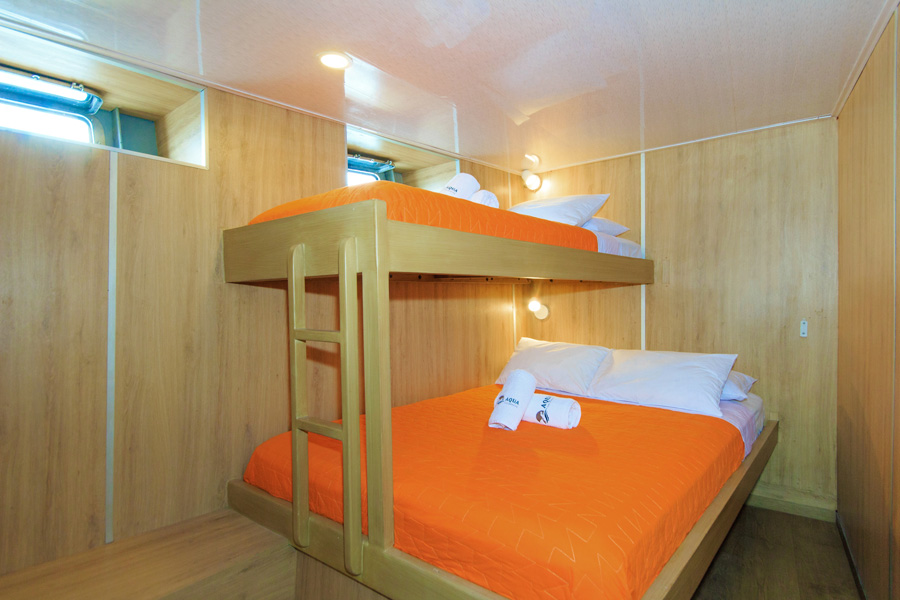
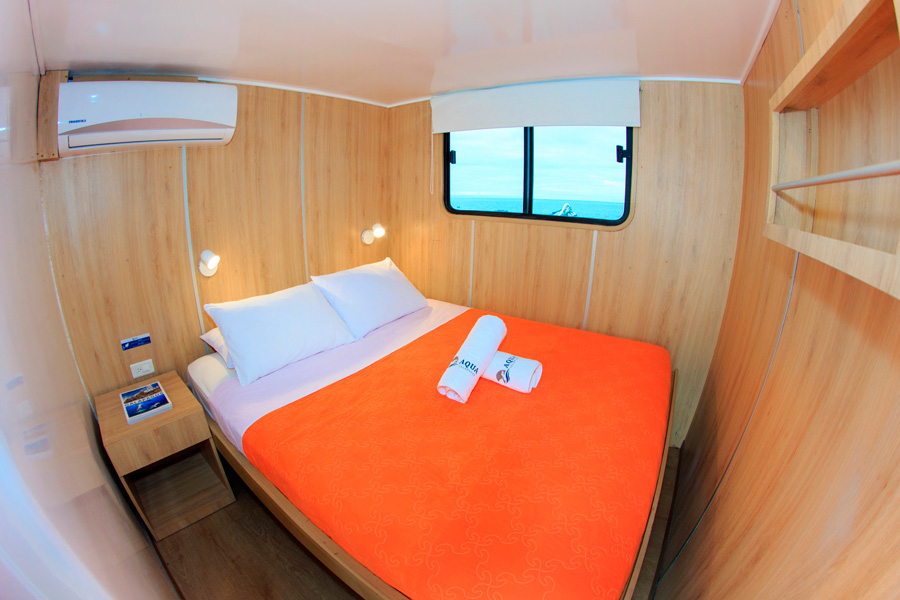
M/Y Aqua offers: the main deck and upper deck cabins(Double and Bunk beds) have picture windows that can be opened.
The lower deck cabins(Bunk beds) have portholes only.
M/Y Aqua has cosy social areas that will complement a comfortable and adventurous stay. Shared with a total of just 16 guests, the library, shaded outside lounge, solarium and dining areas are great choices for you to relax and enjoy the nature that surrounds you.
All staff has been trained in primary first aid and secondary care, and no expense has been spared in relevant safety departments. Have a fully stocked first aid kit on board, as well as emergency oxygen and a trauma kit.
Every effort has been made to attain high-security standards. On the bridge have an EPIRB, marine rescue GPS to locate divers, long-range radio phone (for use in emergencies only), FM and SW Radio, and VHF and SSB radio. There are also fire detectors throughout the boat and a large number of fire extinguishers. All staff are trained by a fire control specialist in the unlikely event of an outbreak. There is also an adequate number of personal flotation devices and lifebuoys.
Lower Deck Cabin
Cabins with a double size lower bed and single upper bed (for double or triple use).
from 3.785 €/pers
Main/Upper Deck Cabin
M/Y Aqua offers the main deck and upper deck cabins have picture windows that can be opened.
from 3.931 €/pers
Route A: Darwin's Spirit7 nights
Ecuador: Central Islands, Fernandina & Isabela (Marine Iguanas), Wolf & Darwin
DAY 1 - Baltra This is the perfect spot to start your adventure with moderate currents.
DAY 2 - Cape Marshall, Isabela This is a great location for spotting hammerhead, white-tipped, and Galapagos sharks. There are huge schools of black-striped salema and large schools of barracudas. The main attraction of Cape Marshall is a spot where it is so frequent to see giant mantas that it was named “Ciudad de las Mantas”
DAYS 3, 4 AND 5 - Wolf & Darwin Islands
Highlights include the following dive sites.
El Darwin’s Arch It is a hotspot for schools of scalloped hammerhead and, particularly, whale sharks.
Darwin’s Theatre Admire the endless parade of extraordinary marine fauna swarms by, which includes schools of hundreds of hammerhead sharks, patrolling Galapagos requiem sharks, incidental silky sharks, and likewise, hunting yellow-fin tunas, wahoos, bonitos, amberjacks, as well as massive pelagic schools.
El Arenal It is possible to be dropped off in these shallows, amidst dancing clouds of creolefish, to come face-to-face with individual and small groups of scalloped hammerhead sharks, as well as resting Pacific green turtles and rare hawksbill turtles in between hundreds of garden eels stretching up and plenty of colourful starfish.
Shark Bay Shark Bay, located on the exposed east coast of Wolf, is shallower than most sites around, yet for many the most memorable. Critically endangered hawksbill and Pacific green turtles visit busy king angelfishes. Cleaner fishes also groom spotted eagle rays and even hammerhead sharks. In these shallows, individual male hammerheads tend to approach motionless divers closer than schooling females in open water do.
The Landslide Beware that well-camouflaged scorpionfishes, abundant white-spotted moray eels, and whitetip reef sharks hang around! Clicks and whistles indicate that bottlenose dolphins are also not far away. The hot season usually brings lots of Pacific green turtles, majestic formations of spotted eagle rays, and, if lucky, Mobula devil rays and giant oceanic mantas.
The Pinnacle and The Caves This area has four good underwater caves that penetrate into the wall of the islet. In general, the large variety of life around and in the caves includes schools of soldierfish, guineafowl puffers, moray eels, whitetip reef sharks, marble rays, cardinalfish, and lobsters. The dive ends in the northeastern corner of Wolf at a tall and massive underwater pinnacle. Here you can watch for large pelagic species, like hammerhead and Galapagos sharks, bottlenose dolphins, and turtles.
DAY 6 - Isabela and Fernandina The calmer waters of the caves at Vicente Roca Point (Isabela) are well protected from the ocean swell and are a great place to dive amongst species of sharks, penguins, pufferfish, and even seahorses. Encounters with sunfish are common.
At Cape Douglas (Fernandina), as you prepare for the dive you can see Galapagos penguins, flightless cormorants and Galapagos marine iguanas, animals that are only found exclusively on these islands. Some of the marine life forms you can see are the red-lipped batfish, horned shark, sunfish, and possibly whales!
DAY 7 - Santiagio & Santa Cruz This bare volcanic rock serves as a roosting place for blue-footed boobies, brown pelicans, Galapagos fur seals, sea lions, and seasonally Galapagos penguins, which might be spotted during a dinghy ride.
Highlands (Santa Cruz)The native scalesia forest of El Chato Tortoise Reserve is the best place to search for Galapagos giant tortoises in their most authentic setting!
DAY 8 - Transfer to Baltra Airport
Included in the price
✓ Accommodation in the selected cabin for the number of guests and nights indicated
✓ Full board on board: breakfast, lunch, snack (if provided) and dinner
✓ Water, tea and instant coffee
✓ Guided dives as per the programme
✓ Tanks, weight belt and weights
✓ Airport transfers (round trip)
✓ On-site assistance from the cruise operator
Not included
• Flights
• Visas and any entry documents required by the destination country
• Soft drinks, alcoholic and spirit beverages
• Diving equipment rental (full or partial)
• Any currency or fuel surcharge
• Tips and personal extras
• Medical-Baggage and Trip Cancellation insurance (recommended, you can add it during check-out)
• Mandatory diving insurance (DAN or similar, you can add it during check-out)
Any mandatory costs payable on board or on site are detailed during checkout.
• Anything not expressly listed under “Included in the price”
Guest satisfaction index
★★★★★4.6/5
Departures
Date
Itinerary
Duration
Availability
Price
24 Nov 2026→ 1 Dec 2026
7 nights
Sold out
4.731 €
✓ We will notify you
Route A: Darwin's Spirit · 7 nights · 24 Nov 2026 → 1 Dec 2026
⚓ Embarkation: Baltra⚓ Disembarkation: Baltra
🎖️ Certification: PADI advanced or equivalent · min. 50 logged dives🤿 Dives: approx. 19 in total
Dive areas & sites: Ecuador: Central Islands, Fernandina & Isabela (Marine Iguanas), Wolf & Darwin
DAY 1 - Baltra This is the perfect spot to start your adventure with moderate currents.
DAY 2 - Cape Marshall, Isabela This is a great location for spotting hammerhead, white-tipped, and Galapagos sharks. There are huge schools of black-striped salema and large schools of barracudas. The main attraction of Cape Marshall is a spot where it is so frequent to see giant mantas that it was named “Ciudad de las Mantas”
DAYS 3, 4 AND 5 - Wolf & Darwin Islands
Highlights include the following dive sites.
El Darwin’s Arch It is a hotspot for schools of scalloped hammerhead and, particularly, whale sharks.
Darwin’s Theatre Admire the endless parade of extraordinary marine fauna swarms by, which includes schools of hundreds of hammerhead sharks, patrolling Galapagos requiem sharks, incidental silky sharks, and likewise, hunting yellow-fin tunas, wahoos, bonitos, amberjacks, as well as massive pelagic schools.
El Arenal It is possible to be dropped off in these shallows, amidst dancing clouds of creolefish, to come face-to-face with individual and small groups of scalloped hammerhead sharks, as well as resting Pacific green turtles and rare hawksbill turtles in between hundreds of garden eels stretching up and plenty of colourful starfish.
Shark Bay Shark Bay, located on the exposed east coast of Wolf, is shallower than most sites around, yet for many the most memorable. Critically endangered hawksbill and Pacific green turtles visit busy king angelfishes. Cleaner fishes also groom spotted eagle rays and even hammerhead sharks. In these shallows, individual male hammerheads tend to approach motionless divers closer than schooling females in open water do.
The Landslide Beware that well-camouflaged scorpionfishes, abundant white-spotted moray eels, and whitetip reef sharks hang around! Clicks and whistles indicate that bottlenose dolphins are also not far away. The hot season usually brings lots of Pacific green turtles, majestic formations of spotted eagle rays, and, if lucky, Mobula devil rays and giant oceanic mantas.
The Pinnacle and The Caves This area has four good underwater caves that penetrate into the wall of the islet. In general, the large variety of life around and in the caves includes schools of soldierfish, guineafowl puffers, moray eels, whitetip reef sharks, marble rays, cardinalfish, and lobsters. The dive ends in the northeastern corner of Wolf at a tall and massive underwater pinnacle. Here you can watch for large pelagic species, like hammerhead and Galapagos sharks, bottlenose dolphins, and turtles.
DAY 6 - Isabela and Fernandina The calmer waters of the caves at Vicente Roca Point (Isabela) are well protected from the ocean swell and are a great place to dive amongst species of sharks, penguins, pufferfish, and even seahorses. Encounters with sunfish are common.
At Cape Douglas (Fernandina), as you prepare for the dive you can see Galapagos penguins, flightless cormorants and Galapagos marine iguanas, animals that are only found exclusively on these islands. Some of the marine life forms you can see are the red-lipped batfish, horned shark, sunfish, and possibly whales!
DAY 7 - Santiagio & Santa Cruz This bare volcanic rock serves as a roosting place for blue-footed boobies, brown pelicans, Galapagos fur seals, sea lions, and seasonally Galapagos penguins, which might be spotted during a dinghy ride.
Highlands (Santa Cruz)The native scalesia forest of El Chato Tortoise Reserve is the best place to search for Galapagos giant tortoises in their most authentic setting!
DAY 8 - Transfer to Baltra Airport
ℹ︎ Flexible programme subject to weather and sea conditions.
1 Dec 2026→ 8 Dec 2026
7 nights
Sold out
4.731 €
✓ We will notify you
Route A: Darwin's Spirit · 7 nights · 1 Dec 2026 → 8 Dec 2026
⚓ Embarkation: Baltra⚓ Disembarkation: Baltra
🎖️ Certification: PADI advanced or equivalent · min. 50 logged dives🤿 Dives: approx. 19 in total
Dive areas & sites: Ecuador: Central Islands, Fernandina & Isabela (Marine Iguanas), Wolf & Darwin
DAY 1 - Baltra This is the perfect spot to start your adventure with moderate currents.
DAY 2 - Cape Marshall, Isabela This is a great location for spotting hammerhead, white-tipped, and Galapagos sharks. There are huge schools of black-striped salema and large schools of barracudas. The main attraction of Cape Marshall is a spot where it is so frequent to see giant mantas that it was named “Ciudad de las Mantas”
DAYS 3, 4 AND 5 - Wolf & Darwin Islands
Highlights include the following dive sites.
El Darwin’s Arch It is a hotspot for schools of scalloped hammerhead and, particularly, whale sharks.
Darwin’s Theatre Admire the endless parade of extraordinary marine fauna swarms by, which includes schools of hundreds of hammerhead sharks, patrolling Galapagos requiem sharks, incidental silky sharks, and likewise, hunting yellow-fin tunas, wahoos, bonitos, amberjacks, as well as massive pelagic schools.
El Arenal It is possible to be dropped off in these shallows, amidst dancing clouds of creolefish, to come face-to-face with individual and small groups of scalloped hammerhead sharks, as well as resting Pacific green turtles and rare hawksbill turtles in between hundreds of garden eels stretching up and plenty of colourful starfish.
Shark Bay Shark Bay, located on the exposed east coast of Wolf, is shallower than most sites around, yet for many the most memorable. Critically endangered hawksbill and Pacific green turtles visit busy king angelfishes. Cleaner fishes also groom spotted eagle rays and even hammerhead sharks. In these shallows, individual male hammerheads tend to approach motionless divers closer than schooling females in open water do.
The Landslide Beware that well-camouflaged scorpionfishes, abundant white-spotted moray eels, and whitetip reef sharks hang around! Clicks and whistles indicate that bottlenose dolphins are also not far away. The hot season usually brings lots of Pacific green turtles, majestic formations of spotted eagle rays, and, if lucky, Mobula devil rays and giant oceanic mantas.
The Pinnacle and The Caves This area has four good underwater caves that penetrate into the wall of the islet. In general, the large variety of life around and in the caves includes schools of soldierfish, guineafowl puffers, moray eels, whitetip reef sharks, marble rays, cardinalfish, and lobsters. The dive ends in the northeastern corner of Wolf at a tall and massive underwater pinnacle. Here you can watch for large pelagic species, like hammerhead and Galapagos sharks, bottlenose dolphins, and turtles.
DAY 6 - Isabela and Fernandina The calmer waters of the caves at Vicente Roca Point (Isabela) are well protected from the ocean swell and are a great place to dive amongst species of sharks, penguins, pufferfish, and even seahorses. Encounters with sunfish are common.
At Cape Douglas (Fernandina), as you prepare for the dive you can see Galapagos penguins, flightless cormorants and Galapagos marine iguanas, animals that are only found exclusively on these islands. Some of the marine life forms you can see are the red-lipped batfish, horned shark, sunfish, and possibly whales!
DAY 7 - Santiagio & Santa Cruz This bare volcanic rock serves as a roosting place for blue-footed boobies, brown pelicans, Galapagos fur seals, sea lions, and seasonally Galapagos penguins, which might be spotted during a dinghy ride.
Highlands (Santa Cruz)The native scalesia forest of El Chato Tortoise Reserve is the best place to search for Galapagos giant tortoises in their most authentic setting!
DAY 8 - Transfer to Baltra Airport
ℹ︎ Flexible programme subject to weather and sea conditions.
8 Dec 2026→ 15 Dec 2026
7 nights
Available5 places available
4.731 €3.785 €
Route A: Darwin's Spirit · 7 nights · 8 Dec 2026 → 15 Dec 2026
⚓ Embarkation: Baltra⚓ Disembarkation: Baltra
🎖️ Certification: PADI advanced or equivalent · min. 50 logged dives🤿 Dives: approx. 19 in total
Dive areas & sites: Ecuador: Central Islands, Fernandina & Isabela (Marine Iguanas), Wolf & Darwin
DAY 1 - Baltra This is the perfect spot to start your adventure with moderate currents.
DAY 2 - Cape Marshall, Isabela This is a great location for spotting hammerhead, white-tipped, and Galapagos sharks. There are huge schools of black-striped salema and large schools of barracudas. The main attraction of Cape Marshall is a spot where it is so frequent to see giant mantas that it was named “Ciudad de las Mantas”
DAYS 3, 4 AND 5 - Wolf & Darwin Islands
Highlights include the following dive sites.
El Darwin’s Arch It is a hotspot for schools of scalloped hammerhead and, particularly, whale sharks.
Darwin’s Theatre Admire the endless parade of extraordinary marine fauna swarms by, which includes schools of hundreds of hammerhead sharks, patrolling Galapagos requiem sharks, incidental silky sharks, and likewise, hunting yellow-fin tunas, wahoos, bonitos, amberjacks, as well as massive pelagic schools.
El Arenal It is possible to be dropped off in these shallows, amidst dancing clouds of creolefish, to come face-to-face with individual and small groups of scalloped hammerhead sharks, as well as resting Pacific green turtles and rare hawksbill turtles in between hundreds of garden eels stretching up and plenty of colourful starfish.
Shark Bay Shark Bay, located on the exposed east coast of Wolf, is shallower than most sites around, yet for many the most memorable. Critically endangered hawksbill and Pacific green turtles visit busy king angelfishes. Cleaner fishes also groom spotted eagle rays and even hammerhead sharks. In these shallows, individual male hammerheads tend to approach motionless divers closer than schooling females in open water do.
The Landslide Beware that well-camouflaged scorpionfishes, abundant white-spotted moray eels, and whitetip reef sharks hang around! Clicks and whistles indicate that bottlenose dolphins are also not far away. The hot season usually brings lots of Pacific green turtles, majestic formations of spotted eagle rays, and, if lucky, Mobula devil rays and giant oceanic mantas.
The Pinnacle and The Caves This area has four good underwater caves that penetrate into the wall of the islet. In general, the large variety of life around and in the caves includes schools of soldierfish, guineafowl puffers, moray eels, whitetip reef sharks, marble rays, cardinalfish, and lobsters. The dive ends in the northeastern corner of Wolf at a tall and massive underwater pinnacle. Here you can watch for large pelagic species, like hammerhead and Galapagos sharks, bottlenose dolphins, and turtles.
DAY 6 - Isabela and Fernandina The calmer waters of the caves at Vicente Roca Point (Isabela) are well protected from the ocean swell and are a great place to dive amongst species of sharks, penguins, pufferfish, and even seahorses. Encounters with sunfish are common.
At Cape Douglas (Fernandina), as you prepare for the dive you can see Galapagos penguins, flightless cormorants and Galapagos marine iguanas, animals that are only found exclusively on these islands. Some of the marine life forms you can see are the red-lipped batfish, horned shark, sunfish, and possibly whales!
DAY 7 - Santiagio & Santa Cruz This bare volcanic rock serves as a roosting place for blue-footed boobies, brown pelicans, Galapagos fur seals, sea lions, and seasonally Galapagos penguins, which might be spotted during a dinghy ride.
Highlands (Santa Cruz)The native scalesia forest of El Chato Tortoise Reserve is the best place to search for Galapagos giant tortoises in their most authentic setting!
DAY 8 - Transfer to Baltra Airport
ℹ︎ Flexible programme subject to weather and sea conditions.
15 Dec 2026→ 22 Dec 2026
7 nights
Sold out
4.731 €4.257 €
✓ We will notify you
Route A: Darwin's Spirit · 7 nights · 15 Dec 2026 → 22 Dec 2026
⚓ Embarkation: Baltra⚓ Disembarkation: Baltra
🎖️ Certification: PADI advanced or equivalent · min. 50 logged dives🤿 Dives: approx. 19 in total
Dive areas & sites: Ecuador: Central Islands, Fernandina & Isabela (Marine Iguanas), Wolf & Darwin
DAY 1 - Baltra This is the perfect spot to start your adventure with moderate currents.
DAY 2 - Cape Marshall, Isabela This is a great location for spotting hammerhead, white-tipped, and Galapagos sharks. There are huge schools of black-striped salema and large schools of barracudas. The main attraction of Cape Marshall is a spot where it is so frequent to see giant mantas that it was named “Ciudad de las Mantas”
DAYS 3, 4 AND 5 - Wolf & Darwin Islands
Highlights include the following dive sites.
El Darwin’s Arch It is a hotspot for schools of scalloped hammerhead and, particularly, whale sharks.
Darwin’s Theatre Admire the endless parade of extraordinary marine fauna swarms by, which includes schools of hundreds of hammerhead sharks, patrolling Galapagos requiem sharks, incidental silky sharks, and likewise, hunting yellow-fin tunas, wahoos, bonitos, amberjacks, as well as massive pelagic schools.
El Arenal It is possible to be dropped off in these shallows, amidst dancing clouds of creolefish, to come face-to-face with individual and small groups of scalloped hammerhead sharks, as well as resting Pacific green turtles and rare hawksbill turtles in between hundreds of garden eels stretching up and plenty of colourful starfish.
Shark Bay Shark Bay, located on the exposed east coast of Wolf, is shallower than most sites around, yet for many the most memorable. Critically endangered hawksbill and Pacific green turtles visit busy king angelfishes. Cleaner fishes also groom spotted eagle rays and even hammerhead sharks. In these shallows, individual male hammerheads tend to approach motionless divers closer than schooling females in open water do.
The Landslide Beware that well-camouflaged scorpionfishes, abundant white-spotted moray eels, and whitetip reef sharks hang around! Clicks and whistles indicate that bottlenose dolphins are also not far away. The hot season usually brings lots of Pacific green turtles, majestic formations of spotted eagle rays, and, if lucky, Mobula devil rays and giant oceanic mantas.
The Pinnacle and The Caves This area has four good underwater caves that penetrate into the wall of the islet. In general, the large variety of life around and in the caves includes schools of soldierfish, guineafowl puffers, moray eels, whitetip reef sharks, marble rays, cardinalfish, and lobsters. The dive ends in the northeastern corner of Wolf at a tall and massive underwater pinnacle. Here you can watch for large pelagic species, like hammerhead and Galapagos sharks, bottlenose dolphins, and turtles.
DAY 6 - Isabela and Fernandina The calmer waters of the caves at Vicente Roca Point (Isabela) are well protected from the ocean swell and are a great place to dive amongst species of sharks, penguins, pufferfish, and even seahorses. Encounters with sunfish are common.
At Cape Douglas (Fernandina), as you prepare for the dive you can see Galapagos penguins, flightless cormorants and Galapagos marine iguanas, animals that are only found exclusively on these islands. Some of the marine life forms you can see are the red-lipped batfish, horned shark, sunfish, and possibly whales!
DAY 7 - Santiagio & Santa Cruz This bare volcanic rock serves as a roosting place for blue-footed boobies, brown pelicans, Galapagos fur seals, sea lions, and seasonally Galapagos penguins, which might be spotted during a dinghy ride.
Highlands (Santa Cruz)The native scalesia forest of El Chato Tortoise Reserve is the best place to search for Galapagos giant tortoises in their most authentic setting!
DAY 8 - Transfer to Baltra Airport
ℹ︎ Flexible programme subject to weather and sea conditions.
22 Dec 2026→ 29 Dec 2026
7 nights
Sold out
4.731 €4.257 €
✓ We will notify you
Route A: Darwin's Spirit · 7 nights · 22 Dec 2026 → 29 Dec 2026
⚓ Embarkation: Baltra⚓ Disembarkation: Baltra
🎖️ Certification: PADI advanced or equivalent · min. 50 logged dives🤿 Dives: approx. 19 in total
Dive areas & sites: Ecuador: Central Islands, Fernandina & Isabela (Marine Iguanas), Wolf & Darwin
DAY 1 - Baltra This is the perfect spot to start your adventure with moderate currents.
DAY 2 - Cape Marshall, Isabela This is a great location for spotting hammerhead, white-tipped, and Galapagos sharks. There are huge schools of black-striped salema and large schools of barracudas. The main attraction of Cape Marshall is a spot where it is so frequent to see giant mantas that it was named “Ciudad de las Mantas”
DAYS 3, 4 AND 5 - Wolf & Darwin Islands
Highlights include the following dive sites.
El Darwin’s Arch It is a hotspot for schools of scalloped hammerhead and, particularly, whale sharks.
Darwin’s Theatre Admire the endless parade of extraordinary marine fauna swarms by, which includes schools of hundreds of hammerhead sharks, patrolling Galapagos requiem sharks, incidental silky sharks, and likewise, hunting yellow-fin tunas, wahoos, bonitos, amberjacks, as well as massive pelagic schools.
El Arenal It is possible to be dropped off in these shallows, amidst dancing clouds of creolefish, to come face-to-face with individual and small groups of scalloped hammerhead sharks, as well as resting Pacific green turtles and rare hawksbill turtles in between hundreds of garden eels stretching up and plenty of colourful starfish.
Shark Bay Shark Bay, located on the exposed east coast of Wolf, is shallower than most sites around, yet for many the most memorable. Critically endangered hawksbill and Pacific green turtles visit busy king angelfishes. Cleaner fishes also groom spotted eagle rays and even hammerhead sharks. In these shallows, individual male hammerheads tend to approach motionless divers closer than schooling females in open water do.
The Landslide Beware that well-camouflaged scorpionfishes, abundant white-spotted moray eels, and whitetip reef sharks hang around! Clicks and whistles indicate that bottlenose dolphins are also not far away. The hot season usually brings lots of Pacific green turtles, majestic formations of spotted eagle rays, and, if lucky, Mobula devil rays and giant oceanic mantas.
The Pinnacle and The Caves This area has four good underwater caves that penetrate into the wall of the islet. In general, the large variety of life around and in the caves includes schools of soldierfish, guineafowl puffers, moray eels, whitetip reef sharks, marble rays, cardinalfish, and lobsters. The dive ends in the northeastern corner of Wolf at a tall and massive underwater pinnacle. Here you can watch for large pelagic species, like hammerhead and Galapagos sharks, bottlenose dolphins, and turtles.
DAY 6 - Isabela and Fernandina The calmer waters of the caves at Vicente Roca Point (Isabela) are well protected from the ocean swell and are a great place to dive amongst species of sharks, penguins, pufferfish, and even seahorses. Encounters with sunfish are common.
At Cape Douglas (Fernandina), as you prepare for the dive you can see Galapagos penguins, flightless cormorants and Galapagos marine iguanas, animals that are only found exclusively on these islands. Some of the marine life forms you can see are the red-lipped batfish, horned shark, sunfish, and possibly whales!
DAY 7 - Santiagio & Santa Cruz This bare volcanic rock serves as a roosting place for blue-footed boobies, brown pelicans, Galapagos fur seals, sea lions, and seasonally Galapagos penguins, which might be spotted during a dinghy ride.
Highlands (Santa Cruz)The native scalesia forest of El Chato Tortoise Reserve is the best place to search for Galapagos giant tortoises in their most authentic setting!
DAY 8 - Transfer to Baltra Airport
ℹ︎ Flexible programme subject to weather and sea conditions.
9 Feb 2027→ 16 Feb 2027
7 nights
Sold out
4.913 €
✓ We will notify you
Route A: Darwin's Spirit · 7 nights · 9 Feb 2027 → 16 Feb 2027
⚓ Embarkation: Baltra⚓ Disembarkation: Baltra
🎖️ Certification: PADI advanced or equivalent · min. 50 logged dives🤿 Dives: approx. 19 in total
Dive areas & sites: Ecuador: Central Islands, Fernandina & Isabela (Marine Iguanas), Wolf & Darwin
DAY 1 - Baltra This is the perfect spot to start your adventure with moderate currents.
DAY 2 - Cape Marshall, Isabela This is a great location for spotting hammerhead, white-tipped, and Galapagos sharks. There are huge schools of black-striped salema and large schools of barracudas. The main attraction of Cape Marshall is a spot where it is so frequent to see giant mantas that it was named “Ciudad de las Mantas”
DAYS 3, 4 AND 5 - Wolf & Darwin Islands
Highlights include the following dive sites.
El Darwin’s Arch It is a hotspot for schools of scalloped hammerhead and, particularly, whale sharks.
Darwin’s Theatre Admire the endless parade of extraordinary marine fauna swarms by, which includes schools of hundreds of hammerhead sharks, patrolling Galapagos requiem sharks, incidental silky sharks, and likewise, hunting yellow-fin tunas, wahoos, bonitos, amberjacks, as well as massive pelagic schools.
El Arenal It is possible to be dropped off in these shallows, amidst dancing clouds of creolefish, to come face-to-face with individual and small groups of scalloped hammerhead sharks, as well as resting Pacific green turtles and rare hawksbill turtles in between hundreds of garden eels stretching up and plenty of colourful starfish.
Shark Bay Shark Bay, located on the exposed east coast of Wolf, is shallower than most sites around, yet for many the most memorable. Critically endangered hawksbill and Pacific green turtles visit busy king angelfishes. Cleaner fishes also groom spotted eagle rays and even hammerhead sharks. In these shallows, individual male hammerheads tend to approach motionless divers closer than schooling females in open water do.
The Landslide Beware that well-camouflaged scorpionfishes, abundant white-spotted moray eels, and whitetip reef sharks hang around! Clicks and whistles indicate that bottlenose dolphins are also not far away. The hot season usually brings lots of Pacific green turtles, majestic formations of spotted eagle rays, and, if lucky, Mobula devil rays and giant oceanic mantas.
The Pinnacle and The Caves This area has four good underwater caves that penetrate into the wall of the islet. In general, the large variety of life around and in the caves includes schools of soldierfish, guineafowl puffers, moray eels, whitetip reef sharks, marble rays, cardinalfish, and lobsters. The dive ends in the northeastern corner of Wolf at a tall and massive underwater pinnacle. Here you can watch for large pelagic species, like hammerhead and Galapagos sharks, bottlenose dolphins, and turtles.
DAY 6 - Isabela and Fernandina The calmer waters of the caves at Vicente Roca Point (Isabela) are well protected from the ocean swell and are a great place to dive amongst species of sharks, penguins, pufferfish, and even seahorses. Encounters with sunfish are common.
At Cape Douglas (Fernandina), as you prepare for the dive you can see Galapagos penguins, flightless cormorants and Galapagos marine iguanas, animals that are only found exclusively on these islands. Some of the marine life forms you can see are the red-lipped batfish, horned shark, sunfish, and possibly whales!
DAY 7 - Santiagio & Santa Cruz This bare volcanic rock serves as a roosting place for blue-footed boobies, brown pelicans, Galapagos fur seals, sea lions, and seasonally Galapagos penguins, which might be spotted during a dinghy ride.
Highlands (Santa Cruz)The native scalesia forest of El Chato Tortoise Reserve is the best place to search for Galapagos giant tortoises in their most authentic setting!
DAY 8 - Transfer to Baltra Airport
ℹ︎ Flexible programme subject to weather and sea conditions.
16 Feb 2027→ 23 Feb 2027
7 nights
Sold out
4.913 €
✓ We will notify you
Route A: Darwin's Spirit · 7 nights · 16 Feb 2027 → 23 Feb 2027
⚓ Embarkation: Baltra⚓ Disembarkation: Baltra
🎖️ Certification: PADI advanced or equivalent · min. 50 logged dives🤿 Dives: approx. 19 in total
Dive areas & sites: Ecuador: Central Islands, Fernandina & Isabela (Marine Iguanas), Wolf & Darwin
DAY 1 - Baltra This is the perfect spot to start your adventure with moderate currents.
DAY 2 - Cape Marshall, Isabela This is a great location for spotting hammerhead, white-tipped, and Galapagos sharks. There are huge schools of black-striped salema and large schools of barracudas. The main attraction of Cape Marshall is a spot where it is so frequent to see giant mantas that it was named “Ciudad de las Mantas”
DAYS 3, 4 AND 5 - Wolf & Darwin Islands
Highlights include the following dive sites.
El Darwin’s Arch It is a hotspot for schools of scalloped hammerhead and, particularly, whale sharks.
Darwin’s Theatre Admire the endless parade of extraordinary marine fauna swarms by, which includes schools of hundreds of hammerhead sharks, patrolling Galapagos requiem sharks, incidental silky sharks, and likewise, hunting yellow-fin tunas, wahoos, bonitos, amberjacks, as well as massive pelagic schools.
El Arenal It is possible to be dropped off in these shallows, amidst dancing clouds of creolefish, to come face-to-face with individual and small groups of scalloped hammerhead sharks, as well as resting Pacific green turtles and rare hawksbill turtles in between hundreds of garden eels stretching up and plenty of colourful starfish.
Shark Bay Shark Bay, located on the exposed east coast of Wolf, is shallower than most sites around, yet for many the most memorable. Critically endangered hawksbill and Pacific green turtles visit busy king angelfishes. Cleaner fishes also groom spotted eagle rays and even hammerhead sharks. In these shallows, individual male hammerheads tend to approach motionless divers closer than schooling females in open water do.
The Landslide Beware that well-camouflaged scorpionfishes, abundant white-spotted moray eels, and whitetip reef sharks hang around! Clicks and whistles indicate that bottlenose dolphins are also not far away. The hot season usually brings lots of Pacific green turtles, majestic formations of spotted eagle rays, and, if lucky, Mobula devil rays and giant oceanic mantas.
The Pinnacle and The Caves This area has four good underwater caves that penetrate into the wall of the islet. In general, the large variety of life around and in the caves includes schools of soldierfish, guineafowl puffers, moray eels, whitetip reef sharks, marble rays, cardinalfish, and lobsters. The dive ends in the northeastern corner of Wolf at a tall and massive underwater pinnacle. Here you can watch for large pelagic species, like hammerhead and Galapagos sharks, bottlenose dolphins, and turtles.
DAY 6 - Isabela and Fernandina The calmer waters of the caves at Vicente Roca Point (Isabela) are well protected from the ocean swell and are a great place to dive amongst species of sharks, penguins, pufferfish, and even seahorses. Encounters with sunfish are common.
At Cape Douglas (Fernandina), as you prepare for the dive you can see Galapagos penguins, flightless cormorants and Galapagos marine iguanas, animals that are only found exclusively on these islands. Some of the marine life forms you can see are the red-lipped batfish, horned shark, sunfish, and possibly whales!
DAY 7 - Santiagio & Santa Cruz This bare volcanic rock serves as a roosting place for blue-footed boobies, brown pelicans, Galapagos fur seals, sea lions, and seasonally Galapagos penguins, which might be spotted during a dinghy ride.
Highlands (Santa Cruz)The native scalesia forest of El Chato Tortoise Reserve is the best place to search for Galapagos giant tortoises in their most authentic setting!
DAY 8 - Transfer to Baltra Airport
ℹ︎ Flexible programme subject to weather and sea conditions.
23 Feb 2027→ 2 Mar 2027
7 nights
Last place1 place available
4.913 €
Route A: Darwin's Spirit · 7 nights · 23 Feb 2027 → 2 Mar 2027
⚓ Embarkation: Baltra⚓ Disembarkation: Baltra
🎖️ Certification: PADI advanced or equivalent · min. 50 logged dives🤿 Dives: approx. 19 in total
Dive areas & sites: Ecuador: Central Islands, Fernandina & Isabela (Marine Iguanas), Wolf & Darwin
DAY 1 - Baltra This is the perfect spot to start your adventure with moderate currents.
DAY 2 - Cape Marshall, Isabela This is a great location for spotting hammerhead, white-tipped, and Galapagos sharks. There are huge schools of black-striped salema and large schools of barracudas. The main attraction of Cape Marshall is a spot where it is so frequent to see giant mantas that it was named “Ciudad de las Mantas”
DAYS 3, 4 AND 5 - Wolf & Darwin Islands
Highlights include the following dive sites.
El Darwin’s Arch It is a hotspot for schools of scalloped hammerhead and, particularly, whale sharks.
Darwin’s Theatre Admire the endless parade of extraordinary marine fauna swarms by, which includes schools of hundreds of hammerhead sharks, patrolling Galapagos requiem sharks, incidental silky sharks, and likewise, hunting yellow-fin tunas, wahoos, bonitos, amberjacks, as well as massive pelagic schools.
El Arenal It is possible to be dropped off in these shallows, amidst dancing clouds of creolefish, to come face-to-face with individual and small groups of scalloped hammerhead sharks, as well as resting Pacific green turtles and rare hawksbill turtles in between hundreds of garden eels stretching up and plenty of colourful starfish.
Shark Bay Shark Bay, located on the exposed east coast of Wolf, is shallower than most sites around, yet for many the most memorable. Critically endangered hawksbill and Pacific green turtles visit busy king angelfishes. Cleaner fishes also groom spotted eagle rays and even hammerhead sharks. In these shallows, individual male hammerheads tend to approach motionless divers closer than schooling females in open water do.
The Landslide Beware that well-camouflaged scorpionfishes, abundant white-spotted moray eels, and whitetip reef sharks hang around! Clicks and whistles indicate that bottlenose dolphins are also not far away. The hot season usually brings lots of Pacific green turtles, majestic formations of spotted eagle rays, and, if lucky, Mobula devil rays and giant oceanic mantas.
The Pinnacle and The Caves This area has four good underwater caves that penetrate into the wall of the islet. In general, the large variety of life around and in the caves includes schools of soldierfish, guineafowl puffers, moray eels, whitetip reef sharks, marble rays, cardinalfish, and lobsters. The dive ends in the northeastern corner of Wolf at a tall and massive underwater pinnacle. Here you can watch for large pelagic species, like hammerhead and Galapagos sharks, bottlenose dolphins, and turtles.
DAY 6 - Isabela and Fernandina The calmer waters of the caves at Vicente Roca Point (Isabela) are well protected from the ocean swell and are a great place to dive amongst species of sharks, penguins, pufferfish, and even seahorses. Encounters with sunfish are common.
At Cape Douglas (Fernandina), as you prepare for the dive you can see Galapagos penguins, flightless cormorants and Galapagos marine iguanas, animals that are only found exclusively on these islands. Some of the marine life forms you can see are the red-lipped batfish, horned shark, sunfish, and possibly whales!
DAY 7 - Santiagio & Santa Cruz This bare volcanic rock serves as a roosting place for blue-footed boobies, brown pelicans, Galapagos fur seals, sea lions, and seasonally Galapagos penguins, which might be spotted during a dinghy ride.
Highlands (Santa Cruz)The native scalesia forest of El Chato Tortoise Reserve is the best place to search for Galapagos giant tortoises in their most authentic setting!
DAY 8 - Transfer to Baltra Airport
ℹ︎ Flexible programme subject to weather and sea conditions.
2 Mar 2027→ 9 Mar 2027
7 nights
Sold out
4.913 €
✓ We will notify you
Route A: Darwin's Spirit · 7 nights · 2 Mar 2027 → 9 Mar 2027
⚓ Embarkation: Baltra⚓ Disembarkation: Baltra
🎖️ Certification: PADI advanced or equivalent · min. 50 logged dives🤿 Dives: approx. 19 in total
Dive areas & sites: Ecuador: Central Islands, Fernandina & Isabela (Marine Iguanas), Wolf & Darwin
DAY 1 - Baltra This is the perfect spot to start your adventure with moderate currents.
DAY 2 - Cape Marshall, Isabela This is a great location for spotting hammerhead, white-tipped, and Galapagos sharks. There are huge schools of black-striped salema and large schools of barracudas. The main attraction of Cape Marshall is a spot where it is so frequent to see giant mantas that it was named “Ciudad de las Mantas”
DAYS 3, 4 AND 5 - Wolf & Darwin Islands
Highlights include the following dive sites.
El Darwin’s Arch It is a hotspot for schools of scalloped hammerhead and, particularly, whale sharks.
Darwin’s Theatre Admire the endless parade of extraordinary marine fauna swarms by, which includes schools of hundreds of hammerhead sharks, patrolling Galapagos requiem sharks, incidental silky sharks, and likewise, hunting yellow-fin tunas, wahoos, bonitos, amberjacks, as well as massive pelagic schools.
El Arenal It is possible to be dropped off in these shallows, amidst dancing clouds of creolefish, to come face-to-face with individual and small groups of scalloped hammerhead sharks, as well as resting Pacific green turtles and rare hawksbill turtles in between hundreds of garden eels stretching up and plenty of colourful starfish.
Shark Bay Shark Bay, located on the exposed east coast of Wolf, is shallower than most sites around, yet for many the most memorable. Critically endangered hawksbill and Pacific green turtles visit busy king angelfishes. Cleaner fishes also groom spotted eagle rays and even hammerhead sharks. In these shallows, individual male hammerheads tend to approach motionless divers closer than schooling females in open water do.
The Landslide Beware that well-camouflaged scorpionfishes, abundant white-spotted moray eels, and whitetip reef sharks hang around! Clicks and whistles indicate that bottlenose dolphins are also not far away. The hot season usually brings lots of Pacific green turtles, majestic formations of spotted eagle rays, and, if lucky, Mobula devil rays and giant oceanic mantas.
The Pinnacle and The Caves This area has four good underwater caves that penetrate into the wall of the islet. In general, the large variety of life around and in the caves includes schools of soldierfish, guineafowl puffers, moray eels, whitetip reef sharks, marble rays, cardinalfish, and lobsters. The dive ends in the northeastern corner of Wolf at a tall and massive underwater pinnacle. Here you can watch for large pelagic species, like hammerhead and Galapagos sharks, bottlenose dolphins, and turtles.
DAY 6 - Isabela and Fernandina The calmer waters of the caves at Vicente Roca Point (Isabela) are well protected from the ocean swell and are a great place to dive amongst species of sharks, penguins, pufferfish, and even seahorses. Encounters with sunfish are common.
At Cape Douglas (Fernandina), as you prepare for the dive you can see Galapagos penguins, flightless cormorants and Galapagos marine iguanas, animals that are only found exclusively on these islands. Some of the marine life forms you can see are the red-lipped batfish, horned shark, sunfish, and possibly whales!
DAY 7 - Santiagio & Santa Cruz This bare volcanic rock serves as a roosting place for blue-footed boobies, brown pelicans, Galapagos fur seals, sea lions, and seasonally Galapagos penguins, which might be spotted during a dinghy ride.
Highlands (Santa Cruz)The native scalesia forest of El Chato Tortoise Reserve is the best place to search for Galapagos giant tortoises in their most authentic setting!
DAY 8 - Transfer to Baltra Airport
ℹ︎ Flexible programme subject to weather and sea conditions.
9 Mar 2027→ 16 Mar 2027
7 nights
Sold out
4.913 €
✓ We will notify you
Route A: Darwin's Spirit · 7 nights · 9 Mar 2027 → 16 Mar 2027
⚓ Embarkation: Baltra⚓ Disembarkation: Baltra
🎖️ Certification: PADI advanced or equivalent · min. 50 logged dives🤿 Dives: approx. 19 in total
Dive areas & sites: Ecuador: Central Islands, Fernandina & Isabela (Marine Iguanas), Wolf & Darwin
DAY 1 - Baltra This is the perfect spot to start your adventure with moderate currents.
DAY 2 - Cape Marshall, Isabela This is a great location for spotting hammerhead, white-tipped, and Galapagos sharks. There are huge schools of black-striped salema and large schools of barracudas. The main attraction of Cape Marshall is a spot where it is so frequent to see giant mantas that it was named “Ciudad de las Mantas”
DAYS 3, 4 AND 5 - Wolf & Darwin Islands
Highlights include the following dive sites.
El Darwin’s Arch It is a hotspot for schools of scalloped hammerhead and, particularly, whale sharks.
Darwin’s Theatre Admire the endless parade of extraordinary marine fauna swarms by, which includes schools of hundreds of hammerhead sharks, patrolling Galapagos requiem sharks, incidental silky sharks, and likewise, hunting yellow-fin tunas, wahoos, bonitos, amberjacks, as well as massive pelagic schools.
El Arenal It is possible to be dropped off in these shallows, amidst dancing clouds of creolefish, to come face-to-face with individual and small groups of scalloped hammerhead sharks, as well as resting Pacific green turtles and rare hawksbill turtles in between hundreds of garden eels stretching up and plenty of colourful starfish.
Shark Bay Shark Bay, located on the exposed east coast of Wolf, is shallower than most sites around, yet for many the most memorable. Critically endangered hawksbill and Pacific green turtles visit busy king angelfishes. Cleaner fishes also groom spotted eagle rays and even hammerhead sharks. In these shallows, individual male hammerheads tend to approach motionless divers closer than schooling females in open water do.
The Landslide Beware that well-camouflaged scorpionfishes, abundant white-spotted moray eels, and whitetip reef sharks hang around! Clicks and whistles indicate that bottlenose dolphins are also not far away. The hot season usually brings lots of Pacific green turtles, majestic formations of spotted eagle rays, and, if lucky, Mobula devil rays and giant oceanic mantas.
The Pinnacle and The Caves This area has four good underwater caves that penetrate into the wall of the islet. In general, the large variety of life around and in the caves includes schools of soldierfish, guineafowl puffers, moray eels, whitetip reef sharks, marble rays, cardinalfish, and lobsters. The dive ends in the northeastern corner of Wolf at a tall and massive underwater pinnacle. Here you can watch for large pelagic species, like hammerhead and Galapagos sharks, bottlenose dolphins, and turtles.
DAY 6 - Isabela and Fernandina The calmer waters of the caves at Vicente Roca Point (Isabela) are well protected from the ocean swell and are a great place to dive amongst species of sharks, penguins, pufferfish, and even seahorses. Encounters with sunfish are common.
At Cape Douglas (Fernandina), as you prepare for the dive you can see Galapagos penguins, flightless cormorants and Galapagos marine iguanas, animals that are only found exclusively on these islands. Some of the marine life forms you can see are the red-lipped batfish, horned shark, sunfish, and possibly whales!
DAY 7 - Santiagio & Santa Cruz This bare volcanic rock serves as a roosting place for blue-footed boobies, brown pelicans, Galapagos fur seals, sea lions, and seasonally Galapagos penguins, which might be spotted during a dinghy ride.
Highlands (Santa Cruz)The native scalesia forest of El Chato Tortoise Reserve is the best place to search for Galapagos giant tortoises in their most authentic setting!
DAY 8 - Transfer to Baltra Airport
ℹ︎ Flexible programme subject to weather and sea conditions.
16 Mar 2027→ 23 Mar 2027
7 nights
Available4 places available
4.913 €
Route A: Darwin's Spirit · 7 nights · 16 Mar 2027 → 23 Mar 2027
⚓ Embarkation: Baltra⚓ Disembarkation: Baltra
🎖️ Certification: PADI advanced or equivalent · min. 50 logged dives🤿 Dives: approx. 19 in total
Dive areas & sites: Ecuador: Central Islands, Fernandina & Isabela (Marine Iguanas), Wolf & Darwin
DAY 1 - Baltra This is the perfect spot to start your adventure with moderate currents.
DAY 2 - Cape Marshall, Isabela This is a great location for spotting hammerhead, white-tipped, and Galapagos sharks. There are huge schools of black-striped salema and large schools of barracudas. The main attraction of Cape Marshall is a spot where it is so frequent to see giant mantas that it was named “Ciudad de las Mantas”
DAYS 3, 4 AND 5 - Wolf & Darwin Islands
Highlights include the following dive sites.
El Darwin’s Arch It is a hotspot for schools of scalloped hammerhead and, particularly, whale sharks.
Darwin’s Theatre Admire the endless parade of extraordinary marine fauna swarms by, which includes schools of hundreds of hammerhead sharks, patrolling Galapagos requiem sharks, incidental silky sharks, and likewise, hunting yellow-fin tunas, wahoos, bonitos, amberjacks, as well as massive pelagic schools.
El Arenal It is possible to be dropped off in these shallows, amidst dancing clouds of creolefish, to come face-to-face with individual and small groups of scalloped hammerhead sharks, as well as resting Pacific green turtles and rare hawksbill turtles in between hundreds of garden eels stretching up and plenty of colourful starfish.
Shark Bay Shark Bay, located on the exposed east coast of Wolf, is shallower than most sites around, yet for many the most memorable. Critically endangered hawksbill and Pacific green turtles visit busy king angelfishes. Cleaner fishes also groom spotted eagle rays and even hammerhead sharks. In these shallows, individual male hammerheads tend to approach motionless divers closer than schooling females in open water do.
The Landslide Beware that well-camouflaged scorpionfishes, abundant white-spotted moray eels, and whitetip reef sharks hang around! Clicks and whistles indicate that bottlenose dolphins are also not far away. The hot season usually brings lots of Pacific green turtles, majestic formations of spotted eagle rays, and, if lucky, Mobula devil rays and giant oceanic mantas.
The Pinnacle and The Caves This area has four good underwater caves that penetrate into the wall of the islet. In general, the large variety of life around and in the caves includes schools of soldierfish, guineafowl puffers, moray eels, whitetip reef sharks, marble rays, cardinalfish, and lobsters. The dive ends in the northeastern corner of Wolf at a tall and massive underwater pinnacle. Here you can watch for large pelagic species, like hammerhead and Galapagos sharks, bottlenose dolphins, and turtles.
DAY 6 - Isabela and Fernandina The calmer waters of the caves at Vicente Roca Point (Isabela) are well protected from the ocean swell and are a great place to dive amongst species of sharks, penguins, pufferfish, and even seahorses. Encounters with sunfish are common.
At Cape Douglas (Fernandina), as you prepare for the dive you can see Galapagos penguins, flightless cormorants and Galapagos marine iguanas, animals that are only found exclusively on these islands. Some of the marine life forms you can see are the red-lipped batfish, horned shark, sunfish, and possibly whales!
DAY 7 - Santiagio & Santa Cruz This bare volcanic rock serves as a roosting place for blue-footed boobies, brown pelicans, Galapagos fur seals, sea lions, and seasonally Galapagos penguins, which might be spotted during a dinghy ride.
Highlands (Santa Cruz)The native scalesia forest of El Chato Tortoise Reserve is the best place to search for Galapagos giant tortoises in their most authentic setting!
DAY 8 - Transfer to Baltra Airport
ℹ︎ Flexible programme subject to weather and sea conditions.
23 Mar 2027→ 30 Mar 2027
7 nights
Sold out
4.913 €
✓ We will notify you
Route A: Darwin's Spirit · 7 nights · 23 Mar 2027 → 30 Mar 2027
⚓ Embarkation: Baltra⚓ Disembarkation: Baltra
🎖️ Certification: PADI advanced or equivalent · min. 50 logged dives🤿 Dives: approx. 19 in total
Dive areas & sites: Ecuador: Central Islands, Fernandina & Isabela (Marine Iguanas), Wolf & Darwin
DAY 1 - Baltra This is the perfect spot to start your adventure with moderate currents.
DAY 2 - Cape Marshall, Isabela This is a great location for spotting hammerhead, white-tipped, and Galapagos sharks. There are huge schools of black-striped salema and large schools of barracudas. The main attraction of Cape Marshall is a spot where it is so frequent to see giant mantas that it was named “Ciudad de las Mantas”
DAYS 3, 4 AND 5 - Wolf & Darwin Islands
Highlights include the following dive sites.
El Darwin’s Arch It is a hotspot for schools of scalloped hammerhead and, particularly, whale sharks.
Darwin’s Theatre Admire the endless parade of extraordinary marine fauna swarms by, which includes schools of hundreds of hammerhead sharks, patrolling Galapagos requiem sharks, incidental silky sharks, and likewise, hunting yellow-fin tunas, wahoos, bonitos, amberjacks, as well as massive pelagic schools.
El Arenal It is possible to be dropped off in these shallows, amidst dancing clouds of creolefish, to come face-to-face with individual and small groups of scalloped hammerhead sharks, as well as resting Pacific green turtles and rare hawksbill turtles in between hundreds of garden eels stretching up and plenty of colourful starfish.
Shark Bay Shark Bay, located on the exposed east coast of Wolf, is shallower than most sites around, yet for many the most memorable. Critically endangered hawksbill and Pacific green turtles visit busy king angelfishes. Cleaner fishes also groom spotted eagle rays and even hammerhead sharks. In these shallows, individual male hammerheads tend to approach motionless divers closer than schooling females in open water do.
The Landslide Beware that well-camouflaged scorpionfishes, abundant white-spotted moray eels, and whitetip reef sharks hang around! Clicks and whistles indicate that bottlenose dolphins are also not far away. The hot season usually brings lots of Pacific green turtles, majestic formations of spotted eagle rays, and, if lucky, Mobula devil rays and giant oceanic mantas.
The Pinnacle and The Caves This area has four good underwater caves that penetrate into the wall of the islet. In general, the large variety of life around and in the caves includes schools of soldierfish, guineafowl puffers, moray eels, whitetip reef sharks, marble rays, cardinalfish, and lobsters. The dive ends in the northeastern corner of Wolf at a tall and massive underwater pinnacle. Here you can watch for large pelagic species, like hammerhead and Galapagos sharks, bottlenose dolphins, and turtles.
DAY 6 - Isabela and Fernandina The calmer waters of the caves at Vicente Roca Point (Isabela) are well protected from the ocean swell and are a great place to dive amongst species of sharks, penguins, pufferfish, and even seahorses. Encounters with sunfish are common.
At Cape Douglas (Fernandina), as you prepare for the dive you can see Galapagos penguins, flightless cormorants and Galapagos marine iguanas, animals that are only found exclusively on these islands. Some of the marine life forms you can see are the red-lipped batfish, horned shark, sunfish, and possibly whales!
DAY 7 - Santiagio & Santa Cruz This bare volcanic rock serves as a roosting place for blue-footed boobies, brown pelicans, Galapagos fur seals, sea lions, and seasonally Galapagos penguins, which might be spotted during a dinghy ride.
Highlands (Santa Cruz)The native scalesia forest of El Chato Tortoise Reserve is the best place to search for Galapagos giant tortoises in their most authentic setting!
DAY 8 - Transfer to Baltra Airport
ℹ︎ Flexible programme subject to weather and sea conditions.
4 May 2027→ 11 May 2027
7 nights
Sold out
4.913 €
✓ We will notify you
Route A: Darwin's Spirit · 7 nights · 4 May 2027 → 11 May 2027
⚓ Embarkation: Baltra⚓ Disembarkation: Baltra
🎖️ Certification: PADI advanced or equivalent · min. 50 logged dives🤿 Dives: approx. 19 in total
Dive areas & sites: Ecuador: Central Islands, Fernandina & Isabela (Marine Iguanas), Wolf & Darwin
DAY 1 - Baltra This is the perfect spot to start your adventure with moderate currents.
DAY 2 - Cape Marshall, Isabela This is a great location for spotting hammerhead, white-tipped, and Galapagos sharks. There are huge schools of black-striped salema and large schools of barracudas. The main attraction of Cape Marshall is a spot where it is so frequent to see giant mantas that it was named “Ciudad de las Mantas”
DAYS 3, 4 AND 5 - Wolf & Darwin Islands
Highlights include the following dive sites.
El Darwin’s Arch It is a hotspot for schools of scalloped hammerhead and, particularly, whale sharks.
Darwin’s Theatre Admire the endless parade of extraordinary marine fauna swarms by, which includes schools of hundreds of hammerhead sharks, patrolling Galapagos requiem sharks, incidental silky sharks, and likewise, hunting yellow-fin tunas, wahoos, bonitos, amberjacks, as well as massive pelagic schools.
El Arenal It is possible to be dropped off in these shallows, amidst dancing clouds of creolefish, to come face-to-face with individual and small groups of scalloped hammerhead sharks, as well as resting Pacific green turtles and rare hawksbill turtles in between hundreds of garden eels stretching up and plenty of colourful starfish.
Shark Bay Shark Bay, located on the exposed east coast of Wolf, is shallower than most sites around, yet for many the most memorable. Critically endangered hawksbill and Pacific green turtles visit busy king angelfishes. Cleaner fishes also groom spotted eagle rays and even hammerhead sharks. In these shallows, individual male hammerheads tend to approach motionless divers closer than schooling females in open water do.
The Landslide Beware that well-camouflaged scorpionfishes, abundant white-spotted moray eels, and whitetip reef sharks hang around! Clicks and whistles indicate that bottlenose dolphins are also not far away. The hot season usually brings lots of Pacific green turtles, majestic formations of spotted eagle rays, and, if lucky, Mobula devil rays and giant oceanic mantas.
The Pinnacle and The Caves This area has four good underwater caves that penetrate into the wall of the islet. In general, the large variety of life around and in the caves includes schools of soldierfish, guineafowl puffers, moray eels, whitetip reef sharks, marble rays, cardinalfish, and lobsters. The dive ends in the northeastern corner of Wolf at a tall and massive underwater pinnacle. Here you can watch for large pelagic species, like hammerhead and Galapagos sharks, bottlenose dolphins, and turtles.
DAY 6 - Isabela and Fernandina The calmer waters of the caves at Vicente Roca Point (Isabela) are well protected from the ocean swell and are a great place to dive amongst species of sharks, penguins, pufferfish, and even seahorses. Encounters with sunfish are common.
At Cape Douglas (Fernandina), as you prepare for the dive you can see Galapagos penguins, flightless cormorants and Galapagos marine iguanas, animals that are only found exclusively on these islands. Some of the marine life forms you can see are the red-lipped batfish, horned shark, sunfish, and possibly whales!
DAY 7 - Santiagio & Santa Cruz This bare volcanic rock serves as a roosting place for blue-footed boobies, brown pelicans, Galapagos fur seals, sea lions, and seasonally Galapagos penguins, which might be spotted during a dinghy ride.
Highlands (Santa Cruz)The native scalesia forest of El Chato Tortoise Reserve is the best place to search for Galapagos giant tortoises in their most authentic setting!
DAY 8 - Transfer to Baltra Airport
ℹ︎ Flexible programme subject to weather and sea conditions.
11 May 2027→ 18 May 2027
7 nights
Sold out
4.913 €
✓ We will notify you
Route A: Darwin's Spirit · 7 nights · 11 May 2027 → 18 May 2027
⚓ Embarkation: Baltra⚓ Disembarkation: Baltra
🎖️ Certification: PADI advanced or equivalent · min. 50 logged dives🤿 Dives: approx. 19 in total
Dive areas & sites: Ecuador: Central Islands, Fernandina & Isabela (Marine Iguanas), Wolf & Darwin
DAY 1 - Baltra This is the perfect spot to start your adventure with moderate currents.
DAY 2 - Cape Marshall, Isabela This is a great location for spotting hammerhead, white-tipped, and Galapagos sharks. There are huge schools of black-striped salema and large schools of barracudas. The main attraction of Cape Marshall is a spot where it is so frequent to see giant mantas that it was named “Ciudad de las Mantas”
DAYS 3, 4 AND 5 - Wolf & Darwin Islands
Highlights include the following dive sites.
El Darwin’s Arch It is a hotspot for schools of scalloped hammerhead and, particularly, whale sharks.
Darwin’s Theatre Admire the endless parade of extraordinary marine fauna swarms by, which includes schools of hundreds of hammerhead sharks, patrolling Galapagos requiem sharks, incidental silky sharks, and likewise, hunting yellow-fin tunas, wahoos, bonitos, amberjacks, as well as massive pelagic schools.
El Arenal It is possible to be dropped off in these shallows, amidst dancing clouds of creolefish, to come face-to-face with individual and small groups of scalloped hammerhead sharks, as well as resting Pacific green turtles and rare hawksbill turtles in between hundreds of garden eels stretching up and plenty of colourful starfish.
Shark Bay Shark Bay, located on the exposed east coast of Wolf, is shallower than most sites around, yet for many the most memorable. Critically endangered hawksbill and Pacific green turtles visit busy king angelfishes. Cleaner fishes also groom spotted eagle rays and even hammerhead sharks. In these shallows, individual male hammerheads tend to approach motionless divers closer than schooling females in open water do.
The Landslide Beware that well-camouflaged scorpionfishes, abundant white-spotted moray eels, and whitetip reef sharks hang around! Clicks and whistles indicate that bottlenose dolphins are also not far away. The hot season usually brings lots of Pacific green turtles, majestic formations of spotted eagle rays, and, if lucky, Mobula devil rays and giant oceanic mantas.
The Pinnacle and The Caves This area has four good underwater caves that penetrate into the wall of the islet. In general, the large variety of life around and in the caves includes schools of soldierfish, guineafowl puffers, moray eels, whitetip reef sharks, marble rays, cardinalfish, and lobsters. The dive ends in the northeastern corner of Wolf at a tall and massive underwater pinnacle. Here you can watch for large pelagic species, like hammerhead and Galapagos sharks, bottlenose dolphins, and turtles.
DAY 6 - Isabela and Fernandina The calmer waters of the caves at Vicente Roca Point (Isabela) are well protected from the ocean swell and are a great place to dive amongst species of sharks, penguins, pufferfish, and even seahorses. Encounters with sunfish are common.
At Cape Douglas (Fernandina), as you prepare for the dive you can see Galapagos penguins, flightless cormorants and Galapagos marine iguanas, animals that are only found exclusively on these islands. Some of the marine life forms you can see are the red-lipped batfish, horned shark, sunfish, and possibly whales!
DAY 7 - Santiagio & Santa Cruz This bare volcanic rock serves as a roosting place for blue-footed boobies, brown pelicans, Galapagos fur seals, sea lions, and seasonally Galapagos penguins, which might be spotted during a dinghy ride.
Highlands (Santa Cruz)The native scalesia forest of El Chato Tortoise Reserve is the best place to search for Galapagos giant tortoises in their most authentic setting!
DAY 8 - Transfer to Baltra Airport
ℹ︎ Flexible programme subject to weather and sea conditions.
18 May 2027→ 25 May 2027
7 nights
Available9 places available
4.913 €4.421 €
Route A: Darwin's Spirit · 7 nights · 18 May 2027 → 25 May 2027
⚓ Embarkation: Baltra⚓ Disembarkation: Baltra
🎖️ Certification: PADI advanced or equivalent · min. 50 logged dives🤿 Dives: approx. 19 in total
Dive areas & sites: Ecuador: Central Islands, Fernandina & Isabela (Marine Iguanas), Wolf & Darwin
DAY 1 - Baltra This is the perfect spot to start your adventure with moderate currents.
DAY 2 - Cape Marshall, Isabela This is a great location for spotting hammerhead, white-tipped, and Galapagos sharks. There are huge schools of black-striped salema and large schools of barracudas. The main attraction of Cape Marshall is a spot where it is so frequent to see giant mantas that it was named “Ciudad de las Mantas”
DAYS 3, 4 AND 5 - Wolf & Darwin Islands
Highlights include the following dive sites.
El Darwin’s Arch It is a hotspot for schools of scalloped hammerhead and, particularly, whale sharks.
Darwin’s Theatre Admire the endless parade of extraordinary marine fauna swarms by, which includes schools of hundreds of hammerhead sharks, patrolling Galapagos requiem sharks, incidental silky sharks, and likewise, hunting yellow-fin tunas, wahoos, bonitos, amberjacks, as well as massive pelagic schools.
El Arenal It is possible to be dropped off in these shallows, amidst dancing clouds of creolefish, to come face-to-face with individual and small groups of scalloped hammerhead sharks, as well as resting Pacific green turtles and rare hawksbill turtles in between hundreds of garden eels stretching up and plenty of colourful starfish.
Shark Bay Shark Bay, located on the exposed east coast of Wolf, is shallower than most sites around, yet for many the most memorable. Critically endangered hawksbill and Pacific green turtles visit busy king angelfishes. Cleaner fishes also groom spotted eagle rays and even hammerhead sharks. In these shallows, individual male hammerheads tend to approach motionless divers closer than schooling females in open water do.
The Landslide Beware that well-camouflaged scorpionfishes, abundant white-spotted moray eels, and whitetip reef sharks hang around! Clicks and whistles indicate that bottlenose dolphins are also not far away. The hot season usually brings lots of Pacific green turtles, majestic formations of spotted eagle rays, and, if lucky, Mobula devil rays and giant oceanic mantas.
The Pinnacle and The Caves This area has four good underwater caves that penetrate into the wall of the islet. In general, the large variety of life around and in the caves includes schools of soldierfish, guineafowl puffers, moray eels, whitetip reef sharks, marble rays, cardinalfish, and lobsters. The dive ends in the northeastern corner of Wolf at a tall and massive underwater pinnacle. Here you can watch for large pelagic species, like hammerhead and Galapagos sharks, bottlenose dolphins, and turtles.
DAY 6 - Isabela and Fernandina The calmer waters of the caves at Vicente Roca Point (Isabela) are well protected from the ocean swell and are a great place to dive amongst species of sharks, penguins, pufferfish, and even seahorses. Encounters with sunfish are common.
At Cape Douglas (Fernandina), as you prepare for the dive you can see Galapagos penguins, flightless cormorants and Galapagos marine iguanas, animals that are only found exclusively on these islands. Some of the marine life forms you can see are the red-lipped batfish, horned shark, sunfish, and possibly whales!
DAY 7 - Santiagio & Santa Cruz This bare volcanic rock serves as a roosting place for blue-footed boobies, brown pelicans, Galapagos fur seals, sea lions, and seasonally Galapagos penguins, which might be spotted during a dinghy ride.
Highlands (Santa Cruz)The native scalesia forest of El Chato Tortoise Reserve is the best place to search for Galapagos giant tortoises in their most authentic setting!
DAY 8 - Transfer to Baltra Airport
ℹ︎ Flexible programme subject to weather and sea conditions.
25 May 2027→ 1 Jun 2027
7 nights
Available10 places available
4.913 €4.421 €
Route A: Darwin's Spirit · 7 nights · 25 May 2027 → 1 Jun 2027
⚓ Embarkation: Baltra⚓ Disembarkation: Baltra
🎖️ Certification: PADI advanced or equivalent · min. 50 logged dives🤿 Dives: approx. 19 in total
Dive areas & sites: Ecuador: Central Islands, Fernandina & Isabela (Marine Iguanas), Wolf & Darwin
DAY 1 - Baltra This is the perfect spot to start your adventure with moderate currents.
DAY 2 - Cape Marshall, Isabela This is a great location for spotting hammerhead, white-tipped, and Galapagos sharks. There are huge schools of black-striped salema and large schools of barracudas. The main attraction of Cape Marshall is a spot where it is so frequent to see giant mantas that it was named “Ciudad de las Mantas”
DAYS 3, 4 AND 5 - Wolf & Darwin Islands
Highlights include the following dive sites.
El Darwin’s Arch It is a hotspot for schools of scalloped hammerhead and, particularly, whale sharks.
Darwin’s Theatre Admire the endless parade of extraordinary marine fauna swarms by, which includes schools of hundreds of hammerhead sharks, patrolling Galapagos requiem sharks, incidental silky sharks, and likewise, hunting yellow-fin tunas, wahoos, bonitos, amberjacks, as well as massive pelagic schools.
El Arenal It is possible to be dropped off in these shallows, amidst dancing clouds of creolefish, to come face-to-face with individual and small groups of scalloped hammerhead sharks, as well as resting Pacific green turtles and rare hawksbill turtles in between hundreds of garden eels stretching up and plenty of colourful starfish.
Shark Bay Shark Bay, located on the exposed east coast of Wolf, is shallower than most sites around, yet for many the most memorable. Critically endangered hawksbill and Pacific green turtles visit busy king angelfishes. Cleaner fishes also groom spotted eagle rays and even hammerhead sharks. In these shallows, individual male hammerheads tend to approach motionless divers closer than schooling females in open water do.
The Landslide Beware that well-camouflaged scorpionfishes, abundant white-spotted moray eels, and whitetip reef sharks hang around! Clicks and whistles indicate that bottlenose dolphins are also not far away. The hot season usually brings lots of Pacific green turtles, majestic formations of spotted eagle rays, and, if lucky, Mobula devil rays and giant oceanic mantas.
The Pinnacle and The Caves This area has four good underwater caves that penetrate into the wall of the islet. In general, the large variety of life around and in the caves includes schools of soldierfish, guineafowl puffers, moray eels, whitetip reef sharks, marble rays, cardinalfish, and lobsters. The dive ends in the northeastern corner of Wolf at a tall and massive underwater pinnacle. Here you can watch for large pelagic species, like hammerhead and Galapagos sharks, bottlenose dolphins, and turtles.
DAY 6 - Isabela and Fernandina The calmer waters of the caves at Vicente Roca Point (Isabela) are well protected from the ocean swell and are a great place to dive amongst species of sharks, penguins, pufferfish, and even seahorses. Encounters with sunfish are common.
At Cape Douglas (Fernandina), as you prepare for the dive you can see Galapagos penguins, flightless cormorants and Galapagos marine iguanas, animals that are only found exclusively on these islands. Some of the marine life forms you can see are the red-lipped batfish, horned shark, sunfish, and possibly whales!
DAY 7 - Santiagio & Santa Cruz This bare volcanic rock serves as a roosting place for blue-footed boobies, brown pelicans, Galapagos fur seals, sea lions, and seasonally Galapagos penguins, which might be spotted during a dinghy ride.
Highlands (Santa Cruz)The native scalesia forest of El Chato Tortoise Reserve is the best place to search for Galapagos giant tortoises in their most authentic setting!
DAY 8 - Transfer to Baltra Airport
ℹ︎ Flexible programme subject to weather and sea conditions.
1 Jun 2027→ 8 Jun 2027
7 nights
Sold out
4.913 €
✓ We will notify you
Route A: Darwin's Spirit · 7 nights · 1 Jun 2027 → 8 Jun 2027
⚓ Embarkation: Baltra⚓ Disembarkation: Baltra
🎖️ Certification: PADI advanced or equivalent · min. 50 logged dives🤿 Dives: approx. 19 in total
Dive areas & sites: Ecuador: Central Islands, Fernandina & Isabela (Marine Iguanas), Wolf & Darwin
DAY 1 - Baltra This is the perfect spot to start your adventure with moderate currents.
DAY 2 - Cape Marshall, Isabela This is a great location for spotting hammerhead, white-tipped, and Galapagos sharks. There are huge schools of black-striped salema and large schools of barracudas. The main attraction of Cape Marshall is a spot where it is so frequent to see giant mantas that it was named “Ciudad de las Mantas”
DAYS 3, 4 AND 5 - Wolf & Darwin Islands
Highlights include the following dive sites.
El Darwin’s Arch It is a hotspot for schools of scalloped hammerhead and, particularly, whale sharks.
Darwin’s Theatre Admire the endless parade of extraordinary marine fauna swarms by, which includes schools of hundreds of hammerhead sharks, patrolling Galapagos requiem sharks, incidental silky sharks, and likewise, hunting yellow-fin tunas, wahoos, bonitos, amberjacks, as well as massive pelagic schools.
El Arenal It is possible to be dropped off in these shallows, amidst dancing clouds of creolefish, to come face-to-face with individual and small groups of scalloped hammerhead sharks, as well as resting Pacific green turtles and rare hawksbill turtles in between hundreds of garden eels stretching up and plenty of colourful starfish.
Shark Bay Shark Bay, located on the exposed east coast of Wolf, is shallower than most sites around, yet for many the most memorable. Critically endangered hawksbill and Pacific green turtles visit busy king angelfishes. Cleaner fishes also groom spotted eagle rays and even hammerhead sharks. In these shallows, individual male hammerheads tend to approach motionless divers closer than schooling females in open water do.
The Landslide Beware that well-camouflaged scorpionfishes, abundant white-spotted moray eels, and whitetip reef sharks hang around! Clicks and whistles indicate that bottlenose dolphins are also not far away. The hot season usually brings lots of Pacific green turtles, majestic formations of spotted eagle rays, and, if lucky, Mobula devil rays and giant oceanic mantas.
The Pinnacle and The Caves This area has four good underwater caves that penetrate into the wall of the islet. In general, the large variety of life around and in the caves includes schools of soldierfish, guineafowl puffers, moray eels, whitetip reef sharks, marble rays, cardinalfish, and lobsters. The dive ends in the northeastern corner of Wolf at a tall and massive underwater pinnacle. Here you can watch for large pelagic species, like hammerhead and Galapagos sharks, bottlenose dolphins, and turtles.
DAY 6 - Isabela and Fernandina The calmer waters of the caves at Vicente Roca Point (Isabela) are well protected from the ocean swell and are a great place to dive amongst species of sharks, penguins, pufferfish, and even seahorses. Encounters with sunfish are common.
At Cape Douglas (Fernandina), as you prepare for the dive you can see Galapagos penguins, flightless cormorants and Galapagos marine iguanas, animals that are only found exclusively on these islands. Some of the marine life forms you can see are the red-lipped batfish, horned shark, sunfish, and possibly whales!
DAY 7 - Santiagio & Santa Cruz This bare volcanic rock serves as a roosting place for blue-footed boobies, brown pelicans, Galapagos fur seals, sea lions, and seasonally Galapagos penguins, which might be spotted during a dinghy ride.
Highlands (Santa Cruz)The native scalesia forest of El Chato Tortoise Reserve is the best place to search for Galapagos giant tortoises in their most authentic setting!
DAY 8 - Transfer to Baltra Airport
ℹ︎ Flexible programme subject to weather and sea conditions.
8 Jun 2027→ 15 Jun 2027
7 nights
Sold out
4.913 €
✓ We will notify you
Route A: Darwin's Spirit · 7 nights · 8 Jun 2027 → 15 Jun 2027
⚓ Embarkation: Baltra⚓ Disembarkation: Baltra
🎖️ Certification: PADI advanced or equivalent · min. 50 logged dives🤿 Dives: approx. 19 in total
Dive areas & sites: Ecuador: Central Islands, Fernandina & Isabela (Marine Iguanas), Wolf & Darwin
DAY 1 - Baltra This is the perfect spot to start your adventure with moderate currents.
DAY 2 - Cape Marshall, Isabela This is a great location for spotting hammerhead, white-tipped, and Galapagos sharks. There are huge schools of black-striped salema and large schools of barracudas. The main attraction of Cape Marshall is a spot where it is so frequent to see giant mantas that it was named “Ciudad de las Mantas”
DAYS 3, 4 AND 5 - Wolf & Darwin Islands
Highlights include the following dive sites.
El Darwin’s Arch It is a hotspot for schools of scalloped hammerhead and, particularly, whale sharks.
Darwin’s Theatre Admire the endless parade of extraordinary marine fauna swarms by, which includes schools of hundreds of hammerhead sharks, patrolling Galapagos requiem sharks, incidental silky sharks, and likewise, hunting yellow-fin tunas, wahoos, bonitos, amberjacks, as well as massive pelagic schools.
El Arenal It is possible to be dropped off in these shallows, amidst dancing clouds of creolefish, to come face-to-face with individual and small groups of scalloped hammerhead sharks, as well as resting Pacific green turtles and rare hawksbill turtles in between hundreds of garden eels stretching up and plenty of colourful starfish.
Shark Bay Shark Bay, located on the exposed east coast of Wolf, is shallower than most sites around, yet for many the most memorable. Critically endangered hawksbill and Pacific green turtles visit busy king angelfishes. Cleaner fishes also groom spotted eagle rays and even hammerhead sharks. In these shallows, individual male hammerheads tend to approach motionless divers closer than schooling females in open water do.
The Landslide Beware that well-camouflaged scorpionfishes, abundant white-spotted moray eels, and whitetip reef sharks hang around! Clicks and whistles indicate that bottlenose dolphins are also not far away. The hot season usually brings lots of Pacific green turtles, majestic formations of spotted eagle rays, and, if lucky, Mobula devil rays and giant oceanic mantas.
The Pinnacle and The Caves This area has four good underwater caves that penetrate into the wall of the islet. In general, the large variety of life around and in the caves includes schools of soldierfish, guineafowl puffers, moray eels, whitetip reef sharks, marble rays, cardinalfish, and lobsters. The dive ends in the northeastern corner of Wolf at a tall and massive underwater pinnacle. Here you can watch for large pelagic species, like hammerhead and Galapagos sharks, bottlenose dolphins, and turtles.
DAY 6 - Isabela and Fernandina The calmer waters of the caves at Vicente Roca Point (Isabela) are well protected from the ocean swell and are a great place to dive amongst species of sharks, penguins, pufferfish, and even seahorses. Encounters with sunfish are common.
At Cape Douglas (Fernandina), as you prepare for the dive you can see Galapagos penguins, flightless cormorants and Galapagos marine iguanas, animals that are only found exclusively on these islands. Some of the marine life forms you can see are the red-lipped batfish, horned shark, sunfish, and possibly whales!
DAY 7 - Santiagio & Santa Cruz This bare volcanic rock serves as a roosting place for blue-footed boobies, brown pelicans, Galapagos fur seals, sea lions, and seasonally Galapagos penguins, which might be spotted during a dinghy ride.
Highlands (Santa Cruz)The native scalesia forest of El Chato Tortoise Reserve is the best place to search for Galapagos giant tortoises in their most authentic setting!
DAY 8 - Transfer to Baltra Airport
ℹ︎ Flexible programme subject to weather and sea conditions.
15 Jun 2027→ 22 Jun 2027
7 nights
Sold out
4.913 €
✓ We will notify you
Route A: Darwin's Spirit · 7 nights · 15 Jun 2027 → 22 Jun 2027
⚓ Embarkation: Baltra⚓ Disembarkation: Baltra
🎖️ Certification: PADI advanced or equivalent · min. 50 logged dives🤿 Dives: approx. 19 in total
Dive areas & sites: Ecuador: Central Islands, Fernandina & Isabela (Marine Iguanas), Wolf & Darwin
DAY 1 - Baltra This is the perfect spot to start your adventure with moderate currents.
DAY 2 - Cape Marshall, Isabela This is a great location for spotting hammerhead, white-tipped, and Galapagos sharks. There are huge schools of black-striped salema and large schools of barracudas. The main attraction of Cape Marshall is a spot where it is so frequent to see giant mantas that it was named “Ciudad de las Mantas”
DAYS 3, 4 AND 5 - Wolf & Darwin Islands
Highlights include the following dive sites.
El Darwin’s Arch It is a hotspot for schools of scalloped hammerhead and, particularly, whale sharks.
Darwin’s Theatre Admire the endless parade of extraordinary marine fauna swarms by, which includes schools of hundreds of hammerhead sharks, patrolling Galapagos requiem sharks, incidental silky sharks, and likewise, hunting yellow-fin tunas, wahoos, bonitos, amberjacks, as well as massive pelagic schools.
El Arenal It is possible to be dropped off in these shallows, amidst dancing clouds of creolefish, to come face-to-face with individual and small groups of scalloped hammerhead sharks, as well as resting Pacific green turtles and rare hawksbill turtles in between hundreds of garden eels stretching up and plenty of colourful starfish.
Shark Bay Shark Bay, located on the exposed east coast of Wolf, is shallower than most sites around, yet for many the most memorable. Critically endangered hawksbill and Pacific green turtles visit busy king angelfishes. Cleaner fishes also groom spotted eagle rays and even hammerhead sharks. In these shallows, individual male hammerheads tend to approach motionless divers closer than schooling females in open water do.
The Landslide Beware that well-camouflaged scorpionfishes, abundant white-spotted moray eels, and whitetip reef sharks hang around! Clicks and whistles indicate that bottlenose dolphins are also not far away. The hot season usually brings lots of Pacific green turtles, majestic formations of spotted eagle rays, and, if lucky, Mobula devil rays and giant oceanic mantas.
The Pinnacle and The Caves This area has four good underwater caves that penetrate into the wall of the islet. In general, the large variety of life around and in the caves includes schools of soldierfish, guineafowl puffers, moray eels, whitetip reef sharks, marble rays, cardinalfish, and lobsters. The dive ends in the northeastern corner of Wolf at a tall and massive underwater pinnacle. Here you can watch for large pelagic species, like hammerhead and Galapagos sharks, bottlenose dolphins, and turtles.
DAY 6 - Isabela and Fernandina The calmer waters of the caves at Vicente Roca Point (Isabela) are well protected from the ocean swell and are a great place to dive amongst species of sharks, penguins, pufferfish, and even seahorses. Encounters with sunfish are common.
At Cape Douglas (Fernandina), as you prepare for the dive you can see Galapagos penguins, flightless cormorants and Galapagos marine iguanas, animals that are only found exclusively on these islands. Some of the marine life forms you can see are the red-lipped batfish, horned shark, sunfish, and possibly whales!
DAY 7 - Santiagio & Santa Cruz This bare volcanic rock serves as a roosting place for blue-footed boobies, brown pelicans, Galapagos fur seals, sea lions, and seasonally Galapagos penguins, which might be spotted during a dinghy ride.
Highlands (Santa Cruz)The native scalesia forest of El Chato Tortoise Reserve is the best place to search for Galapagos giant tortoises in their most authentic setting!
DAY 8 - Transfer to Baltra Airport
ℹ︎ Flexible programme subject to weather and sea conditions.
22 Jun 2027→ 29 Jun 2027
7 nights
Sold out
4.913 €
✓ We will notify you
Route A: Darwin's Spirit · 7 nights · 22 Jun 2027 → 29 Jun 2027
⚓ Embarkation: Baltra⚓ Disembarkation: Baltra
🎖️ Certification: PADI advanced or equivalent · min. 50 logged dives🤿 Dives: approx. 19 in total
Dive areas & sites: Ecuador: Central Islands, Fernandina & Isabela (Marine Iguanas), Wolf & Darwin
DAY 1 - Baltra This is the perfect spot to start your adventure with moderate currents.
DAY 2 - Cape Marshall, Isabela This is a great location for spotting hammerhead, white-tipped, and Galapagos sharks. There are huge schools of black-striped salema and large schools of barracudas. The main attraction of Cape Marshall is a spot where it is so frequent to see giant mantas that it was named “Ciudad de las Mantas”
DAYS 3, 4 AND 5 - Wolf & Darwin Islands
Highlights include the following dive sites.
El Darwin’s Arch It is a hotspot for schools of scalloped hammerhead and, particularly, whale sharks.
Darwin’s Theatre Admire the endless parade of extraordinary marine fauna swarms by, which includes schools of hundreds of hammerhead sharks, patrolling Galapagos requiem sharks, incidental silky sharks, and likewise, hunting yellow-fin tunas, wahoos, bonitos, amberjacks, as well as massive pelagic schools.
El Arenal It is possible to be dropped off in these shallows, amidst dancing clouds of creolefish, to come face-to-face with individual and small groups of scalloped hammerhead sharks, as well as resting Pacific green turtles and rare hawksbill turtles in between hundreds of garden eels stretching up and plenty of colourful starfish.
Shark Bay Shark Bay, located on the exposed east coast of Wolf, is shallower than most sites around, yet for many the most memorable. Critically endangered hawksbill and Pacific green turtles visit busy king angelfishes. Cleaner fishes also groom spotted eagle rays and even hammerhead sharks. In these shallows, individual male hammerheads tend to approach motionless divers closer than schooling females in open water do.
The Landslide Beware that well-camouflaged scorpionfishes, abundant white-spotted moray eels, and whitetip reef sharks hang around! Clicks and whistles indicate that bottlenose dolphins are also not far away. The hot season usually brings lots of Pacific green turtles, majestic formations of spotted eagle rays, and, if lucky, Mobula devil rays and giant oceanic mantas.
The Pinnacle and The Caves This area has four good underwater caves that penetrate into the wall of the islet. In general, the large variety of life around and in the caves includes schools of soldierfish, guineafowl puffers, moray eels, whitetip reef sharks, marble rays, cardinalfish, and lobsters. The dive ends in the northeastern corner of Wolf at a tall and massive underwater pinnacle. Here you can watch for large pelagic species, like hammerhead and Galapagos sharks, bottlenose dolphins, and turtles.
DAY 6 - Isabela and Fernandina The calmer waters of the caves at Vicente Roca Point (Isabela) are well protected from the ocean swell and are a great place to dive amongst species of sharks, penguins, pufferfish, and even seahorses. Encounters with sunfish are common.
At Cape Douglas (Fernandina), as you prepare for the dive you can see Galapagos penguins, flightless cormorants and Galapagos marine iguanas, animals that are only found exclusively on these islands. Some of the marine life forms you can see are the red-lipped batfish, horned shark, sunfish, and possibly whales!
DAY 7 - Santiagio & Santa Cruz This bare volcanic rock serves as a roosting place for blue-footed boobies, brown pelicans, Galapagos fur seals, sea lions, and seasonally Galapagos penguins, which might be spotted during a dinghy ride.
Highlands (Santa Cruz)The native scalesia forest of El Chato Tortoise Reserve is the best place to search for Galapagos giant tortoises in their most authentic setting!
DAY 8 - Transfer to Baltra Airport
ℹ︎ Flexible programme subject to weather and sea conditions.
3 Aug 2027→ 10 Aug 2027
7 nights
Sold out
5.650 €
✓ We will notify you
Route A: Darwin's Spirit · 7 nights · 3 Aug 2027 → 10 Aug 2027
⚓ Embarkation: Baltra⚓ Disembarkation: Baltra
🎖️ Certification: PADI advanced or equivalent · min. 50 logged dives🤿 Dives: approx. 19 in total
Dive areas & sites: Ecuador: Central Islands, Fernandina & Isabela (Marine Iguanas), Wolf & Darwin
DAY 1 - Baltra This is the perfect spot to start your adventure with moderate currents.
DAY 2 - Cape Marshall, Isabela This is a great location for spotting hammerhead, white-tipped, and Galapagos sharks. There are huge schools of black-striped salema and large schools of barracudas. The main attraction of Cape Marshall is a spot where it is so frequent to see giant mantas that it was named “Ciudad de las Mantas”
DAYS 3, 4 AND 5 - Wolf & Darwin Islands
Highlights include the following dive sites.
El Darwin’s Arch It is a hotspot for schools of scalloped hammerhead and, particularly, whale sharks.
Darwin’s Theatre Admire the endless parade of extraordinary marine fauna swarms by, which includes schools of hundreds of hammerhead sharks, patrolling Galapagos requiem sharks, incidental silky sharks, and likewise, hunting yellow-fin tunas, wahoos, bonitos, amberjacks, as well as massive pelagic schools.
El Arenal It is possible to be dropped off in these shallows, amidst dancing clouds of creolefish, to come face-to-face with individual and small groups of scalloped hammerhead sharks, as well as resting Pacific green turtles and rare hawksbill turtles in between hundreds of garden eels stretching up and plenty of colourful starfish.
Shark Bay Shark Bay, located on the exposed east coast of Wolf, is shallower than most sites around, yet for many the most memorable. Critically endangered hawksbill and Pacific green turtles visit busy king angelfishes. Cleaner fishes also groom spotted eagle rays and even hammerhead sharks. In these shallows, individual male hammerheads tend to approach motionless divers closer than schooling females in open water do.
The Landslide Beware that well-camouflaged scorpionfishes, abundant white-spotted moray eels, and whitetip reef sharks hang around! Clicks and whistles indicate that bottlenose dolphins are also not far away. The hot season usually brings lots of Pacific green turtles, majestic formations of spotted eagle rays, and, if lucky, Mobula devil rays and giant oceanic mantas.
The Pinnacle and The Caves This area has four good underwater caves that penetrate into the wall of the islet. In general, the large variety of life around and in the caves includes schools of soldierfish, guineafowl puffers, moray eels, whitetip reef sharks, marble rays, cardinalfish, and lobsters. The dive ends in the northeastern corner of Wolf at a tall and massive underwater pinnacle. Here you can watch for large pelagic species, like hammerhead and Galapagos sharks, bottlenose dolphins, and turtles.
DAY 6 - Isabela and Fernandina The calmer waters of the caves at Vicente Roca Point (Isabela) are well protected from the ocean swell and are a great place to dive amongst species of sharks, penguins, pufferfish, and even seahorses. Encounters with sunfish are common.
At Cape Douglas (Fernandina), as you prepare for the dive you can see Galapagos penguins, flightless cormorants and Galapagos marine iguanas, animals that are only found exclusively on these islands. Some of the marine life forms you can see are the red-lipped batfish, horned shark, sunfish, and possibly whales!
DAY 7 - Santiagio & Santa Cruz This bare volcanic rock serves as a roosting place for blue-footed boobies, brown pelicans, Galapagos fur seals, sea lions, and seasonally Galapagos penguins, which might be spotted during a dinghy ride.
Highlands (Santa Cruz)The native scalesia forest of El Chato Tortoise Reserve is the best place to search for Galapagos giant tortoises in their most authentic setting!
DAY 8 - Transfer to Baltra Airport
ℹ︎ Flexible programme subject to weather and sea conditions.
10 Aug 2027→ 17 Aug 2027
7 nights
Sold out
5.650 €
✓ We will notify you
Route A: Darwin's Spirit · 7 nights · 10 Aug 2027 → 17 Aug 2027
⚓ Embarkation: Baltra⚓ Disembarkation: Baltra
🎖️ Certification: PADI advanced or equivalent · min. 50 logged dives🤿 Dives: approx. 19 in total
Dive areas & sites: Ecuador: Central Islands, Fernandina & Isabela (Marine Iguanas), Wolf & Darwin
DAY 1 - Baltra This is the perfect spot to start your adventure with moderate currents.
DAY 2 - Cape Marshall, Isabela This is a great location for spotting hammerhead, white-tipped, and Galapagos sharks. There are huge schools of black-striped salema and large schools of barracudas. The main attraction of Cape Marshall is a spot where it is so frequent to see giant mantas that it was named “Ciudad de las Mantas”
DAYS 3, 4 AND 5 - Wolf & Darwin Islands
Highlights include the following dive sites.
El Darwin’s Arch It is a hotspot for schools of scalloped hammerhead and, particularly, whale sharks.
Darwin’s Theatre Admire the endless parade of extraordinary marine fauna swarms by, which includes schools of hundreds of hammerhead sharks, patrolling Galapagos requiem sharks, incidental silky sharks, and likewise, hunting yellow-fin tunas, wahoos, bonitos, amberjacks, as well as massive pelagic schools.
El Arenal It is possible to be dropped off in these shallows, amidst dancing clouds of creolefish, to come face-to-face with individual and small groups of scalloped hammerhead sharks, as well as resting Pacific green turtles and rare hawksbill turtles in between hundreds of garden eels stretching up and plenty of colourful starfish.
Shark Bay Shark Bay, located on the exposed east coast of Wolf, is shallower than most sites around, yet for many the most memorable. Critically endangered hawksbill and Pacific green turtles visit busy king angelfishes. Cleaner fishes also groom spotted eagle rays and even hammerhead sharks. In these shallows, individual male hammerheads tend to approach motionless divers closer than schooling females in open water do.
The Landslide Beware that well-camouflaged scorpionfishes, abundant white-spotted moray eels, and whitetip reef sharks hang around! Clicks and whistles indicate that bottlenose dolphins are also not far away. The hot season usually brings lots of Pacific green turtles, majestic formations of spotted eagle rays, and, if lucky, Mobula devil rays and giant oceanic mantas.
The Pinnacle and The Caves This area has four good underwater caves that penetrate into the wall of the islet. In general, the large variety of life around and in the caves includes schools of soldierfish, guineafowl puffers, moray eels, whitetip reef sharks, marble rays, cardinalfish, and lobsters. The dive ends in the northeastern corner of Wolf at a tall and massive underwater pinnacle. Here you can watch for large pelagic species, like hammerhead and Galapagos sharks, bottlenose dolphins, and turtles.
DAY 6 - Isabela and Fernandina The calmer waters of the caves at Vicente Roca Point (Isabela) are well protected from the ocean swell and are a great place to dive amongst species of sharks, penguins, pufferfish, and even seahorses. Encounters with sunfish are common.
At Cape Douglas (Fernandina), as you prepare for the dive you can see Galapagos penguins, flightless cormorants and Galapagos marine iguanas, animals that are only found exclusively on these islands. Some of the marine life forms you can see are the red-lipped batfish, horned shark, sunfish, and possibly whales!
DAY 7 - Santiagio & Santa Cruz This bare volcanic rock serves as a roosting place for blue-footed boobies, brown pelicans, Galapagos fur seals, sea lions, and seasonally Galapagos penguins, which might be spotted during a dinghy ride.
Highlands (Santa Cruz)The native scalesia forest of El Chato Tortoise Reserve is the best place to search for Galapagos giant tortoises in their most authentic setting!
DAY 8 - Transfer to Baltra Airport
ℹ︎ Flexible programme subject to weather and sea conditions.
17 Aug 2027→ 24 Aug 2027
7 nights
Sold out
5.650 €
✓ We will notify you
Route A: Darwin's Spirit · 7 nights · 17 Aug 2027 → 24 Aug 2027
⚓ Embarkation: Baltra⚓ Disembarkation: Baltra
🎖️ Certification: PADI advanced or equivalent · min. 50 logged dives🤿 Dives: approx. 19 in total
Dive areas & sites: Ecuador: Central Islands, Fernandina & Isabela (Marine Iguanas), Wolf & Darwin
DAY 1 - Baltra This is the perfect spot to start your adventure with moderate currents.
DAY 2 - Cape Marshall, Isabela This is a great location for spotting hammerhead, white-tipped, and Galapagos sharks. There are huge schools of black-striped salema and large schools of barracudas. The main attraction of Cape Marshall is a spot where it is so frequent to see giant mantas that it was named “Ciudad de las Mantas”
DAYS 3, 4 AND 5 - Wolf & Darwin Islands
Highlights include the following dive sites.
El Darwin’s Arch It is a hotspot for schools of scalloped hammerhead and, particularly, whale sharks.
Darwin’s Theatre Admire the endless parade of extraordinary marine fauna swarms by, which includes schools of hundreds of hammerhead sharks, patrolling Galapagos requiem sharks, incidental silky sharks, and likewise, hunting yellow-fin tunas, wahoos, bonitos, amberjacks, as well as massive pelagic schools.
El Arenal It is possible to be dropped off in these shallows, amidst dancing clouds of creolefish, to come face-to-face with individual and small groups of scalloped hammerhead sharks, as well as resting Pacific green turtles and rare hawksbill turtles in between hundreds of garden eels stretching up and plenty of colourful starfish.
Shark Bay Shark Bay, located on the exposed east coast of Wolf, is shallower than most sites around, yet for many the most memorable. Critically endangered hawksbill and Pacific green turtles visit busy king angelfishes. Cleaner fishes also groom spotted eagle rays and even hammerhead sharks. In these shallows, individual male hammerheads tend to approach motionless divers closer than schooling females in open water do.
The Landslide Beware that well-camouflaged scorpionfishes, abundant white-spotted moray eels, and whitetip reef sharks hang around! Clicks and whistles indicate that bottlenose dolphins are also not far away. The hot season usually brings lots of Pacific green turtles, majestic formations of spotted eagle rays, and, if lucky, Mobula devil rays and giant oceanic mantas.
The Pinnacle and The Caves This area has four good underwater caves that penetrate into the wall of the islet. In general, the large variety of life around and in the caves includes schools of soldierfish, guineafowl puffers, moray eels, whitetip reef sharks, marble rays, cardinalfish, and lobsters. The dive ends in the northeastern corner of Wolf at a tall and massive underwater pinnacle. Here you can watch for large pelagic species, like hammerhead and Galapagos sharks, bottlenose dolphins, and turtles.
DAY 6 - Isabela and Fernandina The calmer waters of the caves at Vicente Roca Point (Isabela) are well protected from the ocean swell and are a great place to dive amongst species of sharks, penguins, pufferfish, and even seahorses. Encounters with sunfish are common.
At Cape Douglas (Fernandina), as you prepare for the dive you can see Galapagos penguins, flightless cormorants and Galapagos marine iguanas, animals that are only found exclusively on these islands. Some of the marine life forms you can see are the red-lipped batfish, horned shark, sunfish, and possibly whales!
DAY 7 - Santiagio & Santa Cruz This bare volcanic rock serves as a roosting place for blue-footed boobies, brown pelicans, Galapagos fur seals, sea lions, and seasonally Galapagos penguins, which might be spotted during a dinghy ride.
Highlands (Santa Cruz)The native scalesia forest of El Chato Tortoise Reserve is the best place to search for Galapagos giant tortoises in their most authentic setting!
DAY 8 - Transfer to Baltra Airport
ℹ︎ Flexible programme subject to weather and sea conditions.
24 Aug 2027→ 31 Aug 2027
7 nights
Sold out
5.650 €
✓ We will notify you
Route A: Darwin's Spirit · 7 nights · 24 Aug 2027 → 31 Aug 2027
⚓ Embarkation: Baltra⚓ Disembarkation: Baltra
🎖️ Certification: PADI advanced or equivalent · min. 50 logged dives🤿 Dives: approx. 19 in total
Dive areas & sites: Ecuador: Central Islands, Fernandina & Isabela (Marine Iguanas), Wolf & Darwin
DAY 1 - Baltra This is the perfect spot to start your adventure with moderate currents.
DAY 2 - Cape Marshall, Isabela This is a great location for spotting hammerhead, white-tipped, and Galapagos sharks. There are huge schools of black-striped salema and large schools of barracudas. The main attraction of Cape Marshall is a spot where it is so frequent to see giant mantas that it was named “Ciudad de las Mantas”
DAYS 3, 4 AND 5 - Wolf & Darwin Islands
Highlights include the following dive sites.
El Darwin’s Arch It is a hotspot for schools of scalloped hammerhead and, particularly, whale sharks.
Darwin’s Theatre Admire the endless parade of extraordinary marine fauna swarms by, which includes schools of hundreds of hammerhead sharks, patrolling Galapagos requiem sharks, incidental silky sharks, and likewise, hunting yellow-fin tunas, wahoos, bonitos, amberjacks, as well as massive pelagic schools.
El Arenal It is possible to be dropped off in these shallows, amidst dancing clouds of creolefish, to come face-to-face with individual and small groups of scalloped hammerhead sharks, as well as resting Pacific green turtles and rare hawksbill turtles in between hundreds of garden eels stretching up and plenty of colourful starfish.
Shark Bay Shark Bay, located on the exposed east coast of Wolf, is shallower than most sites around, yet for many the most memorable. Critically endangered hawksbill and Pacific green turtles visit busy king angelfishes. Cleaner fishes also groom spotted eagle rays and even hammerhead sharks. In these shallows, individual male hammerheads tend to approach motionless divers closer than schooling females in open water do.
The Landslide Beware that well-camouflaged scorpionfishes, abundant white-spotted moray eels, and whitetip reef sharks hang around! Clicks and whistles indicate that bottlenose dolphins are also not far away. The hot season usually brings lots of Pacific green turtles, majestic formations of spotted eagle rays, and, if lucky, Mobula devil rays and giant oceanic mantas.
The Pinnacle and The Caves This area has four good underwater caves that penetrate into the wall of the islet. In general, the large variety of life around and in the caves includes schools of soldierfish, guineafowl puffers, moray eels, whitetip reef sharks, marble rays, cardinalfish, and lobsters. The dive ends in the northeastern corner of Wolf at a tall and massive underwater pinnacle. Here you can watch for large pelagic species, like hammerhead and Galapagos sharks, bottlenose dolphins, and turtles.
DAY 6 - Isabela and Fernandina The calmer waters of the caves at Vicente Roca Point (Isabela) are well protected from the ocean swell and are a great place to dive amongst species of sharks, penguins, pufferfish, and even seahorses. Encounters with sunfish are common.
At Cape Douglas (Fernandina), as you prepare for the dive you can see Galapagos penguins, flightless cormorants and Galapagos marine iguanas, animals that are only found exclusively on these islands. Some of the marine life forms you can see are the red-lipped batfish, horned shark, sunfish, and possibly whales!
DAY 7 - Santiagio & Santa Cruz This bare volcanic rock serves as a roosting place for blue-footed boobies, brown pelicans, Galapagos fur seals, sea lions, and seasonally Galapagos penguins, which might be spotted during a dinghy ride.
Highlands (Santa Cruz)The native scalesia forest of El Chato Tortoise Reserve is the best place to search for Galapagos giant tortoises in their most authentic setting!
DAY 8 - Transfer to Baltra Airport
ℹ︎ Flexible programme subject to weather and sea conditions.
5 Oct 2027→ 12 Oct 2027
7 nights
Sold out
5.650 €
✓ We will notify you
Route A: Darwin's Spirit · 7 nights · 5 Oct 2027 → 12 Oct 2027
⚓ Embarkation: Baltra⚓ Disembarkation: Baltra
🎖️ Certification: PADI advanced or equivalent · min. 50 logged dives🤿 Dives: approx. 19 in total
Dive areas & sites: Ecuador: Central Islands, Fernandina & Isabela (Marine Iguanas), Wolf & Darwin
DAY 1 - Baltra This is the perfect spot to start your adventure with moderate currents.
DAY 2 - Cape Marshall, Isabela This is a great location for spotting hammerhead, white-tipped, and Galapagos sharks. There are huge schools of black-striped salema and large schools of barracudas. The main attraction of Cape Marshall is a spot where it is so frequent to see giant mantas that it was named “Ciudad de las Mantas”
DAYS 3, 4 AND 5 - Wolf & Darwin Islands
Highlights include the following dive sites.
El Darwin’s Arch It is a hotspot for schools of scalloped hammerhead and, particularly, whale sharks.
Darwin’s Theatre Admire the endless parade of extraordinary marine fauna swarms by, which includes schools of hundreds of hammerhead sharks, patrolling Galapagos requiem sharks, incidental silky sharks, and likewise, hunting yellow-fin tunas, wahoos, bonitos, amberjacks, as well as massive pelagic schools.
El Arenal It is possible to be dropped off in these shallows, amidst dancing clouds of creolefish, to come face-to-face with individual and small groups of scalloped hammerhead sharks, as well as resting Pacific green turtles and rare hawksbill turtles in between hundreds of garden eels stretching up and plenty of colourful starfish.
Shark Bay Shark Bay, located on the exposed east coast of Wolf, is shallower than most sites around, yet for many the most memorable. Critically endangered hawksbill and Pacific green turtles visit busy king angelfishes. Cleaner fishes also groom spotted eagle rays and even hammerhead sharks. In these shallows, individual male hammerheads tend to approach motionless divers closer than schooling females in open water do.
The Landslide Beware that well-camouflaged scorpionfishes, abundant white-spotted moray eels, and whitetip reef sharks hang around! Clicks and whistles indicate that bottlenose dolphins are also not far away. The hot season usually brings lots of Pacific green turtles, majestic formations of spotted eagle rays, and, if lucky, Mobula devil rays and giant oceanic mantas.
The Pinnacle and The Caves This area has four good underwater caves that penetrate into the wall of the islet. In general, the large variety of life around and in the caves includes schools of soldierfish, guineafowl puffers, moray eels, whitetip reef sharks, marble rays, cardinalfish, and lobsters. The dive ends in the northeastern corner of Wolf at a tall and massive underwater pinnacle. Here you can watch for large pelagic species, like hammerhead and Galapagos sharks, bottlenose dolphins, and turtles.
DAY 6 - Isabela and Fernandina The calmer waters of the caves at Vicente Roca Point (Isabela) are well protected from the ocean swell and are a great place to dive amongst species of sharks, penguins, pufferfish, and even seahorses. Encounters with sunfish are common.
At Cape Douglas (Fernandina), as you prepare for the dive you can see Galapagos penguins, flightless cormorants and Galapagos marine iguanas, animals that are only found exclusively on these islands. Some of the marine life forms you can see are the red-lipped batfish, horned shark, sunfish, and possibly whales!
DAY 7 - Santiagio & Santa Cruz This bare volcanic rock serves as a roosting place for blue-footed boobies, brown pelicans, Galapagos fur seals, sea lions, and seasonally Galapagos penguins, which might be spotted during a dinghy ride.
Highlands (Santa Cruz)The native scalesia forest of El Chato Tortoise Reserve is the best place to search for Galapagos giant tortoises in their most authentic setting!
DAY 8 - Transfer to Baltra Airport
ℹ︎ Flexible programme subject to weather and sea conditions.
12 Oct 2027→ 19 Oct 2027
7 nights
Sold out
5.650 €
✓ We will notify you
Route A: Darwin's Spirit · 7 nights · 12 Oct 2027 → 19 Oct 2027
⚓ Embarkation: Baltra⚓ Disembarkation: Baltra
🎖️ Certification: PADI advanced or equivalent · min. 50 logged dives🤿 Dives: approx. 19 in total
Dive areas & sites: Ecuador: Central Islands, Fernandina & Isabela (Marine Iguanas), Wolf & Darwin
DAY 1 - Baltra This is the perfect spot to start your adventure with moderate currents.
DAY 2 - Cape Marshall, Isabela This is a great location for spotting hammerhead, white-tipped, and Galapagos sharks. There are huge schools of black-striped salema and large schools of barracudas. The main attraction of Cape Marshall is a spot where it is so frequent to see giant mantas that it was named “Ciudad de las Mantas”
DAYS 3, 4 AND 5 - Wolf & Darwin Islands
Highlights include the following dive sites.
El Darwin’s Arch It is a hotspot for schools of scalloped hammerhead and, particularly, whale sharks.
Darwin’s Theatre Admire the endless parade of extraordinary marine fauna swarms by, which includes schools of hundreds of hammerhead sharks, patrolling Galapagos requiem sharks, incidental silky sharks, and likewise, hunting yellow-fin tunas, wahoos, bonitos, amberjacks, as well as massive pelagic schools.
El Arenal It is possible to be dropped off in these shallows, amidst dancing clouds of creolefish, to come face-to-face with individual and small groups of scalloped hammerhead sharks, as well as resting Pacific green turtles and rare hawksbill turtles in between hundreds of garden eels stretching up and plenty of colourful starfish.
Shark Bay Shark Bay, located on the exposed east coast of Wolf, is shallower than most sites around, yet for many the most memorable. Critically endangered hawksbill and Pacific green turtles visit busy king angelfishes. Cleaner fishes also groom spotted eagle rays and even hammerhead sharks. In these shallows, individual male hammerheads tend to approach motionless divers closer than schooling females in open water do.
The Landslide Beware that well-camouflaged scorpionfishes, abundant white-spotted moray eels, and whitetip reef sharks hang around! Clicks and whistles indicate that bottlenose dolphins are also not far away. The hot season usually brings lots of Pacific green turtles, majestic formations of spotted eagle rays, and, if lucky, Mobula devil rays and giant oceanic mantas.
The Pinnacle and The Caves This area has four good underwater caves that penetrate into the wall of the islet. In general, the large variety of life around and in the caves includes schools of soldierfish, guineafowl puffers, moray eels, whitetip reef sharks, marble rays, cardinalfish, and lobsters. The dive ends in the northeastern corner of Wolf at a tall and massive underwater pinnacle. Here you can watch for large pelagic species, like hammerhead and Galapagos sharks, bottlenose dolphins, and turtles.
DAY 6 - Isabela and Fernandina The calmer waters of the caves at Vicente Roca Point (Isabela) are well protected from the ocean swell and are a great place to dive amongst species of sharks, penguins, pufferfish, and even seahorses. Encounters with sunfish are common.
At Cape Douglas (Fernandina), as you prepare for the dive you can see Galapagos penguins, flightless cormorants and Galapagos marine iguanas, animals that are only found exclusively on these islands. Some of the marine life forms you can see are the red-lipped batfish, horned shark, sunfish, and possibly whales!
DAY 7 - Santiagio & Santa Cruz This bare volcanic rock serves as a roosting place for blue-footed boobies, brown pelicans, Galapagos fur seals, sea lions, and seasonally Galapagos penguins, which might be spotted during a dinghy ride.
Highlands (Santa Cruz)The native scalesia forest of El Chato Tortoise Reserve is the best place to search for Galapagos giant tortoises in their most authentic setting!
DAY 8 - Transfer to Baltra Airport
ℹ︎ Flexible programme subject to weather and sea conditions.
19 Oct 2027→ 26 Oct 2027
7 nights
Sold out
4.913 €
✓ We will notify you
Route A: Darwin's Spirit · 7 nights · 19 Oct 2027 → 26 Oct 2027
⚓ Embarkation: Baltra⚓ Disembarkation: Baltra
🎖️ Certification: PADI advanced or equivalent · min. 50 logged dives🤿 Dives: approx. 19 in total
Dive areas & sites: Ecuador: Central Islands, Fernandina & Isabela (Marine Iguanas), Wolf & Darwin
DAY 1 - Baltra This is the perfect spot to start your adventure with moderate currents.
DAY 2 - Cape Marshall, Isabela This is a great location for spotting hammerhead, white-tipped, and Galapagos sharks. There are huge schools of black-striped salema and large schools of barracudas. The main attraction of Cape Marshall is a spot where it is so frequent to see giant mantas that it was named “Ciudad de las Mantas”
DAYS 3, 4 AND 5 - Wolf & Darwin Islands
Highlights include the following dive sites.
El Darwin’s Arch It is a hotspot for schools of scalloped hammerhead and, particularly, whale sharks.
Darwin’s Theatre Admire the endless parade of extraordinary marine fauna swarms by, which includes schools of hundreds of hammerhead sharks, patrolling Galapagos requiem sharks, incidental silky sharks, and likewise, hunting yellow-fin tunas, wahoos, bonitos, amberjacks, as well as massive pelagic schools.
El Arenal It is possible to be dropped off in these shallows, amidst dancing clouds of creolefish, to come face-to-face with individual and small groups of scalloped hammerhead sharks, as well as resting Pacific green turtles and rare hawksbill turtles in between hundreds of garden eels stretching up and plenty of colourful starfish.
Shark Bay Shark Bay, located on the exposed east coast of Wolf, is shallower than most sites around, yet for many the most memorable. Critically endangered hawksbill and Pacific green turtles visit busy king angelfishes. Cleaner fishes also groom spotted eagle rays and even hammerhead sharks. In these shallows, individual male hammerheads tend to approach motionless divers closer than schooling females in open water do.
The Landslide Beware that well-camouflaged scorpionfishes, abundant white-spotted moray eels, and whitetip reef sharks hang around! Clicks and whistles indicate that bottlenose dolphins are also not far away. The hot season usually brings lots of Pacific green turtles, majestic formations of spotted eagle rays, and, if lucky, Mobula devil rays and giant oceanic mantas.
The Pinnacle and The Caves This area has four good underwater caves that penetrate into the wall of the islet. In general, the large variety of life around and in the caves includes schools of soldierfish, guineafowl puffers, moray eels, whitetip reef sharks, marble rays, cardinalfish, and lobsters. The dive ends in the northeastern corner of Wolf at a tall and massive underwater pinnacle. Here you can watch for large pelagic species, like hammerhead and Galapagos sharks, bottlenose dolphins, and turtles.
DAY 6 - Isabela and Fernandina The calmer waters of the caves at Vicente Roca Point (Isabela) are well protected from the ocean swell and are a great place to dive amongst species of sharks, penguins, pufferfish, and even seahorses. Encounters with sunfish are common.
At Cape Douglas (Fernandina), as you prepare for the dive you can see Galapagos penguins, flightless cormorants and Galapagos marine iguanas, animals that are only found exclusively on these islands. Some of the marine life forms you can see are the red-lipped batfish, horned shark, sunfish, and possibly whales!
DAY 7 - Santiagio & Santa Cruz This bare volcanic rock serves as a roosting place for blue-footed boobies, brown pelicans, Galapagos fur seals, sea lions, and seasonally Galapagos penguins, which might be spotted during a dinghy ride.
Highlands (Santa Cruz)The native scalesia forest of El Chato Tortoise Reserve is the best place to search for Galapagos giant tortoises in their most authentic setting!
DAY 8 - Transfer to Baltra Airport
ℹ︎ Flexible programme subject to weather and sea conditions.
26 Oct 2027→ 2 Nov 2027
7 nights
Sold out
4.913 €
✓ We will notify you
Route A: Darwin's Spirit · 7 nights · 26 Oct 2027 → 2 Nov 2027
⚓ Embarkation: Baltra⚓ Disembarkation: Baltra
🎖️ Certification: PADI advanced or equivalent · min. 50 logged dives🤿 Dives: approx. 19 in total
Dive areas & sites: Ecuador: Central Islands, Fernandina & Isabela (Marine Iguanas), Wolf & Darwin
DAY 1 - Baltra This is the perfect spot to start your adventure with moderate currents.
DAY 2 - Cape Marshall, Isabela This is a great location for spotting hammerhead, white-tipped, and Galapagos sharks. There are huge schools of black-striped salema and large schools of barracudas. The main attraction of Cape Marshall is a spot where it is so frequent to see giant mantas that it was named “Ciudad de las Mantas”
DAYS 3, 4 AND 5 - Wolf & Darwin Islands
Highlights include the following dive sites.
El Darwin’s Arch It is a hotspot for schools of scalloped hammerhead and, particularly, whale sharks.
Darwin’s Theatre Admire the endless parade of extraordinary marine fauna swarms by, which includes schools of hundreds of hammerhead sharks, patrolling Galapagos requiem sharks, incidental silky sharks, and likewise, hunting yellow-fin tunas, wahoos, bonitos, amberjacks, as well as massive pelagic schools.
El Arenal It is possible to be dropped off in these shallows, amidst dancing clouds of creolefish, to come face-to-face with individual and small groups of scalloped hammerhead sharks, as well as resting Pacific green turtles and rare hawksbill turtles in between hundreds of garden eels stretching up and plenty of colourful starfish.
Shark Bay Shark Bay, located on the exposed east coast of Wolf, is shallower than most sites around, yet for many the most memorable. Critically endangered hawksbill and Pacific green turtles visit busy king angelfishes. Cleaner fishes also groom spotted eagle rays and even hammerhead sharks. In these shallows, individual male hammerheads tend to approach motionless divers closer than schooling females in open water do.
The Landslide Beware that well-camouflaged scorpionfishes, abundant white-spotted moray eels, and whitetip reef sharks hang around! Clicks and whistles indicate that bottlenose dolphins are also not far away. The hot season usually brings lots of Pacific green turtles, majestic formations of spotted eagle rays, and, if lucky, Mobula devil rays and giant oceanic mantas.
The Pinnacle and The Caves This area has four good underwater caves that penetrate into the wall of the islet. In general, the large variety of life around and in the caves includes schools of soldierfish, guineafowl puffers, moray eels, whitetip reef sharks, marble rays, cardinalfish, and lobsters. The dive ends in the northeastern corner of Wolf at a tall and massive underwater pinnacle. Here you can watch for large pelagic species, like hammerhead and Galapagos sharks, bottlenose dolphins, and turtles.
DAY 6 - Isabela and Fernandina The calmer waters of the caves at Vicente Roca Point (Isabela) are well protected from the ocean swell and are a great place to dive amongst species of sharks, penguins, pufferfish, and even seahorses. Encounters with sunfish are common.
At Cape Douglas (Fernandina), as you prepare for the dive you can see Galapagos penguins, flightless cormorants and Galapagos marine iguanas, animals that are only found exclusively on these islands. Some of the marine life forms you can see are the red-lipped batfish, horned shark, sunfish, and possibly whales!
DAY 7 - Santiagio & Santa Cruz This bare volcanic rock serves as a roosting place for blue-footed boobies, brown pelicans, Galapagos fur seals, sea lions, and seasonally Galapagos penguins, which might be spotted during a dinghy ride.
Highlands (Santa Cruz)The native scalesia forest of El Chato Tortoise Reserve is the best place to search for Galapagos giant tortoises in their most authentic setting!
DAY 8 - Transfer to Baltra Airport
ℹ︎ Flexible programme subject to weather and sea conditions.
2 Nov 2027→ 9 Nov 2027
7 nights
Sold out
5.650 €
✓ We will notify you
Route A: Darwin's Spirit · 7 nights · 2 Nov 2027 → 9 Nov 2027
⚓ Embarkation: Baltra⚓ Disembarkation: Baltra
🎖️ Certification: PADI advanced or equivalent · min. 50 logged dives🤿 Dives: approx. 19 in total
Dive areas & sites: Ecuador: Central Islands, Fernandina & Isabela (Marine Iguanas), Wolf & Darwin
DAY 1 - Baltra This is the perfect spot to start your adventure with moderate currents.
DAY 2 - Cape Marshall, Isabela This is a great location for spotting hammerhead, white-tipped, and Galapagos sharks. There are huge schools of black-striped salema and large schools of barracudas. The main attraction of Cape Marshall is a spot where it is so frequent to see giant mantas that it was named “Ciudad de las Mantas”
DAYS 3, 4 AND 5 - Wolf & Darwin Islands
Highlights include the following dive sites.
El Darwin’s Arch It is a hotspot for schools of scalloped hammerhead and, particularly, whale sharks.
Darwin’s Theatre Admire the endless parade of extraordinary marine fauna swarms by, which includes schools of hundreds of hammerhead sharks, patrolling Galapagos requiem sharks, incidental silky sharks, and likewise, hunting yellow-fin tunas, wahoos, bonitos, amberjacks, as well as massive pelagic schools.
El Arenal It is possible to be dropped off in these shallows, amidst dancing clouds of creolefish, to come face-to-face with individual and small groups of scalloped hammerhead sharks, as well as resting Pacific green turtles and rare hawksbill turtles in between hundreds of garden eels stretching up and plenty of colourful starfish.
Shark Bay Shark Bay, located on the exposed east coast of Wolf, is shallower than most sites around, yet for many the most memorable. Critically endangered hawksbill and Pacific green turtles visit busy king angelfishes. Cleaner fishes also groom spotted eagle rays and even hammerhead sharks. In these shallows, individual male hammerheads tend to approach motionless divers closer than schooling females in open water do.
The Landslide Beware that well-camouflaged scorpionfishes, abundant white-spotted moray eels, and whitetip reef sharks hang around! Clicks and whistles indicate that bottlenose dolphins are also not far away. The hot season usually brings lots of Pacific green turtles, majestic formations of spotted eagle rays, and, if lucky, Mobula devil rays and giant oceanic mantas.
The Pinnacle and The Caves This area has four good underwater caves that penetrate into the wall of the islet. In general, the large variety of life around and in the caves includes schools of soldierfish, guineafowl puffers, moray eels, whitetip reef sharks, marble rays, cardinalfish, and lobsters. The dive ends in the northeastern corner of Wolf at a tall and massive underwater pinnacle. Here you can watch for large pelagic species, like hammerhead and Galapagos sharks, bottlenose dolphins, and turtles.
DAY 6 - Isabela and Fernandina The calmer waters of the caves at Vicente Roca Point (Isabela) are well protected from the ocean swell and are a great place to dive amongst species of sharks, penguins, pufferfish, and even seahorses. Encounters with sunfish are common.
At Cape Douglas (Fernandina), as you prepare for the dive you can see Galapagos penguins, flightless cormorants and Galapagos marine iguanas, animals that are only found exclusively on these islands. Some of the marine life forms you can see are the red-lipped batfish, horned shark, sunfish, and possibly whales!
DAY 7 - Santiagio & Santa Cruz This bare volcanic rock serves as a roosting place for blue-footed boobies, brown pelicans, Galapagos fur seals, sea lions, and seasonally Galapagos penguins, which might be spotted during a dinghy ride.
Highlands (Santa Cruz)The native scalesia forest of El Chato Tortoise Reserve is the best place to search for Galapagos giant tortoises in their most authentic setting!
DAY 8 - Transfer to Baltra Airport
ℹ︎ Flexible programme subject to weather and sea conditions.
9 Nov 2027→ 16 Nov 2027
7 nights
Sold out
5.650 €
✓ We will notify you
Route A: Darwin's Spirit · 7 nights · 9 Nov 2027 → 16 Nov 2027
⚓ Embarkation: Baltra⚓ Disembarkation: Baltra
🎖️ Certification: PADI advanced or equivalent · min. 50 logged dives🤿 Dives: approx. 19 in total
Dive areas & sites: Ecuador: Central Islands, Fernandina & Isabela (Marine Iguanas), Wolf & Darwin
DAY 1 - Baltra This is the perfect spot to start your adventure with moderate currents.
DAY 2 - Cape Marshall, Isabela This is a great location for spotting hammerhead, white-tipped, and Galapagos sharks. There are huge schools of black-striped salema and large schools of barracudas. The main attraction of Cape Marshall is a spot where it is so frequent to see giant mantas that it was named “Ciudad de las Mantas”
DAYS 3, 4 AND 5 - Wolf & Darwin Islands
Highlights include the following dive sites.
El Darwin’s Arch It is a hotspot for schools of scalloped hammerhead and, particularly, whale sharks.
Darwin’s Theatre Admire the endless parade of extraordinary marine fauna swarms by, which includes schools of hundreds of hammerhead sharks, patrolling Galapagos requiem sharks, incidental silky sharks, and likewise, hunting yellow-fin tunas, wahoos, bonitos, amberjacks, as well as massive pelagic schools.
El Arenal It is possible to be dropped off in these shallows, amidst dancing clouds of creolefish, to come face-to-face with individual and small groups of scalloped hammerhead sharks, as well as resting Pacific green turtles and rare hawksbill turtles in between hundreds of garden eels stretching up and plenty of colourful starfish.
Shark Bay Shark Bay, located on the exposed east coast of Wolf, is shallower than most sites around, yet for many the most memorable. Critically endangered hawksbill and Pacific green turtles visit busy king angelfishes. Cleaner fishes also groom spotted eagle rays and even hammerhead sharks. In these shallows, individual male hammerheads tend to approach motionless divers closer than schooling females in open water do.
The Landslide Beware that well-camouflaged scorpionfishes, abundant white-spotted moray eels, and whitetip reef sharks hang around! Clicks and whistles indicate that bottlenose dolphins are also not far away. The hot season usually brings lots of Pacific green turtles, majestic formations of spotted eagle rays, and, if lucky, Mobula devil rays and giant oceanic mantas.
The Pinnacle and The Caves This area has four good underwater caves that penetrate into the wall of the islet. In general, the large variety of life around and in the caves includes schools of soldierfish, guineafowl puffers, moray eels, whitetip reef sharks, marble rays, cardinalfish, and lobsters. The dive ends in the northeastern corner of Wolf at a tall and massive underwater pinnacle. Here you can watch for large pelagic species, like hammerhead and Galapagos sharks, bottlenose dolphins, and turtles.
DAY 6 - Isabela and Fernandina The calmer waters of the caves at Vicente Roca Point (Isabela) are well protected from the ocean swell and are a great place to dive amongst species of sharks, penguins, pufferfish, and even seahorses. Encounters with sunfish are common.
At Cape Douglas (Fernandina), as you prepare for the dive you can see Galapagos penguins, flightless cormorants and Galapagos marine iguanas, animals that are only found exclusively on these islands. Some of the marine life forms you can see are the red-lipped batfish, horned shark, sunfish, and possibly whales!
DAY 7 - Santiagio & Santa Cruz This bare volcanic rock serves as a roosting place for blue-footed boobies, brown pelicans, Galapagos fur seals, sea lions, and seasonally Galapagos penguins, which might be spotted during a dinghy ride.
Highlands (Santa Cruz)The native scalesia forest of El Chato Tortoise Reserve is the best place to search for Galapagos giant tortoises in their most authentic setting!
DAY 8 - Transfer to Baltra Airport
ℹ︎ Flexible programme subject to weather and sea conditions.
16 Nov 2027→ 23 Nov 2027
7 nights
Sold out
5.650 €
✓ We will notify you
Route A: Darwin's Spirit · 7 nights · 16 Nov 2027 → 23 Nov 2027
⚓ Embarkation: Baltra⚓ Disembarkation: Baltra
🎖️ Certification: PADI advanced or equivalent · min. 50 logged dives🤿 Dives: approx. 19 in total
Dive areas & sites: Ecuador: Central Islands, Fernandina & Isabela (Marine Iguanas), Wolf & Darwin
DAY 1 - Baltra This is the perfect spot to start your adventure with moderate currents.
DAY 2 - Cape Marshall, Isabela This is a great location for spotting hammerhead, white-tipped, and Galapagos sharks. There are huge schools of black-striped salema and large schools of barracudas. The main attraction of Cape Marshall is a spot where it is so frequent to see giant mantas that it was named “Ciudad de las Mantas”
DAYS 3, 4 AND 5 - Wolf & Darwin Islands
Highlights include the following dive sites.
El Darwin’s Arch It is a hotspot for schools of scalloped hammerhead and, particularly, whale sharks.
Darwin’s Theatre Admire the endless parade of extraordinary marine fauna swarms by, which includes schools of hundreds of hammerhead sharks, patrolling Galapagos requiem sharks, incidental silky sharks, and likewise, hunting yellow-fin tunas, wahoos, bonitos, amberjacks, as well as massive pelagic schools.
El Arenal It is possible to be dropped off in these shallows, amidst dancing clouds of creolefish, to come face-to-face with individual and small groups of scalloped hammerhead sharks, as well as resting Pacific green turtles and rare hawksbill turtles in between hundreds of garden eels stretching up and plenty of colourful starfish.
Shark Bay Shark Bay, located on the exposed east coast of Wolf, is shallower than most sites around, yet for many the most memorable. Critically endangered hawksbill and Pacific green turtles visit busy king angelfishes. Cleaner fishes also groom spotted eagle rays and even hammerhead sharks. In these shallows, individual male hammerheads tend to approach motionless divers closer than schooling females in open water do.
The Landslide Beware that well-camouflaged scorpionfishes, abundant white-spotted moray eels, and whitetip reef sharks hang around! Clicks and whistles indicate that bottlenose dolphins are also not far away. The hot season usually brings lots of Pacific green turtles, majestic formations of spotted eagle rays, and, if lucky, Mobula devil rays and giant oceanic mantas.
The Pinnacle and The Caves This area has four good underwater caves that penetrate into the wall of the islet. In general, the large variety of life around and in the caves includes schools of soldierfish, guineafowl puffers, moray eels, whitetip reef sharks, marble rays, cardinalfish, and lobsters. The dive ends in the northeastern corner of Wolf at a tall and massive underwater pinnacle. Here you can watch for large pelagic species, like hammerhead and Galapagos sharks, bottlenose dolphins, and turtles.
DAY 6 - Isabela and Fernandina The calmer waters of the caves at Vicente Roca Point (Isabela) are well protected from the ocean swell and are a great place to dive amongst species of sharks, penguins, pufferfish, and even seahorses. Encounters with sunfish are common.
At Cape Douglas (Fernandina), as you prepare for the dive you can see Galapagos penguins, flightless cormorants and Galapagos marine iguanas, animals that are only found exclusively on these islands. Some of the marine life forms you can see are the red-lipped batfish, horned shark, sunfish, and possibly whales!
DAY 7 - Santiagio & Santa Cruz This bare volcanic rock serves as a roosting place for blue-footed boobies, brown pelicans, Galapagos fur seals, sea lions, and seasonally Galapagos penguins, which might be spotted during a dinghy ride.
Highlands (Santa Cruz)The native scalesia forest of El Chato Tortoise Reserve is the best place to search for Galapagos giant tortoises in their most authentic setting!
DAY 8 - Transfer to Baltra Airport
ℹ︎ Flexible programme subject to weather and sea conditions.
23 Nov 2027→ 30 Nov 2027
7 nights
Sold out
5.650 €
✓ We will notify you
Route A: Darwin's Spirit · 7 nights · 23 Nov 2027 → 30 Nov 2027
⚓ Embarkation: Baltra⚓ Disembarkation: Baltra
🎖️ Certification: PADI advanced or equivalent · min. 50 logged dives🤿 Dives: approx. 19 in total
Dive areas & sites: Ecuador: Central Islands, Fernandina & Isabela (Marine Iguanas), Wolf & Darwin
DAY 1 - Baltra This is the perfect spot to start your adventure with moderate currents.
DAY 2 - Cape Marshall, Isabela This is a great location for spotting hammerhead, white-tipped, and Galapagos sharks. There are huge schools of black-striped salema and large schools of barracudas. The main attraction of Cape Marshall is a spot where it is so frequent to see giant mantas that it was named “Ciudad de las Mantas”
DAYS 3, 4 AND 5 - Wolf & Darwin Islands
Highlights include the following dive sites.
El Darwin’s Arch It is a hotspot for schools of scalloped hammerhead and, particularly, whale sharks.
Darwin’s Theatre Admire the endless parade of extraordinary marine fauna swarms by, which includes schools of hundreds of hammerhead sharks, patrolling Galapagos requiem sharks, incidental silky sharks, and likewise, hunting yellow-fin tunas, wahoos, bonitos, amberjacks, as well as massive pelagic schools.
El Arenal It is possible to be dropped off in these shallows, amidst dancing clouds of creolefish, to come face-to-face with individual and small groups of scalloped hammerhead sharks, as well as resting Pacific green turtles and rare hawksbill turtles in between hundreds of garden eels stretching up and plenty of colourful starfish.
Shark Bay Shark Bay, located on the exposed east coast of Wolf, is shallower than most sites around, yet for many the most memorable. Critically endangered hawksbill and Pacific green turtles visit busy king angelfishes. Cleaner fishes also groom spotted eagle rays and even hammerhead sharks. In these shallows, individual male hammerheads tend to approach motionless divers closer than schooling females in open water do.
The Landslide Beware that well-camouflaged scorpionfishes, abundant white-spotted moray eels, and whitetip reef sharks hang around! Clicks and whistles indicate that bottlenose dolphins are also not far away. The hot season usually brings lots of Pacific green turtles, majestic formations of spotted eagle rays, and, if lucky, Mobula devil rays and giant oceanic mantas.
The Pinnacle and The Caves This area has four good underwater caves that penetrate into the wall of the islet. In general, the large variety of life around and in the caves includes schools of soldierfish, guineafowl puffers, moray eels, whitetip reef sharks, marble rays, cardinalfish, and lobsters. The dive ends in the northeastern corner of Wolf at a tall and massive underwater pinnacle. Here you can watch for large pelagic species, like hammerhead and Galapagos sharks, bottlenose dolphins, and turtles.
DAY 6 - Isabela and Fernandina The calmer waters of the caves at Vicente Roca Point (Isabela) are well protected from the ocean swell and are a great place to dive amongst species of sharks, penguins, pufferfish, and even seahorses. Encounters with sunfish are common.
At Cape Douglas (Fernandina), as you prepare for the dive you can see Galapagos penguins, flightless cormorants and Galapagos marine iguanas, animals that are only found exclusively on these islands. Some of the marine life forms you can see are the red-lipped batfish, horned shark, sunfish, and possibly whales!
DAY 7 - Santiagio & Santa Cruz This bare volcanic rock serves as a roosting place for blue-footed boobies, brown pelicans, Galapagos fur seals, sea lions, and seasonally Galapagos penguins, which might be spotted during a dinghy ride.
Highlands (Santa Cruz)The native scalesia forest of El Chato Tortoise Reserve is the best place to search for Galapagos giant tortoises in their most authentic setting!
DAY 8 - Transfer to Baltra Airport
ℹ︎ Flexible programme subject to weather and sea conditions.
30 Nov 2027→ 7 Dec 2027
7 nights
Sold out
4.913 €
✓ We will notify you
Route A: Darwin's Spirit · 7 nights · 30 Nov 2027 → 7 Dec 2027
⚓ Embarkation: Baltra⚓ Disembarkation: Baltra
🎖️ Certification: PADI advanced or equivalent · min. 50 logged dives🤿 Dives: approx. 19 in total
Dive areas & sites: Ecuador: Central Islands, Fernandina & Isabela (Marine Iguanas), Wolf & Darwin
DAY 1 - Baltra This is the perfect spot to start your adventure with moderate currents.
DAY 2 - Cape Marshall, Isabela This is a great location for spotting hammerhead, white-tipped, and Galapagos sharks. There are huge schools of black-striped salema and large schools of barracudas. The main attraction of Cape Marshall is a spot where it is so frequent to see giant mantas that it was named “Ciudad de las Mantas”
DAYS 3, 4 AND 5 - Wolf & Darwin Islands
Highlights include the following dive sites.
El Darwin’s Arch It is a hotspot for schools of scalloped hammerhead and, particularly, whale sharks.
Darwin’s Theatre Admire the endless parade of extraordinary marine fauna swarms by, which includes schools of hundreds of hammerhead sharks, patrolling Galapagos requiem sharks, incidental silky sharks, and likewise, hunting yellow-fin tunas, wahoos, bonitos, amberjacks, as well as massive pelagic schools.
El Arenal It is possible to be dropped off in these shallows, amidst dancing clouds of creolefish, to come face-to-face with individual and small groups of scalloped hammerhead sharks, as well as resting Pacific green turtles and rare hawksbill turtles in between hundreds of garden eels stretching up and plenty of colourful starfish.
Shark Bay Shark Bay, located on the exposed east coast of Wolf, is shallower than most sites around, yet for many the most memorable. Critically endangered hawksbill and Pacific green turtles visit busy king angelfishes. Cleaner fishes also groom spotted eagle rays and even hammerhead sharks. In these shallows, individual male hammerheads tend to approach motionless divers closer than schooling females in open water do.
The Landslide Beware that well-camouflaged scorpionfishes, abundant white-spotted moray eels, and whitetip reef sharks hang around! Clicks and whistles indicate that bottlenose dolphins are also not far away. The hot season usually brings lots of Pacific green turtles, majestic formations of spotted eagle rays, and, if lucky, Mobula devil rays and giant oceanic mantas.
The Pinnacle and The Caves This area has four good underwater caves that penetrate into the wall of the islet. In general, the large variety of life around and in the caves includes schools of soldierfish, guineafowl puffers, moray eels, whitetip reef sharks, marble rays, cardinalfish, and lobsters. The dive ends in the northeastern corner of Wolf at a tall and massive underwater pinnacle. Here you can watch for large pelagic species, like hammerhead and Galapagos sharks, bottlenose dolphins, and turtles.
DAY 6 - Isabela and Fernandina The calmer waters of the caves at Vicente Roca Point (Isabela) are well protected from the ocean swell and are a great place to dive amongst species of sharks, penguins, pufferfish, and even seahorses. Encounters with sunfish are common.
At Cape Douglas (Fernandina), as you prepare for the dive you can see Galapagos penguins, flightless cormorants and Galapagos marine iguanas, animals that are only found exclusively on these islands. Some of the marine life forms you can see are the red-lipped batfish, horned shark, sunfish, and possibly whales!
DAY 7 - Santiagio & Santa Cruz This bare volcanic rock serves as a roosting place for blue-footed boobies, brown pelicans, Galapagos fur seals, sea lions, and seasonally Galapagos penguins, which might be spotted during a dinghy ride.
Highlands (Santa Cruz)The native scalesia forest of El Chato Tortoise Reserve is the best place to search for Galapagos giant tortoises in their most authentic setting!
DAY 8 - Transfer to Baltra Airport
ℹ︎ Flexible programme subject to weather and sea conditions.
7 Dec 2027→ 14 Dec 2027
7 nights
Sold out
4.913 €
✓ We will notify you
Route A: Darwin's Spirit · 7 nights · 7 Dec 2027 → 14 Dec 2027
⚓ Embarkation: Baltra⚓ Disembarkation: Baltra
🎖️ Certification: PADI advanced or equivalent · min. 50 logged dives🤿 Dives: approx. 19 in total
Dive areas & sites: Ecuador: Central Islands, Fernandina & Isabela (Marine Iguanas), Wolf & Darwin
DAY 1 - Baltra This is the perfect spot to start your adventure with moderate currents.
DAY 2 - Cape Marshall, Isabela This is a great location for spotting hammerhead, white-tipped, and Galapagos sharks. There are huge schools of black-striped salema and large schools of barracudas. The main attraction of Cape Marshall is a spot where it is so frequent to see giant mantas that it was named “Ciudad de las Mantas”
DAYS 3, 4 AND 5 - Wolf & Darwin Islands
Highlights include the following dive sites.
El Darwin’s Arch It is a hotspot for schools of scalloped hammerhead and, particularly, whale sharks.
Darwin’s Theatre Admire the endless parade of extraordinary marine fauna swarms by, which includes schools of hundreds of hammerhead sharks, patrolling Galapagos requiem sharks, incidental silky sharks, and likewise, hunting yellow-fin tunas, wahoos, bonitos, amberjacks, as well as massive pelagic schools.
El Arenal It is possible to be dropped off in these shallows, amidst dancing clouds of creolefish, to come face-to-face with individual and small groups of scalloped hammerhead sharks, as well as resting Pacific green turtles and rare hawksbill turtles in between hundreds of garden eels stretching up and plenty of colourful starfish.
Shark Bay Shark Bay, located on the exposed east coast of Wolf, is shallower than most sites around, yet for many the most memorable. Critically endangered hawksbill and Pacific green turtles visit busy king angelfishes. Cleaner fishes also groom spotted eagle rays and even hammerhead sharks. In these shallows, individual male hammerheads tend to approach motionless divers closer than schooling females in open water do.
The Landslide Beware that well-camouflaged scorpionfishes, abundant white-spotted moray eels, and whitetip reef sharks hang around! Clicks and whistles indicate that bottlenose dolphins are also not far away. The hot season usually brings lots of Pacific green turtles, majestic formations of spotted eagle rays, and, if lucky, Mobula devil rays and giant oceanic mantas.
The Pinnacle and The Caves This area has four good underwater caves that penetrate into the wall of the islet. In general, the large variety of life around and in the caves includes schools of soldierfish, guineafowl puffers, moray eels, whitetip reef sharks, marble rays, cardinalfish, and lobsters. The dive ends in the northeastern corner of Wolf at a tall and massive underwater pinnacle. Here you can watch for large pelagic species, like hammerhead and Galapagos sharks, bottlenose dolphins, and turtles.
DAY 6 - Isabela and Fernandina The calmer waters of the caves at Vicente Roca Point (Isabela) are well protected from the ocean swell and are a great place to dive amongst species of sharks, penguins, pufferfish, and even seahorses. Encounters with sunfish are common.
At Cape Douglas (Fernandina), as you prepare for the dive you can see Galapagos penguins, flightless cormorants and Galapagos marine iguanas, animals that are only found exclusively on these islands. Some of the marine life forms you can see are the red-lipped batfish, horned shark, sunfish, and possibly whales!
DAY 7 - Santiagio & Santa Cruz This bare volcanic rock serves as a roosting place for blue-footed boobies, brown pelicans, Galapagos fur seals, sea lions, and seasonally Galapagos penguins, which might be spotted during a dinghy ride.
Highlands (Santa Cruz)The native scalesia forest of El Chato Tortoise Reserve is the best place to search for Galapagos giant tortoises in their most authentic setting!
DAY 8 - Transfer to Baltra Airport
ℹ︎ Flexible programme subject to weather and sea conditions.
14 Dec 2027→ 21 Dec 2027
7 nights
Sold out
4.913 €
✓ We will notify you
Route A: Darwin's Spirit · 7 nights · 14 Dec 2027 → 21 Dec 2027
⚓ Embarkation: Baltra⚓ Disembarkation: Baltra
🎖️ Certification: PADI advanced or equivalent · min. 50 logged dives🤿 Dives: approx. 19 in total
Dive areas & sites: Ecuador: Central Islands, Fernandina & Isabela (Marine Iguanas), Wolf & Darwin
DAY 1 - Baltra This is the perfect spot to start your adventure with moderate currents.
DAY 2 - Cape Marshall, Isabela This is a great location for spotting hammerhead, white-tipped, and Galapagos sharks. There are huge schools of black-striped salema and large schools of barracudas. The main attraction of Cape Marshall is a spot where it is so frequent to see giant mantas that it was named “Ciudad de las Mantas”
DAYS 3, 4 AND 5 - Wolf & Darwin Islands
Highlights include the following dive sites.
El Darwin’s Arch It is a hotspot for schools of scalloped hammerhead and, particularly, whale sharks.
Darwin’s Theatre Admire the endless parade of extraordinary marine fauna swarms by, which includes schools of hundreds of hammerhead sharks, patrolling Galapagos requiem sharks, incidental silky sharks, and likewise, hunting yellow-fin tunas, wahoos, bonitos, amberjacks, as well as massive pelagic schools.
El Arenal It is possible to be dropped off in these shallows, amidst dancing clouds of creolefish, to come face-to-face with individual and small groups of scalloped hammerhead sharks, as well as resting Pacific green turtles and rare hawksbill turtles in between hundreds of garden eels stretching up and plenty of colourful starfish.
Shark Bay Shark Bay, located on the exposed east coast of Wolf, is shallower than most sites around, yet for many the most memorable. Critically endangered hawksbill and Pacific green turtles visit busy king angelfishes. Cleaner fishes also groom spotted eagle rays and even hammerhead sharks. In these shallows, individual male hammerheads tend to approach motionless divers closer than schooling females in open water do.
The Landslide Beware that well-camouflaged scorpionfishes, abundant white-spotted moray eels, and whitetip reef sharks hang around! Clicks and whistles indicate that bottlenose dolphins are also not far away. The hot season usually brings lots of Pacific green turtles, majestic formations of spotted eagle rays, and, if lucky, Mobula devil rays and giant oceanic mantas.
The Pinnacle and The Caves This area has four good underwater caves that penetrate into the wall of the islet. In general, the large variety of life around and in the caves includes schools of soldierfish, guineafowl puffers, moray eels, whitetip reef sharks, marble rays, cardinalfish, and lobsters. The dive ends in the northeastern corner of Wolf at a tall and massive underwater pinnacle. Here you can watch for large pelagic species, like hammerhead and Galapagos sharks, bottlenose dolphins, and turtles.
DAY 6 - Isabela and Fernandina The calmer waters of the caves at Vicente Roca Point (Isabela) are well protected from the ocean swell and are a great place to dive amongst species of sharks, penguins, pufferfish, and even seahorses. Encounters with sunfish are common.
At Cape Douglas (Fernandina), as you prepare for the dive you can see Galapagos penguins, flightless cormorants and Galapagos marine iguanas, animals that are only found exclusively on these islands. Some of the marine life forms you can see are the red-lipped batfish, horned shark, sunfish, and possibly whales!
DAY 7 - Santiagio & Santa Cruz This bare volcanic rock serves as a roosting place for blue-footed boobies, brown pelicans, Galapagos fur seals, sea lions, and seasonally Galapagos penguins, which might be spotted during a dinghy ride.
Highlands (Santa Cruz)The native scalesia forest of El Chato Tortoise Reserve is the best place to search for Galapagos giant tortoises in their most authentic setting!
DAY 8 - Transfer to Baltra Airport
ℹ︎ Flexible programme subject to weather and sea conditions.
21 Dec 2027→ 28 Dec 2027
7 nights
Available6 places available
5.095 €
Route A: Darwin's Spirit · 7 nights · 21 Dec 2027 → 28 Dec 2027
⚓ Embarkation: Baltra⚓ Disembarkation: Baltra
🎖️ Certification: PADI advanced or equivalent · min. 50 logged dives🤿 Dives: approx. 19 in total
Dive areas & sites: Ecuador: Central Islands, Fernandina & Isabela (Marine Iguanas), Wolf & Darwin
DAY 1 - Baltra This is the perfect spot to start your adventure with moderate currents.
DAY 2 - Cape Marshall, Isabela This is a great location for spotting hammerhead, white-tipped, and Galapagos sharks. There are huge schools of black-striped salema and large schools of barracudas. The main attraction of Cape Marshall is a spot where it is so frequent to see giant mantas that it was named “Ciudad de las Mantas”
DAYS 3, 4 AND 5 - Wolf & Darwin Islands
Highlights include the following dive sites.
El Darwin’s Arch It is a hotspot for schools of scalloped hammerhead and, particularly, whale sharks.
Darwin’s Theatre Admire the endless parade of extraordinary marine fauna swarms by, which includes schools of hundreds of hammerhead sharks, patrolling Galapagos requiem sharks, incidental silky sharks, and likewise, hunting yellow-fin tunas, wahoos, bonitos, amberjacks, as well as massive pelagic schools.
El Arenal It is possible to be dropped off in these shallows, amidst dancing clouds of creolefish, to come face-to-face with individual and small groups of scalloped hammerhead sharks, as well as resting Pacific green turtles and rare hawksbill turtles in between hundreds of garden eels stretching up and plenty of colourful starfish.
Shark Bay Shark Bay, located on the exposed east coast of Wolf, is shallower than most sites around, yet for many the most memorable. Critically endangered hawksbill and Pacific green turtles visit busy king angelfishes. Cleaner fishes also groom spotted eagle rays and even hammerhead sharks. In these shallows, individual male hammerheads tend to approach motionless divers closer than schooling females in open water do.
The Landslide Beware that well-camouflaged scorpionfishes, abundant white-spotted moray eels, and whitetip reef sharks hang around! Clicks and whistles indicate that bottlenose dolphins are also not far away. The hot season usually brings lots of Pacific green turtles, majestic formations of spotted eagle rays, and, if lucky, Mobula devil rays and giant oceanic mantas.
The Pinnacle and The Caves This area has four good underwater caves that penetrate into the wall of the islet. In general, the large variety of life around and in the caves includes schools of soldierfish, guineafowl puffers, moray eels, whitetip reef sharks, marble rays, cardinalfish, and lobsters. The dive ends in the northeastern corner of Wolf at a tall and massive underwater pinnacle. Here you can watch for large pelagic species, like hammerhead and Galapagos sharks, bottlenose dolphins, and turtles.
DAY 6 - Isabela and Fernandina The calmer waters of the caves at Vicente Roca Point (Isabela) are well protected from the ocean swell and are a great place to dive amongst species of sharks, penguins, pufferfish, and even seahorses. Encounters with sunfish are common.
At Cape Douglas (Fernandina), as you prepare for the dive you can see Galapagos penguins, flightless cormorants and Galapagos marine iguanas, animals that are only found exclusively on these islands. Some of the marine life forms you can see are the red-lipped batfish, horned shark, sunfish, and possibly whales!
DAY 7 - Santiagio & Santa Cruz This bare volcanic rock serves as a roosting place for blue-footed boobies, brown pelicans, Galapagos fur seals, sea lions, and seasonally Galapagos penguins, which might be spotted during a dinghy ride.
Highlands (Santa Cruz)The native scalesia forest of El Chato Tortoise Reserve is the best place to search for Galapagos giant tortoises in their most authentic setting!
DAY 8 - Transfer to Baltra Airport
ℹ︎ Flexible programme subject to weather and sea conditions.
28 Dec 2027→ 4 Jan 2028
7 nights
Available6 places available
5.095 €
Route A: Darwin's Spirit · 7 nights · 28 Dec 2027 → 4 Jan 2028
⚓ Embarkation: Baltra⚓ Disembarkation: Baltra
🎖️ Certification: PADI advanced or equivalent · min. 50 logged dives🤿 Dives: approx. 19 in total
Dive areas & sites: Ecuador: Central Islands, Fernandina & Isabela (Marine Iguanas), Wolf & Darwin
DAY 1 - Baltra This is the perfect spot to start your adventure with moderate currents.
DAY 2 - Cape Marshall, Isabela This is a great location for spotting hammerhead, white-tipped, and Galapagos sharks. There are huge schools of black-striped salema and large schools of barracudas. The main attraction of Cape Marshall is a spot where it is so frequent to see giant mantas that it was named “Ciudad de las Mantas”
DAYS 3, 4 AND 5 - Wolf & Darwin Islands
Highlights include the following dive sites.
El Darwin’s Arch It is a hotspot for schools of scalloped hammerhead and, particularly, whale sharks.
Darwin’s Theatre Admire the endless parade of extraordinary marine fauna swarms by, which includes schools of hundreds of hammerhead sharks, patrolling Galapagos requiem sharks, incidental silky sharks, and likewise, hunting yellow-fin tunas, wahoos, bonitos, amberjacks, as well as massive pelagic schools.
El Arenal It is possible to be dropped off in these shallows, amidst dancing clouds of creolefish, to come face-to-face with individual and small groups of scalloped hammerhead sharks, as well as resting Pacific green turtles and rare hawksbill turtles in between hundreds of garden eels stretching up and plenty of colourful starfish.
Shark Bay Shark Bay, located on the exposed east coast of Wolf, is shallower than most sites around, yet for many the most memorable. Critically endangered hawksbill and Pacific green turtles visit busy king angelfishes. Cleaner fishes also groom spotted eagle rays and even hammerhead sharks. In these shallows, individual male hammerheads tend to approach motionless divers closer than schooling females in open water do.
The Landslide Beware that well-camouflaged scorpionfishes, abundant white-spotted moray eels, and whitetip reef sharks hang around! Clicks and whistles indicate that bottlenose dolphins are also not far away. The hot season usually brings lots of Pacific green turtles, majestic formations of spotted eagle rays, and, if lucky, Mobula devil rays and giant oceanic mantas.
The Pinnacle and The Caves This area has four good underwater caves that penetrate into the wall of the islet. In general, the large variety of life around and in the caves includes schools of soldierfish, guineafowl puffers, moray eels, whitetip reef sharks, marble rays, cardinalfish, and lobsters. The dive ends in the northeastern corner of Wolf at a tall and massive underwater pinnacle. Here you can watch for large pelagic species, like hammerhead and Galapagos sharks, bottlenose dolphins, and turtles.
DAY 6 - Isabela and Fernandina The calmer waters of the caves at Vicente Roca Point (Isabela) are well protected from the ocean swell and are a great place to dive amongst species of sharks, penguins, pufferfish, and even seahorses. Encounters with sunfish are common.
At Cape Douglas (Fernandina), as you prepare for the dive you can see Galapagos penguins, flightless cormorants and Galapagos marine iguanas, animals that are only found exclusively on these islands. Some of the marine life forms you can see are the red-lipped batfish, horned shark, sunfish, and possibly whales!
DAY 7 - Santiagio & Santa Cruz This bare volcanic rock serves as a roosting place for blue-footed boobies, brown pelicans, Galapagos fur seals, sea lions, and seasonally Galapagos penguins, which might be spotted during a dinghy ride.
Highlands (Santa Cruz)The native scalesia forest of El Chato Tortoise Reserve is the best place to search for Galapagos giant tortoises in their most authentic setting!
DAY 8 - Transfer to Baltra Airport
ℹ︎ Flexible programme subject to weather and sea conditions.
4 Jan 2028→ 11 Jan 2028
7 nights
Available8 places available
5.460 €
Route A: Darwin's Spirit · 7 nights · 4 Jan 2028 → 11 Jan 2028
⚓ Embarkation: Baltra⚓ Disembarkation: Baltra
🎖️ Certification: PADI advanced or equivalent · min. 50 logged dives🤿 Dives: approx. 19 in total
Dive areas & sites: Ecuador: Central Islands, Fernandina & Isabela (Marine Iguanas), Wolf & Darwin
DAY 1 - Baltra This is the perfect spot to start your adventure with moderate currents.
DAY 2 - Cape Marshall, Isabela This is a great location for spotting hammerhead, white-tipped, and Galapagos sharks. There are huge schools of black-striped salema and large schools of barracudas. The main attraction of Cape Marshall is a spot where it is so frequent to see giant mantas that it was named “Ciudad de las Mantas”
DAYS 3, 4 AND 5 - Wolf & Darwin Islands
Highlights include the following dive sites.
El Darwin’s Arch It is a hotspot for schools of scalloped hammerhead and, particularly, whale sharks.
Darwin’s Theatre Admire the endless parade of extraordinary marine fauna swarms by, which includes schools of hundreds of hammerhead sharks, patrolling Galapagos requiem sharks, incidental silky sharks, and likewise, hunting yellow-fin tunas, wahoos, bonitos, amberjacks, as well as massive pelagic schools.
El Arenal It is possible to be dropped off in these shallows, amidst dancing clouds of creolefish, to come face-to-face with individual and small groups of scalloped hammerhead sharks, as well as resting Pacific green turtles and rare hawksbill turtles in between hundreds of garden eels stretching up and plenty of colourful starfish.
Shark Bay Shark Bay, located on the exposed east coast of Wolf, is shallower than most sites around, yet for many the most memorable. Critically endangered hawksbill and Pacific green turtles visit busy king angelfishes. Cleaner fishes also groom spotted eagle rays and even hammerhead sharks. In these shallows, individual male hammerheads tend to approach motionless divers closer than schooling females in open water do.
The Landslide Beware that well-camouflaged scorpionfishes, abundant white-spotted moray eels, and whitetip reef sharks hang around! Clicks and whistles indicate that bottlenose dolphins are also not far away. The hot season usually brings lots of Pacific green turtles, majestic formations of spotted eagle rays, and, if lucky, Mobula devil rays and giant oceanic mantas.
The Pinnacle and The Caves This area has four good underwater caves that penetrate into the wall of the islet. In general, the large variety of life around and in the caves includes schools of soldierfish, guineafowl puffers, moray eels, whitetip reef sharks, marble rays, cardinalfish, and lobsters. The dive ends in the northeastern corner of Wolf at a tall and massive underwater pinnacle. Here you can watch for large pelagic species, like hammerhead and Galapagos sharks, bottlenose dolphins, and turtles.
DAY 6 - Isabela and Fernandina The calmer waters of the caves at Vicente Roca Point (Isabela) are well protected from the ocean swell and are a great place to dive amongst species of sharks, penguins, pufferfish, and even seahorses. Encounters with sunfish are common.
At Cape Douglas (Fernandina), as you prepare for the dive you can see Galapagos penguins, flightless cormorants and Galapagos marine iguanas, animals that are only found exclusively on these islands. Some of the marine life forms you can see are the red-lipped batfish, horned shark, sunfish, and possibly whales!
DAY 7 - Santiagio & Santa Cruz This bare volcanic rock serves as a roosting place for blue-footed boobies, brown pelicans, Galapagos fur seals, sea lions, and seasonally Galapagos penguins, which might be spotted during a dinghy ride.
Highlands (Santa Cruz)The native scalesia forest of El Chato Tortoise Reserve is the best place to search for Galapagos giant tortoises in their most authentic setting!
DAY 8 - Transfer to Baltra Airport
ℹ︎ Flexible programme subject to weather and sea conditions.
11 Jan 2028→ 18 Jan 2028
7 nights
Available8 places available
5.460 €4.913 €
Route A: Darwin's Spirit · 7 nights · 11 Jan 2028 → 18 Jan 2028
⚓ Embarkation: Baltra⚓ Disembarkation: Baltra
🎖️ Certification: PADI advanced or equivalent · min. 50 logged dives🤿 Dives: approx. 19 in total
Dive areas & sites: Ecuador: Central Islands, Fernandina & Isabela (Marine Iguanas), Wolf & Darwin
DAY 1 - Baltra This is the perfect spot to start your adventure with moderate currents.
DAY 2 - Cape Marshall, Isabela This is a great location for spotting hammerhead, white-tipped, and Galapagos sharks. There are huge schools of black-striped salema and large schools of barracudas. The main attraction of Cape Marshall is a spot where it is so frequent to see giant mantas that it was named “Ciudad de las Mantas”
DAYS 3, 4 AND 5 - Wolf & Darwin Islands
Highlights include the following dive sites.
El Darwin’s Arch It is a hotspot for schools of scalloped hammerhead and, particularly, whale sharks.
Darwin’s Theatre Admire the endless parade of extraordinary marine fauna swarms by, which includes schools of hundreds of hammerhead sharks, patrolling Galapagos requiem sharks, incidental silky sharks, and likewise, hunting yellow-fin tunas, wahoos, bonitos, amberjacks, as well as massive pelagic schools.
El Arenal It is possible to be dropped off in these shallows, amidst dancing clouds of creolefish, to come face-to-face with individual and small groups of scalloped hammerhead sharks, as well as resting Pacific green turtles and rare hawksbill turtles in between hundreds of garden eels stretching up and plenty of colourful starfish.
Shark Bay Shark Bay, located on the exposed east coast of Wolf, is shallower than most sites around, yet for many the most memorable. Critically endangered hawksbill and Pacific green turtles visit busy king angelfishes. Cleaner fishes also groom spotted eagle rays and even hammerhead sharks. In these shallows, individual male hammerheads tend to approach motionless divers closer than schooling females in open water do.
The Landslide Beware that well-camouflaged scorpionfishes, abundant white-spotted moray eels, and whitetip reef sharks hang around! Clicks and whistles indicate that bottlenose dolphins are also not far away. The hot season usually brings lots of Pacific green turtles, majestic formations of spotted eagle rays, and, if lucky, Mobula devil rays and giant oceanic mantas.
The Pinnacle and The Caves This area has four good underwater caves that penetrate into the wall of the islet. In general, the large variety of life around and in the caves includes schools of soldierfish, guineafowl puffers, moray eels, whitetip reef sharks, marble rays, cardinalfish, and lobsters. The dive ends in the northeastern corner of Wolf at a tall and massive underwater pinnacle. Here you can watch for large pelagic species, like hammerhead and Galapagos sharks, bottlenose dolphins, and turtles.
DAY 6 - Isabela and Fernandina The calmer waters of the caves at Vicente Roca Point (Isabela) are well protected from the ocean swell and are a great place to dive amongst species of sharks, penguins, pufferfish, and even seahorses. Encounters with sunfish are common.
At Cape Douglas (Fernandina), as you prepare for the dive you can see Galapagos penguins, flightless cormorants and Galapagos marine iguanas, animals that are only found exclusively on these islands. Some of the marine life forms you can see are the red-lipped batfish, horned shark, sunfish, and possibly whales!
DAY 7 - Santiagio & Santa Cruz This bare volcanic rock serves as a roosting place for blue-footed boobies, brown pelicans, Galapagos fur seals, sea lions, and seasonally Galapagos penguins, which might be spotted during a dinghy ride.
Highlands (Santa Cruz)The native scalesia forest of El Chato Tortoise Reserve is the best place to search for Galapagos giant tortoises in their most authentic setting!
DAY 8 - Transfer to Baltra Airport
ℹ︎ Flexible programme subject to weather and sea conditions.
18 Jan 2028→ 25 Jan 2028
7 nights
Available13 places available
5.278 €
Route A: Darwin's Spirit · 7 nights · 18 Jan 2028 → 25 Jan 2028
⚓ Embarkation: Baltra⚓ Disembarkation: Baltra
🎖️ Certification: PADI advanced or equivalent · min. 50 logged dives🤿 Dives: approx. 19 in total
Dive areas & sites: Ecuador: Central Islands, Fernandina & Isabela (Marine Iguanas), Wolf & Darwin
DAY 1 - Baltra This is the perfect spot to start your adventure with moderate currents.
DAY 2 - Cape Marshall, Isabela This is a great location for spotting hammerhead, white-tipped, and Galapagos sharks. There are huge schools of black-striped salema and large schools of barracudas. The main attraction of Cape Marshall is a spot where it is so frequent to see giant mantas that it was named “Ciudad de las Mantas”
DAYS 3, 4 AND 5 - Wolf & Darwin Islands
Highlights include the following dive sites.
El Darwin’s Arch It is a hotspot for schools of scalloped hammerhead and, particularly, whale sharks.
Darwin’s Theatre Admire the endless parade of extraordinary marine fauna swarms by, which includes schools of hundreds of hammerhead sharks, patrolling Galapagos requiem sharks, incidental silky sharks, and likewise, hunting yellow-fin tunas, wahoos, bonitos, amberjacks, as well as massive pelagic schools.
El Arenal It is possible to be dropped off in these shallows, amidst dancing clouds of creolefish, to come face-to-face with individual and small groups of scalloped hammerhead sharks, as well as resting Pacific green turtles and rare hawksbill turtles in between hundreds of garden eels stretching up and plenty of colourful starfish.
Shark Bay Shark Bay, located on the exposed east coast of Wolf, is shallower than most sites around, yet for many the most memorable. Critically endangered hawksbill and Pacific green turtles visit busy king angelfishes. Cleaner fishes also groom spotted eagle rays and even hammerhead sharks. In these shallows, individual male hammerheads tend to approach motionless divers closer than schooling females in open water do.
The Landslide Beware that well-camouflaged scorpionfishes, abundant white-spotted moray eels, and whitetip reef sharks hang around! Clicks and whistles indicate that bottlenose dolphins are also not far away. The hot season usually brings lots of Pacific green turtles, majestic formations of spotted eagle rays, and, if lucky, Mobula devil rays and giant oceanic mantas.
The Pinnacle and The Caves This area has four good underwater caves that penetrate into the wall of the islet. In general, the large variety of life around and in the caves includes schools of soldierfish, guineafowl puffers, moray eels, whitetip reef sharks, marble rays, cardinalfish, and lobsters. The dive ends in the northeastern corner of Wolf at a tall and massive underwater pinnacle. Here you can watch for large pelagic species, like hammerhead and Galapagos sharks, bottlenose dolphins, and turtles.
DAY 6 - Isabela and Fernandina The calmer waters of the caves at Vicente Roca Point (Isabela) are well protected from the ocean swell and are a great place to dive amongst species of sharks, penguins, pufferfish, and even seahorses. Encounters with sunfish are common.
At Cape Douglas (Fernandina), as you prepare for the dive you can see Galapagos penguins, flightless cormorants and Galapagos marine iguanas, animals that are only found exclusively on these islands. Some of the marine life forms you can see are the red-lipped batfish, horned shark, sunfish, and possibly whales!
DAY 7 - Santiagio & Santa Cruz This bare volcanic rock serves as a roosting place for blue-footed boobies, brown pelicans, Galapagos fur seals, sea lions, and seasonally Galapagos penguins, which might be spotted during a dinghy ride.
Highlands (Santa Cruz)The native scalesia forest of El Chato Tortoise Reserve is the best place to search for Galapagos giant tortoises in their most authentic setting!
DAY 8 - Transfer to Baltra Airport
ℹ︎ Flexible programme subject to weather and sea conditions.
25 Jan 2028→ 1 Feb 2028
7 nights
Sold out
5.278 €
✓ We will notify you
Route A: Darwin's Spirit · 7 nights · 25 Jan 2028 → 1 Feb 2028
⚓ Embarkation: Baltra⚓ Disembarkation: Baltra
🎖️ Certification: PADI advanced or equivalent · min. 50 logged dives🤿 Dives: approx. 19 in total
Dive areas & sites: Ecuador: Central Islands, Fernandina & Isabela (Marine Iguanas), Wolf & Darwin
DAY 1 - Baltra This is the perfect spot to start your adventure with moderate currents.
DAY 2 - Cape Marshall, Isabela This is a great location for spotting hammerhead, white-tipped, and Galapagos sharks. There are huge schools of black-striped salema and large schools of barracudas. The main attraction of Cape Marshall is a spot where it is so frequent to see giant mantas that it was named “Ciudad de las Mantas”
DAYS 3, 4 AND 5 - Wolf & Darwin Islands
Highlights include the following dive sites.
El Darwin’s Arch It is a hotspot for schools of scalloped hammerhead and, particularly, whale sharks.
Darwin’s Theatre Admire the endless parade of extraordinary marine fauna swarms by, which includes schools of hundreds of hammerhead sharks, patrolling Galapagos requiem sharks, incidental silky sharks, and likewise, hunting yellow-fin tunas, wahoos, bonitos, amberjacks, as well as massive pelagic schools.
El Arenal It is possible to be dropped off in these shallows, amidst dancing clouds of creolefish, to come face-to-face with individual and small groups of scalloped hammerhead sharks, as well as resting Pacific green turtles and rare hawksbill turtles in between hundreds of garden eels stretching up and plenty of colourful starfish.
Shark Bay Shark Bay, located on the exposed east coast of Wolf, is shallower than most sites around, yet for many the most memorable. Critically endangered hawksbill and Pacific green turtles visit busy king angelfishes. Cleaner fishes also groom spotted eagle rays and even hammerhead sharks. In these shallows, individual male hammerheads tend to approach motionless divers closer than schooling females in open water do.
The Landslide Beware that well-camouflaged scorpionfishes, abundant white-spotted moray eels, and whitetip reef sharks hang around! Clicks and whistles indicate that bottlenose dolphins are also not far away. The hot season usually brings lots of Pacific green turtles, majestic formations of spotted eagle rays, and, if lucky, Mobula devil rays and giant oceanic mantas.
The Pinnacle and The Caves This area has four good underwater caves that penetrate into the wall of the islet. In general, the large variety of life around and in the caves includes schools of soldierfish, guineafowl puffers, moray eels, whitetip reef sharks, marble rays, cardinalfish, and lobsters. The dive ends in the northeastern corner of Wolf at a tall and massive underwater pinnacle. Here you can watch for large pelagic species, like hammerhead and Galapagos sharks, bottlenose dolphins, and turtles.
DAY 6 - Isabela and Fernandina The calmer waters of the caves at Vicente Roca Point (Isabela) are well protected from the ocean swell and are a great place to dive amongst species of sharks, penguins, pufferfish, and even seahorses. Encounters with sunfish are common.
At Cape Douglas (Fernandina), as you prepare for the dive you can see Galapagos penguins, flightless cormorants and Galapagos marine iguanas, animals that are only found exclusively on these islands. Some of the marine life forms you can see are the red-lipped batfish, horned shark, sunfish, and possibly whales!
DAY 7 - Santiagio & Santa Cruz This bare volcanic rock serves as a roosting place for blue-footed boobies, brown pelicans, Galapagos fur seals, sea lions, and seasonally Galapagos penguins, which might be spotted during a dinghy ride.
Highlands (Santa Cruz)The native scalesia forest of El Chato Tortoise Reserve is the best place to search for Galapagos giant tortoises in their most authentic setting!
DAY 8 - Transfer to Baltra Airport
ℹ︎ Flexible programme subject to weather and sea conditions.
1 Feb 2028→ 8 Feb 2028
7 nights
Sold out
5.278 €
✓ We will notify you
Route A: Darwin's Spirit · 7 nights · 1 Feb 2028 → 8 Feb 2028
⚓ Embarkation: Baltra⚓ Disembarkation: Baltra
🎖️ Certification: PADI advanced or equivalent · min. 50 logged dives🤿 Dives: approx. 19 in total
Dive areas & sites: Ecuador: Central Islands, Fernandina & Isabela (Marine Iguanas), Wolf & Darwin
DAY 1 - Baltra This is the perfect spot to start your adventure with moderate currents.
DAY 2 - Cape Marshall, Isabela This is a great location for spotting hammerhead, white-tipped, and Galapagos sharks. There are huge schools of black-striped salema and large schools of barracudas. The main attraction of Cape Marshall is a spot where it is so frequent to see giant mantas that it was named “Ciudad de las Mantas”
DAYS 3, 4 AND 5 - Wolf & Darwin Islands
Highlights include the following dive sites.
El Darwin’s Arch It is a hotspot for schools of scalloped hammerhead and, particularly, whale sharks.
Darwin’s Theatre Admire the endless parade of extraordinary marine fauna swarms by, which includes schools of hundreds of hammerhead sharks, patrolling Galapagos requiem sharks, incidental silky sharks, and likewise, hunting yellow-fin tunas, wahoos, bonitos, amberjacks, as well as massive pelagic schools.
El Arenal It is possible to be dropped off in these shallows, amidst dancing clouds of creolefish, to come face-to-face with individual and small groups of scalloped hammerhead sharks, as well as resting Pacific green turtles and rare hawksbill turtles in between hundreds of garden eels stretching up and plenty of colourful starfish.
Shark Bay Shark Bay, located on the exposed east coast of Wolf, is shallower than most sites around, yet for many the most memorable. Critically endangered hawksbill and Pacific green turtles visit busy king angelfishes. Cleaner fishes also groom spotted eagle rays and even hammerhead sharks. In these shallows, individual male hammerheads tend to approach motionless divers closer than schooling females in open water do.
The Landslide Beware that well-camouflaged scorpionfishes, abundant white-spotted moray eels, and whitetip reef sharks hang around! Clicks and whistles indicate that bottlenose dolphins are also not far away. The hot season usually brings lots of Pacific green turtles, majestic formations of spotted eagle rays, and, if lucky, Mobula devil rays and giant oceanic mantas.
The Pinnacle and The Caves This area has four good underwater caves that penetrate into the wall of the islet. In general, the large variety of life around and in the caves includes schools of soldierfish, guineafowl puffers, moray eels, whitetip reef sharks, marble rays, cardinalfish, and lobsters. The dive ends in the northeastern corner of Wolf at a tall and massive underwater pinnacle. Here you can watch for large pelagic species, like hammerhead and Galapagos sharks, bottlenose dolphins, and turtles.
DAY 6 - Isabela and Fernandina The calmer waters of the caves at Vicente Roca Point (Isabela) are well protected from the ocean swell and are a great place to dive amongst species of sharks, penguins, pufferfish, and even seahorses. Encounters with sunfish are common.
At Cape Douglas (Fernandina), as you prepare for the dive you can see Galapagos penguins, flightless cormorants and Galapagos marine iguanas, animals that are only found exclusively on these islands. Some of the marine life forms you can see are the red-lipped batfish, horned shark, sunfish, and possibly whales!
DAY 7 - Santiagio & Santa Cruz This bare volcanic rock serves as a roosting place for blue-footed boobies, brown pelicans, Galapagos fur seals, sea lions, and seasonally Galapagos penguins, which might be spotted during a dinghy ride.
Highlands (Santa Cruz)The native scalesia forest of El Chato Tortoise Reserve is the best place to search for Galapagos giant tortoises in their most authentic setting!
DAY 8 - Transfer to Baltra Airport
ℹ︎ Flexible programme subject to weather and sea conditions.
8 Feb 2028→ 15 Feb 2028
7 nights
Available8 places available
5.460 €
Route A: Darwin's Spirit · 7 nights · 8 Feb 2028 → 15 Feb 2028
⚓ Embarkation: Baltra⚓ Disembarkation: Baltra
🎖️ Certification: PADI advanced or equivalent · min. 50 logged dives🤿 Dives: approx. 19 in total
Dive areas & sites: Ecuador: Central Islands, Fernandina & Isabela (Marine Iguanas), Wolf & Darwin
DAY 1 - Baltra This is the perfect spot to start your adventure with moderate currents.
DAY 2 - Cape Marshall, Isabela This is a great location for spotting hammerhead, white-tipped, and Galapagos sharks. There are huge schools of black-striped salema and large schools of barracudas. The main attraction of Cape Marshall is a spot where it is so frequent to see giant mantas that it was named “Ciudad de las Mantas”
DAYS 3, 4 AND 5 - Wolf & Darwin Islands
Highlights include the following dive sites.
El Darwin’s Arch It is a hotspot for schools of scalloped hammerhead and, particularly, whale sharks.
Darwin’s Theatre Admire the endless parade of extraordinary marine fauna swarms by, which includes schools of hundreds of hammerhead sharks, patrolling Galapagos requiem sharks, incidental silky sharks, and likewise, hunting yellow-fin tunas, wahoos, bonitos, amberjacks, as well as massive pelagic schools.
El Arenal It is possible to be dropped off in these shallows, amidst dancing clouds of creolefish, to come face-to-face with individual and small groups of scalloped hammerhead sharks, as well as resting Pacific green turtles and rare hawksbill turtles in between hundreds of garden eels stretching up and plenty of colourful starfish.
Shark Bay Shark Bay, located on the exposed east coast of Wolf, is shallower than most sites around, yet for many the most memorable. Critically endangered hawksbill and Pacific green turtles visit busy king angelfishes. Cleaner fishes also groom spotted eagle rays and even hammerhead sharks. In these shallows, individual male hammerheads tend to approach motionless divers closer than schooling females in open water do.
The Landslide Beware that well-camouflaged scorpionfishes, abundant white-spotted moray eels, and whitetip reef sharks hang around! Clicks and whistles indicate that bottlenose dolphins are also not far away. The hot season usually brings lots of Pacific green turtles, majestic formations of spotted eagle rays, and, if lucky, Mobula devil rays and giant oceanic mantas.
The Pinnacle and The Caves This area has four good underwater caves that penetrate into the wall of the islet. In general, the large variety of life around and in the caves includes schools of soldierfish, guineafowl puffers, moray eels, whitetip reef sharks, marble rays, cardinalfish, and lobsters. The dive ends in the northeastern corner of Wolf at a tall and massive underwater pinnacle. Here you can watch for large pelagic species, like hammerhead and Galapagos sharks, bottlenose dolphins, and turtles.
DAY 6 - Isabela and Fernandina The calmer waters of the caves at Vicente Roca Point (Isabela) are well protected from the ocean swell and are a great place to dive amongst species of sharks, penguins, pufferfish, and even seahorses. Encounters with sunfish are common.
At Cape Douglas (Fernandina), as you prepare for the dive you can see Galapagos penguins, flightless cormorants and Galapagos marine iguanas, animals that are only found exclusively on these islands. Some of the marine life forms you can see are the red-lipped batfish, horned shark, sunfish, and possibly whales!
DAY 7 - Santiagio & Santa Cruz This bare volcanic rock serves as a roosting place for blue-footed boobies, brown pelicans, Galapagos fur seals, sea lions, and seasonally Galapagos penguins, which might be spotted during a dinghy ride.
Highlands (Santa Cruz)The native scalesia forest of El Chato Tortoise Reserve is the best place to search for Galapagos giant tortoises in their most authentic setting!
DAY 8 - Transfer to Baltra Airport
ℹ︎ Flexible programme subject to weather and sea conditions.
15 Feb 2028→ 22 Feb 2028
7 nights
Available7 places available
5.460 €4.913 €
Route A: Darwin's Spirit · 7 nights · 15 Feb 2028 → 22 Feb 2028
⚓ Embarkation: Baltra⚓ Disembarkation: Baltra
🎖️ Certification: PADI advanced or equivalent · min. 50 logged dives🤿 Dives: approx. 19 in total
Dive areas & sites: Ecuador: Central Islands, Fernandina & Isabela (Marine Iguanas), Wolf & Darwin
DAY 1 - Baltra This is the perfect spot to start your adventure with moderate currents.
DAY 2 - Cape Marshall, Isabela This is a great location for spotting hammerhead, white-tipped, and Galapagos sharks. There are huge schools of black-striped salema and large schools of barracudas. The main attraction of Cape Marshall is a spot where it is so frequent to see giant mantas that it was named “Ciudad de las Mantas”
DAYS 3, 4 AND 5 - Wolf & Darwin Islands
Highlights include the following dive sites.
El Darwin’s Arch It is a hotspot for schools of scalloped hammerhead and, particularly, whale sharks.
Darwin’s Theatre Admire the endless parade of extraordinary marine fauna swarms by, which includes schools of hundreds of hammerhead sharks, patrolling Galapagos requiem sharks, incidental silky sharks, and likewise, hunting yellow-fin tunas, wahoos, bonitos, amberjacks, as well as massive pelagic schools.
El Arenal It is possible to be dropped off in these shallows, amidst dancing clouds of creolefish, to come face-to-face with individual and small groups of scalloped hammerhead sharks, as well as resting Pacific green turtles and rare hawksbill turtles in between hundreds of garden eels stretching up and plenty of colourful starfish.
Shark Bay Shark Bay, located on the exposed east coast of Wolf, is shallower than most sites around, yet for many the most memorable. Critically endangered hawksbill and Pacific green turtles visit busy king angelfishes. Cleaner fishes also groom spotted eagle rays and even hammerhead sharks. In these shallows, individual male hammerheads tend to approach motionless divers closer than schooling females in open water do.
The Landslide Beware that well-camouflaged scorpionfishes, abundant white-spotted moray eels, and whitetip reef sharks hang around! Clicks and whistles indicate that bottlenose dolphins are also not far away. The hot season usually brings lots of Pacific green turtles, majestic formations of spotted eagle rays, and, if lucky, Mobula devil rays and giant oceanic mantas.
The Pinnacle and The Caves This area has four good underwater caves that penetrate into the wall of the islet. In general, the large variety of life around and in the caves includes schools of soldierfish, guineafowl puffers, moray eels, whitetip reef sharks, marble rays, cardinalfish, and lobsters. The dive ends in the northeastern corner of Wolf at a tall and massive underwater pinnacle. Here you can watch for large pelagic species, like hammerhead and Galapagos sharks, bottlenose dolphins, and turtles.
DAY 6 - Isabela and Fernandina The calmer waters of the caves at Vicente Roca Point (Isabela) are well protected from the ocean swell and are a great place to dive amongst species of sharks, penguins, pufferfish, and even seahorses. Encounters with sunfish are common.
At Cape Douglas (Fernandina), as you prepare for the dive you can see Galapagos penguins, flightless cormorants and Galapagos marine iguanas, animals that are only found exclusively on these islands. Some of the marine life forms you can see are the red-lipped batfish, horned shark, sunfish, and possibly whales!
DAY 7 - Santiagio & Santa Cruz This bare volcanic rock serves as a roosting place for blue-footed boobies, brown pelicans, Galapagos fur seals, sea lions, and seasonally Galapagos penguins, which might be spotted during a dinghy ride.
Highlands (Santa Cruz)The native scalesia forest of El Chato Tortoise Reserve is the best place to search for Galapagos giant tortoises in their most authentic setting!
DAY 8 - Transfer to Baltra Airport
ℹ︎ Flexible programme subject to weather and sea conditions.
22 Feb 2028→ 29 Feb 2028
7 nights
Available8 places available
5.460 €
Route A: Darwin's Spirit · 7 nights · 22 Feb 2028 → 29 Feb 2028
⚓ Embarkation: Baltra⚓ Disembarkation: Baltra
🎖️ Certification: PADI advanced or equivalent · min. 50 logged dives🤿 Dives: approx. 19 in total
Dive areas & sites: Ecuador: Central Islands, Fernandina & Isabela (Marine Iguanas), Wolf & Darwin
DAY 1 - Baltra This is the perfect spot to start your adventure with moderate currents.
DAY 2 - Cape Marshall, Isabela This is a great location for spotting hammerhead, white-tipped, and Galapagos sharks. There are huge schools of black-striped salema and large schools of barracudas. The main attraction of Cape Marshall is a spot where it is so frequent to see giant mantas that it was named “Ciudad de las Mantas”
DAYS 3, 4 AND 5 - Wolf & Darwin Islands
Highlights include the following dive sites.
El Darwin’s Arch It is a hotspot for schools of scalloped hammerhead and, particularly, whale sharks.
Darwin’s Theatre Admire the endless parade of extraordinary marine fauna swarms by, which includes schools of hundreds of hammerhead sharks, patrolling Galapagos requiem sharks, incidental silky sharks, and likewise, hunting yellow-fin tunas, wahoos, bonitos, amberjacks, as well as massive pelagic schools.
El Arenal It is possible to be dropped off in these shallows, amidst dancing clouds of creolefish, to come face-to-face with individual and small groups of scalloped hammerhead sharks, as well as resting Pacific green turtles and rare hawksbill turtles in between hundreds of garden eels stretching up and plenty of colourful starfish.
Shark Bay Shark Bay, located on the exposed east coast of Wolf, is shallower than most sites around, yet for many the most memorable. Critically endangered hawksbill and Pacific green turtles visit busy king angelfishes. Cleaner fishes also groom spotted eagle rays and even hammerhead sharks. In these shallows, individual male hammerheads tend to approach motionless divers closer than schooling females in open water do.
The Landslide Beware that well-camouflaged scorpionfishes, abundant white-spotted moray eels, and whitetip reef sharks hang around! Clicks and whistles indicate that bottlenose dolphins are also not far away. The hot season usually brings lots of Pacific green turtles, majestic formations of spotted eagle rays, and, if lucky, Mobula devil rays and giant oceanic mantas.
The Pinnacle and The Caves This area has four good underwater caves that penetrate into the wall of the islet. In general, the large variety of life around and in the caves includes schools of soldierfish, guineafowl puffers, moray eels, whitetip reef sharks, marble rays, cardinalfish, and lobsters. The dive ends in the northeastern corner of Wolf at a tall and massive underwater pinnacle. Here you can watch for large pelagic species, like hammerhead and Galapagos sharks, bottlenose dolphins, and turtles.
DAY 6 - Isabela and Fernandina The calmer waters of the caves at Vicente Roca Point (Isabela) are well protected from the ocean swell and are a great place to dive amongst species of sharks, penguins, pufferfish, and even seahorses. Encounters with sunfish are common.
At Cape Douglas (Fernandina), as you prepare for the dive you can see Galapagos penguins, flightless cormorants and Galapagos marine iguanas, animals that are only found exclusively on these islands. Some of the marine life forms you can see are the red-lipped batfish, horned shark, sunfish, and possibly whales!
DAY 7 - Santiagio & Santa Cruz This bare volcanic rock serves as a roosting place for blue-footed boobies, brown pelicans, Galapagos fur seals, sea lions, and seasonally Galapagos penguins, which might be spotted during a dinghy ride.
Highlands (Santa Cruz)The native scalesia forest of El Chato Tortoise Reserve is the best place to search for Galapagos giant tortoises in their most authentic setting!
DAY 8 - Transfer to Baltra Airport
ℹ︎ Flexible programme subject to weather and sea conditions.
29 Feb 2028→ 7 Mar 2028
7 nights
Available6 places available
5.278 €
Route A: Darwin's Spirit · 7 nights · 29 Feb 2028 → 7 Mar 2028
⚓ Embarkation: Baltra⚓ Disembarkation: Baltra
🎖️ Certification: PADI advanced or equivalent · min. 50 logged dives🤿 Dives: approx. 19 in total
Dive areas & sites: Ecuador: Central Islands, Fernandina & Isabela (Marine Iguanas), Wolf & Darwin
DAY 1 - Baltra This is the perfect spot to start your adventure with moderate currents.
DAY 2 - Cape Marshall, Isabela This is a great location for spotting hammerhead, white-tipped, and Galapagos sharks. There are huge schools of black-striped salema and large schools of barracudas. The main attraction of Cape Marshall is a spot where it is so frequent to see giant mantas that it was named “Ciudad de las Mantas”
DAYS 3, 4 AND 5 - Wolf & Darwin Islands
Highlights include the following dive sites.
El Darwin’s Arch It is a hotspot for schools of scalloped hammerhead and, particularly, whale sharks.
Darwin’s Theatre Admire the endless parade of extraordinary marine fauna swarms by, which includes schools of hundreds of hammerhead sharks, patrolling Galapagos requiem sharks, incidental silky sharks, and likewise, hunting yellow-fin tunas, wahoos, bonitos, amberjacks, as well as massive pelagic schools.
El Arenal It is possible to be dropped off in these shallows, amidst dancing clouds of creolefish, to come face-to-face with individual and small groups of scalloped hammerhead sharks, as well as resting Pacific green turtles and rare hawksbill turtles in between hundreds of garden eels stretching up and plenty of colourful starfish.
Shark Bay Shark Bay, located on the exposed east coast of Wolf, is shallower than most sites around, yet for many the most memorable. Critically endangered hawksbill and Pacific green turtles visit busy king angelfishes. Cleaner fishes also groom spotted eagle rays and even hammerhead sharks. In these shallows, individual male hammerheads tend to approach motionless divers closer than schooling females in open water do.
The Landslide Beware that well-camouflaged scorpionfishes, abundant white-spotted moray eels, and whitetip reef sharks hang around! Clicks and whistles indicate that bottlenose dolphins are also not far away. The hot season usually brings lots of Pacific green turtles, majestic formations of spotted eagle rays, and, if lucky, Mobula devil rays and giant oceanic mantas.
The Pinnacle and The Caves This area has four good underwater caves that penetrate into the wall of the islet. In general, the large variety of life around and in the caves includes schools of soldierfish, guineafowl puffers, moray eels, whitetip reef sharks, marble rays, cardinalfish, and lobsters. The dive ends in the northeastern corner of Wolf at a tall and massive underwater pinnacle. Here you can watch for large pelagic species, like hammerhead and Galapagos sharks, bottlenose dolphins, and turtles.
DAY 6 - Isabela and Fernandina The calmer waters of the caves at Vicente Roca Point (Isabela) are well protected from the ocean swell and are a great place to dive amongst species of sharks, penguins, pufferfish, and even seahorses. Encounters with sunfish are common.
At Cape Douglas (Fernandina), as you prepare for the dive you can see Galapagos penguins, flightless cormorants and Galapagos marine iguanas, animals that are only found exclusively on these islands. Some of the marine life forms you can see are the red-lipped batfish, horned shark, sunfish, and possibly whales!
DAY 7 - Santiagio & Santa Cruz This bare volcanic rock serves as a roosting place for blue-footed boobies, brown pelicans, Galapagos fur seals, sea lions, and seasonally Galapagos penguins, which might be spotted during a dinghy ride.
Highlands (Santa Cruz)The native scalesia forest of El Chato Tortoise Reserve is the best place to search for Galapagos giant tortoises in their most authentic setting!
DAY 8 - Transfer to Baltra Airport
ℹ︎ Flexible programme subject to weather and sea conditions.
7 Mar 2028→ 14 Mar 2028
7 nights
Available8 places available
5.460 €
Route A: Darwin's Spirit · 7 nights · 7 Mar 2028 → 14 Mar 2028
⚓ Embarkation: Baltra⚓ Disembarkation: Baltra
🎖️ Certification: PADI advanced or equivalent · min. 50 logged dives🤿 Dives: approx. 19 in total
Dive areas & sites: Ecuador: Central Islands, Fernandina & Isabela (Marine Iguanas), Wolf & Darwin
DAY 1 - Baltra This is the perfect spot to start your adventure with moderate currents.
DAY 2 - Cape Marshall, Isabela This is a great location for spotting hammerhead, white-tipped, and Galapagos sharks. There are huge schools of black-striped salema and large schools of barracudas. The main attraction of Cape Marshall is a spot where it is so frequent to see giant mantas that it was named “Ciudad de las Mantas”
DAYS 3, 4 AND 5 - Wolf & Darwin Islands
Highlights include the following dive sites.
El Darwin’s Arch It is a hotspot for schools of scalloped hammerhead and, particularly, whale sharks.
Darwin’s Theatre Admire the endless parade of extraordinary marine fauna swarms by, which includes schools of hundreds of hammerhead sharks, patrolling Galapagos requiem sharks, incidental silky sharks, and likewise, hunting yellow-fin tunas, wahoos, bonitos, amberjacks, as well as massive pelagic schools.
El Arenal It is possible to be dropped off in these shallows, amidst dancing clouds of creolefish, to come face-to-face with individual and small groups of scalloped hammerhead sharks, as well as resting Pacific green turtles and rare hawksbill turtles in between hundreds of garden eels stretching up and plenty of colourful starfish.
Shark Bay Shark Bay, located on the exposed east coast of Wolf, is shallower than most sites around, yet for many the most memorable. Critically endangered hawksbill and Pacific green turtles visit busy king angelfishes. Cleaner fishes also groom spotted eagle rays and even hammerhead sharks. In these shallows, individual male hammerheads tend to approach motionless divers closer than schooling females in open water do.
The Landslide Beware that well-camouflaged scorpionfishes, abundant white-spotted moray eels, and whitetip reef sharks hang around! Clicks and whistles indicate that bottlenose dolphins are also not far away. The hot season usually brings lots of Pacific green turtles, majestic formations of spotted eagle rays, and, if lucky, Mobula devil rays and giant oceanic mantas.
The Pinnacle and The Caves This area has four good underwater caves that penetrate into the wall of the islet. In general, the large variety of life around and in the caves includes schools of soldierfish, guineafowl puffers, moray eels, whitetip reef sharks, marble rays, cardinalfish, and lobsters. The dive ends in the northeastern corner of Wolf at a tall and massive underwater pinnacle. Here you can watch for large pelagic species, like hammerhead and Galapagos sharks, bottlenose dolphins, and turtles.
DAY 6 - Isabela and Fernandina The calmer waters of the caves at Vicente Roca Point (Isabela) are well protected from the ocean swell and are a great place to dive amongst species of sharks, penguins, pufferfish, and even seahorses. Encounters with sunfish are common.
At Cape Douglas (Fernandina), as you prepare for the dive you can see Galapagos penguins, flightless cormorants and Galapagos marine iguanas, animals that are only found exclusively on these islands. Some of the marine life forms you can see are the red-lipped batfish, horned shark, sunfish, and possibly whales!
DAY 7 - Santiagio & Santa Cruz This bare volcanic rock serves as a roosting place for blue-footed boobies, brown pelicans, Galapagos fur seals, sea lions, and seasonally Galapagos penguins, which might be spotted during a dinghy ride.
Highlands (Santa Cruz)The native scalesia forest of El Chato Tortoise Reserve is the best place to search for Galapagos giant tortoises in their most authentic setting!
DAY 8 - Transfer to Baltra Airport
ℹ︎ Flexible programme subject to weather and sea conditions.
14 Mar 2028→ 21 Mar 2028
7 nights
Available8 places available
5.460 €
Route A: Darwin's Spirit · 7 nights · 14 Mar 2028 → 21 Mar 2028
⚓ Embarkation: Baltra⚓ Disembarkation: Baltra
🎖️ Certification: PADI advanced or equivalent · min. 50 logged dives🤿 Dives: approx. 19 in total
Dive areas & sites: Ecuador: Central Islands, Fernandina & Isabela (Marine Iguanas), Wolf & Darwin
DAY 1 - Baltra This is the perfect spot to start your adventure with moderate currents.
DAY 2 - Cape Marshall, Isabela This is a great location for spotting hammerhead, white-tipped, and Galapagos sharks. There are huge schools of black-striped salema and large schools of barracudas. The main attraction of Cape Marshall is a spot where it is so frequent to see giant mantas that it was named “Ciudad de las Mantas”
DAYS 3, 4 AND 5 - Wolf & Darwin Islands
Highlights include the following dive sites.
El Darwin’s Arch It is a hotspot for schools of scalloped hammerhead and, particularly, whale sharks.
Darwin’s Theatre Admire the endless parade of extraordinary marine fauna swarms by, which includes schools of hundreds of hammerhead sharks, patrolling Galapagos requiem sharks, incidental silky sharks, and likewise, hunting yellow-fin tunas, wahoos, bonitos, amberjacks, as well as massive pelagic schools.
El Arenal It is possible to be dropped off in these shallows, amidst dancing clouds of creolefish, to come face-to-face with individual and small groups of scalloped hammerhead sharks, as well as resting Pacific green turtles and rare hawksbill turtles in between hundreds of garden eels stretching up and plenty of colourful starfish.
Shark Bay Shark Bay, located on the exposed east coast of Wolf, is shallower than most sites around, yet for many the most memorable. Critically endangered hawksbill and Pacific green turtles visit busy king angelfishes. Cleaner fishes also groom spotted eagle rays and even hammerhead sharks. In these shallows, individual male hammerheads tend to approach motionless divers closer than schooling females in open water do.
The Landslide Beware that well-camouflaged scorpionfishes, abundant white-spotted moray eels, and whitetip reef sharks hang around! Clicks and whistles indicate that bottlenose dolphins are also not far away. The hot season usually brings lots of Pacific green turtles, majestic formations of spotted eagle rays, and, if lucky, Mobula devil rays and giant oceanic mantas.
The Pinnacle and The Caves This area has four good underwater caves that penetrate into the wall of the islet. In general, the large variety of life around and in the caves includes schools of soldierfish, guineafowl puffers, moray eels, whitetip reef sharks, marble rays, cardinalfish, and lobsters. The dive ends in the northeastern corner of Wolf at a tall and massive underwater pinnacle. Here you can watch for large pelagic species, like hammerhead and Galapagos sharks, bottlenose dolphins, and turtles.
DAY 6 - Isabela and Fernandina The calmer waters of the caves at Vicente Roca Point (Isabela) are well protected from the ocean swell and are a great place to dive amongst species of sharks, penguins, pufferfish, and even seahorses. Encounters with sunfish are common.
At Cape Douglas (Fernandina), as you prepare for the dive you can see Galapagos penguins, flightless cormorants and Galapagos marine iguanas, animals that are only found exclusively on these islands. Some of the marine life forms you can see are the red-lipped batfish, horned shark, sunfish, and possibly whales!
DAY 7 - Santiagio & Santa Cruz This bare volcanic rock serves as a roosting place for blue-footed boobies, brown pelicans, Galapagos fur seals, sea lions, and seasonally Galapagos penguins, which might be spotted during a dinghy ride.
Highlands (Santa Cruz)The native scalesia forest of El Chato Tortoise Reserve is the best place to search for Galapagos giant tortoises in their most authentic setting!
DAY 8 - Transfer to Baltra Airport
ℹ︎ Flexible programme subject to weather and sea conditions.
21 Mar 2028→ 28 Mar 2028
7 nights
Available8 places available
5.460 €4.913 €
Route A: Darwin's Spirit · 7 nights · 21 Mar 2028 → 28 Mar 2028
⚓ Embarkation: Baltra⚓ Disembarkation: Baltra
🎖️ Certification: PADI advanced or equivalent · min. 50 logged dives🤿 Dives: approx. 19 in total
Dive areas & sites: Ecuador: Central Islands, Fernandina & Isabela (Marine Iguanas), Wolf & Darwin
DAY 1 - Baltra This is the perfect spot to start your adventure with moderate currents.
DAY 2 - Cape Marshall, Isabela This is a great location for spotting hammerhead, white-tipped, and Galapagos sharks. There are huge schools of black-striped salema and large schools of barracudas. The main attraction of Cape Marshall is a spot where it is so frequent to see giant mantas that it was named “Ciudad de las Mantas”
DAYS 3, 4 AND 5 - Wolf & Darwin Islands
Highlights include the following dive sites.
El Darwin’s Arch It is a hotspot for schools of scalloped hammerhead and, particularly, whale sharks.
Darwin’s Theatre Admire the endless parade of extraordinary marine fauna swarms by, which includes schools of hundreds of hammerhead sharks, patrolling Galapagos requiem sharks, incidental silky sharks, and likewise, hunting yellow-fin tunas, wahoos, bonitos, amberjacks, as well as massive pelagic schools.
El Arenal It is possible to be dropped off in these shallows, amidst dancing clouds of creolefish, to come face-to-face with individual and small groups of scalloped hammerhead sharks, as well as resting Pacific green turtles and rare hawksbill turtles in between hundreds of garden eels stretching up and plenty of colourful starfish.
Shark Bay Shark Bay, located on the exposed east coast of Wolf, is shallower than most sites around, yet for many the most memorable. Critically endangered hawksbill and Pacific green turtles visit busy king angelfishes. Cleaner fishes also groom spotted eagle rays and even hammerhead sharks. In these shallows, individual male hammerheads tend to approach motionless divers closer than schooling females in open water do.
The Landslide Beware that well-camouflaged scorpionfishes, abundant white-spotted moray eels, and whitetip reef sharks hang around! Clicks and whistles indicate that bottlenose dolphins are also not far away. The hot season usually brings lots of Pacific green turtles, majestic formations of spotted eagle rays, and, if lucky, Mobula devil rays and giant oceanic mantas.
The Pinnacle and The Caves This area has four good underwater caves that penetrate into the wall of the islet. In general, the large variety of life around and in the caves includes schools of soldierfish, guineafowl puffers, moray eels, whitetip reef sharks, marble rays, cardinalfish, and lobsters. The dive ends in the northeastern corner of Wolf at a tall and massive underwater pinnacle. Here you can watch for large pelagic species, like hammerhead and Galapagos sharks, bottlenose dolphins, and turtles.
DAY 6 - Isabela and Fernandina The calmer waters of the caves at Vicente Roca Point (Isabela) are well protected from the ocean swell and are a great place to dive amongst species of sharks, penguins, pufferfish, and even seahorses. Encounters with sunfish are common.
At Cape Douglas (Fernandina), as you prepare for the dive you can see Galapagos penguins, flightless cormorants and Galapagos marine iguanas, animals that are only found exclusively on these islands. Some of the marine life forms you can see are the red-lipped batfish, horned shark, sunfish, and possibly whales!
DAY 7 - Santiagio & Santa Cruz This bare volcanic rock serves as a roosting place for blue-footed boobies, brown pelicans, Galapagos fur seals, sea lions, and seasonally Galapagos penguins, which might be spotted during a dinghy ride.
Highlands (Santa Cruz)The native scalesia forest of El Chato Tortoise Reserve is the best place to search for Galapagos giant tortoises in their most authentic setting!
DAY 8 - Transfer to Baltra Airport
ℹ︎ Flexible programme subject to weather and sea conditions.
2 May 2028→ 9 May 2028
7 nights
Available8 places available
5.460 €
Route A: Darwin's Spirit · 7 nights · 2 May 2028 → 9 May 2028
⚓ Embarkation: Baltra⚓ Disembarkation: Baltra
🎖️ Certification: PADI advanced or equivalent · min. 50 logged dives🤿 Dives: approx. 19 in total
Dive areas & sites: Ecuador: Central Islands, Fernandina & Isabela (Marine Iguanas), Wolf & Darwin
DAY 1 - Baltra This is the perfect spot to start your adventure with moderate currents.
DAY 2 - Cape Marshall, Isabela This is a great location for spotting hammerhead, white-tipped, and Galapagos sharks. There are huge schools of black-striped salema and large schools of barracudas. The main attraction of Cape Marshall is a spot where it is so frequent to see giant mantas that it was named “Ciudad de las Mantas”
DAYS 3, 4 AND 5 - Wolf & Darwin Islands
Highlights include the following dive sites.
El Darwin’s Arch It is a hotspot for schools of scalloped hammerhead and, particularly, whale sharks.
Darwin’s Theatre Admire the endless parade of extraordinary marine fauna swarms by, which includes schools of hundreds of hammerhead sharks, patrolling Galapagos requiem sharks, incidental silky sharks, and likewise, hunting yellow-fin tunas, wahoos, bonitos, amberjacks, as well as massive pelagic schools.
El Arenal It is possible to be dropped off in these shallows, amidst dancing clouds of creolefish, to come face-to-face with individual and small groups of scalloped hammerhead sharks, as well as resting Pacific green turtles and rare hawksbill turtles in between hundreds of garden eels stretching up and plenty of colourful starfish.
Shark Bay Shark Bay, located on the exposed east coast of Wolf, is shallower than most sites around, yet for many the most memorable. Critically endangered hawksbill and Pacific green turtles visit busy king angelfishes. Cleaner fishes also groom spotted eagle rays and even hammerhead sharks. In these shallows, individual male hammerheads tend to approach motionless divers closer than schooling females in open water do.
The Landslide Beware that well-camouflaged scorpionfishes, abundant white-spotted moray eels, and whitetip reef sharks hang around! Clicks and whistles indicate that bottlenose dolphins are also not far away. The hot season usually brings lots of Pacific green turtles, majestic formations of spotted eagle rays, and, if lucky, Mobula devil rays and giant oceanic mantas.
The Pinnacle and The Caves This area has four good underwater caves that penetrate into the wall of the islet. In general, the large variety of life around and in the caves includes schools of soldierfish, guineafowl puffers, moray eels, whitetip reef sharks, marble rays, cardinalfish, and lobsters. The dive ends in the northeastern corner of Wolf at a tall and massive underwater pinnacle. Here you can watch for large pelagic species, like hammerhead and Galapagos sharks, bottlenose dolphins, and turtles.
DAY 6 - Isabela and Fernandina The calmer waters of the caves at Vicente Roca Point (Isabela) are well protected from the ocean swell and are a great place to dive amongst species of sharks, penguins, pufferfish, and even seahorses. Encounters with sunfish are common.
At Cape Douglas (Fernandina), as you prepare for the dive you can see Galapagos penguins, flightless cormorants and Galapagos marine iguanas, animals that are only found exclusively on these islands. Some of the marine life forms you can see are the red-lipped batfish, horned shark, sunfish, and possibly whales!
DAY 7 - Santiagio & Santa Cruz This bare volcanic rock serves as a roosting place for blue-footed boobies, brown pelicans, Galapagos fur seals, sea lions, and seasonally Galapagos penguins, which might be spotted during a dinghy ride.
Highlands (Santa Cruz)The native scalesia forest of El Chato Tortoise Reserve is the best place to search for Galapagos giant tortoises in their most authentic setting!
DAY 8 - Transfer to Baltra Airport
ℹ︎ Flexible programme subject to weather and sea conditions.
9 May 2028→ 16 May 2028
7 nights
Available8 places available
5.460 €
Route A: Darwin's Spirit · 7 nights · 9 May 2028 → 16 May 2028
⚓ Embarkation: Baltra⚓ Disembarkation: Baltra
🎖️ Certification: PADI advanced or equivalent · min. 50 logged dives🤿 Dives: approx. 19 in total
Dive areas & sites: Ecuador: Central Islands, Fernandina & Isabela (Marine Iguanas), Wolf & Darwin
DAY 1 - Baltra This is the perfect spot to start your adventure with moderate currents.
DAY 2 - Cape Marshall, Isabela This is a great location for spotting hammerhead, white-tipped, and Galapagos sharks. There are huge schools of black-striped salema and large schools of barracudas. The main attraction of Cape Marshall is a spot where it is so frequent to see giant mantas that it was named “Ciudad de las Mantas”
DAYS 3, 4 AND 5 - Wolf & Darwin Islands
Highlights include the following dive sites.
El Darwin’s Arch It is a hotspot for schools of scalloped hammerhead and, particularly, whale sharks.
Darwin’s Theatre Admire the endless parade of extraordinary marine fauna swarms by, which includes schools of hundreds of hammerhead sharks, patrolling Galapagos requiem sharks, incidental silky sharks, and likewise, hunting yellow-fin tunas, wahoos, bonitos, amberjacks, as well as massive pelagic schools.
El Arenal It is possible to be dropped off in these shallows, amidst dancing clouds of creolefish, to come face-to-face with individual and small groups of scalloped hammerhead sharks, as well as resting Pacific green turtles and rare hawksbill turtles in between hundreds of garden eels stretching up and plenty of colourful starfish.
Shark Bay Shark Bay, located on the exposed east coast of Wolf, is shallower than most sites around, yet for many the most memorable. Critically endangered hawksbill and Pacific green turtles visit busy king angelfishes. Cleaner fishes also groom spotted eagle rays and even hammerhead sharks. In these shallows, individual male hammerheads tend to approach motionless divers closer than schooling females in open water do.
The Landslide Beware that well-camouflaged scorpionfishes, abundant white-spotted moray eels, and whitetip reef sharks hang around! Clicks and whistles indicate that bottlenose dolphins are also not far away. The hot season usually brings lots of Pacific green turtles, majestic formations of spotted eagle rays, and, if lucky, Mobula devil rays and giant oceanic mantas.
The Pinnacle and The Caves This area has four good underwater caves that penetrate into the wall of the islet. In general, the large variety of life around and in the caves includes schools of soldierfish, guineafowl puffers, moray eels, whitetip reef sharks, marble rays, cardinalfish, and lobsters. The dive ends in the northeastern corner of Wolf at a tall and massive underwater pinnacle. Here you can watch for large pelagic species, like hammerhead and Galapagos sharks, bottlenose dolphins, and turtles.
DAY 6 - Isabela and Fernandina The calmer waters of the caves at Vicente Roca Point (Isabela) are well protected from the ocean swell and are a great place to dive amongst species of sharks, penguins, pufferfish, and even seahorses. Encounters with sunfish are common.
At Cape Douglas (Fernandina), as you prepare for the dive you can see Galapagos penguins, flightless cormorants and Galapagos marine iguanas, animals that are only found exclusively on these islands. Some of the marine life forms you can see are the red-lipped batfish, horned shark, sunfish, and possibly whales!
DAY 7 - Santiagio & Santa Cruz This bare volcanic rock serves as a roosting place for blue-footed boobies, brown pelicans, Galapagos fur seals, sea lions, and seasonally Galapagos penguins, which might be spotted during a dinghy ride.
Highlands (Santa Cruz)The native scalesia forest of El Chato Tortoise Reserve is the best place to search for Galapagos giant tortoises in their most authentic setting!
DAY 8 - Transfer to Baltra Airport
ℹ︎ Flexible programme subject to weather and sea conditions.
16 May 2028→ 23 May 2028
7 nights
Available8 places available
5.460 €
Route A: Darwin's Spirit · 7 nights · 16 May 2028 → 23 May 2028
⚓ Embarkation: Baltra⚓ Disembarkation: Baltra
🎖️ Certification: PADI advanced or equivalent · min. 50 logged dives🤿 Dives: approx. 19 in total
Dive areas & sites: Ecuador: Central Islands, Fernandina & Isabela (Marine Iguanas), Wolf & Darwin
DAY 1 - Baltra This is the perfect spot to start your adventure with moderate currents.
DAY 2 - Cape Marshall, Isabela This is a great location for spotting hammerhead, white-tipped, and Galapagos sharks. There are huge schools of black-striped salema and large schools of barracudas. The main attraction of Cape Marshall is a spot where it is so frequent to see giant mantas that it was named “Ciudad de las Mantas”
DAYS 3, 4 AND 5 - Wolf & Darwin Islands
Highlights include the following dive sites.
El Darwin’s Arch It is a hotspot for schools of scalloped hammerhead and, particularly, whale sharks.
Darwin’s Theatre Admire the endless parade of extraordinary marine fauna swarms by, which includes schools of hundreds of hammerhead sharks, patrolling Galapagos requiem sharks, incidental silky sharks, and likewise, hunting yellow-fin tunas, wahoos, bonitos, amberjacks, as well as massive pelagic schools.
El Arenal It is possible to be dropped off in these shallows, amidst dancing clouds of creolefish, to come face-to-face with individual and small groups of scalloped hammerhead sharks, as well as resting Pacific green turtles and rare hawksbill turtles in between hundreds of garden eels stretching up and plenty of colourful starfish.
Shark Bay Shark Bay, located on the exposed east coast of Wolf, is shallower than most sites around, yet for many the most memorable. Critically endangered hawksbill and Pacific green turtles visit busy king angelfishes. Cleaner fishes also groom spotted eagle rays and even hammerhead sharks. In these shallows, individual male hammerheads tend to approach motionless divers closer than schooling females in open water do.
The Landslide Beware that well-camouflaged scorpionfishes, abundant white-spotted moray eels, and whitetip reef sharks hang around! Clicks and whistles indicate that bottlenose dolphins are also not far away. The hot season usually brings lots of Pacific green turtles, majestic formations of spotted eagle rays, and, if lucky, Mobula devil rays and giant oceanic mantas.
The Pinnacle and The Caves This area has four good underwater caves that penetrate into the wall of the islet. In general, the large variety of life around and in the caves includes schools of soldierfish, guineafowl puffers, moray eels, whitetip reef sharks, marble rays, cardinalfish, and lobsters. The dive ends in the northeastern corner of Wolf at a tall and massive underwater pinnacle. Here you can watch for large pelagic species, like hammerhead and Galapagos sharks, bottlenose dolphins, and turtles.
DAY 6 - Isabela and Fernandina The calmer waters of the caves at Vicente Roca Point (Isabela) are well protected from the ocean swell and are a great place to dive amongst species of sharks, penguins, pufferfish, and even seahorses. Encounters with sunfish are common.
At Cape Douglas (Fernandina), as you prepare for the dive you can see Galapagos penguins, flightless cormorants and Galapagos marine iguanas, animals that are only found exclusively on these islands. Some of the marine life forms you can see are the red-lipped batfish, horned shark, sunfish, and possibly whales!
DAY 7 - Santiagio & Santa Cruz This bare volcanic rock serves as a roosting place for blue-footed boobies, brown pelicans, Galapagos fur seals, sea lions, and seasonally Galapagos penguins, which might be spotted during a dinghy ride.
Highlands (Santa Cruz)The native scalesia forest of El Chato Tortoise Reserve is the best place to search for Galapagos giant tortoises in their most authentic setting!
DAY 8 - Transfer to Baltra Airport
ℹ︎ Flexible programme subject to weather and sea conditions.
23 May 2028→ 30 May 2028
7 nights
Available8 places available
5.460 €4.913 €
Route A: Darwin's Spirit · 7 nights · 23 May 2028 → 30 May 2028
⚓ Embarkation: Baltra⚓ Disembarkation: Baltra
🎖️ Certification: PADI advanced or equivalent · min. 50 logged dives🤿 Dives: approx. 19 in total
Dive areas & sites: Ecuador: Central Islands, Fernandina & Isabela (Marine Iguanas), Wolf & Darwin
DAY 1 - Baltra This is the perfect spot to start your adventure with moderate currents.
DAY 2 - Cape Marshall, Isabela This is a great location for spotting hammerhead, white-tipped, and Galapagos sharks. There are huge schools of black-striped salema and large schools of barracudas. The main attraction of Cape Marshall is a spot where it is so frequent to see giant mantas that it was named “Ciudad de las Mantas”
DAYS 3, 4 AND 5 - Wolf & Darwin Islands
Highlights include the following dive sites.
El Darwin’s Arch It is a hotspot for schools of scalloped hammerhead and, particularly, whale sharks.
Darwin’s Theatre Admire the endless parade of extraordinary marine fauna swarms by, which includes schools of hundreds of hammerhead sharks, patrolling Galapagos requiem sharks, incidental silky sharks, and likewise, hunting yellow-fin tunas, wahoos, bonitos, amberjacks, as well as massive pelagic schools.
El Arenal It is possible to be dropped off in these shallows, amidst dancing clouds of creolefish, to come face-to-face with individual and small groups of scalloped hammerhead sharks, as well as resting Pacific green turtles and rare hawksbill turtles in between hundreds of garden eels stretching up and plenty of colourful starfish.
Shark Bay Shark Bay, located on the exposed east coast of Wolf, is shallower than most sites around, yet for many the most memorable. Critically endangered hawksbill and Pacific green turtles visit busy king angelfishes. Cleaner fishes also groom spotted eagle rays and even hammerhead sharks. In these shallows, individual male hammerheads tend to approach motionless divers closer than schooling females in open water do.
The Landslide Beware that well-camouflaged scorpionfishes, abundant white-spotted moray eels, and whitetip reef sharks hang around! Clicks and whistles indicate that bottlenose dolphins are also not far away. The hot season usually brings lots of Pacific green turtles, majestic formations of spotted eagle rays, and, if lucky, Mobula devil rays and giant oceanic mantas.
The Pinnacle and The Caves This area has four good underwater caves that penetrate into the wall of the islet. In general, the large variety of life around and in the caves includes schools of soldierfish, guineafowl puffers, moray eels, whitetip reef sharks, marble rays, cardinalfish, and lobsters. The dive ends in the northeastern corner of Wolf at a tall and massive underwater pinnacle. Here you can watch for large pelagic species, like hammerhead and Galapagos sharks, bottlenose dolphins, and turtles.
DAY 6 - Isabela and Fernandina The calmer waters of the caves at Vicente Roca Point (Isabela) are well protected from the ocean swell and are a great place to dive amongst species of sharks, penguins, pufferfish, and even seahorses. Encounters with sunfish are common.
At Cape Douglas (Fernandina), as you prepare for the dive you can see Galapagos penguins, flightless cormorants and Galapagos marine iguanas, animals that are only found exclusively on these islands. Some of the marine life forms you can see are the red-lipped batfish, horned shark, sunfish, and possibly whales!
DAY 7 - Santiagio & Santa Cruz This bare volcanic rock serves as a roosting place for blue-footed boobies, brown pelicans, Galapagos fur seals, sea lions, and seasonally Galapagos penguins, which might be spotted during a dinghy ride.
Highlands (Santa Cruz)The native scalesia forest of El Chato Tortoise Reserve is the best place to search for Galapagos giant tortoises in their most authentic setting!
DAY 8 - Transfer to Baltra Airport
ℹ︎ Flexible programme subject to weather and sea conditions.
30 May 2028→ 6 Jun 2028
7 nights
Available7 places available
5.460 €4.913 €
Route A: Darwin's Spirit · 7 nights · 30 May 2028 → 6 Jun 2028
⚓ Embarkation: Baltra⚓ Disembarkation: Baltra
🎖️ Certification: PADI advanced or equivalent · min. 50 logged dives🤿 Dives: approx. 19 in total
Dive areas & sites: Ecuador: Central Islands, Fernandina & Isabela (Marine Iguanas), Wolf & Darwin
DAY 1 - Baltra This is the perfect spot to start your adventure with moderate currents.
DAY 2 - Cape Marshall, Isabela This is a great location for spotting hammerhead, white-tipped, and Galapagos sharks. There are huge schools of black-striped salema and large schools of barracudas. The main attraction of Cape Marshall is a spot where it is so frequent to see giant mantas that it was named “Ciudad de las Mantas”
DAYS 3, 4 AND 5 - Wolf & Darwin Islands
Highlights include the following dive sites.
El Darwin’s Arch It is a hotspot for schools of scalloped hammerhead and, particularly, whale sharks.
Darwin’s Theatre Admire the endless parade of extraordinary marine fauna swarms by, which includes schools of hundreds of hammerhead sharks, patrolling Galapagos requiem sharks, incidental silky sharks, and likewise, hunting yellow-fin tunas, wahoos, bonitos, amberjacks, as well as massive pelagic schools.
El Arenal It is possible to be dropped off in these shallows, amidst dancing clouds of creolefish, to come face-to-face with individual and small groups of scalloped hammerhead sharks, as well as resting Pacific green turtles and rare hawksbill turtles in between hundreds of garden eels stretching up and plenty of colourful starfish.
Shark Bay Shark Bay, located on the exposed east coast of Wolf, is shallower than most sites around, yet for many the most memorable. Critically endangered hawksbill and Pacific green turtles visit busy king angelfishes. Cleaner fishes also groom spotted eagle rays and even hammerhead sharks. In these shallows, individual male hammerheads tend to approach motionless divers closer than schooling females in open water do.
The Landslide Beware that well-camouflaged scorpionfishes, abundant white-spotted moray eels, and whitetip reef sharks hang around! Clicks and whistles indicate that bottlenose dolphins are also not far away. The hot season usually brings lots of Pacific green turtles, majestic formations of spotted eagle rays, and, if lucky, Mobula devil rays and giant oceanic mantas.
The Pinnacle and The Caves This area has four good underwater caves that penetrate into the wall of the islet. In general, the large variety of life around and in the caves includes schools of soldierfish, guineafowl puffers, moray eels, whitetip reef sharks, marble rays, cardinalfish, and lobsters. The dive ends in the northeastern corner of Wolf at a tall and massive underwater pinnacle. Here you can watch for large pelagic species, like hammerhead and Galapagos sharks, bottlenose dolphins, and turtles.
DAY 6 - Isabela and Fernandina The calmer waters of the caves at Vicente Roca Point (Isabela) are well protected from the ocean swell and are a great place to dive amongst species of sharks, penguins, pufferfish, and even seahorses. Encounters with sunfish are common.
At Cape Douglas (Fernandina), as you prepare for the dive you can see Galapagos penguins, flightless cormorants and Galapagos marine iguanas, animals that are only found exclusively on these islands. Some of the marine life forms you can see are the red-lipped batfish, horned shark, sunfish, and possibly whales!
DAY 7 - Santiagio & Santa Cruz This bare volcanic rock serves as a roosting place for blue-footed boobies, brown pelicans, Galapagos fur seals, sea lions, and seasonally Galapagos penguins, which might be spotted during a dinghy ride.
Highlands (Santa Cruz)The native scalesia forest of El Chato Tortoise Reserve is the best place to search for Galapagos giant tortoises in their most authentic setting!
DAY 8 - Transfer to Baltra Airport
ℹ︎ Flexible programme subject to weather and sea conditions.
6 Jun 2028→ 13 Jun 2028
7 nights
Available8 places available
5.460 €
Route A: Darwin's Spirit · 7 nights · 6 Jun 2028 → 13 Jun 2028
⚓ Embarkation: Baltra⚓ Disembarkation: Baltra
🎖️ Certification: PADI advanced or equivalent · min. 50 logged dives🤿 Dives: approx. 19 in total
Dive areas & sites: Ecuador: Central Islands, Fernandina & Isabela (Marine Iguanas), Wolf & Darwin
DAY 1 - Baltra This is the perfect spot to start your adventure with moderate currents.
DAY 2 - Cape Marshall, Isabela This is a great location for spotting hammerhead, white-tipped, and Galapagos sharks. There are huge schools of black-striped salema and large schools of barracudas. The main attraction of Cape Marshall is a spot where it is so frequent to see giant mantas that it was named “Ciudad de las Mantas”
DAYS 3, 4 AND 5 - Wolf & Darwin Islands
Highlights include the following dive sites.
El Darwin’s Arch It is a hotspot for schools of scalloped hammerhead and, particularly, whale sharks.
Darwin’s Theatre Admire the endless parade of extraordinary marine fauna swarms by, which includes schools of hundreds of hammerhead sharks, patrolling Galapagos requiem sharks, incidental silky sharks, and likewise, hunting yellow-fin tunas, wahoos, bonitos, amberjacks, as well as massive pelagic schools.
El Arenal It is possible to be dropped off in these shallows, amidst dancing clouds of creolefish, to come face-to-face with individual and small groups of scalloped hammerhead sharks, as well as resting Pacific green turtles and rare hawksbill turtles in between hundreds of garden eels stretching up and plenty of colourful starfish.
Shark Bay Shark Bay, located on the exposed east coast of Wolf, is shallower than most sites around, yet for many the most memorable. Critically endangered hawksbill and Pacific green turtles visit busy king angelfishes. Cleaner fishes also groom spotted eagle rays and even hammerhead sharks. In these shallows, individual male hammerheads tend to approach motionless divers closer than schooling females in open water do.
The Landslide Beware that well-camouflaged scorpionfishes, abundant white-spotted moray eels, and whitetip reef sharks hang around! Clicks and whistles indicate that bottlenose dolphins are also not far away. The hot season usually brings lots of Pacific green turtles, majestic formations of spotted eagle rays, and, if lucky, Mobula devil rays and giant oceanic mantas.
The Pinnacle and The Caves This area has four good underwater caves that penetrate into the wall of the islet. In general, the large variety of life around and in the caves includes schools of soldierfish, guineafowl puffers, moray eels, whitetip reef sharks, marble rays, cardinalfish, and lobsters. The dive ends in the northeastern corner of Wolf at a tall and massive underwater pinnacle. Here you can watch for large pelagic species, like hammerhead and Galapagos sharks, bottlenose dolphins, and turtles.
DAY 6 - Isabela and Fernandina The calmer waters of the caves at Vicente Roca Point (Isabela) are well protected from the ocean swell and are a great place to dive amongst species of sharks, penguins, pufferfish, and even seahorses. Encounters with sunfish are common.
At Cape Douglas (Fernandina), as you prepare for the dive you can see Galapagos penguins, flightless cormorants and Galapagos marine iguanas, animals that are only found exclusively on these islands. Some of the marine life forms you can see are the red-lipped batfish, horned shark, sunfish, and possibly whales!
DAY 7 - Santiagio & Santa Cruz This bare volcanic rock serves as a roosting place for blue-footed boobies, brown pelicans, Galapagos fur seals, sea lions, and seasonally Galapagos penguins, which might be spotted during a dinghy ride.
Highlands (Santa Cruz)The native scalesia forest of El Chato Tortoise Reserve is the best place to search for Galapagos giant tortoises in their most authentic setting!
DAY 8 - Transfer to Baltra Airport
ℹ︎ Flexible programme subject to weather and sea conditions.
13 Jun 2028→ 20 Jun 2028
7 nights
Available8 places available
5.460 €
Route A: Darwin's Spirit · 7 nights · 13 Jun 2028 → 20 Jun 2028
⚓ Embarkation: Baltra⚓ Disembarkation: Baltra
🎖️ Certification: PADI advanced or equivalent · min. 50 logged dives🤿 Dives: approx. 19 in total
Dive areas & sites: Ecuador: Central Islands, Fernandina & Isabela (Marine Iguanas), Wolf & Darwin
DAY 1 - Baltra This is the perfect spot to start your adventure with moderate currents.
DAY 2 - Cape Marshall, Isabela This is a great location for spotting hammerhead, white-tipped, and Galapagos sharks. There are huge schools of black-striped salema and large schools of barracudas. The main attraction of Cape Marshall is a spot where it is so frequent to see giant mantas that it was named “Ciudad de las Mantas”
DAYS 3, 4 AND 5 - Wolf & Darwin Islands
Highlights include the following dive sites.
El Darwin’s Arch It is a hotspot for schools of scalloped hammerhead and, particularly, whale sharks.
Darwin’s Theatre Admire the endless parade of extraordinary marine fauna swarms by, which includes schools of hundreds of hammerhead sharks, patrolling Galapagos requiem sharks, incidental silky sharks, and likewise, hunting yellow-fin tunas, wahoos, bonitos, amberjacks, as well as massive pelagic schools.
El Arenal It is possible to be dropped off in these shallows, amidst dancing clouds of creolefish, to come face-to-face with individual and small groups of scalloped hammerhead sharks, as well as resting Pacific green turtles and rare hawksbill turtles in between hundreds of garden eels stretching up and plenty of colourful starfish.
Shark Bay Shark Bay, located on the exposed east coast of Wolf, is shallower than most sites around, yet for many the most memorable. Critically endangered hawksbill and Pacific green turtles visit busy king angelfishes. Cleaner fishes also groom spotted eagle rays and even hammerhead sharks. In these shallows, individual male hammerheads tend to approach motionless divers closer than schooling females in open water do.
The Landslide Beware that well-camouflaged scorpionfishes, abundant white-spotted moray eels, and whitetip reef sharks hang around! Clicks and whistles indicate that bottlenose dolphins are also not far away. The hot season usually brings lots of Pacific green turtles, majestic formations of spotted eagle rays, and, if lucky, Mobula devil rays and giant oceanic mantas.
The Pinnacle and The Caves This area has four good underwater caves that penetrate into the wall of the islet. In general, the large variety of life around and in the caves includes schools of soldierfish, guineafowl puffers, moray eels, whitetip reef sharks, marble rays, cardinalfish, and lobsters. The dive ends in the northeastern corner of Wolf at a tall and massive underwater pinnacle. Here you can watch for large pelagic species, like hammerhead and Galapagos sharks, bottlenose dolphins, and turtles.
DAY 6 - Isabela and Fernandina The calmer waters of the caves at Vicente Roca Point (Isabela) are well protected from the ocean swell and are a great place to dive amongst species of sharks, penguins, pufferfish, and even seahorses. Encounters with sunfish are common.
At Cape Douglas (Fernandina), as you prepare for the dive you can see Galapagos penguins, flightless cormorants and Galapagos marine iguanas, animals that are only found exclusively on these islands. Some of the marine life forms you can see are the red-lipped batfish, horned shark, sunfish, and possibly whales!
DAY 7 - Santiagio & Santa Cruz This bare volcanic rock serves as a roosting place for blue-footed boobies, brown pelicans, Galapagos fur seals, sea lions, and seasonally Galapagos penguins, which might be spotted during a dinghy ride.
Highlands (Santa Cruz)The native scalesia forest of El Chato Tortoise Reserve is the best place to search for Galapagos giant tortoises in their most authentic setting!
DAY 8 - Transfer to Baltra Airport
ℹ︎ Flexible programme subject to weather and sea conditions.
20 Jun 2028→ 27 Jun 2028
7 nights
Available8 places available
5.460 €
Route A: Darwin's Spirit · 7 nights · 20 Jun 2028 → 27 Jun 2028
⚓ Embarkation: Baltra⚓ Disembarkation: Baltra
🎖️ Certification: PADI advanced or equivalent · min. 50 logged dives🤿 Dives: approx. 19 in total
Dive areas & sites: Ecuador: Central Islands, Fernandina & Isabela (Marine Iguanas), Wolf & Darwin
DAY 1 - Baltra This is the perfect spot to start your adventure with moderate currents.
DAY 2 - Cape Marshall, Isabela This is a great location for spotting hammerhead, white-tipped, and Galapagos sharks. There are huge schools of black-striped salema and large schools of barracudas. The main attraction of Cape Marshall is a spot where it is so frequent to see giant mantas that it was named “Ciudad de las Mantas”
DAYS 3, 4 AND 5 - Wolf & Darwin Islands
Highlights include the following dive sites.
El Darwin’s Arch It is a hotspot for schools of scalloped hammerhead and, particularly, whale sharks.
Darwin’s Theatre Admire the endless parade of extraordinary marine fauna swarms by, which includes schools of hundreds of hammerhead sharks, patrolling Galapagos requiem sharks, incidental silky sharks, and likewise, hunting yellow-fin tunas, wahoos, bonitos, amberjacks, as well as massive pelagic schools.
El Arenal It is possible to be dropped off in these shallows, amidst dancing clouds of creolefish, to come face-to-face with individual and small groups of scalloped hammerhead sharks, as well as resting Pacific green turtles and rare hawksbill turtles in between hundreds of garden eels stretching up and plenty of colourful starfish.
Shark Bay Shark Bay, located on the exposed east coast of Wolf, is shallower than most sites around, yet for many the most memorable. Critically endangered hawksbill and Pacific green turtles visit busy king angelfishes. Cleaner fishes also groom spotted eagle rays and even hammerhead sharks. In these shallows, individual male hammerheads tend to approach motionless divers closer than schooling females in open water do.
The Landslide Beware that well-camouflaged scorpionfishes, abundant white-spotted moray eels, and whitetip reef sharks hang around! Clicks and whistles indicate that bottlenose dolphins are also not far away. The hot season usually brings lots of Pacific green turtles, majestic formations of spotted eagle rays, and, if lucky, Mobula devil rays and giant oceanic mantas.
The Pinnacle and The Caves This area has four good underwater caves that penetrate into the wall of the islet. In general, the large variety of life around and in the caves includes schools of soldierfish, guineafowl puffers, moray eels, whitetip reef sharks, marble rays, cardinalfish, and lobsters. The dive ends in the northeastern corner of Wolf at a tall and massive underwater pinnacle. Here you can watch for large pelagic species, like hammerhead and Galapagos sharks, bottlenose dolphins, and turtles.
DAY 6 - Isabela and Fernandina The calmer waters of the caves at Vicente Roca Point (Isabela) are well protected from the ocean swell and are a great place to dive amongst species of sharks, penguins, pufferfish, and even seahorses. Encounters with sunfish are common.
At Cape Douglas (Fernandina), as you prepare for the dive you can see Galapagos penguins, flightless cormorants and Galapagos marine iguanas, animals that are only found exclusively on these islands. Some of the marine life forms you can see are the red-lipped batfish, horned shark, sunfish, and possibly whales!
DAY 7 - Santiagio & Santa Cruz This bare volcanic rock serves as a roosting place for blue-footed boobies, brown pelicans, Galapagos fur seals, sea lions, and seasonally Galapagos penguins, which might be spotted during a dinghy ride.
Highlands (Santa Cruz)The native scalesia forest of El Chato Tortoise Reserve is the best place to search for Galapagos giant tortoises in their most authentic setting!
DAY 8 - Transfer to Baltra Airport
ℹ︎ Flexible programme subject to weather and sea conditions.
1 Aug 2028→ 8 Aug 2028
7 nights
Available6 places available
6.069 €
Route A: Darwin's Spirit · 7 nights · 1 Aug 2028 → 8 Aug 2028
⚓ Embarkation: Baltra⚓ Disembarkation: Baltra
🎖️ Certification: PADI advanced or equivalent · min. 50 logged dives🤿 Dives: approx. 19 in total
Dive areas & sites: Ecuador: Central Islands, Fernandina & Isabela (Marine Iguanas), Wolf & Darwin
DAY 1 - Baltra This is the perfect spot to start your adventure with moderate currents.
DAY 2 - Cape Marshall, Isabela This is a great location for spotting hammerhead, white-tipped, and Galapagos sharks. There are huge schools of black-striped salema and large schools of barracudas. The main attraction of Cape Marshall is a spot where it is so frequent to see giant mantas that it was named “Ciudad de las Mantas”
DAYS 3, 4 AND 5 - Wolf & Darwin Islands
Highlights include the following dive sites.
El Darwin’s Arch It is a hotspot for schools of scalloped hammerhead and, particularly, whale sharks.
Darwin’s Theatre Admire the endless parade of extraordinary marine fauna swarms by, which includes schools of hundreds of hammerhead sharks, patrolling Galapagos requiem sharks, incidental silky sharks, and likewise, hunting yellow-fin tunas, wahoos, bonitos, amberjacks, as well as massive pelagic schools.
El Arenal It is possible to be dropped off in these shallows, amidst dancing clouds of creolefish, to come face-to-face with individual and small groups of scalloped hammerhead sharks, as well as resting Pacific green turtles and rare hawksbill turtles in between hundreds of garden eels stretching up and plenty of colourful starfish.
Shark Bay Shark Bay, located on the exposed east coast of Wolf, is shallower than most sites around, yet for many the most memorable. Critically endangered hawksbill and Pacific green turtles visit busy king angelfishes. Cleaner fishes also groom spotted eagle rays and even hammerhead sharks. In these shallows, individual male hammerheads tend to approach motionless divers closer than schooling females in open water do.
The Landslide Beware that well-camouflaged scorpionfishes, abundant white-spotted moray eels, and whitetip reef sharks hang around! Clicks and whistles indicate that bottlenose dolphins are also not far away. The hot season usually brings lots of Pacific green turtles, majestic formations of spotted eagle rays, and, if lucky, Mobula devil rays and giant oceanic mantas.
The Pinnacle and The Caves This area has four good underwater caves that penetrate into the wall of the islet. In general, the large variety of life around and in the caves includes schools of soldierfish, guineafowl puffers, moray eels, whitetip reef sharks, marble rays, cardinalfish, and lobsters. The dive ends in the northeastern corner of Wolf at a tall and massive underwater pinnacle. Here you can watch for large pelagic species, like hammerhead and Galapagos sharks, bottlenose dolphins, and turtles.
DAY 6 - Isabela and Fernandina The calmer waters of the caves at Vicente Roca Point (Isabela) are well protected from the ocean swell and are a great place to dive amongst species of sharks, penguins, pufferfish, and even seahorses. Encounters with sunfish are common.
At Cape Douglas (Fernandina), as you prepare for the dive you can see Galapagos penguins, flightless cormorants and Galapagos marine iguanas, animals that are only found exclusively on these islands. Some of the marine life forms you can see are the red-lipped batfish, horned shark, sunfish, and possibly whales!
DAY 7 - Santiagio & Santa Cruz This bare volcanic rock serves as a roosting place for blue-footed boobies, brown pelicans, Galapagos fur seals, sea lions, and seasonally Galapagos penguins, which might be spotted during a dinghy ride.
Highlands (Santa Cruz)The native scalesia forest of El Chato Tortoise Reserve is the best place to search for Galapagos giant tortoises in their most authentic setting!
DAY 8 - Transfer to Baltra Airport
ℹ︎ Flexible programme subject to weather and sea conditions.
8 Aug 2028→ 15 Aug 2028
7 nights
Sold out
6.069 €
✓ We will notify you
Route A: Darwin's Spirit · 7 nights · 8 Aug 2028 → 15 Aug 2028
⚓ Embarkation: Baltra⚓ Disembarkation: Baltra
🎖️ Certification: PADI advanced or equivalent · min. 50 logged dives🤿 Dives: approx. 19 in total
Dive areas & sites: Ecuador: Central Islands, Fernandina & Isabela (Marine Iguanas), Wolf & Darwin
DAY 1 - Baltra This is the perfect spot to start your adventure with moderate currents.
DAY 2 - Cape Marshall, Isabela This is a great location for spotting hammerhead, white-tipped, and Galapagos sharks. There are huge schools of black-striped salema and large schools of barracudas. The main attraction of Cape Marshall is a spot where it is so frequent to see giant mantas that it was named “Ciudad de las Mantas”
DAYS 3, 4 AND 5 - Wolf & Darwin Islands
Highlights include the following dive sites.
El Darwin’s Arch It is a hotspot for schools of scalloped hammerhead and, particularly, whale sharks.
Darwin’s Theatre Admire the endless parade of extraordinary marine fauna swarms by, which includes schools of hundreds of hammerhead sharks, patrolling Galapagos requiem sharks, incidental silky sharks, and likewise, hunting yellow-fin tunas, wahoos, bonitos, amberjacks, as well as massive pelagic schools.
El Arenal It is possible to be dropped off in these shallows, amidst dancing clouds of creolefish, to come face-to-face with individual and small groups of scalloped hammerhead sharks, as well as resting Pacific green turtles and rare hawksbill turtles in between hundreds of garden eels stretching up and plenty of colourful starfish.
Shark Bay Shark Bay, located on the exposed east coast of Wolf, is shallower than most sites around, yet for many the most memorable. Critically endangered hawksbill and Pacific green turtles visit busy king angelfishes. Cleaner fishes also groom spotted eagle rays and even hammerhead sharks. In these shallows, individual male hammerheads tend to approach motionless divers closer than schooling females in open water do.
The Landslide Beware that well-camouflaged scorpionfishes, abundant white-spotted moray eels, and whitetip reef sharks hang around! Clicks and whistles indicate that bottlenose dolphins are also not far away. The hot season usually brings lots of Pacific green turtles, majestic formations of spotted eagle rays, and, if lucky, Mobula devil rays and giant oceanic mantas.
The Pinnacle and The Caves This area has four good underwater caves that penetrate into the wall of the islet. In general, the large variety of life around and in the caves includes schools of soldierfish, guineafowl puffers, moray eels, whitetip reef sharks, marble rays, cardinalfish, and lobsters. The dive ends in the northeastern corner of Wolf at a tall and massive underwater pinnacle. Here you can watch for large pelagic species, like hammerhead and Galapagos sharks, bottlenose dolphins, and turtles.
DAY 6 - Isabela and Fernandina The calmer waters of the caves at Vicente Roca Point (Isabela) are well protected from the ocean swell and are a great place to dive amongst species of sharks, penguins, pufferfish, and even seahorses. Encounters with sunfish are common.
At Cape Douglas (Fernandina), as you prepare for the dive you can see Galapagos penguins, flightless cormorants and Galapagos marine iguanas, animals that are only found exclusively on these islands. Some of the marine life forms you can see are the red-lipped batfish, horned shark, sunfish, and possibly whales!
DAY 7 - Santiagio & Santa Cruz This bare volcanic rock serves as a roosting place for blue-footed boobies, brown pelicans, Galapagos fur seals, sea lions, and seasonally Galapagos penguins, which might be spotted during a dinghy ride.
Highlands (Santa Cruz)The native scalesia forest of El Chato Tortoise Reserve is the best place to search for Galapagos giant tortoises in their most authentic setting!
DAY 8 - Transfer to Baltra Airport
ℹ︎ Flexible programme subject to weather and sea conditions.
15 Aug 2028→ 22 Aug 2028
7 nights
Sold out
6.069 €
✓ We will notify you
Route A: Darwin's Spirit · 7 nights · 15 Aug 2028 → 22 Aug 2028
⚓ Embarkation: Baltra⚓ Disembarkation: Baltra
🎖️ Certification: PADI advanced or equivalent · min. 50 logged dives🤿 Dives: approx. 19 in total
Dive areas & sites: Ecuador: Central Islands, Fernandina & Isabela (Marine Iguanas), Wolf & Darwin
DAY 1 - Baltra This is the perfect spot to start your adventure with moderate currents.
DAY 2 - Cape Marshall, Isabela This is a great location for spotting hammerhead, white-tipped, and Galapagos sharks. There are huge schools of black-striped salema and large schools of barracudas. The main attraction of Cape Marshall is a spot where it is so frequent to see giant mantas that it was named “Ciudad de las Mantas”
DAYS 3, 4 AND 5 - Wolf & Darwin Islands
Highlights include the following dive sites.
El Darwin’s Arch It is a hotspot for schools of scalloped hammerhead and, particularly, whale sharks.
Darwin’s Theatre Admire the endless parade of extraordinary marine fauna swarms by, which includes schools of hundreds of hammerhead sharks, patrolling Galapagos requiem sharks, incidental silky sharks, and likewise, hunting yellow-fin tunas, wahoos, bonitos, amberjacks, as well as massive pelagic schools.
El Arenal It is possible to be dropped off in these shallows, amidst dancing clouds of creolefish, to come face-to-face with individual and small groups of scalloped hammerhead sharks, as well as resting Pacific green turtles and rare hawksbill turtles in between hundreds of garden eels stretching up and plenty of colourful starfish.
Shark Bay Shark Bay, located on the exposed east coast of Wolf, is shallower than most sites around, yet for many the most memorable. Critically endangered hawksbill and Pacific green turtles visit busy king angelfishes. Cleaner fishes also groom spotted eagle rays and even hammerhead sharks. In these shallows, individual male hammerheads tend to approach motionless divers closer than schooling females in open water do.
The Landslide Beware that well-camouflaged scorpionfishes, abundant white-spotted moray eels, and whitetip reef sharks hang around! Clicks and whistles indicate that bottlenose dolphins are also not far away. The hot season usually brings lots of Pacific green turtles, majestic formations of spotted eagle rays, and, if lucky, Mobula devil rays and giant oceanic mantas.
The Pinnacle and The Caves This area has four good underwater caves that penetrate into the wall of the islet. In general, the large variety of life around and in the caves includes schools of soldierfish, guineafowl puffers, moray eels, whitetip reef sharks, marble rays, cardinalfish, and lobsters. The dive ends in the northeastern corner of Wolf at a tall and massive underwater pinnacle. Here you can watch for large pelagic species, like hammerhead and Galapagos sharks, bottlenose dolphins, and turtles.
DAY 6 - Isabela and Fernandina The calmer waters of the caves at Vicente Roca Point (Isabela) are well protected from the ocean swell and are a great place to dive amongst species of sharks, penguins, pufferfish, and even seahorses. Encounters with sunfish are common.
At Cape Douglas (Fernandina), as you prepare for the dive you can see Galapagos penguins, flightless cormorants and Galapagos marine iguanas, animals that are only found exclusively on these islands. Some of the marine life forms you can see are the red-lipped batfish, horned shark, sunfish, and possibly whales!
DAY 7 - Santiagio & Santa Cruz This bare volcanic rock serves as a roosting place for blue-footed boobies, brown pelicans, Galapagos fur seals, sea lions, and seasonally Galapagos penguins, which might be spotted during a dinghy ride.
Highlands (Santa Cruz)The native scalesia forest of El Chato Tortoise Reserve is the best place to search for Galapagos giant tortoises in their most authentic setting!
DAY 8 - Transfer to Baltra Airport
ℹ︎ Flexible programme subject to weather and sea conditions.
22 Aug 2028→ 29 Aug 2028
7 nights
Sold out
6.069 €
✓ We will notify you
Route A: Darwin's Spirit · 7 nights · 22 Aug 2028 → 29 Aug 2028
⚓ Embarkation: Baltra⚓ Disembarkation: Baltra
🎖️ Certification: PADI advanced or equivalent · min. 50 logged dives🤿 Dives: approx. 19 in total
Dive areas & sites: Ecuador: Central Islands, Fernandina & Isabela (Marine Iguanas), Wolf & Darwin
DAY 1 - Baltra This is the perfect spot to start your adventure with moderate currents.
DAY 2 - Cape Marshall, Isabela This is a great location for spotting hammerhead, white-tipped, and Galapagos sharks. There are huge schools of black-striped salema and large schools of barracudas. The main attraction of Cape Marshall is a spot where it is so frequent to see giant mantas that it was named “Ciudad de las Mantas”
DAYS 3, 4 AND 5 - Wolf & Darwin Islands
Highlights include the following dive sites.
El Darwin’s Arch It is a hotspot for schools of scalloped hammerhead and, particularly, whale sharks.
Darwin’s Theatre Admire the endless parade of extraordinary marine fauna swarms by, which includes schools of hundreds of hammerhead sharks, patrolling Galapagos requiem sharks, incidental silky sharks, and likewise, hunting yellow-fin tunas, wahoos, bonitos, amberjacks, as well as massive pelagic schools.
El Arenal It is possible to be dropped off in these shallows, amidst dancing clouds of creolefish, to come face-to-face with individual and small groups of scalloped hammerhead sharks, as well as resting Pacific green turtles and rare hawksbill turtles in between hundreds of garden eels stretching up and plenty of colourful starfish.
Shark Bay Shark Bay, located on the exposed east coast of Wolf, is shallower than most sites around, yet for many the most memorable. Critically endangered hawksbill and Pacific green turtles visit busy king angelfishes. Cleaner fishes also groom spotted eagle rays and even hammerhead sharks. In these shallows, individual male hammerheads tend to approach motionless divers closer than schooling females in open water do.
The Landslide Beware that well-camouflaged scorpionfishes, abundant white-spotted moray eels, and whitetip reef sharks hang around! Clicks and whistles indicate that bottlenose dolphins are also not far away. The hot season usually brings lots of Pacific green turtles, majestic formations of spotted eagle rays, and, if lucky, Mobula devil rays and giant oceanic mantas.
The Pinnacle and The Caves This area has four good underwater caves that penetrate into the wall of the islet. In general, the large variety of life around and in the caves includes schools of soldierfish, guineafowl puffers, moray eels, whitetip reef sharks, marble rays, cardinalfish, and lobsters. The dive ends in the northeastern corner of Wolf at a tall and massive underwater pinnacle. Here you can watch for large pelagic species, like hammerhead and Galapagos sharks, bottlenose dolphins, and turtles.
DAY 6 - Isabela and Fernandina The calmer waters of the caves at Vicente Roca Point (Isabela) are well protected from the ocean swell and are a great place to dive amongst species of sharks, penguins, pufferfish, and even seahorses. Encounters with sunfish are common.
At Cape Douglas (Fernandina), as you prepare for the dive you can see Galapagos penguins, flightless cormorants and Galapagos marine iguanas, animals that are only found exclusively on these islands. Some of the marine life forms you can see are the red-lipped batfish, horned shark, sunfish, and possibly whales!
DAY 7 - Santiagio & Santa Cruz This bare volcanic rock serves as a roosting place for blue-footed boobies, brown pelicans, Galapagos fur seals, sea lions, and seasonally Galapagos penguins, which might be spotted during a dinghy ride.
Highlands (Santa Cruz)The native scalesia forest of El Chato Tortoise Reserve is the best place to search for Galapagos giant tortoises in their most authentic setting!
DAY 8 - Transfer to Baltra Airport
ℹ︎ Flexible programme subject to weather and sea conditions.
7 Oct 2028→ 14 Oct 2028
7 nights
Sold out
8.907 €
✓ We will notify you
Route A: Darwin's Spirit · 7 nights · 7 Oct 2028 → 14 Oct 2028
⚓ Embarkation: Baltra⚓ Disembarkation: Baltra
🎖️ Certification: PADI advanced or equivalent · min. 50 logged dives🤿 Dives: approx. 19 in total
Dive areas & sites: Ecuador: Central Islands, Fernandina & Isabela (Marine Iguanas), Wolf & Darwin
DAY 1 - Baltra This is the perfect spot to start your adventure with moderate currents.
DAY 2 - Cape Marshall, Isabela This is a great location for spotting hammerhead, white-tipped, and Galapagos sharks. There are huge schools of black-striped salema and large schools of barracudas. The main attraction of Cape Marshall is a spot where it is so frequent to see giant mantas that it was named “Ciudad de las Mantas”
DAYS 3, 4 AND 5 - Wolf & Darwin Islands
Highlights include the following dive sites.
El Darwin’s Arch It is a hotspot for schools of scalloped hammerhead and, particularly, whale sharks.
Darwin’s Theatre Admire the endless parade of extraordinary marine fauna swarms by, which includes schools of hundreds of hammerhead sharks, patrolling Galapagos requiem sharks, incidental silky sharks, and likewise, hunting yellow-fin tunas, wahoos, bonitos, amberjacks, as well as massive pelagic schools.
El Arenal It is possible to be dropped off in these shallows, amidst dancing clouds of creolefish, to come face-to-face with individual and small groups of scalloped hammerhead sharks, as well as resting Pacific green turtles and rare hawksbill turtles in between hundreds of garden eels stretching up and plenty of colourful starfish.
Shark Bay Shark Bay, located on the exposed east coast of Wolf, is shallower than most sites around, yet for many the most memorable. Critically endangered hawksbill and Pacific green turtles visit busy king angelfishes. Cleaner fishes also groom spotted eagle rays and even hammerhead sharks. In these shallows, individual male hammerheads tend to approach motionless divers closer than schooling females in open water do.
The Landslide Beware that well-camouflaged scorpionfishes, abundant white-spotted moray eels, and whitetip reef sharks hang around! Clicks and whistles indicate that bottlenose dolphins are also not far away. The hot season usually brings lots of Pacific green turtles, majestic formations of spotted eagle rays, and, if lucky, Mobula devil rays and giant oceanic mantas.
The Pinnacle and The Caves This area has four good underwater caves that penetrate into the wall of the islet. In general, the large variety of life around and in the caves includes schools of soldierfish, guineafowl puffers, moray eels, whitetip reef sharks, marble rays, cardinalfish, and lobsters. The dive ends in the northeastern corner of Wolf at a tall and massive underwater pinnacle. Here you can watch for large pelagic species, like hammerhead and Galapagos sharks, bottlenose dolphins, and turtles.
DAY 6 - Isabela and Fernandina The calmer waters of the caves at Vicente Roca Point (Isabela) are well protected from the ocean swell and are a great place to dive amongst species of sharks, penguins, pufferfish, and even seahorses. Encounters with sunfish are common.
At Cape Douglas (Fernandina), as you prepare for the dive you can see Galapagos penguins, flightless cormorants and Galapagos marine iguanas, animals that are only found exclusively on these islands. Some of the marine life forms you can see are the red-lipped batfish, horned shark, sunfish, and possibly whales!
DAY 7 - Santiagio & Santa Cruz This bare volcanic rock serves as a roosting place for blue-footed boobies, brown pelicans, Galapagos fur seals, sea lions, and seasonally Galapagos penguins, which might be spotted during a dinghy ride.
Highlands (Santa Cruz)The native scalesia forest of El Chato Tortoise Reserve is the best place to search for Galapagos giant tortoises in their most authentic setting!
DAY 8 - Transfer to Baltra Airport
ℹ︎ Flexible programme subject to weather and sea conditions.
17 Oct 2028→ 24 Oct 2028
7 nights
Sold out
6.069 €
✓ We will notify you
Route A: Darwin's Spirit · 7 nights · 17 Oct 2028 → 24 Oct 2028
⚓ Embarkation: Baltra⚓ Disembarkation: Baltra
🎖️ Certification: PADI advanced or equivalent · min. 50 logged dives🤿 Dives: approx. 19 in total
Dive areas & sites: Ecuador: Central Islands, Fernandina & Isabela (Marine Iguanas), Wolf & Darwin
DAY 1 - Baltra This is the perfect spot to start your adventure with moderate currents.
DAY 2 - Cape Marshall, Isabela This is a great location for spotting hammerhead, white-tipped, and Galapagos sharks. There are huge schools of black-striped salema and large schools of barracudas. The main attraction of Cape Marshall is a spot where it is so frequent to see giant mantas that it was named “Ciudad de las Mantas”
DAYS 3, 4 AND 5 - Wolf & Darwin Islands
Highlights include the following dive sites.
El Darwin’s Arch It is a hotspot for schools of scalloped hammerhead and, particularly, whale sharks.
Darwin’s Theatre Admire the endless parade of extraordinary marine fauna swarms by, which includes schools of hundreds of hammerhead sharks, patrolling Galapagos requiem sharks, incidental silky sharks, and likewise, hunting yellow-fin tunas, wahoos, bonitos, amberjacks, as well as massive pelagic schools.
El Arenal It is possible to be dropped off in these shallows, amidst dancing clouds of creolefish, to come face-to-face with individual and small groups of scalloped hammerhead sharks, as well as resting Pacific green turtles and rare hawksbill turtles in between hundreds of garden eels stretching up and plenty of colourful starfish.
Shark Bay Shark Bay, located on the exposed east coast of Wolf, is shallower than most sites around, yet for many the most memorable. Critically endangered hawksbill and Pacific green turtles visit busy king angelfishes. Cleaner fishes also groom spotted eagle rays and even hammerhead sharks. In these shallows, individual male hammerheads tend to approach motionless divers closer than schooling females in open water do.
The Landslide Beware that well-camouflaged scorpionfishes, abundant white-spotted moray eels, and whitetip reef sharks hang around! Clicks and whistles indicate that bottlenose dolphins are also not far away. The hot season usually brings lots of Pacific green turtles, majestic formations of spotted eagle rays, and, if lucky, Mobula devil rays and giant oceanic mantas.
The Pinnacle and The Caves This area has four good underwater caves that penetrate into the wall of the islet. In general, the large variety of life around and in the caves includes schools of soldierfish, guineafowl puffers, moray eels, whitetip reef sharks, marble rays, cardinalfish, and lobsters. The dive ends in the northeastern corner of Wolf at a tall and massive underwater pinnacle. Here you can watch for large pelagic species, like hammerhead and Galapagos sharks, bottlenose dolphins, and turtles.
DAY 6 - Isabela and Fernandina The calmer waters of the caves at Vicente Roca Point (Isabela) are well protected from the ocean swell and are a great place to dive amongst species of sharks, penguins, pufferfish, and even seahorses. Encounters with sunfish are common.
At Cape Douglas (Fernandina), as you prepare for the dive you can see Galapagos penguins, flightless cormorants and Galapagos marine iguanas, animals that are only found exclusively on these islands. Some of the marine life forms you can see are the red-lipped batfish, horned shark, sunfish, and possibly whales!
DAY 7 - Santiagio & Santa Cruz This bare volcanic rock serves as a roosting place for blue-footed boobies, brown pelicans, Galapagos fur seals, sea lions, and seasonally Galapagos penguins, which might be spotted during a dinghy ride.
Highlands (Santa Cruz)The native scalesia forest of El Chato Tortoise Reserve is the best place to search for Galapagos giant tortoises in their most authentic setting!
DAY 8 - Transfer to Baltra Airport
ℹ︎ Flexible programme subject to weather and sea conditions.
24 Oct 2028→ 31 Oct 2028
7 nights
Sold out
6.069 €
✓ We will notify you
Route A: Darwin's Spirit · 7 nights · 24 Oct 2028 → 31 Oct 2028
⚓ Embarkation: Baltra⚓ Disembarkation: Baltra
🎖️ Certification: PADI advanced or equivalent · min. 50 logged dives🤿 Dives: approx. 19 in total
Dive areas & sites: Ecuador: Central Islands, Fernandina & Isabela (Marine Iguanas), Wolf & Darwin
DAY 1 - Baltra This is the perfect spot to start your adventure with moderate currents.
DAY 2 - Cape Marshall, Isabela This is a great location for spotting hammerhead, white-tipped, and Galapagos sharks. There are huge schools of black-striped salema and large schools of barracudas. The main attraction of Cape Marshall is a spot where it is so frequent to see giant mantas that it was named “Ciudad de las Mantas”
DAYS 3, 4 AND 5 - Wolf & Darwin Islands
Highlights include the following dive sites.
El Darwin’s Arch It is a hotspot for schools of scalloped hammerhead and, particularly, whale sharks.
Darwin’s Theatre Admire the endless parade of extraordinary marine fauna swarms by, which includes schools of hundreds of hammerhead sharks, patrolling Galapagos requiem sharks, incidental silky sharks, and likewise, hunting yellow-fin tunas, wahoos, bonitos, amberjacks, as well as massive pelagic schools.
El Arenal It is possible to be dropped off in these shallows, amidst dancing clouds of creolefish, to come face-to-face with individual and small groups of scalloped hammerhead sharks, as well as resting Pacific green turtles and rare hawksbill turtles in between hundreds of garden eels stretching up and plenty of colourful starfish.
Shark Bay Shark Bay, located on the exposed east coast of Wolf, is shallower than most sites around, yet for many the most memorable. Critically endangered hawksbill and Pacific green turtles visit busy king angelfishes. Cleaner fishes also groom spotted eagle rays and even hammerhead sharks. In these shallows, individual male hammerheads tend to approach motionless divers closer than schooling females in open water do.
The Landslide Beware that well-camouflaged scorpionfishes, abundant white-spotted moray eels, and whitetip reef sharks hang around! Clicks and whistles indicate that bottlenose dolphins are also not far away. The hot season usually brings lots of Pacific green turtles, majestic formations of spotted eagle rays, and, if lucky, Mobula devil rays and giant oceanic mantas.
The Pinnacle and The Caves This area has four good underwater caves that penetrate into the wall of the islet. In general, the large variety of life around and in the caves includes schools of soldierfish, guineafowl puffers, moray eels, whitetip reef sharks, marble rays, cardinalfish, and lobsters. The dive ends in the northeastern corner of Wolf at a tall and massive underwater pinnacle. Here you can watch for large pelagic species, like hammerhead and Galapagos sharks, bottlenose dolphins, and turtles.
DAY 6 - Isabela and Fernandina The calmer waters of the caves at Vicente Roca Point (Isabela) are well protected from the ocean swell and are a great place to dive amongst species of sharks, penguins, pufferfish, and even seahorses. Encounters with sunfish are common.
At Cape Douglas (Fernandina), as you prepare for the dive you can see Galapagos penguins, flightless cormorants and Galapagos marine iguanas, animals that are only found exclusively on these islands. Some of the marine life forms you can see are the red-lipped batfish, horned shark, sunfish, and possibly whales!
DAY 7 - Santiagio & Santa Cruz This bare volcanic rock serves as a roosting place for blue-footed boobies, brown pelicans, Galapagos fur seals, sea lions, and seasonally Galapagos penguins, which might be spotted during a dinghy ride.
Highlands (Santa Cruz)The native scalesia forest of El Chato Tortoise Reserve is the best place to search for Galapagos giant tortoises in their most authentic setting!
DAY 8 - Transfer to Baltra Airport
ℹ︎ Flexible programme subject to weather and sea conditions.
31 Oct 2028→ 7 Nov 2028
7 nights
Sold out
6.069 €
✓ We will notify you
Route A: Darwin's Spirit · 7 nights · 31 Oct 2028 → 7 Nov 2028
⚓ Embarkation: Baltra⚓ Disembarkation: Baltra
🎖️ Certification: PADI advanced or equivalent · min. 50 logged dives🤿 Dives: approx. 19 in total
Dive areas & sites: Ecuador: Central Islands, Fernandina & Isabela (Marine Iguanas), Wolf & Darwin
DAY 1 - Baltra This is the perfect spot to start your adventure with moderate currents.
DAY 2 - Cape Marshall, Isabela This is a great location for spotting hammerhead, white-tipped, and Galapagos sharks. There are huge schools of black-striped salema and large schools of barracudas. The main attraction of Cape Marshall is a spot where it is so frequent to see giant mantas that it was named “Ciudad de las Mantas”
DAYS 3, 4 AND 5 - Wolf & Darwin Islands
Highlights include the following dive sites.
El Darwin’s Arch It is a hotspot for schools of scalloped hammerhead and, particularly, whale sharks.
Darwin’s Theatre Admire the endless parade of extraordinary marine fauna swarms by, which includes schools of hundreds of hammerhead sharks, patrolling Galapagos requiem sharks, incidental silky sharks, and likewise, hunting yellow-fin tunas, wahoos, bonitos, amberjacks, as well as massive pelagic schools.
El Arenal It is possible to be dropped off in these shallows, amidst dancing clouds of creolefish, to come face-to-face with individual and small groups of scalloped hammerhead sharks, as well as resting Pacific green turtles and rare hawksbill turtles in between hundreds of garden eels stretching up and plenty of colourful starfish.
Shark Bay Shark Bay, located on the exposed east coast of Wolf, is shallower than most sites around, yet for many the most memorable. Critically endangered hawksbill and Pacific green turtles visit busy king angelfishes. Cleaner fishes also groom spotted eagle rays and even hammerhead sharks. In these shallows, individual male hammerheads tend to approach motionless divers closer than schooling females in open water do.
The Landslide Beware that well-camouflaged scorpionfishes, abundant white-spotted moray eels, and whitetip reef sharks hang around! Clicks and whistles indicate that bottlenose dolphins are also not far away. The hot season usually brings lots of Pacific green turtles, majestic formations of spotted eagle rays, and, if lucky, Mobula devil rays and giant oceanic mantas.
The Pinnacle and The Caves This area has four good underwater caves that penetrate into the wall of the islet. In general, the large variety of life around and in the caves includes schools of soldierfish, guineafowl puffers, moray eels, whitetip reef sharks, marble rays, cardinalfish, and lobsters. The dive ends in the northeastern corner of Wolf at a tall and massive underwater pinnacle. Here you can watch for large pelagic species, like hammerhead and Galapagos sharks, bottlenose dolphins, and turtles.
DAY 6 - Isabela and Fernandina The calmer waters of the caves at Vicente Roca Point (Isabela) are well protected from the ocean swell and are a great place to dive amongst species of sharks, penguins, pufferfish, and even seahorses. Encounters with sunfish are common.
At Cape Douglas (Fernandina), as you prepare for the dive you can see Galapagos penguins, flightless cormorants and Galapagos marine iguanas, animals that are only found exclusively on these islands. Some of the marine life forms you can see are the red-lipped batfish, horned shark, sunfish, and possibly whales!
DAY 7 - Santiagio & Santa Cruz This bare volcanic rock serves as a roosting place for blue-footed boobies, brown pelicans, Galapagos fur seals, sea lions, and seasonally Galapagos penguins, which might be spotted during a dinghy ride.
Highlands (Santa Cruz)The native scalesia forest of El Chato Tortoise Reserve is the best place to search for Galapagos giant tortoises in their most authentic setting!
DAY 8 - Transfer to Baltra Airport
ℹ︎ Flexible programme subject to weather and sea conditions.
7 Nov 2028→ 14 Nov 2028
7 nights
Available7 places available
6.279 €
Route A: Darwin's Spirit · 7 nights · 7 Nov 2028 → 14 Nov 2028
⚓ Embarkation: Baltra⚓ Disembarkation: Baltra
🎖️ Certification: PADI advanced or equivalent · min. 50 logged dives🤿 Dives: approx. 19 in total
Dive areas & sites: Ecuador: Central Islands, Fernandina & Isabela (Marine Iguanas), Wolf & Darwin
DAY 1 - Baltra This is the perfect spot to start your adventure with moderate currents.
DAY 2 - Cape Marshall, Isabela This is a great location for spotting hammerhead, white-tipped, and Galapagos sharks. There are huge schools of black-striped salema and large schools of barracudas. The main attraction of Cape Marshall is a spot where it is so frequent to see giant mantas that it was named “Ciudad de las Mantas”
DAYS 3, 4 AND 5 - Wolf & Darwin Islands
Highlights include the following dive sites.
El Darwin’s Arch It is a hotspot for schools of scalloped hammerhead and, particularly, whale sharks.
Darwin’s Theatre Admire the endless parade of extraordinary marine fauna swarms by, which includes schools of hundreds of hammerhead sharks, patrolling Galapagos requiem sharks, incidental silky sharks, and likewise, hunting yellow-fin tunas, wahoos, bonitos, amberjacks, as well as massive pelagic schools.
El Arenal It is possible to be dropped off in these shallows, amidst dancing clouds of creolefish, to come face-to-face with individual and small groups of scalloped hammerhead sharks, as well as resting Pacific green turtles and rare hawksbill turtles in between hundreds of garden eels stretching up and plenty of colourful starfish.
Shark Bay Shark Bay, located on the exposed east coast of Wolf, is shallower than most sites around, yet for many the most memorable. Critically endangered hawksbill and Pacific green turtles visit busy king angelfishes. Cleaner fishes also groom spotted eagle rays and even hammerhead sharks. In these shallows, individual male hammerheads tend to approach motionless divers closer than schooling females in open water do.
The Landslide Beware that well-camouflaged scorpionfishes, abundant white-spotted moray eels, and whitetip reef sharks hang around! Clicks and whistles indicate that bottlenose dolphins are also not far away. The hot season usually brings lots of Pacific green turtles, majestic formations of spotted eagle rays, and, if lucky, Mobula devil rays and giant oceanic mantas.
The Pinnacle and The Caves This area has four good underwater caves that penetrate into the wall of the islet. In general, the large variety of life around and in the caves includes schools of soldierfish, guineafowl puffers, moray eels, whitetip reef sharks, marble rays, cardinalfish, and lobsters. The dive ends in the northeastern corner of Wolf at a tall and massive underwater pinnacle. Here you can watch for large pelagic species, like hammerhead and Galapagos sharks, bottlenose dolphins, and turtles.
DAY 6 - Isabela and Fernandina The calmer waters of the caves at Vicente Roca Point (Isabela) are well protected from the ocean swell and are a great place to dive amongst species of sharks, penguins, pufferfish, and even seahorses. Encounters with sunfish are common.
At Cape Douglas (Fernandina), as you prepare for the dive you can see Galapagos penguins, flightless cormorants and Galapagos marine iguanas, animals that are only found exclusively on these islands. Some of the marine life forms you can see are the red-lipped batfish, horned shark, sunfish, and possibly whales!
DAY 7 - Santiagio & Santa Cruz This bare volcanic rock serves as a roosting place for blue-footed boobies, brown pelicans, Galapagos fur seals, sea lions, and seasonally Galapagos penguins, which might be spotted during a dinghy ride.
Highlands (Santa Cruz)The native scalesia forest of El Chato Tortoise Reserve is the best place to search for Galapagos giant tortoises in their most authentic setting!
DAY 8 - Transfer to Baltra Airport
ℹ︎ Flexible programme subject to weather and sea conditions.
14 Nov 2028→ 21 Nov 2028
7 nights
Sold out
6.069 €
✓ We will notify you
Route A: Darwin's Spirit · 7 nights · 14 Nov 2028 → 21 Nov 2028
⚓ Embarkation: Baltra⚓ Disembarkation: Baltra
🎖️ Certification: PADI advanced or equivalent · min. 50 logged dives🤿 Dives: approx. 19 in total
Dive areas & sites: Ecuador: Central Islands, Fernandina & Isabela (Marine Iguanas), Wolf & Darwin
DAY 1 - Baltra This is the perfect spot to start your adventure with moderate currents.
DAY 2 - Cape Marshall, Isabela This is a great location for spotting hammerhead, white-tipped, and Galapagos sharks. There are huge schools of black-striped salema and large schools of barracudas. The main attraction of Cape Marshall is a spot where it is so frequent to see giant mantas that it was named “Ciudad de las Mantas”
DAYS 3, 4 AND 5 - Wolf & Darwin Islands
Highlights include the following dive sites.
El Darwin’s Arch It is a hotspot for schools of scalloped hammerhead and, particularly, whale sharks.
Darwin’s Theatre Admire the endless parade of extraordinary marine fauna swarms by, which includes schools of hundreds of hammerhead sharks, patrolling Galapagos requiem sharks, incidental silky sharks, and likewise, hunting yellow-fin tunas, wahoos, bonitos, amberjacks, as well as massive pelagic schools.
El Arenal It is possible to be dropped off in these shallows, amidst dancing clouds of creolefish, to come face-to-face with individual and small groups of scalloped hammerhead sharks, as well as resting Pacific green turtles and rare hawksbill turtles in between hundreds of garden eels stretching up and plenty of colourful starfish.
Shark Bay Shark Bay, located on the exposed east coast of Wolf, is shallower than most sites around, yet for many the most memorable. Critically endangered hawksbill and Pacific green turtles visit busy king angelfishes. Cleaner fishes also groom spotted eagle rays and even hammerhead sharks. In these shallows, individual male hammerheads tend to approach motionless divers closer than schooling females in open water do.
The Landslide Beware that well-camouflaged scorpionfishes, abundant white-spotted moray eels, and whitetip reef sharks hang around! Clicks and whistles indicate that bottlenose dolphins are also not far away. The hot season usually brings lots of Pacific green turtles, majestic formations of spotted eagle rays, and, if lucky, Mobula devil rays and giant oceanic mantas.
The Pinnacle and The Caves This area has four good underwater caves that penetrate into the wall of the islet. In general, the large variety of life around and in the caves includes schools of soldierfish, guineafowl puffers, moray eels, whitetip reef sharks, marble rays, cardinalfish, and lobsters. The dive ends in the northeastern corner of Wolf at a tall and massive underwater pinnacle. Here you can watch for large pelagic species, like hammerhead and Galapagos sharks, bottlenose dolphins, and turtles.
DAY 6 - Isabela and Fernandina The calmer waters of the caves at Vicente Roca Point (Isabela) are well protected from the ocean swell and are a great place to dive amongst species of sharks, penguins, pufferfish, and even seahorses. Encounters with sunfish are common.
At Cape Douglas (Fernandina), as you prepare for the dive you can see Galapagos penguins, flightless cormorants and Galapagos marine iguanas, animals that are only found exclusively on these islands. Some of the marine life forms you can see are the red-lipped batfish, horned shark, sunfish, and possibly whales!
DAY 7 - Santiagio & Santa Cruz This bare volcanic rock serves as a roosting place for blue-footed boobies, brown pelicans, Galapagos fur seals, sea lions, and seasonally Galapagos penguins, which might be spotted during a dinghy ride.
Highlands (Santa Cruz)The native scalesia forest of El Chato Tortoise Reserve is the best place to search for Galapagos giant tortoises in their most authentic setting!
DAY 8 - Transfer to Baltra Airport
ℹ︎ Flexible programme subject to weather and sea conditions.
21 Nov 2028→ 28 Nov 2028
7 nights
Sold out
6.069 €
✓ We will notify you
Route A: Darwin's Spirit · 7 nights · 21 Nov 2028 → 28 Nov 2028
⚓ Embarkation: Baltra⚓ Disembarkation: Baltra
🎖️ Certification: PADI advanced or equivalent · min. 50 logged dives🤿 Dives: approx. 19 in total
Dive areas & sites: Ecuador: Central Islands, Fernandina & Isabela (Marine Iguanas), Wolf & Darwin
DAY 1 - Baltra This is the perfect spot to start your adventure with moderate currents.
DAY 2 - Cape Marshall, Isabela This is a great location for spotting hammerhead, white-tipped, and Galapagos sharks. There are huge schools of black-striped salema and large schools of barracudas. The main attraction of Cape Marshall is a spot where it is so frequent to see giant mantas that it was named “Ciudad de las Mantas”
DAYS 3, 4 AND 5 - Wolf & Darwin Islands
Highlights include the following dive sites.
El Darwin’s Arch It is a hotspot for schools of scalloped hammerhead and, particularly, whale sharks.
Darwin’s Theatre Admire the endless parade of extraordinary marine fauna swarms by, which includes schools of hundreds of hammerhead sharks, patrolling Galapagos requiem sharks, incidental silky sharks, and likewise, hunting yellow-fin tunas, wahoos, bonitos, amberjacks, as well as massive pelagic schools.
El Arenal It is possible to be dropped off in these shallows, amidst dancing clouds of creolefish, to come face-to-face with individual and small groups of scalloped hammerhead sharks, as well as resting Pacific green turtles and rare hawksbill turtles in between hundreds of garden eels stretching up and plenty of colourful starfish.
Shark Bay Shark Bay, located on the exposed east coast of Wolf, is shallower than most sites around, yet for many the most memorable. Critically endangered hawksbill and Pacific green turtles visit busy king angelfishes. Cleaner fishes also groom spotted eagle rays and even hammerhead sharks. In these shallows, individual male hammerheads tend to approach motionless divers closer than schooling females in open water do.
The Landslide Beware that well-camouflaged scorpionfishes, abundant white-spotted moray eels, and whitetip reef sharks hang around! Clicks and whistles indicate that bottlenose dolphins are also not far away. The hot season usually brings lots of Pacific green turtles, majestic formations of spotted eagle rays, and, if lucky, Mobula devil rays and giant oceanic mantas.
The Pinnacle and The Caves This area has four good underwater caves that penetrate into the wall of the islet. In general, the large variety of life around and in the caves includes schools of soldierfish, guineafowl puffers, moray eels, whitetip reef sharks, marble rays, cardinalfish, and lobsters. The dive ends in the northeastern corner of Wolf at a tall and massive underwater pinnacle. Here you can watch for large pelagic species, like hammerhead and Galapagos sharks, bottlenose dolphins, and turtles.
DAY 6 - Isabela and Fernandina The calmer waters of the caves at Vicente Roca Point (Isabela) are well protected from the ocean swell and are a great place to dive amongst species of sharks, penguins, pufferfish, and even seahorses. Encounters with sunfish are common.
At Cape Douglas (Fernandina), as you prepare for the dive you can see Galapagos penguins, flightless cormorants and Galapagos marine iguanas, animals that are only found exclusively on these islands. Some of the marine life forms you can see are the red-lipped batfish, horned shark, sunfish, and possibly whales!
DAY 7 - Santiagio & Santa Cruz This bare volcanic rock serves as a roosting place for blue-footed boobies, brown pelicans, Galapagos fur seals, sea lions, and seasonally Galapagos penguins, which might be spotted during a dinghy ride.
Highlands (Santa Cruz)The native scalesia forest of El Chato Tortoise Reserve is the best place to search for Galapagos giant tortoises in their most authentic setting!
DAY 8 - Transfer to Baltra Airport
ℹ︎ Flexible programme subject to weather and sea conditions.
28 Nov 2028→ 5 Dec 2028
7 nights
Sold out
6.069 €
✓ We will notify you
Route A: Darwin's Spirit · 7 nights · 28 Nov 2028 → 5 Dec 2028
⚓ Embarkation: Baltra⚓ Disembarkation: Baltra
🎖️ Certification: PADI advanced or equivalent · min. 50 logged dives🤿 Dives: approx. 19 in total
Dive areas & sites: Ecuador: Central Islands, Fernandina & Isabela (Marine Iguanas), Wolf & Darwin
DAY 1 - Baltra This is the perfect spot to start your adventure with moderate currents.
DAY 2 - Cape Marshall, Isabela This is a great location for spotting hammerhead, white-tipped, and Galapagos sharks. There are huge schools of black-striped salema and large schools of barracudas. The main attraction of Cape Marshall is a spot where it is so frequent to see giant mantas that it was named “Ciudad de las Mantas”
DAYS 3, 4 AND 5 - Wolf & Darwin Islands
Highlights include the following dive sites.
El Darwin’s Arch It is a hotspot for schools of scalloped hammerhead and, particularly, whale sharks.
Darwin’s Theatre Admire the endless parade of extraordinary marine fauna swarms by, which includes schools of hundreds of hammerhead sharks, patrolling Galapagos requiem sharks, incidental silky sharks, and likewise, hunting yellow-fin tunas, wahoos, bonitos, amberjacks, as well as massive pelagic schools.
El Arenal It is possible to be dropped off in these shallows, amidst dancing clouds of creolefish, to come face-to-face with individual and small groups of scalloped hammerhead sharks, as well as resting Pacific green turtles and rare hawksbill turtles in between hundreds of garden eels stretching up and plenty of colourful starfish.
Shark Bay Shark Bay, located on the exposed east coast of Wolf, is shallower than most sites around, yet for many the most memorable. Critically endangered hawksbill and Pacific green turtles visit busy king angelfishes. Cleaner fishes also groom spotted eagle rays and even hammerhead sharks. In these shallows, individual male hammerheads tend to approach motionless divers closer than schooling females in open water do.
The Landslide Beware that well-camouflaged scorpionfishes, abundant white-spotted moray eels, and whitetip reef sharks hang around! Clicks and whistles indicate that bottlenose dolphins are also not far away. The hot season usually brings lots of Pacific green turtles, majestic formations of spotted eagle rays, and, if lucky, Mobula devil rays and giant oceanic mantas.
The Pinnacle and The Caves This area has four good underwater caves that penetrate into the wall of the islet. In general, the large variety of life around and in the caves includes schools of soldierfish, guineafowl puffers, moray eels, whitetip reef sharks, marble rays, cardinalfish, and lobsters. The dive ends in the northeastern corner of Wolf at a tall and massive underwater pinnacle. Here you can watch for large pelagic species, like hammerhead and Galapagos sharks, bottlenose dolphins, and turtles.
DAY 6 - Isabela and Fernandina The calmer waters of the caves at Vicente Roca Point (Isabela) are well protected from the ocean swell and are a great place to dive amongst species of sharks, penguins, pufferfish, and even seahorses. Encounters with sunfish are common.
At Cape Douglas (Fernandina), as you prepare for the dive you can see Galapagos penguins, flightless cormorants and Galapagos marine iguanas, animals that are only found exclusively on these islands. Some of the marine life forms you can see are the red-lipped batfish, horned shark, sunfish, and possibly whales!
DAY 7 - Santiagio & Santa Cruz This bare volcanic rock serves as a roosting place for blue-footed boobies, brown pelicans, Galapagos fur seals, sea lions, and seasonally Galapagos penguins, which might be spotted during a dinghy ride.
Highlands (Santa Cruz)The native scalesia forest of El Chato Tortoise Reserve is the best place to search for Galapagos giant tortoises in their most authentic setting!
DAY 8 - Transfer to Baltra Airport
ℹ︎ Flexible programme subject to weather and sea conditions.
5 Dec 2028→ 12 Dec 2028
7 nights
Sold out
5.278 €
✓ We will notify you
Route A: Darwin's Spirit · 7 nights · 5 Dec 2028 → 12 Dec 2028
⚓ Embarkation: Baltra⚓ Disembarkation: Baltra
🎖️ Certification: PADI advanced or equivalent · min. 50 logged dives🤿 Dives: approx. 19 in total
Dive areas & sites: Ecuador: Central Islands, Fernandina & Isabela (Marine Iguanas), Wolf & Darwin
DAY 1 - Baltra This is the perfect spot to start your adventure with moderate currents.
DAY 2 - Cape Marshall, Isabela This is a great location for spotting hammerhead, white-tipped, and Galapagos sharks. There are huge schools of black-striped salema and large schools of barracudas. The main attraction of Cape Marshall is a spot where it is so frequent to see giant mantas that it was named “Ciudad de las Mantas”
DAYS 3, 4 AND 5 - Wolf & Darwin Islands
Highlights include the following dive sites.
El Darwin’s Arch It is a hotspot for schools of scalloped hammerhead and, particularly, whale sharks.
Darwin’s Theatre Admire the endless parade of extraordinary marine fauna swarms by, which includes schools of hundreds of hammerhead sharks, patrolling Galapagos requiem sharks, incidental silky sharks, and likewise, hunting yellow-fin tunas, wahoos, bonitos, amberjacks, as well as massive pelagic schools.
El Arenal It is possible to be dropped off in these shallows, amidst dancing clouds of creolefish, to come face-to-face with individual and small groups of scalloped hammerhead sharks, as well as resting Pacific green turtles and rare hawksbill turtles in between hundreds of garden eels stretching up and plenty of colourful starfish.
Shark Bay Shark Bay, located on the exposed east coast of Wolf, is shallower than most sites around, yet for many the most memorable. Critically endangered hawksbill and Pacific green turtles visit busy king angelfishes. Cleaner fishes also groom spotted eagle rays and even hammerhead sharks. In these shallows, individual male hammerheads tend to approach motionless divers closer than schooling females in open water do.
The Landslide Beware that well-camouflaged scorpionfishes, abundant white-spotted moray eels, and whitetip reef sharks hang around! Clicks and whistles indicate that bottlenose dolphins are also not far away. The hot season usually brings lots of Pacific green turtles, majestic formations of spotted eagle rays, and, if lucky, Mobula devil rays and giant oceanic mantas.
The Pinnacle and The Caves This area has four good underwater caves that penetrate into the wall of the islet. In general, the large variety of life around and in the caves includes schools of soldierfish, guineafowl puffers, moray eels, whitetip reef sharks, marble rays, cardinalfish, and lobsters. The dive ends in the northeastern corner of Wolf at a tall and massive underwater pinnacle. Here you can watch for large pelagic species, like hammerhead and Galapagos sharks, bottlenose dolphins, and turtles.
DAY 6 - Isabela and Fernandina The calmer waters of the caves at Vicente Roca Point (Isabela) are well protected from the ocean swell and are a great place to dive amongst species of sharks, penguins, pufferfish, and even seahorses. Encounters with sunfish are common.
At Cape Douglas (Fernandina), as you prepare for the dive you can see Galapagos penguins, flightless cormorants and Galapagos marine iguanas, animals that are only found exclusively on these islands. Some of the marine life forms you can see are the red-lipped batfish, horned shark, sunfish, and possibly whales!
DAY 7 - Santiagio & Santa Cruz This bare volcanic rock serves as a roosting place for blue-footed boobies, brown pelicans, Galapagos fur seals, sea lions, and seasonally Galapagos penguins, which might be spotted during a dinghy ride.
Highlands (Santa Cruz)The native scalesia forest of El Chato Tortoise Reserve is the best place to search for Galapagos giant tortoises in their most authentic setting!
DAY 8 - Transfer to Baltra Airport
ℹ︎ Flexible programme subject to weather and sea conditions.
Richiesta inviata!
Grazie per averci contattato. Il nostro team si metterà in contatto con te nel minor tempo possibile. Nel frattempo, continua a esplorare le nostre proposte di viaggio!

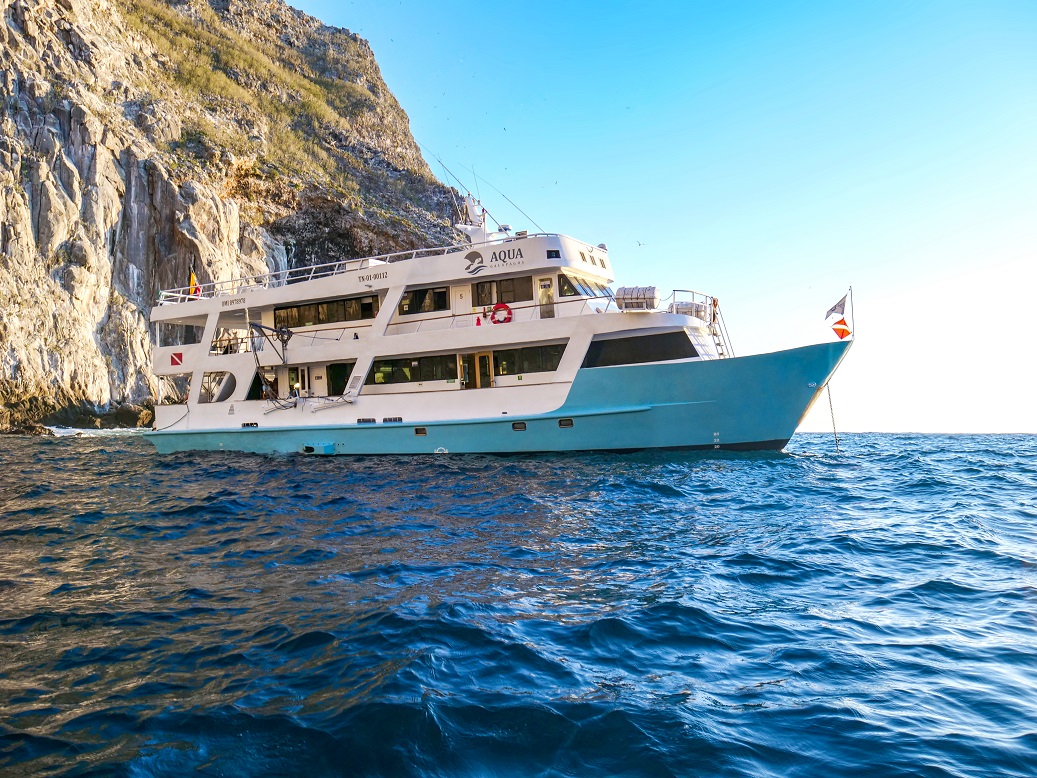

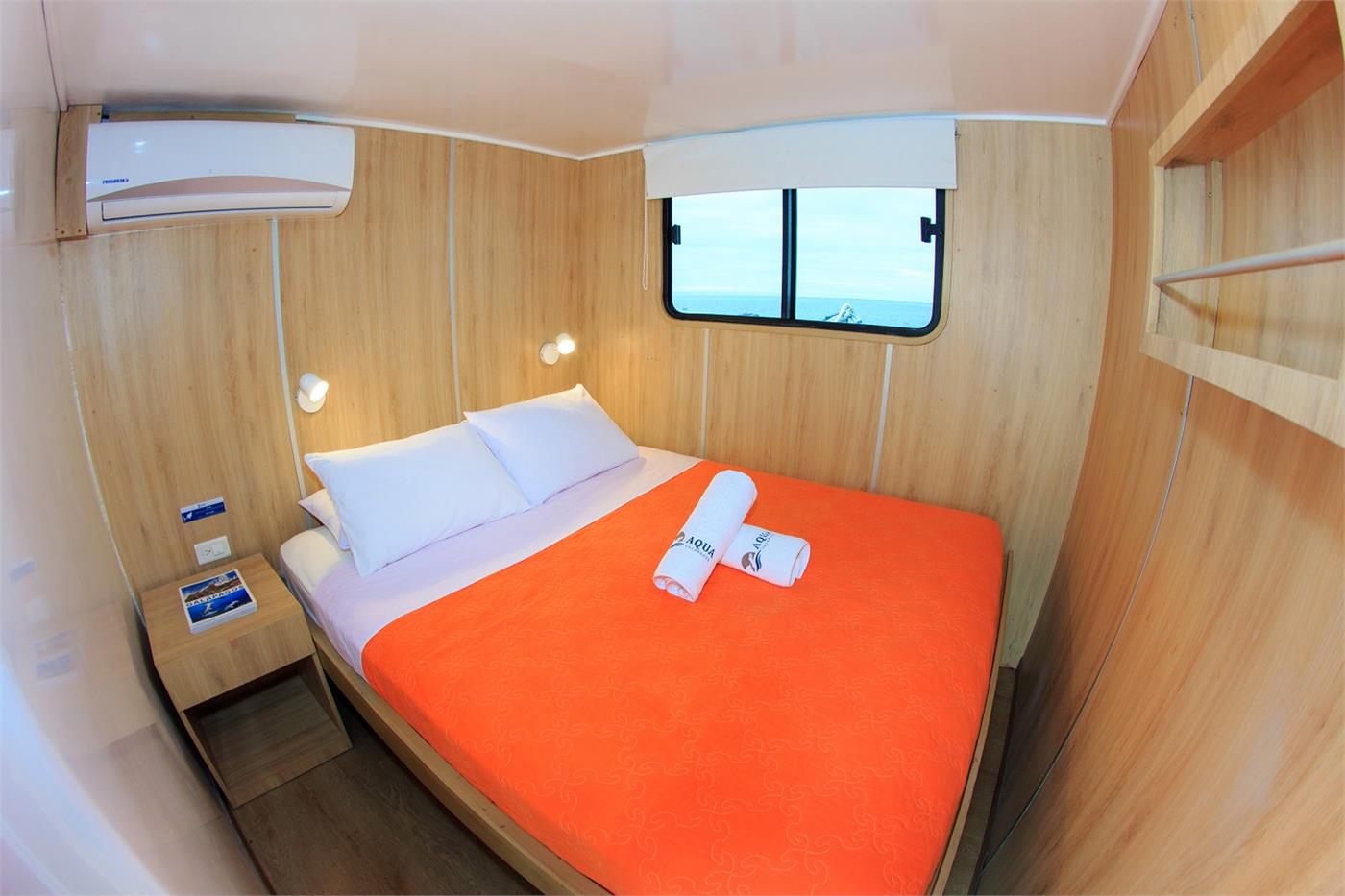 +9 photos