
 +9 photos
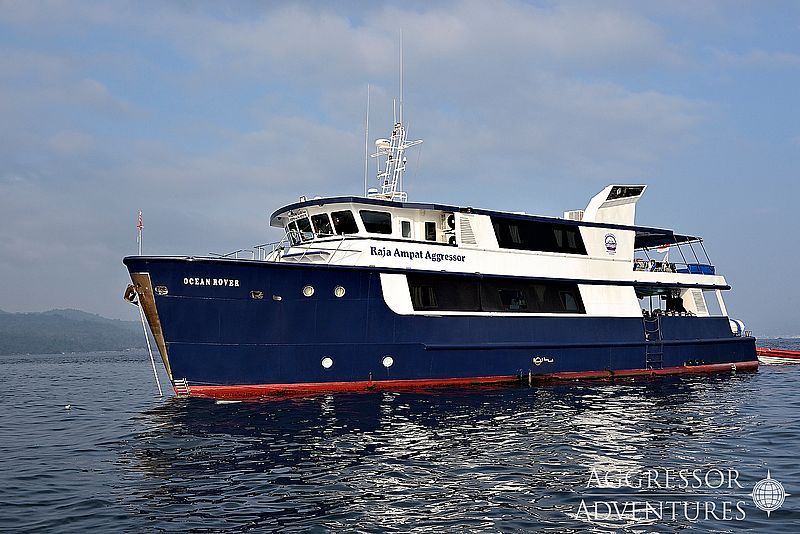
Raja Ampat Aggressor
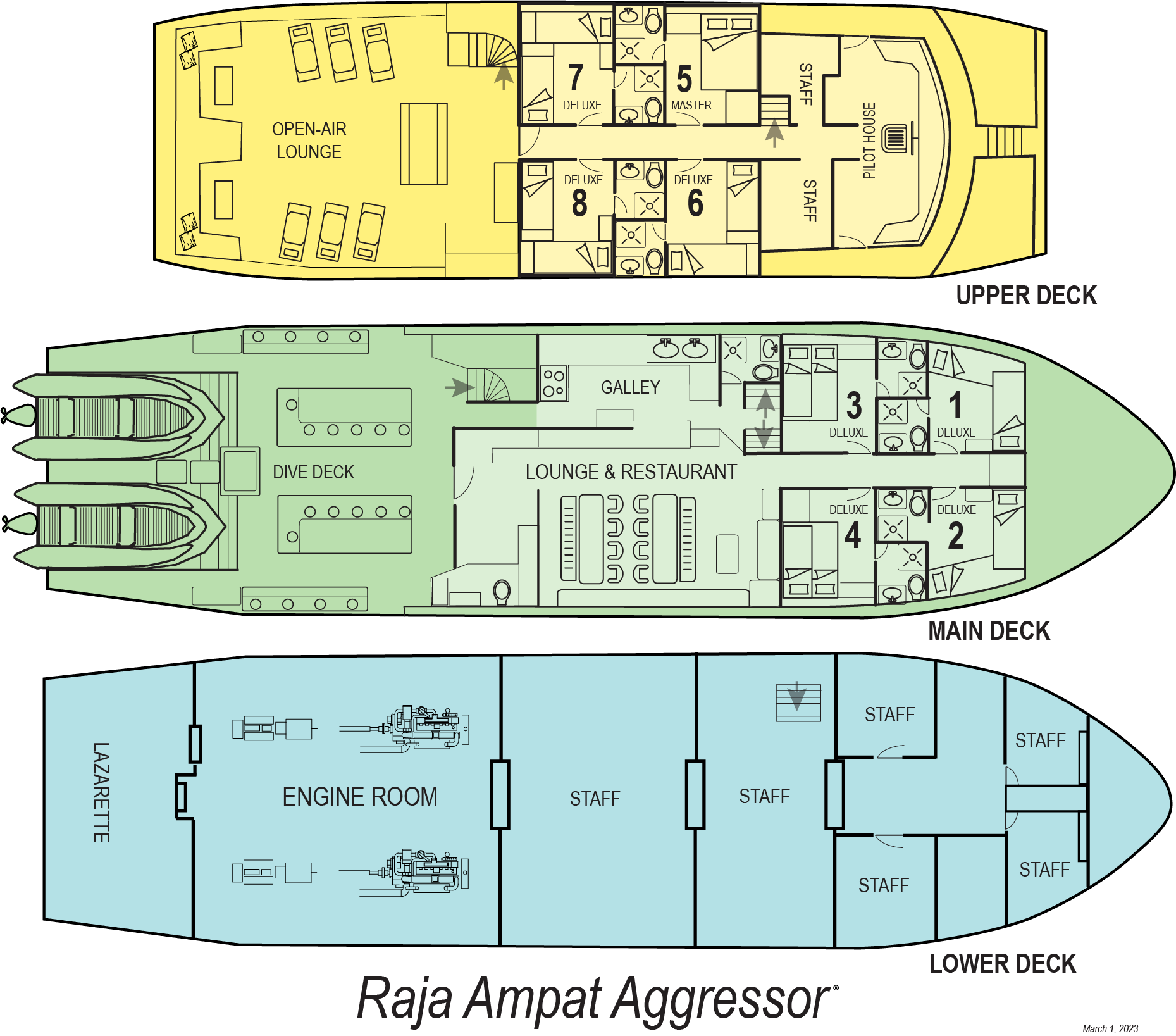
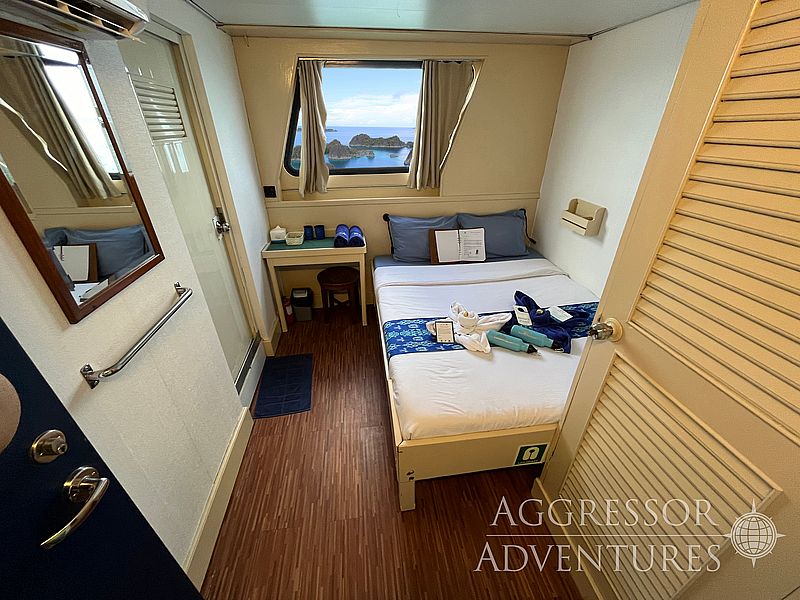
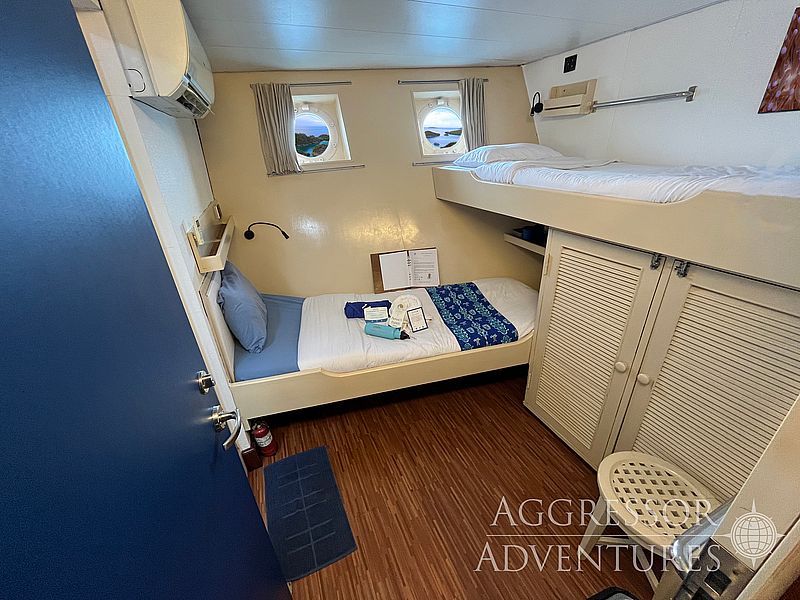
All staterooms have port holes or picture windows, climate controls, TV’s with movies and private bathrooms.
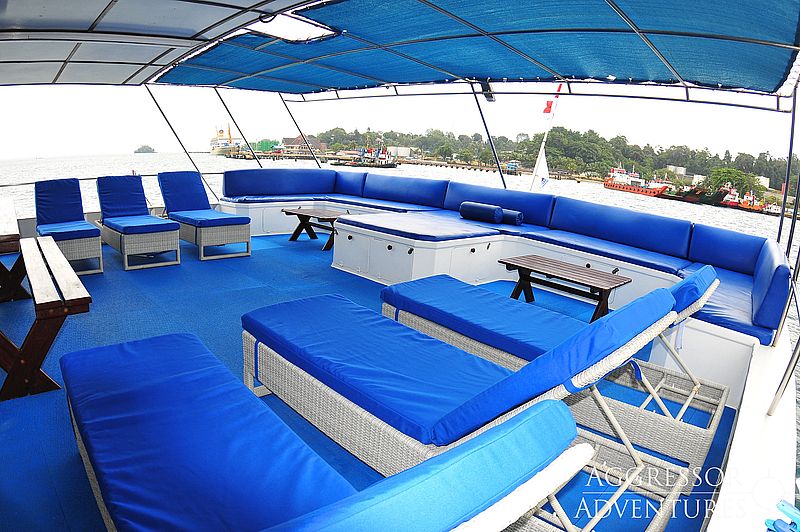
The Raja Ampat Aggressor sleeps 16 guests in privacy and comfort. She features a roomy, air-conditioned salon and dining area, and shaded sun deck complete with lounge and deck chairs. There is also a TV/Media player in the main salon. Diving amenities include Nitrox, camera table, and fresh water showers. There are no 110v outlets in the staterooms, only in the large station.
There is a variety of nightly entertainment, including diving, fish identification presentations, movies, games and more. If you have a favorite movie, digital presentation or a video to share, would encourage you to bring it along. The crew especially loves new releases of movies, recent magazines and books. A small library of books for exchange is maintained onboard as well as fish identification books for reference.
-
Raja Ampat10 nightsIndonesia: Raja Ampat & West Papua
The great highlights are the manta cleaning
station near Mansuar and the huge schools of fish near Farondi.The
Dampier straight separates the Birdhead Peninsula from Waigeo and
Mansuar. The name comes from the Dutch colonial times. It refers to the
shape of the peninsula on the map, but it is also a paradise for many
rare bird species.Here the Pacific Ocean meets the Halmahera Sea,
with an explosion of marine life as consequence. With regular strong
currents, big fish feel especially comfortable. Manta rays, reef sharks,
different schools of mackerel, tuna and barracuda, dolphin and whales.The
night dives under the Arborek or Cape Mansuar jetty is a favorite spot
with peculiar creatures such as wobbegongs, epaulette sharks (walking
sharks), nudibranchs, pipefish, seahorses, frogfish, scorpion fish and
the list goes on.Misool is the southeast of the four big islands
of the Raja Ampat archipelago. At the same time it is one of the most
biodiverse regions in the world. The rich variety of reefs are also not
to be overlooked with vertical walls, slopes, dry rocks, caves and
lagoons; some covered with hard corals while the others are covered with
brightly colored soft corals. Also renowned as the center of pygmy
seahorses and gorgonians, everywhere you go you will be amazed by the
profusion of marine life that Raja Ampat has to offer you. -
Lembeh/North Sulawesi/Derawan12 nightsIndonesia: Kalimantan (Derawan), North Sulawesi
The remote island of Halmahera is located between the Molucca Sea to the west and the Pacific Ocean to the east and has a unique geography with its four peninsulas enclosing three great bays and three volcanoes. Divers will find exciting dives with plenty of weird and wonderful creatures and pinnacles encircled by massive schools of barracuda and other pelagic fishes.
North Sulawesi: The first 4 – 5 days will be spent diving the northern tip of North Sulawesi then 2 – 3 days exploring new areas before crossing to the Derawan islands.
Lembeh Strait - A Muck Diving Mecca and the Twilight Zone are just a few of the names that have been given to Lembeh over the years due to it’s high density, and diversity, of rare and unusual marine life. Diving in Lembeh is unlike diving anywhere else as every dive reveals countless species of critters which have made their homes here on Lembeh’s famous muck diving slopes. Lembeh isn’t just home to frogfish, it’s home to 8 different species of frogfish, 12 species of octopus, numerous crustacean species that cannot be found anywhere else on earth, 3 species of pygmy seahorse, countless numbers of nudibranch species. Other critters frequently found here include the Hairy Frogfish, Pontohi Pygmy Seahorse, Wunderpus, Mandarin Fish, Mimic Octopus, Rhinopias Scorpionfish, Flamboyant Cuttlefish, Blue Ring Octopus.
Bangka Island area - With more than 30 world-class dive sites, Bangka's archipelago offers several different diving spots, from richly-colonized volcanic pinnacles, beautiful pristine coral reef slopes to sandy slopes, mangroves and walls.
Bunaken National Park - Often simply called Bunaken, the Bunaken Marine Park consists of five islands: Manado Tua, Siladen, Mantehage, Nain and Bunaken itself. The dive sites around the islands are slopes, walls or sloping walls. It features pristine hard corals, abundant reef fish, and larger pelagic species including reef sharks, eagle rays and tuna.
Derawan Islands are part of the Coral Triangle, which features 872 species of reef fish, 507 species of coral, and invertebrates, including protected species (5 giants clam species, 2 sea turtles, coconut crab, etc.).
Diving Highlights:
• Kakaban: Kakaban is known for the non-stinging jelly fish lake, located in the middle of the island and a brisk 15 minute walk. The non-stinging jellyfish have inhabited the lake for centuries as there are no known predators. The outer ring of Kakaban island offers divers a wide variety of dive sites that includes corals, large pelagic and thrilling caves.
The most famous area is Barracuda Point which has schooling barracuda which are visited by large tuna and sharks.
• Sangalaki: This area is famous for the large population of turtles and manta rays year round and guests will frequently see them feeding. The island has a turtle nursery run by the local government which can be visited. Whale sharks are frequently seen off the coast of the island.
• Maratua Atoll: The Raja Ampat Aggressors favorite dives are "The Channel" and "Big Fish Country" which has tornadoes of barracuda, grey reef sharks, thresher sharks, loads of turtles and schooling eagle rays schooling. Maratua Island has at least 13 caves with hundreds more that have yet to be explored.
• Pulau Panjang & Pulau Derawan: This is an area known for amazing macro life such as satomi pigmys, sea dragons, ghost pipefish, frogfish, blue ring octopus, harlequin shrimp and tiger shrimp. This is a macro haven with the weird and wonderful.
• Talisayan: A large population of whale sharks can be found here during the diving season. Similar to Cenderawasih Bay, the whale sharks can be found swimming under the fishing platforms of the local fishermen.
-
Derawan Islands7 nightsIndonesia: Kalimantan (Derawan)
Derawan Islands are part of the Coral Triangle, which features 872 species of reef fish, 507 species of coral, and invertebrates, including protected species (5 giants clam species, 2 sea turtles, coconut crab, etc.). The diving offers abundant marine life with a huge variety of coral reef
dives, caves, walls, and lagoons, including a jellyfish lake visit.
Guests will see sharks, schooling barracudas, mantas, whalesharks and
macro life. Derawan also contains the largest green turtle nesting site
in Indonesia, making dives with turtles quite common. -
Raja Ampat, Halmahera & Lembeh12 nightsIndonesia: Raja Ampat & West Papua, Halmahera, North Sulawesi
Arborek: Manta Sandy, West Mansuar, Arborek Jetty
My Reef Dampier: Mioskon, Sardines Reef, Blue Magic, Friwinbonda, Nudis Rock, The Passage. Batu Lima.Friwonda, Cape Kri, Chicken Reef, Cape, Batanta, North Batata, Algae Patch
Penemu: Melissa’s Garden, Keruo Channel
Mansuar Misool: Magic Mountain, Boo Windows, Nudi Rock, Barracuda Point, Tank Rock, Whale Rock, Three Sisters, Killer Cave, Farondi Wall
The Dampier straight separates the Birdhead Peninsula from Waigeo and Mansuar. The name comes from the Dutch colonial times. It refers to the shape of the peninsula on the map, but it is also a paradise for many rare bird species.
Here the Pacific Ocean meets the Halmahera Sea, with an explosion of marine life as consequence. With regular strong currents, big fish feel especially comfortable. Manta rays, reef sharks, different schools of mackerel, tuna and barracuda, dolphin and whales. The night dives under the Arborek or Cape Mansuar jetty is a favorite spot with peculiar creatures such as wobbegongs, epaulette sharks (walking sharks), nudibranchs, pipefish, seahorses, frogfish, scorpion fish and the list goes on.
Misool is the southeast of the four big islands of the Raja Ampat archipelago. At the same time it is one of the most biodiverse regions in the world. The rich variety of reefs are also not to be overlooked with vertical walls, slopes, dry rocks, caves and lagoons; some covered with hard corals while the others are covered with brightly colored soft corals. Also renowned as the center of pygmy seahorses and gorgonians, everywhere you go you will be amazed by the profusion of marine life that Raja Ampat has to offer you.
Halmahera: Divers will see pristine, untouched reefs with amazing biodiversity diving on these beautiful shallow reefs filled with colorful reef fish, exotic invertebrates and, in the deeper waters, current-cooled seamounts, walls, and pinnacles with sharks, flamboyant cuttlefish and tunas. There are over 800 species of fish found in these islands. The remote island of Halmahera is located between the Molucca Sea to the west and the Pacific Ocean to the east and has a unique geography with its four peninsulas enclosing three great bays and three volcanoes. Divers will find exciting dives with plenty of weird and wonderful creatures and pinnacles encircled by massive schools of barracuda, turtles, bumphead parrotfish, manta rays and other pelagic fishes.
Lembeh Island is located east of the mainland of North Sulawesi and is separated by a long, narrow stretch of water known as the Lembeh Strait. It is world famous for its abundance of rare and unusual marine life. Underwater photographers find this a true critter paradise with seahorses, pipefish, frogfish, stargazers, mandarinfish, the endemic Banggai cardinalfish and other weird and wonderful creatures.
Included in the price
- ✓ Accommodation in the selected cabin for the number of guests and nights indicated
- ✓ Full board on board: breakfast, lunch, snack and dinner
- ✓ Water, tea and instant coffee
- ✓ Soft drinks, local beer and wine
- ✓ Guided dives as per the programme
- ✓ Tanks, weight belt and weights
- ✓ Transfers to the closest airport (round trip)
- ✓ On-site assistance from the cruise operator
Not included
- • Flights
- • Visas and any entry documents required by the destination country
- • Spirit beverages
- • Diving equipment rental (full or partial)
- • Any currency or fuel surcharge
- • Tips and personal extras
- • Medical-Baggage and Trip Cancellation insurance (recommended, you can add it during check-out)
- • Mandatory diving insurance (DAN or similar, you can add it during check-out)
- • Anything not expressly listed under “Included in the price”
- Any mandatory costs payable on board or on site are detailed during checkout.
Departures
| Date | Itinerary | Duration | Availability | Price | |
|---|---|---|---|---|---|
| 5 Jan 2027→ 15 Jan 2027 | 10 nights | Available 10 places available | 5.236 € | ||
|
Raja Ampat · 10 nights · 5 Jan 2027 → 15 Jan 2027
⚓ Embarkation: Sorong ⚓ Disembarkation: Sorong
Dive areas & sites: Indonesia: Raja Ampat & West Papua
The great highlights are the manta cleaning The Here the Pacific Ocean meets the Halmahera Sea, The Misool is the southeast of the four big islands ℹ︎ Flexible programme subject to weather and sea conditions. |
|||||
| 16 Jan 2027→ 26 Jan 2027 | 10 nights | Available 16 places available | 5.236 € | ||
|
Raja Ampat · 10 nights · 16 Jan 2027 → 26 Jan 2027
⚓ Embarkation: Sorong ⚓ Disembarkation: Sorong
Dive areas & sites: Indonesia: Raja Ampat & West Papua
The great highlights are the manta cleaning The Here the Pacific Ocean meets the Halmahera Sea, The Misool is the southeast of the four big islands ℹ︎ Flexible programme subject to weather and sea conditions. |
|||||
| 28 Jan 2027→ 7 Feb 2027 | 10 nights | Available 10 places available | 5.236 € | ||
|
Raja Ampat · 10 nights · 28 Jan 2027 → 7 Feb 2027
⚓ Embarkation: Sorong ⚓ Disembarkation: Sorong
Dive areas & sites: Indonesia: Raja Ampat & West Papua
The great highlights are the manta cleaning The Here the Pacific Ocean meets the Halmahera Sea, The Misool is the southeast of the four big islands ℹ︎ Flexible programme subject to weather and sea conditions. |
|||||
| 19 Feb 2027→ 26 Feb 2027 | 7 nights | Available 6 places available | 3.920 € | ||
|
Raja Ampat · 7 nights · 19 Feb 2027 → 26 Feb 2027
⚓ Embarkation: Sorong ⚓ Disembarkation: Sorong
Dive areas & sites: Indonesia: Raja Ampat & West Papua
The great highlights are the manta cleaning The Here the Pacific Ocean meets the Halmahera Sea, The Misool is the southeast of the four big islands ℹ︎ Flexible programme subject to weather and sea conditions. |
|||||
| 27 Feb 2027→ 9 Mar 2027 | 10 nights | Available 10 places available | 5.236 € | ||
|
Raja Ampat · 10 nights · 27 Feb 2027 → 9 Mar 2027
⚓ Embarkation: Sorong ⚓ Disembarkation: Sorong
Dive areas & sites: Indonesia: Raja Ampat & West Papua
The great highlights are the manta cleaning The Here the Pacific Ocean meets the Halmahera Sea, The Misool is the southeast of the four big islands ℹ︎ Flexible programme subject to weather and sea conditions. |
|||||
| 10 Mar 2027→ 20 Mar 2027 | 10 nights | Available 16 places available | 5.236 € | ||
|
Raja Ampat · 10 nights · 10 Mar 2027 → 20 Mar 2027
⚓ Embarkation: Sorong ⚓ Disembarkation: Sorong
Dive areas & sites: Indonesia: Raja Ampat & West Papua
The great highlights are the manta cleaning The Here the Pacific Ocean meets the Halmahera Sea, The Misool is the southeast of the four big islands ℹ︎ Flexible programme subject to weather and sea conditions. |
|||||
| 2 May 2027→ 12 May 2027 | 10 nights | Available 16 places available | 5.236 € | ||
|
Raja Ampat · 10 nights · 2 May 2027 → 12 May 2027
⚓ Embarkation: Sorong ⚓ Disembarkation: Sorong
Dive areas & sites: Indonesia: Raja Ampat & West Papua
The great highlights are the manta cleaning The Here the Pacific Ocean meets the Halmahera Sea, The Misool is the southeast of the four big islands ℹ︎ Flexible programme subject to weather and sea conditions. |
|||||
| 13 May 2027→ 23 May 2027 | 10 nights | Available 10 places available | 5.236 € 3.926 € | ||
|
Raja Ampat · 10 nights · 13 May 2027 → 23 May 2027
⚓ Embarkation: Sorong ⚓ Disembarkation: Sorong
Dive areas & sites: Indonesia: Raja Ampat & West Papua
The great highlights are the manta cleaning The Here the Pacific Ocean meets the Halmahera Sea, The Misool is the southeast of the four big islands ℹ︎ Flexible programme subject to weather and sea conditions. |
|||||
| 24 May 2027→ 3 Jun 2027 | 10 nights | Available 16 places available | 5.236 € | ||
|
Raja Ampat · 10 nights · 24 May 2027 → 3 Jun 2027
⚓ Embarkation: Sorong ⚓ Disembarkation: Sorong
Dive areas & sites: Indonesia: Raja Ampat & West Papua
The great highlights are the manta cleaning The Here the Pacific Ocean meets the Halmahera Sea, The Misool is the southeast of the four big islands ℹ︎ Flexible programme subject to weather and sea conditions. |
|||||
| 4 Jun 2027→ 11 Jun 2027 | 7 nights | Available 16 places available | 3.665 € | ||
|
Raja Ampat · 7 nights · 4 Jun 2027 → 11 Jun 2027
⚓ Embarkation: Sorong ⚓ Disembarkation: Sorong
Dive areas & sites: Indonesia: Raja Ampat & West Papua
The great highlights are the manta cleaning The Here the Pacific Ocean meets the Halmahera Sea, The Misool is the southeast of the four big islands ℹ︎ Flexible programme subject to weather and sea conditions. |
|||||
| 27 Jun 2027→ 9 Jul 2027 | 12 nights | Available 10 places available | 6.284 € | ||
|
Lembeh/North Sulawesi/Derawan · 12 nights · 27 Jun 2027 → 9 Jul 2027
⚓ Embarkation: Bitung ⚓ Disembarkation: Berau
Dive areas & sites: Indonesia: Kalimantan (Derawan), North Sulawesi
The remote island of Halmahera is located between the Molucca Sea to the west and the Pacific Ocean to the east and has a unique geography with its four peninsulas enclosing three great bays and three volcanoes. Divers will find exciting dives with plenty of weird and wonderful creatures and pinnacles encircled by massive schools of barracuda and other pelagic fishes. North Sulawesi: The first 4 – 5 days will be spent diving the northern tip of North Sulawesi then 2 – 3 days exploring new areas before crossing to the Derawan islands. Lembeh Strait - A Muck Diving Mecca and the Twilight Zone are just a few of the names that have been given to Lembeh over the years due to it’s high density, and diversity, of rare and unusual marine life. Diving in Lembeh is unlike diving anywhere else as every dive reveals countless species of critters which have made their homes here on Lembeh’s famous muck diving slopes. Lembeh isn’t just home to frogfish, it’s home to 8 different species of frogfish, 12 species of octopus, numerous crustacean species that cannot be found anywhere else on earth, 3 species of pygmy seahorse, countless numbers of nudibranch species. Other critters frequently found here include the Hairy Frogfish, Pontohi Pygmy Seahorse, Wunderpus, Mandarin Fish, Mimic Octopus, Rhinopias Scorpionfish, Flamboyant Cuttlefish, Blue Ring Octopus. Bangka Island area - With more than 30 world-class dive sites, Bangka's archipelago offers several different diving spots, from richly-colonized volcanic pinnacles, beautiful pristine coral reef slopes to sandy slopes, mangroves and walls. Bunaken National Park - Often simply called Bunaken, the Bunaken Marine Park consists of five islands: Manado Tua, Siladen, Mantehage, Nain and Bunaken itself. The dive sites around the islands are slopes, walls or sloping walls. It features pristine hard corals, abundant reef fish, and larger pelagic species including reef sharks, eagle rays and tuna. Derawan Islands are part of the Coral Triangle, which features 872 species of reef fish, 507 species of coral, and invertebrates, including protected species (5 giants clam species, 2 sea turtles, coconut crab, etc.). Diving Highlights: • Kakaban: Kakaban is known for the non-stinging jelly fish lake, located in the middle of the island and a brisk 15 minute walk. The non-stinging jellyfish have inhabited the lake for centuries as there are no known predators. The outer ring of Kakaban island offers divers a wide variety of dive sites that includes corals, large pelagic and thrilling caves. The most famous area is Barracuda Point which has schooling barracuda which are visited by large tuna and sharks. • Sangalaki: This area is famous for the large population of turtles and manta rays year round and guests will frequently see them feeding. The island has a turtle nursery run by the local government which can be visited. Whale sharks are frequently seen off the coast of the island. • Maratua Atoll: The Raja Ampat Aggressors favorite dives are "The Channel" and "Big Fish Country" which has tornadoes of barracuda, grey reef sharks, thresher sharks, loads of turtles and schooling eagle rays schooling. Maratua Island has at least 13 caves with hundreds more that have yet to be explored. • Pulau Panjang & Pulau Derawan: This is an area known for amazing macro life such as satomi pigmys, sea dragons, ghost pipefish, frogfish, blue ring octopus, harlequin shrimp and tiger shrimp. This is a macro haven with the weird and wonderful. • Talisayan: A large population of whale sharks can be found here during the diving season. Similar to Cenderawasih Bay, the whale sharks can be found swimming under the fishing platforms of the local fishermen. ℹ︎ Flexible programme subject to weather and sea conditions. |
|||||
| 10 Jul 2027→ 17 Jul 2027 | 7 nights | Available 16 places available | 3.410 € | ||
|
Derawan Islands · 7 nights · 10 Jul 2027 → 17 Jul 2027
⚓ Embarkation: Berau ⚓ Disembarkation: Berau
Dive areas & sites: Indonesia: Kalimantan (Derawan)
Derawan Islands are part of the Coral Triangle, which features 872 species of reef fish, 507 species of coral, and invertebrates, including protected species (5 giants clam species, 2 sea turtles, coconut crab, etc.). The diving offers abundant marine life with a huge variety of coral reef ℹ︎ Flexible programme subject to weather and sea conditions. |
|||||
| 26 Jul 2027→ 2 Aug 2027 | 7 nights | Available 16 places available | 3.410 € | ||
|
Derawan Islands · 7 nights · 26 Jul 2027 → 2 Aug 2027
⚓ Embarkation: Berau ⚓ Disembarkation: Berau
Dive areas & sites: Indonesia: Kalimantan (Derawan)
Derawan Islands are part of the Coral Triangle, which features 872 species of reef fish, 507 species of coral, and invertebrates, including protected species (5 giants clam species, 2 sea turtles, coconut crab, etc.). The diving offers abundant marine life with a huge variety of coral reef ℹ︎ Flexible programme subject to weather and sea conditions. |
|||||
| 11 Aug 2027→ 23 Aug 2027 | 12 nights | Available 16 places available | 6.284 € 4.713 € | ||
|
Lembeh/North Sulawesi/Derawan · 12 nights · 11 Aug 2027 → 23 Aug 2027
⚓ Embarkation: Tanjung Batu ⚓ Disembarkation: Bitung
Dive areas & sites: Indonesia: Kalimantan (Derawan), North Sulawesi
The remote island of Halmahera is located between the Molucca Sea to the west and the Pacific Ocean to the east and has a unique geography with its four peninsulas enclosing three great bays and three volcanoes. Divers will find exciting dives with plenty of weird and wonderful creatures and pinnacles encircled by massive schools of barracuda and other pelagic fishes. North Sulawesi: The first 4 – 5 days will be spent diving the northern tip of North Sulawesi then 2 – 3 days exploring new areas before crossing to the Derawan islands. Lembeh Strait - A Muck Diving Mecca and the Twilight Zone are just a few of the names that have been given to Lembeh over the years due to it’s high density, and diversity, of rare and unusual marine life. Diving in Lembeh is unlike diving anywhere else as every dive reveals countless species of critters which have made their homes here on Lembeh’s famous muck diving slopes. Lembeh isn’t just home to frogfish, it’s home to 8 different species of frogfish, 12 species of octopus, numerous crustacean species that cannot be found anywhere else on earth, 3 species of pygmy seahorse, countless numbers of nudibranch species. Other critters frequently found here include the Hairy Frogfish, Pontohi Pygmy Seahorse, Wunderpus, Mandarin Fish, Mimic Octopus, Rhinopias Scorpionfish, Flamboyant Cuttlefish, Blue Ring Octopus. Bangka Island area - With more than 30 world-class dive sites, Bangka's archipelago offers several different diving spots, from richly-colonized volcanic pinnacles, beautiful pristine coral reef slopes to sandy slopes, mangroves and walls. Bunaken National Park - Often simply called Bunaken, the Bunaken Marine Park consists of five islands: Manado Tua, Siladen, Mantehage, Nain and Bunaken itself. The dive sites around the islands are slopes, walls or sloping walls. It features pristine hard corals, abundant reef fish, and larger pelagic species including reef sharks, eagle rays and tuna. Derawan Islands are part of the Coral Triangle, which features 872 species of reef fish, 507 species of coral, and invertebrates, including protected species (5 giants clam species, 2 sea turtles, coconut crab, etc.). Diving Highlights: • Kakaban: Kakaban is known for the non-stinging jelly fish lake, located in the middle of the island and a brisk 15 minute walk. The non-stinging jellyfish have inhabited the lake for centuries as there are no known predators. The outer ring of Kakaban island offers divers a wide variety of dive sites that includes corals, large pelagic and thrilling caves. The most famous area is Barracuda Point which has schooling barracuda which are visited by large tuna and sharks. • Sangalaki: This area is famous for the large population of turtles and manta rays year round and guests will frequently see them feeding. The island has a turtle nursery run by the local government which can be visited. Whale sharks are frequently seen off the coast of the island. • Maratua Atoll: The Raja Ampat Aggressors favorite dives are "The Channel" and "Big Fish Country" which has tornadoes of barracuda, grey reef sharks, thresher sharks, loads of turtles and schooling eagle rays schooling. Maratua Island has at least 13 caves with hundreds more that have yet to be explored. • Pulau Panjang & Pulau Derawan: This is an area known for amazing macro life such as satomi pigmys, sea dragons, ghost pipefish, frogfish, blue ring octopus, harlequin shrimp and tiger shrimp. This is a macro haven with the weird and wonderful. • Talisayan: A large population of whale sharks can be found here during the diving season. Similar to Cenderawasih Bay, the whale sharks can be found swimming under the fishing platforms of the local fishermen. ℹ︎ Flexible programme subject to weather and sea conditions. |
|||||
| 17 Oct 2027→ 29 Oct 2027 | 12 nights | Available 16 places available | 6.284 € | ||
|
Raja Ampat, Halmahera & Lembeh · 12 nights · 17 Oct 2027 → 29 Oct 2027
⚓ Embarkation: Bitung ⚓ Disembarkation: Sorong
Dive areas & sites: Indonesia: Raja Ampat & West Papua, Halmahera, North Sulawesi
Arborek: Manta Sandy, West Mansuar, Arborek Jetty My Reef Dampier: Mioskon, Sardines Reef, Blue Magic, Friwinbonda, Nudis Rock, The Passage. Batu Lima.Friwonda, Cape Kri, Chicken Reef, Cape, Batanta, North Batata, Algae Patch Penemu: Melissa’s Garden, Keruo Channel Mansuar Misool: Magic Mountain, Boo Windows, Nudi Rock, Barracuda Point, Tank Rock, Whale Rock, Three Sisters, Killer Cave, Farondi Wall The Dampier straight separates the Birdhead Peninsula from Waigeo and Mansuar. The name comes from the Dutch colonial times. It refers to the shape of the peninsula on the map, but it is also a paradise for many rare bird species. Here the Pacific Ocean meets the Halmahera Sea, with an explosion of marine life as consequence. With regular strong currents, big fish feel especially comfortable. Manta rays, reef sharks, different schools of mackerel, tuna and barracuda, dolphin and whales. The night dives under the Arborek or Cape Mansuar jetty is a favorite spot with peculiar creatures such as wobbegongs, epaulette sharks (walking sharks), nudibranchs, pipefish, seahorses, frogfish, scorpion fish and the list goes on. Misool is the southeast of the four big islands of the Raja Ampat archipelago. At the same time it is one of the most biodiverse regions in the world. The rich variety of reefs are also not to be overlooked with vertical walls, slopes, dry rocks, caves and lagoons; some covered with hard corals while the others are covered with brightly colored soft corals. Also renowned as the center of pygmy seahorses and gorgonians, everywhere you go you will be amazed by the profusion of marine life that Raja Ampat has to offer you. Halmahera: Divers will see pristine, untouched reefs with amazing biodiversity diving on these beautiful shallow reefs filled with colorful reef fish, exotic invertebrates and, in the deeper waters, current-cooled seamounts, walls, and pinnacles with sharks, flamboyant cuttlefish and tunas. There are over 800 species of fish found in these islands. The remote island of Halmahera is located between the Molucca Sea to the west and the Pacific Ocean to the east and has a unique geography with its four peninsulas enclosing three great bays and three volcanoes. Divers will find exciting dives with plenty of weird and wonderful creatures and pinnacles encircled by massive schools of barracuda, turtles, bumphead parrotfish, manta rays and other pelagic fishes. Lembeh Island is located east of the mainland of North Sulawesi and is separated by a long, narrow stretch of water known as the Lembeh Strait. It is world famous for its abundance of rare and unusual marine life. Underwater photographers find this a true critter paradise with seahorses, pipefish, frogfish, stargazers, mandarinfish, the endemic Banggai cardinalfish and other weird and wonderful creatures. ℹ︎ Flexible programme subject to weather and sea conditions. |
|||||
| 30 Oct 2027→ 9 Nov 2027 | 10 nights | Available 6 places available | 5.600 € | ||
|
Raja Ampat · 10 nights · 30 Oct 2027 → 9 Nov 2027
⚓ Embarkation: Sorong ⚓ Disembarkation: Sorong
Dive areas & sites: Indonesia: Raja Ampat & West Papua
The great highlights are the manta cleaning The Here the Pacific Ocean meets the Halmahera Sea, The Misool is the southeast of the four big islands ℹ︎ Flexible programme subject to weather and sea conditions. |
|||||
| 30 Nov 2027→ 10 Dec 2027 | 10 nights | Available 10 places available | 5.236 € | ||
|
Raja Ampat · 10 nights · 30 Nov 2027 → 10 Dec 2027
⚓ Embarkation: Sorong ⚓ Disembarkation: Sorong
Dive areas & sites: Indonesia: Raja Ampat & West Papua
The great highlights are the manta cleaning The Here the Pacific Ocean meets the Halmahera Sea, The Misool is the southeast of the four big islands ℹ︎ Flexible programme subject to weather and sea conditions. |
|||||
| 11 Dec 2027→ 21 Dec 2027 | 10 nights | Available 16 places available | 5.236 € | ||
|
Raja Ampat · 10 nights · 11 Dec 2027 → 21 Dec 2027
⚓ Embarkation: Sorong ⚓ Disembarkation: Sorong
Dive areas & sites: Indonesia: Raja Ampat & West Papua
The great highlights are the manta cleaning The Here the Pacific Ocean meets the Halmahera Sea, The Misool is the southeast of the four big islands ℹ︎ Flexible programme subject to weather and sea conditions. |
|||||
| 22 Dec 2027→ 1 Jan 2028 | 10 nights | Available 16 places available | 5.236 € | ||
|
Raja Ampat · 10 nights · 22 Dec 2027 → 1 Jan 2028
⚓ Embarkation: Sorong ⚓ Disembarkation: Sorong
Dive areas & sites: Indonesia: Raja Ampat & West Papua
The great highlights are the manta cleaning The Here the Pacific Ocean meets the Halmahera Sea, The Misool is the southeast of the four big islands ℹ︎ Flexible programme subject to weather and sea conditions. |
|||||
| 2 Jan 2028→ 12 Jan 2028 | 10 nights | Available 16 places available | 5.236 € | ||
|
Raja Ampat · 10 nights · 2 Jan 2028 → 12 Jan 2028
⚓ Embarkation: Sorong ⚓ Disembarkation: Sorong
Dive areas & sites: Indonesia: Raja Ampat & West Papua
The great highlights are the manta cleaning The Here the Pacific Ocean meets the Halmahera Sea, The Misool is the southeast of the four big islands ℹ︎ Flexible programme subject to weather and sea conditions. |
|||||
| 13 Jan 2028→ 23 Jan 2028 | 10 nights | Available 16 places available | 5.236 € | ||
|
Raja Ampat · 10 nights · 13 Jan 2028 → 23 Jan 2028
⚓ Embarkation: Sorong ⚓ Disembarkation: Sorong
Dive areas & sites: Indonesia: Raja Ampat & West Papua
The great highlights are the manta cleaning The Here the Pacific Ocean meets the Halmahera Sea, The Misool is the southeast of the four big islands ℹ︎ Flexible programme subject to weather and sea conditions. |
|||||
| 25 Jan 2028→ 4 Feb 2028 | 10 nights | Available 16 places available | 5.236 € | ||
|
Raja Ampat · 10 nights · 25 Jan 2028 → 4 Feb 2028
⚓ Embarkation: Sorong ⚓ Disembarkation: Sorong
Dive areas & sites: Indonesia: Raja Ampat & West Papua
The great highlights are the manta cleaning The Here the Pacific Ocean meets the Halmahera Sea, The Misool is the southeast of the four big islands ℹ︎ Flexible programme subject to weather and sea conditions. |
|||||
| 5 Feb 2028→ 15 Feb 2028 | 10 nights | Available 10 places available | 5.236 € | ||
|
Raja Ampat · 10 nights · 5 Feb 2028 → 15 Feb 2028
⚓ Embarkation: Sorong ⚓ Disembarkation: Sorong
Dive areas & sites: Indonesia: Raja Ampat & West Papua
The great highlights are the manta cleaning The Here the Pacific Ocean meets the Halmahera Sea, The Misool is the southeast of the four big islands ℹ︎ Flexible programme subject to weather and sea conditions. |
|||||
| 16 Feb 2028→ 23 Feb 2028 | 7 nights | Available 16 places available | 3.665 € | ||
|
Raja Ampat · 7 nights · 16 Feb 2028 → 23 Feb 2028
⚓ Embarkation: Sorong ⚓ Disembarkation: Sorong
Dive areas & sites: Indonesia: Raja Ampat & West Papua
The great highlights are the manta cleaning The Here the Pacific Ocean meets the Halmahera Sea, The Misool is the southeast of the four big islands ℹ︎ Flexible programme subject to weather and sea conditions. |
|||||
| 7 Mar 2028→ 17 Mar 2028 | 10 nights | Available 16 places available | 5.236 € | ||
|
Raja Ampat · 10 nights · 7 Mar 2028 → 17 Mar 2028
⚓ Embarkation: Sorong ⚓ Disembarkation: Sorong
Dive areas & sites: Indonesia: Raja Ampat & West Papua
The great highlights are the manta cleaning The Here the Pacific Ocean meets the Halmahera Sea, The Misool is the southeast of the four big islands ℹ︎ Flexible programme subject to weather and sea conditions. |
|||||
| 18 Apr 2028→ 28 Apr 2028 | 10 nights | Available 16 places available | 5.236 € | ||
|
Raja Ampat · 10 nights · 18 Apr 2028 → 28 Apr 2028
⚓ Embarkation: Sorong ⚓ Disembarkation: Sorong
Dive areas & sites: Indonesia: Raja Ampat & West Papua
The great highlights are the manta cleaning The Here the Pacific Ocean meets the Halmahera Sea, The Misool is the southeast of the four big islands ℹ︎ Flexible programme subject to weather and sea conditions. |
|||||
| 29 Apr 2028→ 9 May 2028 | 10 nights | Available 16 places available | 5.236 € | ||
|
Raja Ampat · 10 nights · 29 Apr 2028 → 9 May 2028
⚓ Embarkation: Sorong ⚓ Disembarkation: Sorong
Dive areas & sites: Indonesia: Raja Ampat & West Papua
The great highlights are the manta cleaning The Here the Pacific Ocean meets the Halmahera Sea, The Misool is the southeast of the four big islands ℹ︎ Flexible programme subject to weather and sea conditions. |
|||||
| 10 May 2028→ 20 May 2028 | 10 nights | Available 16 places available | 5.236 € | ||
|
Raja Ampat · 10 nights · 10 May 2028 → 20 May 2028
⚓ Embarkation: Sorong ⚓ Disembarkation: Sorong
Dive areas & sites: Indonesia: Raja Ampat & West Papua
The great highlights are the manta cleaning The Here the Pacific Ocean meets the Halmahera Sea, The Misool is the southeast of the four big islands ℹ︎ Flexible programme subject to weather and sea conditions. |
|||||
| 21 May 2028→ 31 May 2028 | 10 nights | Available 16 places available | 5.236 € | ||
|
Raja Ampat · 10 nights · 21 May 2028 → 31 May 2028
⚓ Embarkation: Sorong ⚓ Disembarkation: Sorong
Dive areas & sites: Indonesia: Raja Ampat & West Papua
The great highlights are the manta cleaning The Here the Pacific Ocean meets the Halmahera Sea, The Misool is the southeast of the four big islands ℹ︎ Flexible programme subject to weather and sea conditions. |
|||||
| 1 Jun 2028→ 11 Jun 2028 | 10 nights | Available 16 places available | 5.236 € | ||
|
Raja Ampat · 10 nights · 1 Jun 2028 → 11 Jun 2028
⚓ Embarkation: Sorong ⚓ Disembarkation: Sorong
Dive areas & sites: Indonesia: Raja Ampat & West Papua
The great highlights are the manta cleaning The Here the Pacific Ocean meets the Halmahera Sea, The Misool is the southeast of the four big islands ℹ︎ Flexible programme subject to weather and sea conditions. |
|||||
| 12 Jun 2028→ 24 Jun 2028 | 12 nights | Available 16 places available | 6.284 € | ||
|
Raja Ampat, Halmahera & Lembeh · 12 nights · 12 Jun 2028 → 24 Jun 2028
⚓ Embarkation: Sorong ⚓ Disembarkation: Bitung
Dive areas & sites: Indonesia: Raja Ampat & West Papua, Halmahera, North Sulawesi
Arborek: Manta Sandy, West Mansuar, Arborek Jetty My Reef Dampier: Mioskon, Sardines Reef, Blue Magic, Friwinbonda, Nudis Rock, The Passage. Batu Lima.Friwonda, Cape Kri, Chicken Reef, Cape, Batanta, North Batata, Algae Patch Penemu: Melissa’s Garden, Keruo Channel Mansuar Misool: Magic Mountain, Boo Windows, Nudi Rock, Barracuda Point, Tank Rock, Whale Rock, Three Sisters, Killer Cave, Farondi Wall The Dampier straight separates the Birdhead Peninsula from Waigeo and Mansuar. The name comes from the Dutch colonial times. It refers to the shape of the peninsula on the map, but it is also a paradise for many rare bird species. Here the Pacific Ocean meets the Halmahera Sea, with an explosion of marine life as consequence. With regular strong currents, big fish feel especially comfortable. Manta rays, reef sharks, different schools of mackerel, tuna and barracuda, dolphin and whales. The night dives under the Arborek or Cape Mansuar jetty is a favorite spot with peculiar creatures such as wobbegongs, epaulette sharks (walking sharks), nudibranchs, pipefish, seahorses, frogfish, scorpion fish and the list goes on. Misool is the southeast of the four big islands of the Raja Ampat archipelago. At the same time it is one of the most biodiverse regions in the world. The rich variety of reefs are also not to be overlooked with vertical walls, slopes, dry rocks, caves and lagoons; some covered with hard corals while the others are covered with brightly colored soft corals. Also renowned as the center of pygmy seahorses and gorgonians, everywhere you go you will be amazed by the profusion of marine life that Raja Ampat has to offer you. Halmahera: Divers will see pristine, untouched reefs with amazing biodiversity diving on these beautiful shallow reefs filled with colorful reef fish, exotic invertebrates and, in the deeper waters, current-cooled seamounts, walls, and pinnacles with sharks, flamboyant cuttlefish and tunas. There are over 800 species of fish found in these islands. The remote island of Halmahera is located between the Molucca Sea to the west and the Pacific Ocean to the east and has a unique geography with its four peninsulas enclosing three great bays and three volcanoes. Divers will find exciting dives with plenty of weird and wonderful creatures and pinnacles encircled by massive schools of barracuda, turtles, bumphead parrotfish, manta rays and other pelagic fishes. Lembeh Island is located east of the mainland of North Sulawesi and is separated by a long, narrow stretch of water known as the Lembeh Strait. It is world famous for its abundance of rare and unusual marine life. Underwater photographers find this a true critter paradise with seahorses, pipefish, frogfish, stargazers, mandarinfish, the endemic Banggai cardinalfish and other weird and wonderful creatures. ℹ︎ Flexible programme subject to weather and sea conditions. |
|||||
| 26 Jun 2028→ 8 Jul 2028 | 12 nights | Available 16 places available | 6.284 € | ||
|
Lembeh/North Sulawesi/Derawan · 12 nights · 26 Jun 2028 → 8 Jul 2028
⚓ Embarkation: Bitung ⚓ Disembarkation: Berau
Dive areas & sites: Indonesia: Kalimantan (Derawan), North Sulawesi
The remote island of Halmahera is located between the Molucca Sea to the west and the Pacific Ocean to the east and has a unique geography with its four peninsulas enclosing three great bays and three volcanoes. Divers will find exciting dives with plenty of weird and wonderful creatures and pinnacles encircled by massive schools of barracuda and other pelagic fishes. North Sulawesi: The first 4 – 5 days will be spent diving the northern tip of North Sulawesi then 2 – 3 days exploring new areas before crossing to the Derawan islands. Lembeh Strait - A Muck Diving Mecca and the Twilight Zone are just a few of the names that have been given to Lembeh over the years due to it’s high density, and diversity, of rare and unusual marine life. Diving in Lembeh is unlike diving anywhere else as every dive reveals countless species of critters which have made their homes here on Lembeh’s famous muck diving slopes. Lembeh isn’t just home to frogfish, it’s home to 8 different species of frogfish, 12 species of octopus, numerous crustacean species that cannot be found anywhere else on earth, 3 species of pygmy seahorse, countless numbers of nudibranch species. Other critters frequently found here include the Hairy Frogfish, Pontohi Pygmy Seahorse, Wunderpus, Mandarin Fish, Mimic Octopus, Rhinopias Scorpionfish, Flamboyant Cuttlefish, Blue Ring Octopus. Bangka Island area - With more than 30 world-class dive sites, Bangka's archipelago offers several different diving spots, from richly-colonized volcanic pinnacles, beautiful pristine coral reef slopes to sandy slopes, mangroves and walls. Bunaken National Park - Often simply called Bunaken, the Bunaken Marine Park consists of five islands: Manado Tua, Siladen, Mantehage, Nain and Bunaken itself. The dive sites around the islands are slopes, walls or sloping walls. It features pristine hard corals, abundant reef fish, and larger pelagic species including reef sharks, eagle rays and tuna. Derawan Islands are part of the Coral Triangle, which features 872 species of reef fish, 507 species of coral, and invertebrates, including protected species (5 giants clam species, 2 sea turtles, coconut crab, etc.). Diving Highlights: • Kakaban: Kakaban is known for the non-stinging jelly fish lake, located in the middle of the island and a brisk 15 minute walk. The non-stinging jellyfish have inhabited the lake for centuries as there are no known predators. The outer ring of Kakaban island offers divers a wide variety of dive sites that includes corals, large pelagic and thrilling caves. The most famous area is Barracuda Point which has schooling barracuda which are visited by large tuna and sharks. • Sangalaki: This area is famous for the large population of turtles and manta rays year round and guests will frequently see them feeding. The island has a turtle nursery run by the local government which can be visited. Whale sharks are frequently seen off the coast of the island. • Maratua Atoll: The Raja Ampat Aggressors favorite dives are "The Channel" and "Big Fish Country" which has tornadoes of barracuda, grey reef sharks, thresher sharks, loads of turtles and schooling eagle rays schooling. Maratua Island has at least 13 caves with hundreds more that have yet to be explored. • Pulau Panjang & Pulau Derawan: This is an area known for amazing macro life such as satomi pigmys, sea dragons, ghost pipefish, frogfish, blue ring octopus, harlequin shrimp and tiger shrimp. This is a macro haven with the weird and wonderful. • Talisayan: A large population of whale sharks can be found here during the diving season. Similar to Cenderawasih Bay, the whale sharks can be found swimming under the fishing platforms of the local fishermen. ℹ︎ Flexible programme subject to weather and sea conditions. |
|||||
| 9 Jul 2028→ 16 Jul 2028 | 7 nights | Available 16 places available | 3.410 € 2.557 € | ||
|
Derawan Islands · 7 nights · 9 Jul 2028 → 16 Jul 2028
⚓ Embarkation: Berau ⚓ Disembarkation: Berau
Dive areas & sites: Indonesia: Kalimantan (Derawan)
Derawan Islands are part of the Coral Triangle, which features 872 species of reef fish, 507 species of coral, and invertebrates, including protected species (5 giants clam species, 2 sea turtles, coconut crab, etc.). The diving offers abundant marine life with a huge variety of coral reef ℹ︎ Flexible programme subject to weather and sea conditions. |
|||||
| 17 Jul 2028→ 24 Jul 2028 | 7 nights | Available 16 places available | 3.410 € | ||
|
Derawan Islands · 7 nights · 17 Jul 2028 → 24 Jul 2028
⚓ Embarkation: Berau ⚓ Disembarkation: Berau
Dive areas & sites: Indonesia: Kalimantan (Derawan)
Derawan Islands are part of the Coral Triangle, which features 872 species of reef fish, 507 species of coral, and invertebrates, including protected species (5 giants clam species, 2 sea turtles, coconut crab, etc.). The diving offers abundant marine life with a huge variety of coral reef ℹ︎ Flexible programme subject to weather and sea conditions. |
|||||
| 25 Jul 2028→ 1 Aug 2028 | 7 nights | Available 16 places available | 3.410 € | ||
|
Derawan Islands · 7 nights · 25 Jul 2028 → 1 Aug 2028
⚓ Embarkation: Berau ⚓ Disembarkation: Berau
Dive areas & sites: Indonesia: Kalimantan (Derawan)
Derawan Islands are part of the Coral Triangle, which features 872 species of reef fish, 507 species of coral, and invertebrates, including protected species (5 giants clam species, 2 sea turtles, coconut crab, etc.). The diving offers abundant marine life with a huge variety of coral reef ℹ︎ Flexible programme subject to weather and sea conditions. |
|||||
| 10 Aug 2028→ 17 Aug 2028 | 7 nights | Available 16 places available | 3.410 € | ||
|
Derawan Islands · 7 nights · 10 Aug 2028 → 17 Aug 2028
⚓ Embarkation: Berau ⚓ Disembarkation: Berau
Dive areas & sites: Indonesia: Kalimantan (Derawan)
Derawan Islands are part of the Coral Triangle, which features 872 species of reef fish, 507 species of coral, and invertebrates, including protected species (5 giants clam species, 2 sea turtles, coconut crab, etc.). The diving offers abundant marine life with a huge variety of coral reef ℹ︎ Flexible programme subject to weather and sea conditions. |
|||||
| 18 Aug 2028→ 30 Aug 2028 | 12 nights | Available 16 places available | 6.284 € | ||
|
Lembeh/North Sulawesi/Derawan · 12 nights · 18 Aug 2028 → 30 Aug 2028
⚓ Embarkation: Berau ⚓ Disembarkation: Bitung
Dive areas & sites: Indonesia: Kalimantan (Derawan), North Sulawesi
The remote island of Halmahera is located between the Molucca Sea to the west and the Pacific Ocean to the east and has a unique geography with its four peninsulas enclosing three great bays and three volcanoes. Divers will find exciting dives with plenty of weird and wonderful creatures and pinnacles encircled by massive schools of barracuda and other pelagic fishes. North Sulawesi: The first 4 – 5 days will be spent diving the northern tip of North Sulawesi then 2 – 3 days exploring new areas before crossing to the Derawan islands. Lembeh Strait - A Muck Diving Mecca and the Twilight Zone are just a few of the names that have been given to Lembeh over the years due to it’s high density, and diversity, of rare and unusual marine life. Diving in Lembeh is unlike diving anywhere else as every dive reveals countless species of critters which have made their homes here on Lembeh’s famous muck diving slopes. Lembeh isn’t just home to frogfish, it’s home to 8 different species of frogfish, 12 species of octopus, numerous crustacean species that cannot be found anywhere else on earth, 3 species of pygmy seahorse, countless numbers of nudibranch species. Other critters frequently found here include the Hairy Frogfish, Pontohi Pygmy Seahorse, Wunderpus, Mandarin Fish, Mimic Octopus, Rhinopias Scorpionfish, Flamboyant Cuttlefish, Blue Ring Octopus. Bangka Island area - With more than 30 world-class dive sites, Bangka's archipelago offers several different diving spots, from richly-colonized volcanic pinnacles, beautiful pristine coral reef slopes to sandy slopes, mangroves and walls. Bunaken National Park - Often simply called Bunaken, the Bunaken Marine Park consists of five islands: Manado Tua, Siladen, Mantehage, Nain and Bunaken itself. The dive sites around the islands are slopes, walls or sloping walls. It features pristine hard corals, abundant reef fish, and larger pelagic species including reef sharks, eagle rays and tuna. Derawan Islands are part of the Coral Triangle, which features 872 species of reef fish, 507 species of coral, and invertebrates, including protected species (5 giants clam species, 2 sea turtles, coconut crab, etc.). Diving Highlights: • Kakaban: Kakaban is known for the non-stinging jelly fish lake, located in the middle of the island and a brisk 15 minute walk. The non-stinging jellyfish have inhabited the lake for centuries as there are no known predators. The outer ring of Kakaban island offers divers a wide variety of dive sites that includes corals, large pelagic and thrilling caves. The most famous area is Barracuda Point which has schooling barracuda which are visited by large tuna and sharks. • Sangalaki: This area is famous for the large population of turtles and manta rays year round and guests will frequently see them feeding. The island has a turtle nursery run by the local government which can be visited. Whale sharks are frequently seen off the coast of the island. • Maratua Atoll: The Raja Ampat Aggressors favorite dives are "The Channel" and "Big Fish Country" which has tornadoes of barracuda, grey reef sharks, thresher sharks, loads of turtles and schooling eagle rays schooling. Maratua Island has at least 13 caves with hundreds more that have yet to be explored. • Pulau Panjang & Pulau Derawan: This is an area known for amazing macro life such as satomi pigmys, sea dragons, ghost pipefish, frogfish, blue ring octopus, harlequin shrimp and tiger shrimp. This is a macro haven with the weird and wonderful. • Talisayan: A large population of whale sharks can be found here during the diving season. Similar to Cenderawasih Bay, the whale sharks can be found swimming under the fishing platforms of the local fishermen. ℹ︎ Flexible programme subject to weather and sea conditions. |
|||||
| 29 Sep 2028→ 9 Oct 2028 | 10 nights | Available 16 places available | 5.236 € | ||
|
Raja Ampat · 10 nights · 29 Sep 2028 → 9 Oct 2028
⚓ Embarkation: Sorong ⚓ Disembarkation: Sorong
Dive areas & sites: Indonesia: Raja Ampat & West Papua
The great highlights are the manta cleaning The Here the Pacific Ocean meets the Halmahera Sea, The Misool is the southeast of the four big islands ℹ︎ Flexible programme subject to weather and sea conditions. |
|||||
| 10 Oct 2028→ 20 Oct 2028 | 10 nights | Available 16 places available | 5.236 € | ||
|
Raja Ampat · 10 nights · 10 Oct 2028 → 20 Oct 2028
⚓ Embarkation: Sorong ⚓ Disembarkation: Sorong
Dive areas & sites: Indonesia: Raja Ampat & West Papua
The great highlights are the manta cleaning The Here the Pacific Ocean meets the Halmahera Sea, The Misool is the southeast of the four big islands ℹ︎ Flexible programme subject to weather and sea conditions. |
|||||
| 21 Oct 2028→ 31 Oct 2028 | 10 nights | Available 16 places available | 5.236 € | ||
|
Raja Ampat · 10 nights · 21 Oct 2028 → 31 Oct 2028
⚓ Embarkation: Sorong ⚓ Disembarkation: Sorong
Dive areas & sites: Indonesia: Raja Ampat & West Papua
The great highlights are the manta cleaning The Here the Pacific Ocean meets the Halmahera Sea, The Misool is the southeast of the four big islands ℹ︎ Flexible programme subject to weather and sea conditions. |
|||||
| 9 Nov 2028→ 19 Nov 2028 | 10 nights | Available 16 places available | 5.236 € 3.926 € | ||
|
Raja Ampat · 10 nights · 9 Nov 2028 → 19 Nov 2028
⚓ Embarkation: Sorong ⚓ Disembarkation: Sorong
Dive areas & sites: Indonesia: Raja Ampat & West Papua
The great highlights are the manta cleaning The Here the Pacific Ocean meets the Halmahera Sea, The Misool is the southeast of the four big islands ℹ︎ Flexible programme subject to weather and sea conditions. |
|||||
| 21 Nov 2028→ 1 Dec 2028 | 10 nights | Available 16 places available | 5.236 € | ||
|
Raja Ampat · 10 nights · 21 Nov 2028 → 1 Dec 2028
⚓ Embarkation: Sorong ⚓ Disembarkation: Sorong
Dive areas & sites: Indonesia: Raja Ampat & West Papua
The great highlights are the manta cleaning The Here the Pacific Ocean meets the Halmahera Sea, The Misool is the southeast of the four big islands ℹ︎ Flexible programme subject to weather and sea conditions. |
|||||
| 2 Dec 2028→ 12 Dec 2028 | 10 nights | Available 16 places available | 5.236 € | ||
|
Raja Ampat · 10 nights · 2 Dec 2028 → 12 Dec 2028
⚓ Embarkation: Sorong ⚓ Disembarkation: Sorong
Dive areas & sites: Indonesia: Raja Ampat & West Papua
The great highlights are the manta cleaning The Here the Pacific Ocean meets the Halmahera Sea, The Misool is the southeast of the four big islands ℹ︎ Flexible programme subject to weather and sea conditions. |
|||||
| 13 Dec 2028→ 23 Dec 2028 | 10 nights | Available 16 places available | 5.236 € | ||
|
Raja Ampat · 10 nights · 13 Dec 2028 → 23 Dec 2028
⚓ Embarkation: Sorong ⚓ Disembarkation: Sorong
Dive areas & sites: Indonesia: Raja Ampat & West Papua
The great highlights are the manta cleaning The Here the Pacific Ocean meets the Halmahera Sea, The Misool is the southeast of the four big islands ℹ︎ Flexible programme subject to weather and sea conditions. |
|||||
| 24 Dec 2028→ 3 Jan 2029 | 10 nights | Available 16 places available | 5.236 € | ||
|
Raja Ampat · 10 nights · 24 Dec 2028 → 3 Jan 2029
⚓ Embarkation: Sorong ⚓ Disembarkation: Sorong
Dive areas & sites: Indonesia: Raja Ampat & West Papua
The great highlights are the manta cleaning The Here the Pacific Ocean meets the Halmahera Sea, The Misool is the southeast of the four big islands ℹ︎ Flexible programme subject to weather and sea conditions. |
|||||
| 4 Jan 2029→ 14 Jan 2029 | 10 nights | Available 16 places available | 5.237 € | ||
|
Raja Ampat · 10 nights · 4 Jan 2029 → 14 Jan 2029
⚓ Embarkation: Sorong ⚓ Disembarkation: Sorong
Dive areas & sites: Indonesia: Raja Ampat & West Papua
The great highlights are the manta cleaning The Here the Pacific Ocean meets the Halmahera Sea, The Misool is the southeast of the four big islands ℹ︎ Flexible programme subject to weather and sea conditions. |
|||||
| 15 Jan 2029→ 25 Jan 2029 | 10 nights | Available 16 places available | 5.237 € | ||
|
Raja Ampat · 10 nights · 15 Jan 2029 → 25 Jan 2029
⚓ Embarkation: Sorong ⚓ Disembarkation: Sorong
Dive areas & sites: Indonesia: Raja Ampat & West Papua
The great highlights are the manta cleaning The Here the Pacific Ocean meets the Halmahera Sea, The Misool is the southeast of the four big islands ℹ︎ Flexible programme subject to weather and sea conditions. |
|||||
| 27 Jan 2029→ 6 Feb 2029 | 10 nights | Available 16 places available | 5.237 € | ||
|
Raja Ampat · 10 nights · 27 Jan 2029 → 6 Feb 2029
⚓ Embarkation: Sorong ⚓ Disembarkation: Sorong
Dive areas & sites: Indonesia: Raja Ampat & West Papua
The great highlights are the manta cleaning The Here the Pacific Ocean meets the Halmahera Sea, The Misool is the southeast of the four big islands ℹ︎ Flexible programme subject to weather and sea conditions. |
|||||
| 7 Feb 2029→ 17 Feb 2029 | 10 nights | Available 16 places available | 5.237 € | ||
|
Raja Ampat · 10 nights · 7 Feb 2029 → 17 Feb 2029
⚓ Embarkation: Sorong ⚓ Disembarkation: Sorong
Dive areas & sites: Indonesia: Raja Ampat & West Papua
The great highlights are the manta cleaning The Here the Pacific Ocean meets the Halmahera Sea, The Misool is the southeast of the four big islands ℹ︎ Flexible programme subject to weather and sea conditions. |
|||||
| 18 Feb 2029→ 25 Feb 2029 | 7 nights | Available 16 places available | 3.665 € | ||
|
Raja Ampat · 7 nights · 18 Feb 2029 → 25 Feb 2029
⚓ Embarkation: Sorong ⚓ Disembarkation: Sorong
Dive areas & sites: Indonesia: Raja Ampat & West Papua
The great highlights are the manta cleaning The Here the Pacific Ocean meets the Halmahera Sea, The Misool is the southeast of the four big islands ℹ︎ Flexible programme subject to weather and sea conditions. |
|||||
| 26 Feb 2029→ 8 Mar 2029 | 10 nights | Available 16 places available | 5.237 € | ||
|
Raja Ampat · 10 nights · 26 Feb 2029 → 8 Mar 2029
⚓ Embarkation: Sorong ⚓ Disembarkation: Sorong
Dive areas & sites: Indonesia: Raja Ampat & West Papua
The great highlights are the manta cleaning The Here the Pacific Ocean meets the Halmahera Sea, The Misool is the southeast of the four big islands ℹ︎ Flexible programme subject to weather and sea conditions. |
|||||
| 10 Mar 2029→ 20 Mar 2029 | 10 nights | Available 16 places available | 5.237 € | ||
|
Raja Ampat · 10 nights · 10 Mar 2029 → 20 Mar 2029
⚓ Embarkation: Sorong ⚓ Disembarkation: Sorong
Dive areas & sites: Indonesia: Raja Ampat & West Papua
The great highlights are the manta cleaning The Here the Pacific Ocean meets the Halmahera Sea, The Misool is the southeast of the four big islands ℹ︎ Flexible programme subject to weather and sea conditions. |
|||||
| 21 Mar 2029→ 31 Mar 2029 | 10 nights | Available 16 places available | 5.237 € | ||
|
Raja Ampat · 10 nights · 21 Mar 2029 → 31 Mar 2029
⚓ Embarkation: Sorong ⚓ Disembarkation: Sorong
Dive areas & sites: Indonesia: Raja Ampat & West Papua
The great highlights are the manta cleaning The Here the Pacific Ocean meets the Halmahera Sea, The Misool is the southeast of the four big islands ℹ︎ Flexible programme subject to weather and sea conditions. |
|||||
| 1 Apr 2029→ 11 Apr 2029 | 10 nights | Available 16 places available | 5.237 € | ||
|
Raja Ampat · 10 nights · 1 Apr 2029 → 11 Apr 2029
⚓ Embarkation: Sorong ⚓ Disembarkation: Sorong
Dive areas & sites: Indonesia: Raja Ampat & West Papua
The great highlights are the manta cleaning The Here the Pacific Ocean meets the Halmahera Sea, The Misool is the southeast of the four big islands ℹ︎ Flexible programme subject to weather and sea conditions. |
|||||
| 12 Apr 2029→ 19 Apr 2029 | 7 nights | Available 16 places available | 3.665 € | ||
|
Raja Ampat · 7 nights · 12 Apr 2029 → 19 Apr 2029
⚓ Embarkation: Sorong ⚓ Disembarkation: Sorong
Dive areas & sites: Indonesia: Raja Ampat & West Papua
The great highlights are the manta cleaning The Here the Pacific Ocean meets the Halmahera Sea, The Misool is the southeast of the four big islands ℹ︎ Flexible programme subject to weather and sea conditions. |
|||||
| 21 Apr 2029→ 1 May 2029 | 10 nights | Available 16 places available | 5.237 € | ||
|
Raja Ampat · 10 nights · 21 Apr 2029 → 1 May 2029
⚓ Embarkation: Sorong ⚓ Disembarkation: Sorong
Dive areas & sites: Indonesia: Raja Ampat & West Papua
The great highlights are the manta cleaning The Here the Pacific Ocean meets the Halmahera Sea, The Misool is the southeast of the four big islands ℹ︎ Flexible programme subject to weather and sea conditions. |
|||||
| 2 May 2029→ 12 May 2029 | 10 nights | Available 16 places available | 5.237 € | ||
|
Raja Ampat · 10 nights · 2 May 2029 → 12 May 2029
⚓ Embarkation: Sorong ⚓ Disembarkation: Sorong
Dive areas & sites: Indonesia: Raja Ampat & West Papua
The great highlights are the manta cleaning The Here the Pacific Ocean meets the Halmahera Sea, The Misool is the southeast of the four big islands ℹ︎ Flexible programme subject to weather and sea conditions. |
|||||
| 13 May 2029→ 23 May 2029 | 10 nights | Available 16 places available | 5.237 € | ||
|
Raja Ampat · 10 nights · 13 May 2029 → 23 May 2029
⚓ Embarkation: Sorong ⚓ Disembarkation: Sorong
Dive areas & sites: Indonesia: Raja Ampat & West Papua
The great highlights are the manta cleaning The Here the Pacific Ocean meets the Halmahera Sea, The Misool is the southeast of the four big islands ℹ︎ Flexible programme subject to weather and sea conditions. |
|||||
| 24 May 2029→ 3 Jun 2029 | 10 nights | Available 16 places available | 5.237 € | ||
|
Raja Ampat · 10 nights · 24 May 2029 → 3 Jun 2029
⚓ Embarkation: Sorong ⚓ Disembarkation: Sorong
Dive areas & sites: Indonesia: Raja Ampat & West Papua
The great highlights are the manta cleaning The Here the Pacific Ocean meets the Halmahera Sea, The Misool is the southeast of the four big islands ℹ︎ Flexible programme subject to weather and sea conditions. |
|||||
| 4 Jun 2029→ 14 Jun 2029 | 10 nights | Available 16 places available | 5.237 € | ||
|
Raja Ampat · 10 nights · 4 Jun 2029 → 14 Jun 2029
⚓ Embarkation: Sorong ⚓ Disembarkation: Sorong
Dive areas & sites: Indonesia: Raja Ampat & West Papua
The great highlights are the manta cleaning The Here the Pacific Ocean meets the Halmahera Sea, The Misool is the southeast of the four big islands ℹ︎ Flexible programme subject to weather and sea conditions. |
|||||
| 15 Jun 2029→ 27 Jun 2029 | 12 nights | Available 16 places available | 6.284 € | ||
|
Raja Ampat, Halmahera & Lembeh · 12 nights · 15 Jun 2029 → 27 Jun 2029
⚓ Embarkation: Sorong ⚓ Disembarkation: Bitung
Dive areas & sites: Indonesia: Raja Ampat & West Papua, Halmahera, North Sulawesi
Arborek: Manta Sandy, West Mansuar, Arborek Jetty My Reef Dampier: Mioskon, Sardines Reef, Blue Magic, Friwinbonda, Nudis Rock, The Passage. Batu Lima.Friwonda, Cape Kri, Chicken Reef, Cape, Batanta, North Batata, Algae Patch Penemu: Melissa’s Garden, Keruo Channel Mansuar Misool: Magic Mountain, Boo Windows, Nudi Rock, Barracuda Point, Tank Rock, Whale Rock, Three Sisters, Killer Cave, Farondi Wall The Dampier straight separates the Birdhead Peninsula from Waigeo and Mansuar. The name comes from the Dutch colonial times. It refers to the shape of the peninsula on the map, but it is also a paradise for many rare bird species. Here the Pacific Ocean meets the Halmahera Sea, with an explosion of marine life as consequence. With regular strong currents, big fish feel especially comfortable. Manta rays, reef sharks, different schools of mackerel, tuna and barracuda, dolphin and whales. The night dives under the Arborek or Cape Mansuar jetty is a favorite spot with peculiar creatures such as wobbegongs, epaulette sharks (walking sharks), nudibranchs, pipefish, seahorses, frogfish, scorpion fish and the list goes on. Misool is the southeast of the four big islands of the Raja Ampat archipelago. At the same time it is one of the most biodiverse regions in the world. The rich variety of reefs are also not to be overlooked with vertical walls, slopes, dry rocks, caves and lagoons; some covered with hard corals while the others are covered with brightly colored soft corals. Also renowned as the center of pygmy seahorses and gorgonians, everywhere you go you will be amazed by the profusion of marine life that Raja Ampat has to offer you. Halmahera: Divers will see pristine, untouched reefs with amazing biodiversity diving on these beautiful shallow reefs filled with colorful reef fish, exotic invertebrates and, in the deeper waters, current-cooled seamounts, walls, and pinnacles with sharks, flamboyant cuttlefish and tunas. There are over 800 species of fish found in these islands. The remote island of Halmahera is located between the Molucca Sea to the west and the Pacific Ocean to the east and has a unique geography with its four peninsulas enclosing three great bays and three volcanoes. Divers will find exciting dives with plenty of weird and wonderful creatures and pinnacles encircled by massive schools of barracuda, turtles, bumphead parrotfish, manta rays and other pelagic fishes. Lembeh Island is located east of the mainland of North Sulawesi and is separated by a long, narrow stretch of water known as the Lembeh Strait. It is world famous for its abundance of rare and unusual marine life. Underwater photographers find this a true critter paradise with seahorses, pipefish, frogfish, stargazers, mandarinfish, the endemic Banggai cardinalfish and other weird and wonderful creatures. ℹ︎ Flexible programme subject to weather and sea conditions. |
|||||
| 29 Jun 2029→ 11 Jul 2029 | 12 nights | Available 16 places available | 6.284 € | ||
|
Lembeh/North Sulawesi/Derawan · 12 nights · 29 Jun 2029 → 11 Jul 2029
⚓ Embarkation: Bitung ⚓ Disembarkation: Tanjung Batu
Dive areas & sites: Indonesia: Kalimantan (Derawan), North Sulawesi
The remote island of Halmahera is located between the Molucca Sea to the west and the Pacific Ocean to the east and has a unique geography with its four peninsulas enclosing three great bays and three volcanoes. Divers will find exciting dives with plenty of weird and wonderful creatures and pinnacles encircled by massive schools of barracuda and other pelagic fishes. North Sulawesi: The first 4 – 5 days will be spent diving the northern tip of North Sulawesi then 2 – 3 days exploring new areas before crossing to the Derawan islands. Lembeh Strait - A Muck Diving Mecca and the Twilight Zone are just a few of the names that have been given to Lembeh over the years due to it’s high density, and diversity, of rare and unusual marine life. Diving in Lembeh is unlike diving anywhere else as every dive reveals countless species of critters which have made their homes here on Lembeh’s famous muck diving slopes. Lembeh isn’t just home to frogfish, it’s home to 8 different species of frogfish, 12 species of octopus, numerous crustacean species that cannot be found anywhere else on earth, 3 species of pygmy seahorse, countless numbers of nudibranch species. Other critters frequently found here include the Hairy Frogfish, Pontohi Pygmy Seahorse, Wunderpus, Mandarin Fish, Mimic Octopus, Rhinopias Scorpionfish, Flamboyant Cuttlefish, Blue Ring Octopus. Bangka Island area - With more than 30 world-class dive sites, Bangka's archipelago offers several different diving spots, from richly-colonized volcanic pinnacles, beautiful pristine coral reef slopes to sandy slopes, mangroves and walls. Bunaken National Park - Often simply called Bunaken, the Bunaken Marine Park consists of five islands: Manado Tua, Siladen, Mantehage, Nain and Bunaken itself. The dive sites around the islands are slopes, walls or sloping walls. It features pristine hard corals, abundant reef fish, and larger pelagic species including reef sharks, eagle rays and tuna. Derawan Islands are part of the Coral Triangle, which features 872 species of reef fish, 507 species of coral, and invertebrates, including protected species (5 giants clam species, 2 sea turtles, coconut crab, etc.). Diving Highlights: • Kakaban: Kakaban is known for the non-stinging jelly fish lake, located in the middle of the island and a brisk 15 minute walk. The non-stinging jellyfish have inhabited the lake for centuries as there are no known predators. The outer ring of Kakaban island offers divers a wide variety of dive sites that includes corals, large pelagic and thrilling caves. The most famous area is Barracuda Point which has schooling barracuda which are visited by large tuna and sharks. • Sangalaki: This area is famous for the large population of turtles and manta rays year round and guests will frequently see them feeding. The island has a turtle nursery run by the local government which can be visited. Whale sharks are frequently seen off the coast of the island. • Maratua Atoll: The Raja Ampat Aggressors favorite dives are "The Channel" and "Big Fish Country" which has tornadoes of barracuda, grey reef sharks, thresher sharks, loads of turtles and schooling eagle rays schooling. Maratua Island has at least 13 caves with hundreds more that have yet to be explored. • Pulau Panjang & Pulau Derawan: This is an area known for amazing macro life such as satomi pigmys, sea dragons, ghost pipefish, frogfish, blue ring octopus, harlequin shrimp and tiger shrimp. This is a macro haven with the weird and wonderful. • Talisayan: A large population of whale sharks can be found here during the diving season. Similar to Cenderawasih Bay, the whale sharks can be found swimming under the fishing platforms of the local fishermen. ℹ︎ Flexible programme subject to weather and sea conditions. |
|||||
| 12 Jul 2029→ 19 Jul 2029 | 7 nights | Available 16 places available | 3.410 € | ||
|
Derawan Islands · 7 nights · 12 Jul 2029 → 19 Jul 2029
⚓ Embarkation: Tanjung Batu ⚓ Disembarkation: Tanjung Batu
Dive areas & sites: Indonesia: Kalimantan (Derawan)
Derawan Islands are part of the Coral Triangle, which features 872 species of reef fish, 507 species of coral, and invertebrates, including protected species (5 giants clam species, 2 sea turtles, coconut crab, etc.). The diving offers abundant marine life with a huge variety of coral reef ℹ︎ Flexible programme subject to weather and sea conditions. |
|||||
| 20 Jul 2029→ 27 Jul 2029 | 7 nights | Available 16 places available | 3.410 € | ||
|
Derawan Islands · 7 nights · 20 Jul 2029 → 27 Jul 2029
⚓ Embarkation: Tanjung Batu ⚓ Disembarkation: Tanjung Batu
Dive areas & sites: Indonesia: Kalimantan (Derawan)
Derawan Islands are part of the Coral Triangle, which features 872 species of reef fish, 507 species of coral, and invertebrates, including protected species (5 giants clam species, 2 sea turtles, coconut crab, etc.). The diving offers abundant marine life with a huge variety of coral reef ℹ︎ Flexible programme subject to weather and sea conditions. |
|||||
| 28 Jul 2029→ 4 Aug 2029 | 7 nights | Available 16 places available | 3.410 € | ||
|
Derawan Islands · 7 nights · 28 Jul 2029 → 4 Aug 2029
⚓ Embarkation: Tanjung Batu ⚓ Disembarkation: Tanjung Batu
Dive areas & sites: Indonesia: Kalimantan (Derawan)
Derawan Islands are part of the Coral Triangle, which features 872 species of reef fish, 507 species of coral, and invertebrates, including protected species (5 giants clam species, 2 sea turtles, coconut crab, etc.). The diving offers abundant marine life with a huge variety of coral reef ℹ︎ Flexible programme subject to weather and sea conditions. |
|||||
| 5 Aug 2029→ 12 Aug 2029 | 7 nights | Available 16 places available | 3.410 € | ||
|
Derawan Islands · 7 nights · 5 Aug 2029 → 12 Aug 2029
⚓ Embarkation: Tanjung Batu ⚓ Disembarkation: Tanjung Batu
Dive areas & sites: Indonesia: Kalimantan (Derawan)
Derawan Islands are part of the Coral Triangle, which features 872 species of reef fish, 507 species of coral, and invertebrates, including protected species (5 giants clam species, 2 sea turtles, coconut crab, etc.). The diving offers abundant marine life with a huge variety of coral reef ℹ︎ Flexible programme subject to weather and sea conditions. |
|||||
| 13 Aug 2029→ 20 Aug 2029 | 7 nights | Available 16 places available | 3.410 € | ||
|
Derawan Islands · 7 nights · 13 Aug 2029 → 20 Aug 2029
⚓ Embarkation: Tanjung Batu ⚓ Disembarkation: Tanjung Batu
Dive areas & sites: Indonesia: Kalimantan (Derawan)
Derawan Islands are part of the Coral Triangle, which features 872 species of reef fish, 507 species of coral, and invertebrates, including protected species (5 giants clam species, 2 sea turtles, coconut crab, etc.). The diving offers abundant marine life with a huge variety of coral reef ℹ︎ Flexible programme subject to weather and sea conditions. |
|||||
| 21 Aug 2029→ 2 Sep 2029 | 12 nights | Available 16 places available | 6.284 € | ||
|
Lembeh/North Sulawesi/Derawan · 12 nights · 21 Aug 2029 → 2 Sep 2029
⚓ Embarkation: Tanjung Batu ⚓ Disembarkation: Bitung
Dive areas & sites: Indonesia: Kalimantan (Derawan), North Sulawesi
The remote island of Halmahera is located between the Molucca Sea to the west and the Pacific Ocean to the east and has a unique geography with its four peninsulas enclosing three great bays and three volcanoes. Divers will find exciting dives with plenty of weird and wonderful creatures and pinnacles encircled by massive schools of barracuda and other pelagic fishes. North Sulawesi: The first 4 – 5 days will be spent diving the northern tip of North Sulawesi then 2 – 3 days exploring new areas before crossing to the Derawan islands. Lembeh Strait - A Muck Diving Mecca and the Twilight Zone are just a few of the names that have been given to Lembeh over the years due to it’s high density, and diversity, of rare and unusual marine life. Diving in Lembeh is unlike diving anywhere else as every dive reveals countless species of critters which have made their homes here on Lembeh’s famous muck diving slopes. Lembeh isn’t just home to frogfish, it’s home to 8 different species of frogfish, 12 species of octopus, numerous crustacean species that cannot be found anywhere else on earth, 3 species of pygmy seahorse, countless numbers of nudibranch species. Other critters frequently found here include the Hairy Frogfish, Pontohi Pygmy Seahorse, Wunderpus, Mandarin Fish, Mimic Octopus, Rhinopias Scorpionfish, Flamboyant Cuttlefish, Blue Ring Octopus. Bangka Island area - With more than 30 world-class dive sites, Bangka's archipelago offers several different diving spots, from richly-colonized volcanic pinnacles, beautiful pristine coral reef slopes to sandy slopes, mangroves and walls. Bunaken National Park - Often simply called Bunaken, the Bunaken Marine Park consists of five islands: Manado Tua, Siladen, Mantehage, Nain and Bunaken itself. The dive sites around the islands are slopes, walls or sloping walls. It features pristine hard corals, abundant reef fish, and larger pelagic species including reef sharks, eagle rays and tuna. Derawan Islands are part of the Coral Triangle, which features 872 species of reef fish, 507 species of coral, and invertebrates, including protected species (5 giants clam species, 2 sea turtles, coconut crab, etc.). Diving Highlights: • Kakaban: Kakaban is known for the non-stinging jelly fish lake, located in the middle of the island and a brisk 15 minute walk. The non-stinging jellyfish have inhabited the lake for centuries as there are no known predators. The outer ring of Kakaban island offers divers a wide variety of dive sites that includes corals, large pelagic and thrilling caves. The most famous area is Barracuda Point which has schooling barracuda which are visited by large tuna and sharks. • Sangalaki: This area is famous for the large population of turtles and manta rays year round and guests will frequently see them feeding. The island has a turtle nursery run by the local government which can be visited. Whale sharks are frequently seen off the coast of the island. • Maratua Atoll: The Raja Ampat Aggressors favorite dives are "The Channel" and "Big Fish Country" which has tornadoes of barracuda, grey reef sharks, thresher sharks, loads of turtles and schooling eagle rays schooling. Maratua Island has at least 13 caves with hundreds more that have yet to be explored. • Pulau Panjang & Pulau Derawan: This is an area known for amazing macro life such as satomi pigmys, sea dragons, ghost pipefish, frogfish, blue ring octopus, harlequin shrimp and tiger shrimp. This is a macro haven with the weird and wonderful. • Talisayan: A large population of whale sharks can be found here during the diving season. Similar to Cenderawasih Bay, the whale sharks can be found swimming under the fishing platforms of the local fishermen. ℹ︎ Flexible programme subject to weather and sea conditions. |
|||||
| 2 Oct 2029→ 12 Oct 2029 | 10 nights | Available 16 places available | 5.237 € | ||
|
Raja Ampat · 10 nights · 2 Oct 2029 → 12 Oct 2029
⚓ Embarkation: Sorong ⚓ Disembarkation: Sorong
Dive areas & sites: Indonesia: Raja Ampat & West Papua
The great highlights are the manta cleaning The Here the Pacific Ocean meets the Halmahera Sea, The Misool is the southeast of the four big islands ℹ︎ Flexible programme subject to weather and sea conditions. |
|||||
| 13 Oct 2029→ 23 Oct 2029 | 10 nights | Available 16 places available | 5.237 € | ||
|
Raja Ampat · 10 nights · 13 Oct 2029 → 23 Oct 2029
⚓ Embarkation: Sorong ⚓ Disembarkation: Sorong
Dive areas & sites: Indonesia: Raja Ampat & West Papua
The great highlights are the manta cleaning The Here the Pacific Ocean meets the Halmahera Sea, The Misool is the southeast of the four big islands ℹ︎ Flexible programme subject to weather and sea conditions. |
|||||
| 24 Oct 2029→ 3 Nov 2029 | 10 nights | Available 16 places available | 5.237 € | ||
|
Raja Ampat · 10 nights · 24 Oct 2029 → 3 Nov 2029
⚓ Embarkation: Sorong ⚓ Disembarkation: Sorong
Dive areas & sites: Indonesia: Raja Ampat & West Papua
The great highlights are the manta cleaning The Here the Pacific Ocean meets the Halmahera Sea, The Misool is the southeast of the four big islands ℹ︎ Flexible programme subject to weather and sea conditions. |
|||||
| 4 Nov 2029→ 11 Nov 2029 | 7 nights | Available 16 places available | 3.665 € | ||
|
Raja Ampat · 7 nights · 4 Nov 2029 → 11 Nov 2029
⚓ Embarkation: Sorong ⚓ Disembarkation: Sorong
Dive areas & sites: Indonesia: Raja Ampat & West Papua
The great highlights are the manta cleaning The Here the Pacific Ocean meets the Halmahera Sea, The Misool is the southeast of the four big islands ℹ︎ Flexible programme subject to weather and sea conditions. |
|||||
| 12 Nov 2029→ 22 Nov 2029 | 10 nights | Available 16 places available | 5.237 € | ||
|
Raja Ampat · 10 nights · 12 Nov 2029 → 22 Nov 2029
⚓ Embarkation: Sorong ⚓ Disembarkation: Sorong
Dive areas & sites: Indonesia: Raja Ampat & West Papua
The great highlights are the manta cleaning The Here the Pacific Ocean meets the Halmahera Sea, The Misool is the southeast of the four big islands ℹ︎ Flexible programme subject to weather and sea conditions. |
|||||
| 24 Nov 2029→ 4 Dec 2029 | 10 nights | Available 16 places available | 5.237 € | ||
|
Raja Ampat · 10 nights · 24 Nov 2029 → 4 Dec 2029
⚓ Embarkation: Sorong ⚓ Disembarkation: Sorong
Dive areas & sites: Indonesia: Raja Ampat & West Papua
The great highlights are the manta cleaning The Here the Pacific Ocean meets the Halmahera Sea, The Misool is the southeast of the four big islands ℹ︎ Flexible programme subject to weather and sea conditions. |
|||||
| 5 Dec 2029→ 15 Dec 2029 | 10 nights | Available 16 places available | 5.237 € | ||
|
Raja Ampat · 10 nights · 5 Dec 2029 → 15 Dec 2029
⚓ Embarkation: Sorong ⚓ Disembarkation: Sorong
Dive areas & sites: Indonesia: Raja Ampat & West Papua
The great highlights are the manta cleaning The Here the Pacific Ocean meets the Halmahera Sea, The Misool is the southeast of the four big islands ℹ︎ Flexible programme subject to weather and sea conditions. |
|||||
| 16 Dec 2029→ 26 Dec 2029 | 10 nights | Available 16 places available | 5.237 € | ||
|
Raja Ampat · 10 nights · 16 Dec 2029 → 26 Dec 2029
⚓ Embarkation: Sorong ⚓ Disembarkation: Sorong
Dive areas & sites: Indonesia: Raja Ampat & West Papua
The great highlights are the manta cleaning The Here the Pacific Ocean meets the Halmahera Sea, The Misool is the southeast of the four big islands ℹ︎ Flexible programme subject to weather and sea conditions. |
|||||
| 27 Dec 2029→ 6 Jan 2030 | 10 nights | Available 16 places available | 5.237 € | ||
|
Raja Ampat · 10 nights · 27 Dec 2029 → 6 Jan 2030
⚓ Embarkation: Sorong ⚓ Disembarkation: Sorong
Dive areas & sites: Indonesia: Raja Ampat & West Papua
The great highlights are the manta cleaning The Here the Pacific Ocean meets the Halmahera Sea, The Misool is the southeast of the four big islands ℹ︎ Flexible programme subject to weather and sea conditions. |
|||||
| 7 Jan 2030→ 17 Jan 2030 | 10 nights | Available 16 places available | 5.237 € | ||
|
Raja Ampat · 10 nights · 7 Jan 2030 → 17 Jan 2030
⚓ Embarkation: Sorong ⚓ Disembarkation: Sorong
Dive areas & sites: Indonesia: Raja Ampat & West Papua
The great highlights are the manta cleaning The Here the Pacific Ocean meets the Halmahera Sea, The Misool is the southeast of the four big islands ℹ︎ Flexible programme subject to weather and sea conditions. |
|||||
| 18 Jan 2030→ 28 Jan 2030 | 10 nights | Available 16 places available | 5.237 € | ||
|
Raja Ampat · 10 nights · 18 Jan 2030 → 28 Jan 2030
⚓ Embarkation: Sorong ⚓ Disembarkation: Sorong
Dive areas & sites: Indonesia: Raja Ampat & West Papua
The great highlights are the manta cleaning The Here the Pacific Ocean meets the Halmahera Sea, The Misool is the southeast of the four big islands ℹ︎ Flexible programme subject to weather and sea conditions. |
|||||
| 30 Jan 2030→ 9 Feb 2030 | 10 nights | Available 16 places available | 5.237 € | ||
|
Raja Ampat · 10 nights · 30 Jan 2030 → 9 Feb 2030
⚓ Embarkation: Sorong ⚓ Disembarkation: Sorong
Dive areas & sites: Indonesia: Raja Ampat & West Papua
The great highlights are the manta cleaning The Here the Pacific Ocean meets the Halmahera Sea, The Misool is the southeast of the four big islands ℹ︎ Flexible programme subject to weather and sea conditions. |
|||||
| 10 Feb 2030→ 20 Feb 2030 | 10 nights | Available 16 places available | 5.237 € | ||
|
Raja Ampat · 10 nights · 10 Feb 2030 → 20 Feb 2030
⚓ Embarkation: Sorong ⚓ Disembarkation: Sorong
Dive areas & sites: Indonesia: Raja Ampat & West Papua
The great highlights are the manta cleaning The Here the Pacific Ocean meets the Halmahera Sea, The Misool is the southeast of the four big islands ℹ︎ Flexible programme subject to weather and sea conditions. |
|||||
| 21 Feb 2030→ 28 Feb 2030 | 7 nights | Available 16 places available | 3.665 € | ||
|
Raja Ampat · 7 nights · 21 Feb 2030 → 28 Feb 2030
⚓ Embarkation: Sorong ⚓ Disembarkation: Sorong
Dive areas & sites: Indonesia: Raja Ampat & West Papua
The great highlights are the manta cleaning The Here the Pacific Ocean meets the Halmahera Sea, The Misool is the southeast of the four big islands ℹ︎ Flexible programme subject to weather and sea conditions. |
|||||
| 1 Mar 2030→ 11 Mar 2030 | 10 nights | Available 16 places available | 5.237 € | ||
|
Raja Ampat · 10 nights · 1 Mar 2030 → 11 Mar 2030
⚓ Embarkation: Sorong ⚓ Disembarkation: Sorong
Dive areas & sites: Indonesia: Raja Ampat & West Papua
The great highlights are the manta cleaning The Here the Pacific Ocean meets the Halmahera Sea, The Misool is the southeast of the four big islands ℹ︎ Flexible programme subject to weather and sea conditions. |
|||||
| 13 Mar 2030→ 23 Mar 2030 | 10 nights | Available 16 places available | 5.237 € | ||
|
Raja Ampat · 10 nights · 13 Mar 2030 → 23 Mar 2030
⚓ Embarkation: Sorong ⚓ Disembarkation: Sorong
Dive areas & sites: Indonesia: Raja Ampat & West Papua
The great highlights are the manta cleaning The Here the Pacific Ocean meets the Halmahera Sea, The Misool is the southeast of the four big islands ℹ︎ Flexible programme subject to weather and sea conditions. |
|||||
| 24 Mar 2030→ 3 Apr 2030 | 10 nights | Available 16 places available | 5.237 € | ||
|
Raja Ampat · 10 nights · 24 Mar 2030 → 3 Apr 2030
⚓ Embarkation: Sorong ⚓ Disembarkation: Sorong
Dive areas & sites: Indonesia: Raja Ampat & West Papua
The great highlights are the manta cleaning The Here the Pacific Ocean meets the Halmahera Sea, The Misool is the southeast of the four big islands ℹ︎ Flexible programme subject to weather and sea conditions. |
|||||
| 4 Apr 2030→ 14 Apr 2030 | 10 nights | Available 16 places available | 5.237 € | ||
|
Raja Ampat · 10 nights · 4 Apr 2030 → 14 Apr 2030
⚓ Embarkation: Sorong ⚓ Disembarkation: Sorong
Dive areas & sites: Indonesia: Raja Ampat & West Papua
The great highlights are the manta cleaning The Here the Pacific Ocean meets the Halmahera Sea, The Misool is the southeast of the four big islands ℹ︎ Flexible programme subject to weather and sea conditions. |
|||||
| 15 Apr 2030→ 22 Apr 2030 | 7 nights | Available 16 places available | 3.665 € | ||
|
Raja Ampat · 7 nights · 15 Apr 2030 → 22 Apr 2030
⚓ Embarkation: Sorong ⚓ Disembarkation: Sorong
Dive areas & sites: Indonesia: Raja Ampat & West Papua
The great highlights are the manta cleaning The Here the Pacific Ocean meets the Halmahera Sea, The Misool is the southeast of the four big islands ℹ︎ Flexible programme subject to weather and sea conditions. |
|||||
| 24 Apr 2030→ 4 May 2030 | 10 nights | Available 16 places available | 5.237 € | ||
|
Raja Ampat · 10 nights · 24 Apr 2030 → 4 May 2030
⚓ Embarkation: Sorong ⚓ Disembarkation: Sorong
Dive areas & sites: Indonesia: Raja Ampat & West Papua
The great highlights are the manta cleaning The Here the Pacific Ocean meets the Halmahera Sea, The Misool is the southeast of the four big islands ℹ︎ Flexible programme subject to weather and sea conditions. |
|||||
| 5 May 2030→ 15 May 2030 | 10 nights | Available 16 places available | 5.237 € | ||
|
Raja Ampat · 10 nights · 5 May 2030 → 15 May 2030
⚓ Embarkation: Sorong ⚓ Disembarkation: Sorong
Dive areas & sites: Indonesia: Raja Ampat & West Papua
The great highlights are the manta cleaning The Here the Pacific Ocean meets the Halmahera Sea, The Misool is the southeast of the four big islands ℹ︎ Flexible programme subject to weather and sea conditions. |
|||||
| 16 May 2030→ 26 May 2030 | 10 nights | Available 16 places available | 5.237 € | ||
|
Raja Ampat · 10 nights · 16 May 2030 → 26 May 2030
⚓ Embarkation: Sorong ⚓ Disembarkation: Sorong
Dive areas & sites: Indonesia: Raja Ampat & West Papua
The great highlights are the manta cleaning The Here the Pacific Ocean meets the Halmahera Sea, The Misool is the southeast of the four big islands ℹ︎ Flexible programme subject to weather and sea conditions. |
|||||
| 27 May 2030→ 6 Jun 2030 | 10 nights | Available 16 places available | 5.237 € | ||
|
Raja Ampat · 10 nights · 27 May 2030 → 6 Jun 2030
⚓ Embarkation: Sorong ⚓ Disembarkation: Sorong
Dive areas & sites: Indonesia: Raja Ampat & West Papua
The great highlights are the manta cleaning The Here the Pacific Ocean meets the Halmahera Sea, The Misool is the southeast of the four big islands ℹ︎ Flexible programme subject to weather and sea conditions. |
|||||
| 7 Jun 2030→ 19 Jun 2030 | 12 nights | Available 16 places available | 6.284 € | ||
|
Raja Ampat, Halmahera & Lembeh · 12 nights · 7 Jun 2030 → 19 Jun 2030
⚓ Embarkation: Sorong ⚓ Disembarkation: Bitung
Dive areas & sites: Indonesia: Raja Ampat & West Papua, Halmahera, North Sulawesi
Arborek: Manta Sandy, West Mansuar, Arborek Jetty My Reef Dampier: Mioskon, Sardines Reef, Blue Magic, Friwinbonda, Nudis Rock, The Passage. Batu Lima.Friwonda, Cape Kri, Chicken Reef, Cape, Batanta, North Batata, Algae Patch Penemu: Melissa’s Garden, Keruo Channel Mansuar Misool: Magic Mountain, Boo Windows, Nudi Rock, Barracuda Point, Tank Rock, Whale Rock, Three Sisters, Killer Cave, Farondi Wall The Dampier straight separates the Birdhead Peninsula from Waigeo and Mansuar. The name comes from the Dutch colonial times. It refers to the shape of the peninsula on the map, but it is also a paradise for many rare bird species. Here the Pacific Ocean meets the Halmahera Sea, with an explosion of marine life as consequence. With regular strong currents, big fish feel especially comfortable. Manta rays, reef sharks, different schools of mackerel, tuna and barracuda, dolphin and whales. The night dives under the Arborek or Cape Mansuar jetty is a favorite spot with peculiar creatures such as wobbegongs, epaulette sharks (walking sharks), nudibranchs, pipefish, seahorses, frogfish, scorpion fish and the list goes on. Misool is the southeast of the four big islands of the Raja Ampat archipelago. At the same time it is one of the most biodiverse regions in the world. The rich variety of reefs are also not to be overlooked with vertical walls, slopes, dry rocks, caves and lagoons; some covered with hard corals while the others are covered with brightly colored soft corals. Also renowned as the center of pygmy seahorses and gorgonians, everywhere you go you will be amazed by the profusion of marine life that Raja Ampat has to offer you. Halmahera: Divers will see pristine, untouched reefs with amazing biodiversity diving on these beautiful shallow reefs filled with colorful reef fish, exotic invertebrates and, in the deeper waters, current-cooled seamounts, walls, and pinnacles with sharks, flamboyant cuttlefish and tunas. There are over 800 species of fish found in these islands. The remote island of Halmahera is located between the Molucca Sea to the west and the Pacific Ocean to the east and has a unique geography with its four peninsulas enclosing three great bays and three volcanoes. Divers will find exciting dives with plenty of weird and wonderful creatures and pinnacles encircled by massive schools of barracuda, turtles, bumphead parrotfish, manta rays and other pelagic fishes. Lembeh Island is located east of the mainland of North Sulawesi and is separated by a long, narrow stretch of water known as the Lembeh Strait. It is world famous for its abundance of rare and unusual marine life. Underwater photographers find this a true critter paradise with seahorses, pipefish, frogfish, stargazers, mandarinfish, the endemic Banggai cardinalfish and other weird and wonderful creatures. ℹ︎ Flexible programme subject to weather and sea conditions. |
|||||
| 21 Jun 2030→ 3 Jul 2030 | 12 nights | Available 16 places available | 6.284 € | ||
|
Lembeh/North Sulawesi/Derawan · 12 nights · 21 Jun 2030 → 3 Jul 2030
⚓ Embarkation: Bitung ⚓ Disembarkation: Tanjung Batu
Dive areas & sites: Indonesia: Kalimantan (Derawan), North Sulawesi
The remote island of Halmahera is located between the Molucca Sea to the west and the Pacific Ocean to the east and has a unique geography with its four peninsulas enclosing three great bays and three volcanoes. Divers will find exciting dives with plenty of weird and wonderful creatures and pinnacles encircled by massive schools of barracuda and other pelagic fishes. North Sulawesi: The first 4 – 5 days will be spent diving the northern tip of North Sulawesi then 2 – 3 days exploring new areas before crossing to the Derawan islands. Lembeh Strait - A Muck Diving Mecca and the Twilight Zone are just a few of the names that have been given to Lembeh over the years due to it’s high density, and diversity, of rare and unusual marine life. Diving in Lembeh is unlike diving anywhere else as every dive reveals countless species of critters which have made their homes here on Lembeh’s famous muck diving slopes. Lembeh isn’t just home to frogfish, it’s home to 8 different species of frogfish, 12 species of octopus, numerous crustacean species that cannot be found anywhere else on earth, 3 species of pygmy seahorse, countless numbers of nudibranch species. Other critters frequently found here include the Hairy Frogfish, Pontohi Pygmy Seahorse, Wunderpus, Mandarin Fish, Mimic Octopus, Rhinopias Scorpionfish, Flamboyant Cuttlefish, Blue Ring Octopus. Bangka Island area - With more than 30 world-class dive sites, Bangka's archipelago offers several different diving spots, from richly-colonized volcanic pinnacles, beautiful pristine coral reef slopes to sandy slopes, mangroves and walls. Bunaken National Park - Often simply called Bunaken, the Bunaken Marine Park consists of five islands: Manado Tua, Siladen, Mantehage, Nain and Bunaken itself. The dive sites around the islands are slopes, walls or sloping walls. It features pristine hard corals, abundant reef fish, and larger pelagic species including reef sharks, eagle rays and tuna. Derawan Islands are part of the Coral Triangle, which features 872 species of reef fish, 507 species of coral, and invertebrates, including protected species (5 giants clam species, 2 sea turtles, coconut crab, etc.). Diving Highlights: • Kakaban: Kakaban is known for the non-stinging jelly fish lake, located in the middle of the island and a brisk 15 minute walk. The non-stinging jellyfish have inhabited the lake for centuries as there are no known predators. The outer ring of Kakaban island offers divers a wide variety of dive sites that includes corals, large pelagic and thrilling caves. The most famous area is Barracuda Point which has schooling barracuda which are visited by large tuna and sharks. • Sangalaki: This area is famous for the large population of turtles and manta rays year round and guests will frequently see them feeding. The island has a turtle nursery run by the local government which can be visited. Whale sharks are frequently seen off the coast of the island. • Maratua Atoll: The Raja Ampat Aggressors favorite dives are "The Channel" and "Big Fish Country" which has tornadoes of barracuda, grey reef sharks, thresher sharks, loads of turtles and schooling eagle rays schooling. Maratua Island has at least 13 caves with hundreds more that have yet to be explored. • Pulau Panjang & Pulau Derawan: This is an area known for amazing macro life such as satomi pigmys, sea dragons, ghost pipefish, frogfish, blue ring octopus, harlequin shrimp and tiger shrimp. This is a macro haven with the weird and wonderful. • Talisayan: A large population of whale sharks can be found here during the diving season. Similar to Cenderawasih Bay, the whale sharks can be found swimming under the fishing platforms of the local fishermen. ℹ︎ Flexible programme subject to weather and sea conditions. |
|||||
| 4 Jul 2030→ 11 Jul 2030 | 7 nights | Available 16 places available | 3.410 € | ||
|
Derawan Islands · 7 nights · 4 Jul 2030 → 11 Jul 2030
⚓ Embarkation: Tanjung Batu ⚓ Disembarkation: Tanjung Batu
Dive areas & sites: Indonesia: Kalimantan (Derawan)
Derawan Islands are part of the Coral Triangle, which features 872 species of reef fish, 507 species of coral, and invertebrates, including protected species (5 giants clam species, 2 sea turtles, coconut crab, etc.). The diving offers abundant marine life with a huge variety of coral reef ℹ︎ Flexible programme subject to weather and sea conditions. |
|||||
| 12 Jul 2030→ 19 Jul 2030 | 7 nights | Available 16 places available | 3.410 € | ||
|
Derawan Islands · 7 nights · 12 Jul 2030 → 19 Jul 2030
⚓ Embarkation: Tanjung Batu ⚓ Disembarkation: Tanjung Batu
Dive areas & sites: Indonesia: Kalimantan (Derawan)
Derawan Islands are part of the Coral Triangle, which features 872 species of reef fish, 507 species of coral, and invertebrates, including protected species (5 giants clam species, 2 sea turtles, coconut crab, etc.). The diving offers abundant marine life with a huge variety of coral reef ℹ︎ Flexible programme subject to weather and sea conditions. |
|||||
| 20 Jul 2030→ 27 Jul 2030 | 7 nights | Available 16 places available | 3.410 € | ||
|
Derawan Islands · 7 nights · 20 Jul 2030 → 27 Jul 2030
⚓ Embarkation: Tanjung Batu ⚓ Disembarkation: Tanjung Batu
Dive areas & sites: Indonesia: Kalimantan (Derawan)
Derawan Islands are part of the Coral Triangle, which features 872 species of reef fish, 507 species of coral, and invertebrates, including protected species (5 giants clam species, 2 sea turtles, coconut crab, etc.). The diving offers abundant marine life with a huge variety of coral reef ℹ︎ Flexible programme subject to weather and sea conditions. |
|||||
| 28 Jul 2030→ 4 Aug 2030 | 7 nights | Available 16 places available | 3.410 € | ||
|
Derawan Islands · 7 nights · 28 Jul 2030 → 4 Aug 2030
⚓ Embarkation: Tanjung Batu ⚓ Disembarkation: Tanjung Batu
Dive areas & sites: Indonesia: Kalimantan (Derawan)
Derawan Islands are part of the Coral Triangle, which features 872 species of reef fish, 507 species of coral, and invertebrates, including protected species (5 giants clam species, 2 sea turtles, coconut crab, etc.). The diving offers abundant marine life with a huge variety of coral reef ℹ︎ Flexible programme subject to weather and sea conditions. |
|||||
| 5 Aug 2030→ 12 Aug 2030 | 7 nights | Available 16 places available | 3.410 € | ||
|
Derawan Islands · 7 nights · 5 Aug 2030 → 12 Aug 2030
⚓ Embarkation: Tanjung Batu ⚓ Disembarkation: Tanjung Batu
Dive areas & sites: Indonesia: Kalimantan (Derawan)
Derawan Islands are part of the Coral Triangle, which features 872 species of reef fish, 507 species of coral, and invertebrates, including protected species (5 giants clam species, 2 sea turtles, coconut crab, etc.). The diving offers abundant marine life with a huge variety of coral reef ℹ︎ Flexible programme subject to weather and sea conditions. |
|||||
| 13 Aug 2030→ 20 Aug 2030 | 7 nights | Available 16 places available | 3.410 € | ||
|
Derawan Islands · 7 nights · 13 Aug 2030 → 20 Aug 2030
⚓ Embarkation: Tanjung Batu ⚓ Disembarkation: Tanjung Batu
Dive areas & sites: Indonesia: Kalimantan (Derawan)
Derawan Islands are part of the Coral Triangle, which features 872 species of reef fish, 507 species of coral, and invertebrates, including protected species (5 giants clam species, 2 sea turtles, coconut crab, etc.). The diving offers abundant marine life with a huge variety of coral reef ℹ︎ Flexible programme subject to weather and sea conditions. |
|||||
| 21 Aug 2030→ 2 Sep 2030 | 12 nights | Available 16 places available | 6.284 € | ||
|
Lembeh/North Sulawesi/Derawan · 12 nights · 21 Aug 2030 → 2 Sep 2030
⚓ Embarkation: Tanjung Batu ⚓ Disembarkation: Bitung
Dive areas & sites: Indonesia: Kalimantan (Derawan), North Sulawesi
The remote island of Halmahera is located between the Molucca Sea to the west and the Pacific Ocean to the east and has a unique geography with its four peninsulas enclosing three great bays and three volcanoes. Divers will find exciting dives with plenty of weird and wonderful creatures and pinnacles encircled by massive schools of barracuda and other pelagic fishes. North Sulawesi: The first 4 – 5 days will be spent diving the northern tip of North Sulawesi then 2 – 3 days exploring new areas before crossing to the Derawan islands. Lembeh Strait - A Muck Diving Mecca and the Twilight Zone are just a few of the names that have been given to Lembeh over the years due to it’s high density, and diversity, of rare and unusual marine life. Diving in Lembeh is unlike diving anywhere else as every dive reveals countless species of critters which have made their homes here on Lembeh’s famous muck diving slopes. Lembeh isn’t just home to frogfish, it’s home to 8 different species of frogfish, 12 species of octopus, numerous crustacean species that cannot be found anywhere else on earth, 3 species of pygmy seahorse, countless numbers of nudibranch species. Other critters frequently found here include the Hairy Frogfish, Pontohi Pygmy Seahorse, Wunderpus, Mandarin Fish, Mimic Octopus, Rhinopias Scorpionfish, Flamboyant Cuttlefish, Blue Ring Octopus. Bangka Island area - With more than 30 world-class dive sites, Bangka's archipelago offers several different diving spots, from richly-colonized volcanic pinnacles, beautiful pristine coral reef slopes to sandy slopes, mangroves and walls. Bunaken National Park - Often simply called Bunaken, the Bunaken Marine Park consists of five islands: Manado Tua, Siladen, Mantehage, Nain and Bunaken itself. The dive sites around the islands are slopes, walls or sloping walls. It features pristine hard corals, abundant reef fish, and larger pelagic species including reef sharks, eagle rays and tuna. Derawan Islands are part of the Coral Triangle, which features 872 species of reef fish, 507 species of coral, and invertebrates, including protected species (5 giants clam species, 2 sea turtles, coconut crab, etc.). Diving Highlights: • Kakaban: Kakaban is known for the non-stinging jelly fish lake, located in the middle of the island and a brisk 15 minute walk. The non-stinging jellyfish have inhabited the lake for centuries as there are no known predators. The outer ring of Kakaban island offers divers a wide variety of dive sites that includes corals, large pelagic and thrilling caves. The most famous area is Barracuda Point which has schooling barracuda which are visited by large tuna and sharks. • Sangalaki: This area is famous for the large population of turtles and manta rays year round and guests will frequently see them feeding. The island has a turtle nursery run by the local government which can be visited. Whale sharks are frequently seen off the coast of the island. • Maratua Atoll: The Raja Ampat Aggressors favorite dives are "The Channel" and "Big Fish Country" which has tornadoes of barracuda, grey reef sharks, thresher sharks, loads of turtles and schooling eagle rays schooling. Maratua Island has at least 13 caves with hundreds more that have yet to be explored. • Pulau Panjang & Pulau Derawan: This is an area known for amazing macro life such as satomi pigmys, sea dragons, ghost pipefish, frogfish, blue ring octopus, harlequin shrimp and tiger shrimp. This is a macro haven with the weird and wonderful. • Talisayan: A large population of whale sharks can be found here during the diving season. Similar to Cenderawasih Bay, the whale sharks can be found swimming under the fishing platforms of the local fishermen. ℹ︎ Flexible programme subject to weather and sea conditions. |
|||||